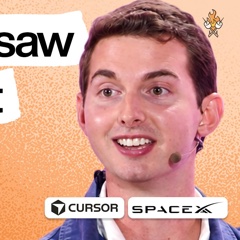
Roman Ugarte
Product lead for Grok Bot at SpaceXAI, formerly head of Growth at Cursor
Where to hear and read about Roman Ugarte1 episode or test

Roman Ugarte was employee number 15 at Cursor, led growth there for two years, and now leads product for Grok Bot at SpaceXAI. The most useful thing to learn from him is to design an AI product around what a good human teammate would do, and to keep deleting whatever users don't need to see.
what would you want from your teammate in this exact situation?
How we built Grok Bot in a month | Roman Ugarte (SpaceXAI)
Roman Ugarte: the story and the lessons
1How Roman Ugarte went from Cursor growth to building Grok Bot
Ugarte moved from leading growth at Cursor to leading Grok Bot product. He was employee number 15 at Cursor and ran growth for two years. He has been on the Grok Bot core team since the early prototype.
Grok Bot is the knowledge-work pillar at SpaceXAI, next to coding (Cursor and Grok Build) and model training.
A small, isolated team built the first version in about a month. A handful of people sat in a separate part of the office with private Slack channels. First line of code to a working internal product took about a month.
A large group planning a 6 to 12 month vision would not have reached the many small daily decisions the team made. "it took a small focused group that was completely isolated from the rest of the company."
Ugarte's team built a new product instead of adding knowledge work to Cursor. After long debate, they chose a fresh product to control every pixel and hold one consistent vision. Adding tabs per form factor would have felt like shipping the org chart.
Coding tools can intimidate non-technical users, and the Cursor brand carries its own association. Codex went the other way, and Ugarte's host noted the choice may look wrong in hindsight.
Starting fresh worked because the team already had the pieces. They had built cloud infrastructure for coding agents and named agents you can talk to, and rebuilt them for general knowledge work.
Ugarte says the ideas were not strokes of genius, since OpenClaw had already shown product-market fit for them. Competitors see the same opening but struggle to act because of sunk cost in their existing product.
Staff use tested the product before the public saw it. An all-hands rollout checked whether people would really switch. In the first week, daily ChatGPT users moved their agentic tasks to Grok Bot, including groups the team did not expect. Public launch followed about three weeks after internal beta.
The success claims are anecdotes. No usage, retention or reliability numbers are given.
2How Ugarte's team launched Grok Bot
Ugarte's team onboarded the first couple hundred users by hand. The core team joined onboarding calls for about two weeks and onboarded roughly 200 to 300 people. Some sessions were rough, such as a 20-minute call where the computer would not spin up.
The reaction was that it could never happen again, because the next onboarding was the next day. "we need to solve this tomorrow because tomorrow I'm onboarding this person and it needs to go better."
Ugarte recruited early users from outside the Silicon Valley bubble. A coffee shop owner became a power user and flagged a flaky Shopify integration and product copy written the wrong way.
That feedback was unlike what internal dogfooding produced. It convinced the team the product is likely most powerful for non-developers.
The team let usage patterns emerge before building them in. Users began promoting one bot to chief of staff to manage the others, around the end of week two of the internal rollout. Most of the company never adopted it.
The team did not lead the witness, then encouraged the pattern slightly in the product. "it shouldn't be a one-way door."
Ugarte hid the bot's internal mechanics from users. Users see a typing indicator and a green active dot, as in Slack, plus updates when the bot sees fit. Nobody asked for streaming text or chain of thought.
Some users did ask to see a to-do list. You would not ask a teammate for second-by-second updates.
Two weeks before launch, the team unshipped debug features. Experimental features were still live, including exposed model thinking and stored memories that helped debugging but not users.
The team prefers a separate observability pane to showing this in the main surface. "We unshipped a lot."
Reliability came from hill climbing a few back-end problems. The team collected the real tasks people gave bots, tracked week over week how many succeeded, and fixed failures like clicking the right button or logging into a site.
Better visibility into the browser and screen pixels unlocked a Salesforce dashboard task. A sales workflow that had failed for seven days then worked, and the sales team reported it the next day.
3Ugarte's colleague-pilled rules for building AI agents
Ugarte settles product debates by asking what a human teammate would do. When both sides of an argument are good, the team drops the tech-company mindset and asks how a human colleague would behave. The answer is often near unanimous.
It points toward long-lived bots with memory and voice "huddles" that no AI product has got right yet. He calls this being colleague-pilled.
He frames features as "Grok Bot can now", not "now has". Each project must pass a launch-post test: if the launch tweet would not be compelling, the team may not build it. "Now has" ends in a button or integration, while "can now" ends in something the bot does.
Automations are set up in natural language, and about 99% of automations on the platform are built that way. Competitors make users open a sidebar and pick a trigger and an action, so few get set up. "adding things to the product is not the goal."
Ugarte runs every agent in the cloud from the start. A persistent cloud bot has the same state everywhere, so users can text it from a phone without a laptop staying awake.
It removes the question of where work runs. He lists this as one of two early decisions that felt non-obvious then and critical later.
He gives each bot its own computer instead of sharing the user's. Many tools, such as sales dashboards, have no good MCP or API. A bot that clicks pixels on its own computer can still use them.
Sharing your computer with a bot is like sharing one laptop with a new hire, with shared credentials and constant collisions. "We as humans don't do our jobs via MCPS and APIs."
He builds long-lived named agents, not one chat per task. Each bot keeps a long memory and gets smarter over time. Work is grouped into roles, like swim lanes on a team.
Copying and pasting between chats signals the wrong model. A bot with a computer can even run Grok Bot itself: one teammate's QA bot tests 10 workflows per build and logs results to Notion.
Ugarte hides power-user concepts like skills and slash commands. Skills are still created in the background as a primitive bots use, but users never need to know what one is. The aim was to remove home VPN and Mac mini setups that cannot scale to millions of users or businesses.
Claire Vo, a major OpenClaw proponent, reportedly shut down all her OpenClaws and switched. "they should never have to type a slash command."
Ugarte treats a new bot like a new hire. His first task was to have it review Slack and email and suggest five things to take off his plate. Two were useful, so he spun off two bots at once.
He avoids hacky pro tips, since knobs and tricks should not need to exist. Power users should give bots one legible place to write outputs, such as a database of daily digests.
4What Ugarte learned at Cursor about speed, culture and moats
Ugarte builds what is impossible today and deletes the scaffolding later. Cursor pulled capabilities from three to six months ahead into the present with extra engineering, then removed that code once models caught up. It moved from autocomplete to agents to the cloud and now Grok Bot.
He says this earned users' trust, and distribution and data advantages followed. He argues moats are discovered, not planned, and that a strategy diagram would not have created Cursor.
He lives by "deleting the product" and "just do the thing". Deleting means removing scaffolding even if it upsets a small set of users. Just doing it means anyone who sees something broken fixes it and pulls in the resources they need.
"this is not an ask for permission culture." He says the value has made many people successful at Cursor and is shared with SpaceXAI.
Ugarte credits Cursor's staying power to a culture that never felt it had won. Early rivals included Microsoft and 10 to 20 other companies, and none leads AI coding today. He says they lost through a cultural inability to change fast, not bad decisions or lack of resources.
Cursor reinvented itself every six months or faster.
He defines a startup by scramble energy, not size. The startup pace survived growth from about 15 people to over 1,000, and now SpaceXAI. Everyone moves fast, trusts each other and shares one clear vision.
He says companies in hypergrowth slow down while still calling themselves startups. The chaos is unpleasant for many people, but you get out what you put in.

How we built Grok Bot in a month | Roman Ugarte (SpaceXAI)
A small, isolated team built Grok Bot, a cloud-first knowledge-work agent, from the first line of code to an internal product in about a month, then to public launch three weeks later. The episode covers the product decisions behind it (starting fresh, cloud computers per bot, hiding mechanics, unshipping) and a 'colleague-pilled' way of making product calls.
Ugarte moved from leading growth at Cursor to leading Grok Bot product. He was employee number 15 at Cursor and ran growth for two years. He has been on the Grok Bot core team since the early prototype.
Grok Bot is the knowledge-work pillar at SpaceXAI, next to coding (Cursor and Grok Build) and model training.
A small, isolated team built the first version in about a month. A handful of people sat in a separate part of the office with private Slack channels. First line of code to a working internal product took about a month.
A large group planning a 6 to 12 month vision would not have reached the many small daily decisions the team made. "it took a small focused group that was completely isolated from the rest of the company."
Ugarte's team built a new product instead of adding knowledge work to Cursor. After long debate, they chose a fresh product to control every pixel and hold one consistent vision. Adding tabs per form factor would have felt like shipping the org chart.
Coding tools can intimidate non-technical users, and the Cursor brand carries its own association. Codex went the other way, and Ugarte's host noted the choice may look wrong in hindsight.
Starting fresh worked because the team already had the pieces. They had built cloud infrastructure for coding agents and named agents you can talk to, and rebuilt them for general knowledge work.
Ugarte says the ideas were not strokes of genius, since OpenClaw had already shown product-market fit for them. Competitors see the same opening but struggle to act because of sunk cost in their existing product.
Staff use tested the product before the public saw it. An all-hands rollout checked whether people would really switch. In the first week, daily ChatGPT users moved their agentic tasks to Grok Bot, including groups the team did not expect. Public launch followed about three weeks after internal beta.
The success claims are anecdotes. No usage, retention or reliability numbers are given.
Ugarte's team onboarded the first couple hundred users by hand. The core team joined onboarding calls for about two weeks and onboarded roughly 200 to 300 people. Some sessions were rough, such as a 20-minute call where the computer would not spin up.
The reaction was that it could never happen again, because the next onboarding was the next day. "we need to solve this tomorrow because tomorrow I'm onboarding this person and it needs to go better."
Ugarte recruited early users from outside the Silicon Valley bubble. A coffee shop owner became a power user and flagged a flaky Shopify integration and product copy written the wrong way.
That feedback was unlike what internal dogfooding produced. It convinced the team the product is likely most powerful for non-developers.
The team let usage patterns emerge before building them in. Users began promoting one bot to chief of staff to manage the others, around the end of week two of the internal rollout. Most of the company never adopted it.
The team did not lead the witness, then encouraged the pattern slightly in the product. "it shouldn't be a one-way door."
Ugarte hid the bot's internal mechanics from users. Users see a typing indicator and a green active dot, as in Slack, plus updates when the bot sees fit. Nobody asked for streaming text or chain of thought.
Some users did ask to see a to-do list. You would not ask a teammate for second-by-second updates.
Two weeks before launch, the team unshipped debug features. Experimental features were still live, including exposed model thinking and stored memories that helped debugging but not users.
The team prefers a separate observability pane to showing this in the main surface. "We unshipped a lot."
Reliability came from hill climbing a few back-end problems. The team collected the real tasks people gave bots, tracked week over week how many succeeded, and fixed failures like clicking the right button or logging into a site.
Better visibility into the browser and screen pixels unlocked a Salesforce dashboard task. A sales workflow that had failed for seven days then worked, and the sales team reported it the next day.
Ugarte settles product debates by asking what a human teammate would do. When both sides of an argument are good, the team drops the tech-company mindset and asks how a human colleague would behave. The answer is often near unanimous.
It points toward long-lived bots with memory and voice "huddles" that no AI product has got right yet. He calls this being colleague-pilled.
He frames features as "Grok Bot can now", not "now has". Each project must pass a launch-post test: if the launch tweet would not be compelling, the team may not build it. "Now has" ends in a button or integration, while "can now" ends in something the bot does.
Automations are set up in natural language, and about 99% of automations on the platform are built that way. Competitors make users open a sidebar and pick a trigger and an action, so few get set up. "adding things to the product is not the goal."
Ugarte runs every agent in the cloud from the start. A persistent cloud bot has the same state everywhere, so users can text it from a phone without a laptop staying awake.
It removes the question of where work runs. He lists this as one of two early decisions that felt non-obvious then and critical later.
He gives each bot its own computer instead of sharing the user's. Many tools, such as sales dashboards, have no good MCP or API. A bot that clicks pixels on its own computer can still use them.
Sharing your computer with a bot is like sharing one laptop with a new hire, with shared credentials and constant collisions. "We as humans don't do our jobs via MCPS and APIs."
He builds long-lived named agents, not one chat per task. Each bot keeps a long memory and gets smarter over time. Work is grouped into roles, like swim lanes on a team.
Copying and pasting between chats signals the wrong model. A bot with a computer can even run Grok Bot itself: one teammate's QA bot tests 10 workflows per build and logs results to Notion.
Ugarte hides power-user concepts like skills and slash commands. Skills are still created in the background as a primitive bots use, but users never need to know what one is. The aim was to remove home VPN and Mac mini setups that cannot scale to millions of users or businesses.
Claire Vo, a major OpenClaw proponent, reportedly shut down all her OpenClaws and switched. "they should never have to type a slash command."
Ugarte treats a new bot like a new hire. His first task was to have it review Slack and email and suggest five things to take off his plate. Two were useful, so he spun off two bots at once.
He avoids hacky pro tips, since knobs and tricks should not need to exist. Power users should give bots one legible place to write outputs, such as a database of daily digests.
Ugarte builds what is impossible today and deletes the scaffolding later. Cursor pulled capabilities from three to six months ahead into the present with extra engineering, then removed that code once models caught up. It moved from autocomplete to agents to the cloud and now Grok Bot.
He says this earned users' trust, and distribution and data advantages followed. He argues moats are discovered, not planned, and that a strategy diagram would not have created Cursor.
He lives by "deleting the product" and "just do the thing". Deleting means removing scaffolding even if it upsets a small set of users. Just doing it means anyone who sees something broken fixes it and pulls in the resources they need.
"this is not an ask for permission culture." He says the value has made many people successful at Cursor and is shared with SpaceXAI.
Ugarte credits Cursor's staying power to a culture that never felt it had won. Early rivals included Microsoft and 10 to 20 other companies, and none leads AI coding today. He says they lost through a cultural inability to change fast, not bad decisions or lack of resources.
Cursor reinvented itself every six months or faster.
He defines a startup by scramble energy, not size. The startup pace survived growth from about 15 people to over 1,000, and now SpaceXAI. Everyone moves fast, trusts each other and shares one clear vision.
He says companies in hypergrowth slow down while still calling themselves startups. The chaos is unpleasant for many people, but you get out what you put in.