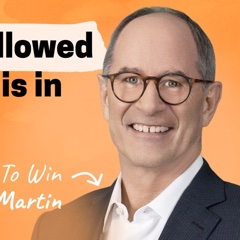
Roger Martin
Strategy advisor, author of Playing to Win, professor emeritus at the Rotman School of Management
Where to hear and read about Roger Martin1 episode or test

Roger Martin is a strategy advisor, author of Playing to Win and professor emeritus at the Rotman School, who built the five-question strategy choice cascade. The thing most worth learning from him is to treat strategy as a set of linked choices that make customers pick you, and to practice it by closing your most painful gap first.
The ultimate way to compete to win is to never actually be forced to compete.
5 essential questions to craft a winning strategy | Roger Martin (author, advisor, speaker)
Roger Martin: the story and the lessons
1Roger Martin and where the strategy cascade came from
Martin combines a top academic record with decades of advising. He is professor emeritus at Rotman and was its dean for five years. He was named Global Dean of the Year in 2013, and Thinkers50 ranked him the number one management thinker in 2017.
He also wrote Playing to Win, a favorite strategy book among practitioners.
He built the cascade because Porter said what, not how. Martin entered strategy in 1981 and ran Monitor's product development from 1987. Monitor could tell clients they were "stuck in the middle" but not how to escape, so he built the five-question cascade between 1987 and 1995.
Henderson founded Boston Consulting Group in 1963 and Porter published in 1980. Clients wanted to know how to create a differentiated or low-cost strategy.
Strategy is five linked choices answered together. The questions are winning aspiration, where to play, how to win, capabilities and management systems. Martin says to toggle among them rather than answer in order, because they must fit and reinforce each other.
He compares it to choosing a whole healthy diet, not just lunch. It is intellectually hard because of the fit, and emotionally hard because choosing means cutting things off and being accountable.
Martin says strategy belongs well below the CEO. At P&G the Head and Shoulders brand leader sits four levels below the CEO yet decides whether the brand does well. About 10% of S&P 500 CEOs are ex-P&G.
He hates the word "execution" for work below the top. Choices made low in the organization produce bad results if made badly and good results if made well.
He argues schools no longer teach practical strategy. Business schools teach the resource-based view, which cannot say which resources to build. In 42 years of consulting Martin has seen VRIO analysis used once.
Even as a powerful dean he could not teach his combined position-and-capabilities approach, because departments control curriculum. He taught it in one unpaid Saturday session a year.
2Martin on winning: differentiated or lowest cost, with a moat
Martin tests strategy by whether customers choose you. If a buyer would flip a coin between your product and a rival's, or a rival can cut price and you cannot follow, you are playing to play. Winners cannot be pushed around, and everyone else gives up ground a step at a time.
His list of companies that cannot be bullied: Vanguard, Southwest, Procter and Gamble and Lego. "There's no way to protect yourself if you're not one of those two."
Southwest beat entrenched airlines on cost and convenience. American and United held a Boston to Chicago duopoly at about $1,000 round trip, and Southwest flew Providence to Midway for $200. Southwest is the only US airline to earn its cost of capital over 50 years.
Its ads showed that for many Boston-area homes, getting to the gate took less time than getting to Logan.
Lego shows differentiation in the growth numbers. For most years in the last decade, Lego was 80 or 90% of the entire toy category's growth, with a price premium over competitors "by a long shot".
Kids define a store without Lego as not a toy store, which Martin calls an insane brand.
Martin says a cost leader needs dominant scale. A niche cost leader almost never happens. Vanguard raced to get gigantic in index funds and now has about $9 trillion in assets and the lowest cost position.
Differentiation is getting harder at small scale too, because branding and R&D are the most scale-sensitive costs. He calls both strategies completely legitimate.
He wants an edge rivals cannot or will not copy. Being better is not enough. Westlaw uses 1,500 full-time lawyers to write headnotes, and a rival would need about 150,000 to match it.
Westlaw also gives access free to law schools, so students learn it before they graduate. Selling the best pet food online failed, because anyone who can build a website can do it, and twenty rivals went bust.
Martin builds advantage from many interlocking pieces. Advantage is fleeting only when it rests on one thing, like the biggest plant. Tide has led detergent for 77 consecutive years and Four Seasons has held its strategy for 35.
To copy Four Seasons, a rival would sell its hotels, fire its development staff and pay far more. Rivals then say "life's too short" and pick a different where and how, as Mandarin Oriental did.
He attacks the fault line a rival cannot cross. Estee Lauder could have killed P&G's Olay by taking Clinique into mass channels, but that would have hurt its prestige brands such as Bobbi Brown and MAC.
Olay overtook Clinique as the biggest skincare brand with higher-priced lines like ProV and Regenerist. Estee Lauder's brands combined are still the biggest in skincare.
Half-copies of a winning model end up as poor versions. Southwest rivals Continental Lite and Ted copied half the model and ended up a "crappy Southwest".
Martin wants rivals to prosper elsewhere, not smash into you and wreck the market for both.
3How Martin works through a real product decision
Martin frames the aspiration around customers, not market size. "There's a big market over there, we'd like to get some" is a weak reason to enter. Foreign companies entering China on that logic often "get their faces shot off".
A better aspiration is serving core customers who love the product but find it too narrow. He says he would not invest on the big-market rationale, though it does not guarantee failure.
He splits where to play into customer, product, channel and chain position. Choose which customers, whether you sell a finished product or a component, through what channel, and at which stage of the value chain. In the 1980s Four Seasons left real estate development, construction and land ownership to focus on hotel management.
Wealthy owners such as Michael Dell and Bill Gates own the hotels and pay a management fee. Martin says app makers who resent Apple's cut chose that position, and should build their own distribution channel.
Four Seasons turned a luxury theory into capabilities. It defined luxury as making up for what the guest left at home. That needed staff who make customized decisions, so it changed recruiting, onboarding and career development.
Hotel turnover of 80% means a 16-month average career. Four Seasons cut turnover to about 10%, so staff stay about 10 years.
Martin says incumbents lose by defending their profit engine. Walmart did nothing online for 10 years because it had 5,000 stores to protect, handing Amazon scale and network effects. GM could not see how to make money on an electric car, giving Tesla a 10-year head start.
His advice is to start now, because waiting until it is clear is too late. "Water flows downhill, the tide comes in, and you cannot stop that."
A.G. Lafley followed customers to Amazon rather than boycott it. A big retailer threatened to de-list P&G products unless it stopped working with Amazon. Lafley refused, and offered the retailer the same help he gave Amazon, asking if it too wanted to ship from P&G's distribution centers.
Vanguard's Jack Bogle disliked ETFs but relented as demand grew, and Vanguard now leads in index ETFs as well as index mutual funds.
Martin measures share by the real job, not the legacy product. He says the right measure for operating systems is share of minutes spent staring at a smart screen. Microsoft kept its PC share but has about 0.4% of smartphones and about 4% of tablets.
He says the last exciting Windows update was Windows 95, almost 30 years ago, because phone functions advanced faster with more users.
4Martin on getting good at strategy through practice
Martin starts with the single most painful gap. Find the gap between the outcomes you get and the ones you wish for. Current outcomes come from past choices, so change one choice in the cascade: where to play, how to win, capabilities or management systems.
Trying to solve all the company's problems at once is perfection. He says betterment does not make purists feel awesome, but he is there to help people get better.
He cites a professor who improved one session a year. The professor polled students on each of 13 sessions and replaced the worst one every year. Over 25 years he won the teaching award more than anyone.
Martin uses it to show that closing gaps one after another improves results over time.
Martin says great strategists are made by practice. He has never met a great natural strategist. A.G. Lafley looked like one but had practiced strategy for decades, starting as a roughly 25-year-old Navy officer.
"Great strategists that I have met have all one thing in common. They just practice." A former Lego CEO is a similar case.
He warns that postponing strategy means never amounting to anything. Waiting until operations calm down guarantees failure. Martin says nobody who says they will get to strategy later ever amounts to anything.
His advice is to work on a gap you feel in your heart and make different choices to solve it.
Martin accepts that nobody gets strategy perfectly right. Even Buffett, who looks for economic castles with unbreachable moats, missed on Salomon Brothers and US Air. Martin says anyone who thinks they can be perfect at strategy is delusional.
He has no scheme for finding moats and suspects Helmer's seven powers may not be the whole list. Of 100 major company strategies he would not like 90 very much.

5 essential questions to craft a winning strategy | Roger Martin (author, advisor, speaker)
Roger Martin lays out the five-question strategy choice cascade (winning aspiration, where to play, how to win, capabilities, management systems) and shows how it applies to teams far below the CEO. He backs it with cases from Southwest, Lego, Four Seasons, Westlaw and P&G Olay, plus a simple 'betterment' method for starting.
Martin combines a top academic record with decades of advising. He is professor emeritus at Rotman and was its dean for five years. He was named Global Dean of the Year in 2013, and Thinkers50 ranked him the number one management thinker in 2017.
He also wrote Playing to Win, a favorite strategy book among practitioners.
He built the cascade because Porter said what, not how. Martin entered strategy in 1981 and ran Monitor's product development from 1987. Monitor could tell clients they were "stuck in the middle" but not how to escape, so he built the five-question cascade between 1987 and 1995.
Henderson founded Boston Consulting Group in 1963 and Porter published in 1980. Clients wanted to know how to create a differentiated or low-cost strategy.
Strategy is five linked choices answered together. The questions are winning aspiration, where to play, how to win, capabilities and management systems. Martin says to toggle among them rather than answer in order, because they must fit and reinforce each other.
He compares it to choosing a whole healthy diet, not just lunch. It is intellectually hard because of the fit, and emotionally hard because choosing means cutting things off and being accountable.
Martin says strategy belongs well below the CEO. At P&G the Head and Shoulders brand leader sits four levels below the CEO yet decides whether the brand does well. About 10% of S&P 500 CEOs are ex-P&G.
He hates the word "execution" for work below the top. Choices made low in the organization produce bad results if made badly and good results if made well.
He argues schools no longer teach practical strategy. Business schools teach the resource-based view, which cannot say which resources to build. In 42 years of consulting Martin has seen VRIO analysis used once.
Even as a powerful dean he could not teach his combined position-and-capabilities approach, because departments control curriculum. He taught it in one unpaid Saturday session a year.
Martin tests strategy by whether customers choose you. If a buyer would flip a coin between your product and a rival's, or a rival can cut price and you cannot follow, you are playing to play. Winners cannot be pushed around, and everyone else gives up ground a step at a time.
His list of companies that cannot be bullied: Vanguard, Southwest, Procter and Gamble and Lego. "There's no way to protect yourself if you're not one of those two."
Southwest beat entrenched airlines on cost and convenience. American and United held a Boston to Chicago duopoly at about $1,000 round trip, and Southwest flew Providence to Midway for $200. Southwest is the only US airline to earn its cost of capital over 50 years.
Its ads showed that for many Boston-area homes, getting to the gate took less time than getting to Logan.
Lego shows differentiation in the growth numbers. For most years in the last decade, Lego was 80 or 90% of the entire toy category's growth, with a price premium over competitors "by a long shot".
Kids define a store without Lego as not a toy store, which Martin calls an insane brand.
Martin says a cost leader needs dominant scale. A niche cost leader almost never happens. Vanguard raced to get gigantic in index funds and now has about $9 trillion in assets and the lowest cost position.
Differentiation is getting harder at small scale too, because branding and R&D are the most scale-sensitive costs. He calls both strategies completely legitimate.
He wants an edge rivals cannot or will not copy. Being better is not enough. Westlaw uses 1,500 full-time lawyers to write headnotes, and a rival would need about 150,000 to match it.
Westlaw also gives access free to law schools, so students learn it before they graduate. Selling the best pet food online failed, because anyone who can build a website can do it, and twenty rivals went bust.
Martin builds advantage from many interlocking pieces. Advantage is fleeting only when it rests on one thing, like the biggest plant. Tide has led detergent for 77 consecutive years and Four Seasons has held its strategy for 35.
To copy Four Seasons, a rival would sell its hotels, fire its development staff and pay far more. Rivals then say "life's too short" and pick a different where and how, as Mandarin Oriental did.
He attacks the fault line a rival cannot cross. Estee Lauder could have killed P&G's Olay by taking Clinique into mass channels, but that would have hurt its prestige brands such as Bobbi Brown and MAC.
Olay overtook Clinique as the biggest skincare brand with higher-priced lines like ProV and Regenerist. Estee Lauder's brands combined are still the biggest in skincare.
Half-copies of a winning model end up as poor versions. Southwest rivals Continental Lite and Ted copied half the model and ended up a "crappy Southwest".
Martin wants rivals to prosper elsewhere, not smash into you and wreck the market for both.
Martin frames the aspiration around customers, not market size. "There's a big market over there, we'd like to get some" is a weak reason to enter. Foreign companies entering China on that logic often "get their faces shot off".
A better aspiration is serving core customers who love the product but find it too narrow. He says he would not invest on the big-market rationale, though it does not guarantee failure.
He splits where to play into customer, product, channel and chain position. Choose which customers, whether you sell a finished product or a component, through what channel, and at which stage of the value chain. In the 1980s Four Seasons left real estate development, construction and land ownership to focus on hotel management.
Wealthy owners such as Michael Dell and Bill Gates own the hotels and pay a management fee. Martin says app makers who resent Apple's cut chose that position, and should build their own distribution channel.
Four Seasons turned a luxury theory into capabilities. It defined luxury as making up for what the guest left at home. That needed staff who make customized decisions, so it changed recruiting, onboarding and career development.
Hotel turnover of 80% means a 16-month average career. Four Seasons cut turnover to about 10%, so staff stay about 10 years.
Martin says incumbents lose by defending their profit engine. Walmart did nothing online for 10 years because it had 5,000 stores to protect, handing Amazon scale and network effects. GM could not see how to make money on an electric car, giving Tesla a 10-year head start.
His advice is to start now, because waiting until it is clear is too late. "Water flows downhill, the tide comes in, and you cannot stop that."
A.G. Lafley followed customers to Amazon rather than boycott it. A big retailer threatened to de-list P&G products unless it stopped working with Amazon. Lafley refused, and offered the retailer the same help he gave Amazon, asking if it too wanted to ship from P&G's distribution centers.
Vanguard's Jack Bogle disliked ETFs but relented as demand grew, and Vanguard now leads in index ETFs as well as index mutual funds.
Martin measures share by the real job, not the legacy product. He says the right measure for operating systems is share of minutes spent staring at a smart screen. Microsoft kept its PC share but has about 0.4% of smartphones and about 4% of tablets.
He says the last exciting Windows update was Windows 95, almost 30 years ago, because phone functions advanced faster with more users.
Martin starts with the single most painful gap. Find the gap between the outcomes you get and the ones you wish for. Current outcomes come from past choices, so change one choice in the cascade: where to play, how to win, capabilities or management systems.
Trying to solve all the company's problems at once is perfection. He says betterment does not make purists feel awesome, but he is there to help people get better.
He cites a professor who improved one session a year. The professor polled students on each of 13 sessions and replaced the worst one every year. Over 25 years he won the teaching award more than anyone.
Martin uses it to show that closing gaps one after another improves results over time.
Martin says great strategists are made by practice. He has never met a great natural strategist. A.G. Lafley looked like one but had practiced strategy for decades, starting as a roughly 25-year-old Navy officer.
"Great strategists that I have met have all one thing in common. They just practice." A former Lego CEO is a similar case.
He warns that postponing strategy means never amounting to anything. Waiting until operations calm down guarantees failure. Martin says nobody who says they will get to strategy later ever amounts to anything.
His advice is to work on a gap you feel in your heart and make different choices to solve it.
Martin accepts that nobody gets strategy perfectly right. Even Buffett, who looks for economic castles with unbreachable moats, missed on Salomon Brothers and US Air. Martin says anyone who thinks they can be perfect at strategy is delusional.
He has no scheme for finding moats and suspects Helmer's seven powers may not be the whole list. Of 100 major company strategies he would not like 90 very much.