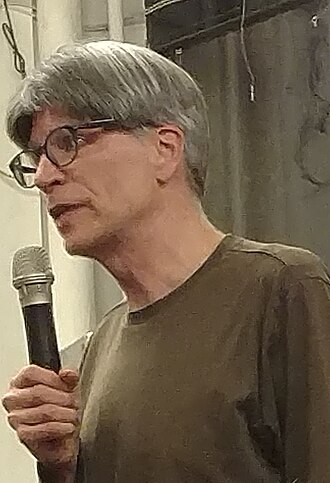
Richard Powers
Pulitzer Prize-winning novelist, 14 novels over 40 years
Where to hear and read about Richard Powers1 episode or test

Richard Powers is a novelist who has written 14 novels over 40 years and won the 2019 Pulitzer Prize for The Overstory. The most useful thing to learn from him is to build every layer of a story, from word choice and sentence shape to character, drama and structure, so they all pull the reader's feeling the same way.
The sled is only going to move when all the dogs are in harness and they're all pulling in the same direction.
How to Become a Master Storyteller (Richard Powers Interview)
Richard Powers: the story and the lessons
1Richard Powers: how a self-described outsider to feeling became a novelist of trees
Powers won the Pulitzer for The Overstory after 14 novels over 40 years. The book won the Pulitzer Prize in 2019. It opens with the line "each child's tree has its own excellence", where the last word is a deliberate surprise.
He treats that first line as a piece of craft, built to set and then break the reader's expectation.
Powers says sensitivity to other people did not come naturally to him. He places himself nearer the machines-and-mathematics end of the spectrum than the high emotional intelligence end. He learned to build characters through method and analogy across ways of knowing the world.
That is why he teaches characterization as a set of steps rather than a gift.
Powers wrote two opposite protagonists as alter egos at age 67. Todd Keane is a wealthy white North Side Chicagoan and Rafi is a young Black man from the South Side. Their tight, competitive friendship extends the unfinished business of Powers's own life from age 10 to 30 and beyond.
He describes writing it almost psychoanalytically, finding a real piece of himself inside each character.
Powers reached trees through a child's sense that creatures are alive. He drew on old literature, indigenous stories and his own earliest sense of narrative. Children see a crow as alive, while adults say it is just wood.
He argues that humans can only be understood in conversation with their neighbors, and that looking at the non-human world also reveals interior drama.
Powers stays attached to his characters after the book is fixed. Each morning he asks how his characters will surprise him. Handing over the manuscript is the sad part, because the heart still asks whether he did right by them.
He says he is still close to the people of Playground, and that a character lives on as a sense of unused potential.
2How Powers builds character and drama
Powers builds a character like an onion, from traits to core values. The outer layer is visible traits, like a green shirt. Beneath are mannerisms, such as answering everything with "what do you mean by that?", and under those are core values like honesty, fidelity or perseverance.
Several values can drive one mannerism, and several mannerisms can sit behind one trait. The outward behavior should both hide and reveal what the person needs to preserve.
Powers builds a role the way an actor would, from a shared core value. Following Stanislavski's An Actor Prepares, he finds a core value in the character that he shares. He abstracts the role enough to use his own inner experience, knowing he is not that person.
Powers makes drama by colliding two good values in one character. He told students to give a character honesty and fidelity, then put him where he cannot keep both. A friend has done something wrong: do you make him own up, or stand by him?
The choice reveals the true core value and creates interior drama. Powers says that single setup is 10,000 stories.
Powers writes three levels of drama: against self, others and nature. Interior drama is person against self. Interpersonal or political drama sets two characters' core values against each other, such as equality against freedom. The third level pits human projects against a living planet that may be hostile, indifferent or sympathetic.
He says much literary fiction from the 1980s to the early 2000s mastered the first two and dropped the third. He built The Overstory to include it, and notes that science fiction and fantasy never abandoned it.
Powers makes both sides of a clash sympathetic and does not pick a winner. In his political example, two people hold equality and freedom as core values and must both vote for one candidate. The author need not say who is right.
The reader is left asking, if that were me, which would I do?
3Powers on sentences, voice and register
Powers says voice, and so character, comes from word choice and sentence shape. He treats the sentence as the base layer of the novel. Diction, register and syntax come first, and pace, scene shape and tempo grow out of them.
Voice leads to character, as with Forrest Gump, whose simple speech shows who he is.
Powers sorts every sentence into one of three types around its subject and verb. The kernel can come first, as in "He pointed the gun at his friend", be delayed behind modifiers, or be split with material in between. He taught this as 80% of the effect for 20% of the grammar.
He guesses that the split predication is the rarest form, but he has no data and would like to run the count on an average text.
Powers delays the subject to hide it from the reader. His example piles up the yard, fence, brook and hedge before "she hid". The sentence hides her the way the yard does, and the reader waits in suspense.
Where the kernel lands sets the reader's mental state, so he chooses its placement to recreate the speaker's or narrator's state.
Powers changes sentence type mid paragraph, like a key change in music. After three trailing sentences in a row, switching to a front-loaded or split sentence resets the reader's ear. The split form can create suspense or comedy.
He recommends using it sparingly because it is rare and strong.
Powers sets the reader's expectation, then breaks it at the sentence's end. Readers guess the next word as they read, somewhat like a language model. In "each child's tree has its own excellence", nobody expects the last word, and the small jolt adds tension.
He read the line to the host and stopped before the last word, and the host admitted he had not predicted it.
Powers picks words by register, using Latin and Anglo-Saxon roots. Latinate words that came through French, like mansion, sound higher in class than Anglo-Saxon ones like house. He says English speakers have a built-in bilingualism.
Students felt they had gained a new power, and freedom and liberty became audibly different once they learned the rules.
Powers wants every craft layer pulling the same way. He pictures a sled and dogs: diction, register, syntax, cadence, scene shape, character, drama and structure all in harness.
Readers attach to different layers, and advice like show don't tell can push a writer to favor one. His aim is for each level to emerge from decisions made lower down.
4Powers on openings, tension and dialogue
Powers opens with a wide establishing shot, then narrows. He borrows from film: a distant shot, then a mid shot, then a close one. The Overstory begins "First there was nothing, then there was everything", and Playground begins before the Earth and the moon.
This sets the size of the canvas and earns him the right to tell a local story inside it. The Overstory line came from a poet friend's dying words, and he moved it to the start in her memory.
Powers searches for his openings, throws them out and starts again. He believes the best first lines hold the whole book in miniature, though readers see this only afterward. He cites Romeo and Juliet opening on two houses alike in dignity.
He still wants to be a poet, where the main job is visceral sensation through the musicality of words.
Powers teaches tension as four parts: hook, exposition, rising action, climax. A slightly inflated hook draws the reader in, then exposition gets everyone on stage. In the long middle each solved problem creates a bigger instability, and the climax is followed by the dénouement, the untying of the knot.
Stakes must climb: a prince who kills ever easier dragons makes no sense. Powers calls the high start a bait and switch that earns the right to slow down, and says you sculpt the graph to suit your characters and readers.
Powers writes dialogue to current conventions, not as a transcript of speech. Talk recorded on the back of a bus would be chaotic and incoherent. When readers call dialogue real, they mean it plays by the fiction conventions they know.
Older fiction sounds false only because readers have lost their decoder ring. He cites Ann Patchett, whose characters sound like neighbors, and Don DeLillo's White Noise, which he says has the best ear of any living writer.
Powers reads dialogue aloud because readers hear it in their heads. Saying it aloud checks register, tone, cadence and the socioeconomic accuracy of the speaker.
He notes authors often dislike their own audiobooks, since a voice actor replaces the voices they have heard for years.
5Why Powers believes fiction changes people, and how he researched The Overstory
Powers argues feeling and identification shift values where facts do not. In an experiment, readers of a moving story were far more likely than readers of data or neutral text to help someone who dropped a pile of pencils in a hallway. The groups had been told it was a reading comprehension exam.
He says grasping a fact and changing a value are different things, and that fiction invites the question of who you would be if you were that guy. The shift is brief, which he takes as a sign of how fragile and malleable people are.
Powers backs lyrical tree language with peer-reviewed research. His botanist Patricia Westerford speaks lyrically, even anthropomorphically, about trees. Every claim in her catalog traces to journal articles Powers read, including trees communicating, feeding their young and signaling wasps.
He wants writing that knows the world as a scientist and as an animist child does. He notes anthropomorphism has blocked scientists from seeing things, though that attitude is changing.
Powers gives each tree one vivid trait to invite the reader's animism. His list includes the ash's diamond bark, the maple's shower of helicopters and the ironwood's fluted muscle. Readers already project feelings onto trees, calling them evil, shy or majestic.
The test of a passage is which words put the reader in the intended mental state, beyond the literal meaning.
Powers slowed down and looked harder until trees became particular. Before The Overstory his walk to his office was "tree tree tree tree". Then it became red oak, maple, hornbeam, then a single oak doing something its neighbors did not.
He calls attention the most profound source of meaning we can have.
Powers sees the effect of his books only in rare glimpses. His brother returns a manuscript and says interesting. A stranger emails that they are now studying forestry because of him.
He puts it as you baffle your friends and change the lives of strangers.
6Powers on rewriting and fixing a draft
Powers tries hard in the first draft, then hides the footwork. He treats a first draft as a note to yourself about the effects you want, which may be too obvious or too loud. On the rewrite he removes the notes that announce his intentions.
He applies this to his tree passage. His point is that you always have an edit to make it look more effortless.
Powers accepts that rewriting never ends and there is no final version. With word processing he cannot count drafts. He reworks yesterday's pages each morning, the chapter each weekend, then the book, and a passage may be redrafted a dozen times.
He still wants to change a book the day after it is published, even while reading from it at the podium.
Powers lets first readers send him back into a draft. A reader told him pages 140 to 200 got slow, so he redrafted that stretch for pace.
Powers treats frustration with a draft as a sign of taste and diagnoses it. He calls it "not a bug, that's a feature", another way of seeing your desire. The cause may be voice, where you do not know how a person would speak, or drama, where two characters you counted on to disagree might not.
If he cannot diagnose it, he relaxes, forgives himself and drops perfectionism: take a hike, stand in front of a tree. He compares the work to surfing, where the ways of going wrong are infinite and the ways of going right are not final.
7How Powers works: solitude, the living world and a changed daily practice
Powers drafts in bed in the dark, then tests the work in the world. He writes with the light off, looking at a bare ceiling, dictating or using a pen, and recalls places he has been and crises he has survived. Once a scene has momentum, he asks whether it is true and resonates.
Staying solitary means spinning out of orbit, so he plunges back into the world as a corrective. He compares his tools to a musician's guitar, piano or a cappella singing, and picks pen, dictation or keyboard by scene and mood.
Powers wrote a thousand words every morning for about 25 to 30 years. He is most alert in the morning, so he ate breakfast, skipped the news and feeds, and wrote. He saw his job as getting a thousand words out each day.
It worked well for a long time. Then he became a different kind of writer, and he says he can point to the moment it began.
Powers now treats being in the living world as his primary job. He checks the weather and calendar and asks what is going on out there, at what elevation, where the show is. Sentences and scenes then arrive with little forced effort.
He is sometimes four miles down a trail and must hurry home before he loses it all. He describes writing as now supporting his growth as a person, in an extended final chapter of meditation and presence.

How to Become a Master Storyteller (Richard Powers Interview)
Richard Powers explains how character, voice, sentence shape and tension work together to make fiction feel alive. The worth-hearing technique is matching sentence structure to the reader's mental state, and he pairs it with a daily practice of walking in the living world until sentences arrive.
Powers won the Pulitzer for The Overstory after 14 novels over 40 years. The book won the Pulitzer Prize in 2019. It opens with the line "each child's tree has its own excellence", where the last word is a deliberate surprise.
He treats that first line as a piece of craft, built to set and then break the reader's expectation.
Powers says sensitivity to other people did not come naturally to him. He places himself nearer the machines-and-mathematics end of the spectrum than the high emotional intelligence end. He learned to build characters through method and analogy across ways of knowing the world.
That is why he teaches characterization as a set of steps rather than a gift.
Powers wrote two opposite protagonists as alter egos at age 67. Todd Keane is a wealthy white North Side Chicagoan and Rafi is a young Black man from the South Side. Their tight, competitive friendship extends the unfinished business of Powers's own life from age 10 to 30 and beyond.
He describes writing it almost psychoanalytically, finding a real piece of himself inside each character.
Powers reached trees through a child's sense that creatures are alive. He drew on old literature, indigenous stories and his own earliest sense of narrative. Children see a crow as alive, while adults say it is just wood.
He argues that humans can only be understood in conversation with their neighbors, and that looking at the non-human world also reveals interior drama.
Powers stays attached to his characters after the book is fixed. Each morning he asks how his characters will surprise him. Handing over the manuscript is the sad part, because the heart still asks whether he did right by them.
He says he is still close to the people of Playground, and that a character lives on as a sense of unused potential.
Powers builds a character like an onion, from traits to core values. The outer layer is visible traits, like a green shirt. Beneath are mannerisms, such as answering everything with "what do you mean by that?", and under those are core values like honesty, fidelity or perseverance.
Several values can drive one mannerism, and several mannerisms can sit behind one trait. The outward behavior should both hide and reveal what the person needs to preserve.
Powers builds a role the way an actor would, from a shared core value. Following Stanislavski's An Actor Prepares, he finds a core value in the character that he shares. He abstracts the role enough to use his own inner experience, knowing he is not that person.
Powers makes drama by colliding two good values in one character. He told students to give a character honesty and fidelity, then put him where he cannot keep both. A friend has done something wrong: do you make him own up, or stand by him?
The choice reveals the true core value and creates interior drama. Powers says that single setup is 10,000 stories.
Powers writes three levels of drama: against self, others and nature. Interior drama is person against self. Interpersonal or political drama sets two characters' core values against each other, such as equality against freedom. The third level pits human projects against a living planet that may be hostile, indifferent or sympathetic.
He says much literary fiction from the 1980s to the early 2000s mastered the first two and dropped the third. He built The Overstory to include it, and notes that science fiction and fantasy never abandoned it.
Powers makes both sides of a clash sympathetic and does not pick a winner. In his political example, two people hold equality and freedom as core values and must both vote for one candidate. The author need not say who is right.
The reader is left asking, if that were me, which would I do?
Powers says voice, and so character, comes from word choice and sentence shape. He treats the sentence as the base layer of the novel. Diction, register and syntax come first, and pace, scene shape and tempo grow out of them.
Voice leads to character, as with Forrest Gump, whose simple speech shows who he is.
Powers sorts every sentence into one of three types around its subject and verb. The kernel can come first, as in "He pointed the gun at his friend", be delayed behind modifiers, or be split with material in between. He taught this as 80% of the effect for 20% of the grammar.
He guesses that the split predication is the rarest form, but he has no data and would like to run the count on an average text.
Powers delays the subject to hide it from the reader. His example piles up the yard, fence, brook and hedge before "she hid". The sentence hides her the way the yard does, and the reader waits in suspense.
Where the kernel lands sets the reader's mental state, so he chooses its placement to recreate the speaker's or narrator's state.
Powers changes sentence type mid paragraph, like a key change in music. After three trailing sentences in a row, switching to a front-loaded or split sentence resets the reader's ear. The split form can create suspense or comedy.
He recommends using it sparingly because it is rare and strong.
Powers sets the reader's expectation, then breaks it at the sentence's end. Readers guess the next word as they read, somewhat like a language model. In "each child's tree has its own excellence", nobody expects the last word, and the small jolt adds tension.
He read the line to the host and stopped before the last word, and the host admitted he had not predicted it.
Powers picks words by register, using Latin and Anglo-Saxon roots. Latinate words that came through French, like mansion, sound higher in class than Anglo-Saxon ones like house. He says English speakers have a built-in bilingualism.
Students felt they had gained a new power, and freedom and liberty became audibly different once they learned the rules.
Powers wants every craft layer pulling the same way. He pictures a sled and dogs: diction, register, syntax, cadence, scene shape, character, drama and structure all in harness.
Readers attach to different layers, and advice like show don't tell can push a writer to favor one. His aim is for each level to emerge from decisions made lower down.
Powers opens with a wide establishing shot, then narrows. He borrows from film: a distant shot, then a mid shot, then a close one. The Overstory begins "First there was nothing, then there was everything", and Playground begins before the Earth and the moon.
This sets the size of the canvas and earns him the right to tell a local story inside it. The Overstory line came from a poet friend's dying words, and he moved it to the start in her memory.
Powers searches for his openings, throws them out and starts again. He believes the best first lines hold the whole book in miniature, though readers see this only afterward. He cites Romeo and Juliet opening on two houses alike in dignity.
He still wants to be a poet, where the main job is visceral sensation through the musicality of words.
Powers teaches tension as four parts: hook, exposition, rising action, climax. A slightly inflated hook draws the reader in, then exposition gets everyone on stage. In the long middle each solved problem creates a bigger instability, and the climax is followed by the dénouement, the untying of the knot.
Stakes must climb: a prince who kills ever easier dragons makes no sense. Powers calls the high start a bait and switch that earns the right to slow down, and says you sculpt the graph to suit your characters and readers.
Powers writes dialogue to current conventions, not as a transcript of speech. Talk recorded on the back of a bus would be chaotic and incoherent. When readers call dialogue real, they mean it plays by the fiction conventions they know.
Older fiction sounds false only because readers have lost their decoder ring. He cites Ann Patchett, whose characters sound like neighbors, and Don DeLillo's White Noise, which he says has the best ear of any living writer.
Powers reads dialogue aloud because readers hear it in their heads. Saying it aloud checks register, tone, cadence and the socioeconomic accuracy of the speaker.
He notes authors often dislike their own audiobooks, since a voice actor replaces the voices they have heard for years.
Powers argues feeling and identification shift values where facts do not. In an experiment, readers of a moving story were far more likely than readers of data or neutral text to help someone who dropped a pile of pencils in a hallway. The groups had been told it was a reading comprehension exam.
He says grasping a fact and changing a value are different things, and that fiction invites the question of who you would be if you were that guy. The shift is brief, which he takes as a sign of how fragile and malleable people are.
Powers backs lyrical tree language with peer-reviewed research. His botanist Patricia Westerford speaks lyrically, even anthropomorphically, about trees. Every claim in her catalog traces to journal articles Powers read, including trees communicating, feeding their young and signaling wasps.
He wants writing that knows the world as a scientist and as an animist child does. He notes anthropomorphism has blocked scientists from seeing things, though that attitude is changing.
Powers gives each tree one vivid trait to invite the reader's animism. His list includes the ash's diamond bark, the maple's shower of helicopters and the ironwood's fluted muscle. Readers already project feelings onto trees, calling them evil, shy or majestic.
The test of a passage is which words put the reader in the intended mental state, beyond the literal meaning.
Powers slowed down and looked harder until trees became particular. Before The Overstory his walk to his office was "tree tree tree tree". Then it became red oak, maple, hornbeam, then a single oak doing something its neighbors did not.
He calls attention the most profound source of meaning we can have.
Powers sees the effect of his books only in rare glimpses. His brother returns a manuscript and says interesting. A stranger emails that they are now studying forestry because of him.
He puts it as you baffle your friends and change the lives of strangers.
Powers tries hard in the first draft, then hides the footwork. He treats a first draft as a note to yourself about the effects you want, which may be too obvious or too loud. On the rewrite he removes the notes that announce his intentions.
He applies this to his tree passage. His point is that you always have an edit to make it look more effortless.
Powers accepts that rewriting never ends and there is no final version. With word processing he cannot count drafts. He reworks yesterday's pages each morning, the chapter each weekend, then the book, and a passage may be redrafted a dozen times.
He still wants to change a book the day after it is published, even while reading from it at the podium.
Powers lets first readers send him back into a draft. A reader told him pages 140 to 200 got slow, so he redrafted that stretch for pace.
Powers treats frustration with a draft as a sign of taste and diagnoses it. He calls it "not a bug, that's a feature", another way of seeing your desire. The cause may be voice, where you do not know how a person would speak, or drama, where two characters you counted on to disagree might not.
If he cannot diagnose it, he relaxes, forgives himself and drops perfectionism: take a hike, stand in front of a tree. He compares the work to surfing, where the ways of going wrong are infinite and the ways of going right are not final.
Powers drafts in bed in the dark, then tests the work in the world. He writes with the light off, looking at a bare ceiling, dictating or using a pen, and recalls places he has been and crises he has survived. Once a scene has momentum, he asks whether it is true and resonates.
Staying solitary means spinning out of orbit, so he plunges back into the world as a corrective. He compares his tools to a musician's guitar, piano or a cappella singing, and picks pen, dictation or keyboard by scene and mood.
Powers wrote a thousand words every morning for about 25 to 30 years. He is most alert in the morning, so he ate breakfast, skipped the news and feeds, and wrote. He saw his job as getting a thousand words out each day.
It worked well for a long time. Then he became a different kind of writer, and he says he can point to the moment it began.
Powers now treats being in the living world as his primary job. He checks the weather and calendar and asks what is going on out there, at what elevation, where the show is. Sentences and scenes then arrive with little forced effort.
He is sometimes four miles down a trail and must hurry home before he loses it all. He describes writing as now supporting his growth as a person, in an extended final chapter of meditation and presence.