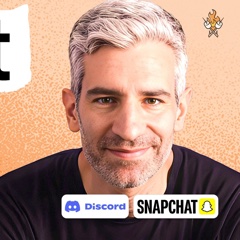
Peter Sellis
Former first PM at Snapchat and former Head of Product at Discord
Where to hear and read about Peter Sellis1 episode or test

Peter Sellis was the first PM at Snapchat, stayed seven years, and later ran product at Discord. The lesson most worth taking is to run a team on a shared mission and clear ownership, and to grow by deepening the core product for people who already use it.
If a museum has all of their collection on the walls, then the curator hasn't done anything.
90 minutes of unfiltered product advice from Snap and Discord’s product chief | Peter Sellis
Peter Sellis: the story and the lessons
1Who Peter Sellis is and where his instincts come from
Sellis built two well-known consumer products from the inside. He was the first PM at Snapchat and stayed seven years. He later became head of product at Discord and helped it grow significantly.
At both companies he worked directly with the founders and treated the head of product role as a vessel for their vision.
An early Ustream job taught him consumer lessons, and one failure. Ustream was an early live streaming company. Its popularity came from a Shiba Inu puppy cam that people used as a soothing work background.
Sellis calls Ustream a failure because it did not focus on gaming, as Justin.tv did on its way to becoming Twitch. He still calls live streaming an uncracked category, technically hard and expensive.
He speaks bluntly now because he is between jobs. With no comms team and nothing to promote, he says he can be unfiltered about what he has seen.
He used to skip podcasts because he read an appearance as a sign someone was job hunting.
2How Sellis finds growth in the core product
Sellis grows products by raising daily use among people who already come. One daily user is worth about 30 monthly users. Moving DAU/MAU a few basis points beats acquiring many new monthly users and hoping they retain.
He describes DAU/MAU as retention over one day: given you used it today, what is the chance you use it tomorrow? He admits the daily-use view may be controversial.
Snap's growth renaissance came from Android performance, not new bets. After the 2018 redesign flattened Snap's DAU, a laser focus on Android performance for existing users started growth that ran for multiple years.
At Discord he kept finding room to grow at 100% penetration. In 2024 the team focused on being the best place for friends to play intentional multiplayer games. Fixing bugs from Reddit threads and improving performance moved users from about 10 active days out of 30 to 11, 12 or 13.
That drove some of Discord's fastest growth since the pandemic. Midjourney's boom on Discord never showed in the usage graph. Many gamers sat on the edge, using in-game voice or FaceTime instead. His line: unless you've built for gamers, you haven't built for critical users.
He looks for new bets in cohorts and in users bending the product. One route is to boil down what people come for, such as Snap's camera or Discord's voice, and find other cohorts who could use it. The other is to watch users who go through hoops for unplanned uses.
Discord saw people organizing communities far larger than 20-person gaming friend groups. He calls the cohort route an "MBA-style 2 by 2" to always be running.
Truly new bets come from backcasting, which few people can do. Start from why the company exists and ignore the present. For Snap, the best way to share a first step or a concert moment points toward glasses.
He says even creative people mostly remix the present. He has no defense against the black-swan risk of refining the core, where something 10x better arrives overnight.
3Sellis's Core Product Value framework
Sellis defines core value as a short phrase plus causal metrics. The phrase says why people return every day, and each part maps to measurable terms tied to retention. He gave Snap's version as an onboarding talk to every new hire for seven years.
Metrics alone mean nothing to people, and a phrase alone never gets acted on by data scientists, PMs and engineers. The hard part is metrics causally tied to retention, and he jokes that no data scientist likes working with him because of it.
Each word of the phrase becomes a filter on the roadmap. Snap's was the fastest way to share a moment with your best friends. "Fast" meant time to load, "share" meant opening to the camera, and "people you care about" meant best friends.
A project with only a tenuous link to those parts should probably not be prioritized.
Discord got the same framework, and it sped up onboarding. Discord's version was the best way to talk and hang out with friends before, during and after playing games. Its metric definitions went into its growth playbooks.
The shared language let new data scientists get up to speed quickly, and teams asked whether a change moved core product value.
4How Sellis designs teams like ideologies, not committees
Sellis pairs a shared ideology with clear decision owners. He wants strategy that works almost like a religion, plus a clear structure of who is directly responsible and trusted for which decision.
He wants a directly responsible individual, single-threaded on a problem. With that clarity you get the result you would have gotten by collaborating. Founders' vision gets distilled into short phrases that act as shortcuts.
He treats collaboration as a cost, not a virtue. Coordination costs make a team as slow as its slowest node. No executive ever tells people to collaborate less, which he reads as a warning sign.
He wants PMs to make the decisions the founders would have made six months to two years earlier. Any principle nobody could disagree with, like "collaborate", is too weak to guide a team.
He modeled the structure on organizations built around an idea, not a leader. A terrorist organization works because people serve an ideology, while a cult works because they serve a person. He prefers the first.
The label came after the design. Discord's chief people officer was horrified and intrigued. His advice is to read about cults and stop one step before the infamous part.
Sellis gives his strongest people more decisions until they make bad ones. He loads consistent performers with more responsibility, defends them in public and never criticizes them in front of others. Confidence compounds, so they can do more.
He admits not paying attention to someone does not mean they are failing. The approach skips the cost of burnout, and he says he has no good way to help people improve.
He built orgs that could absorb spiky talent like Nikita Bier. Bier reported to Sellis at Discord after his startup was acquired, and stayed a little over a year with strong engineers following him. Sellis says you don't manage him, you direct him.
He compares Bier to Liam Neeson in Taken: lethal in one domain, a poor fit for errands. He calls it a failure state if a product org can't handle spiky talent, and models himself on Phil Jackson meshing very different players.
5What Sellis looks for in PMs, taste and talent
Sellis thinks the median PM is probably bad. The best PMs leave to become founders and executives, while weaker ones stay in a well-paid role. In the ZERP era PM became the most lucrative tech career for nontechnical people.
The claim rests on a statistical argument and his experience, with no data. He judges a PM against running the product with no PM, and is building a system to rate the person together with the place they work.
Engineer complaints show him where the weak PMs are. Great engineers rarely complain because they bend PMs to their will. Bad engineers stay quiet because they can hide behind a PM's decisions.
The engineers in the middle are the ones who complain.
He hires PMs who hold three pairs of opposites. The pairs are confidence with humility, process with comfort in ambiguity, and a long-term picture with a daily bias for action. He says "there are two wolves inside of the PM three times".
A confident PM names who earned the credit, such as the designer who made the last-second change or the engineer who stayed up all night. He tests for these in interviews through stories.
He tests taste by asking what someone built but never shipped. The question is about prototypes they held in their hands and judged not ready, not ones that tested badly. He says Evan Spiegel said no to better ideas than almost any other consumer founder.
He wanted founders to become like rich museum curators, where the product is a small slice of a larger collection. He thinks AI adds but does not cut, so cutting becomes a PM skill.
He names his life partner as the biggest career decision. He says the effects on growth are hard to quantify, and no podcast matches a partner who supports you and is an intellectual sounding board.
He calls it his light spicy take. His harder claim, that gender, race and background help in building some consumer products, is left vague and unsupported.
6What Snap's ads and subscriptions taught Sellis
Sellis explains why Snap's ads business was structurally hard. The audience was young, with CPMs jumping between 17 and 18, and tracking rules for under-17s make ROI hard to prove. The app opens to the camera, which has no natural ad slot, and it is a messaging app, a category with few good ad products.
He calls failing to drive camera monetization one of his biggest failures. He still credits Snap with top consumer products: number one teen messaging app in almost every Western country, with 70 to 100% penetration of under-21s, and credits the original design team.
He thinks Snapchat Plus should have launched four years earlier. Subscriptions on a messaging product grow roughly linearly because users must first make the app a daily habit. Time is the enemy.
An earlier launch could have eased the pressure on ads and left more room to compete with TikTok. Discord's Nitro follows the same pattern.
He pushed ads teams to be long-term greedy for advertisers. Ads drifts short-term because it is revenue-driven. He used the phrase at Snap, Discord and companies he advised to give cover for delivering advertiser ROI now, even at a cost to revenue.
Revenue tomorrow is tied to ROI today through retention and growing budgets, like net revenue retention in SaaS. The phrase helps most at a public company when numbers are missed or a layoff looms.
He sees trust as the variable for ad auctions in chat. Meta's auction factors organic value to the user into each bid. In chat products like ChatGPT, trust could replace that term and decide how much advertisers can influence an answer.
He cites Amazon search showing 16 ads before the first result as a case of eroding trust. Maximizing trust likely correlates with retention and advertiser value.
He wants business systems described in math, in a spreadsheet. He maps stocks and flows, levers, and whether each variable is bimodal or normally distributed.
Even if the spreadsheet goes nowhere, it clarifies how the system works. He prefers Jay Forrester's system dynamics to the popular Slinky book.
7Sellis on ambition and retiring your best product
Sellis admires companies willing to obsolete their own winner. He points to SpaceX ending Falcon 9 service, a reusable launcher he says any country would trade its GDP for, because the mission needs the heavier Starship.
He stresses he has no inside information, though his wife is a SpaceX engineer. A clear mission and published roadmap turn such choices into logic, and he aspires to that "swag" as a product leader.
He treats ambition as a muscle that needs a credible push. The status quo creates static friction. Changing a trajectory takes an impulse, and he says the person applying it must be credible.
Walking into meetings asking "what if we did more" achieves nothing. People who can raise ambition repeatedly without being disruptive for its own sake are rare in large organizations.

90 minutes of unfiltered product advice from Snap and Discord’s product chief | Peter Sellis
Peter Sellis explains how he designs product teams around a shared ideology and clear decision ownership, and why growth almost always comes from the core product. His results include a multi-year growth renaissance at Snap after a 2018 stall and some of Discord's fastest growth since the pandemic.
Sellis built two well-known consumer products from the inside. He was the first PM at Snapchat and stayed seven years. He later became head of product at Discord and helped it grow significantly.
At both companies he worked directly with the founders and treated the head of product role as a vessel for their vision.
An early Ustream job taught him consumer lessons, and one failure. Ustream was an early live streaming company. Its popularity came from a Shiba Inu puppy cam that people used as a soothing work background.
Sellis calls Ustream a failure because it did not focus on gaming, as Justin.tv did on its way to becoming Twitch. He still calls live streaming an uncracked category, technically hard and expensive.
He speaks bluntly now because he is between jobs. With no comms team and nothing to promote, he says he can be unfiltered about what he has seen.
He used to skip podcasts because he read an appearance as a sign someone was job hunting.
Sellis grows products by raising daily use among people who already come. One daily user is worth about 30 monthly users. Moving DAU/MAU a few basis points beats acquiring many new monthly users and hoping they retain.
He describes DAU/MAU as retention over one day: given you used it today, what is the chance you use it tomorrow? He admits the daily-use view may be controversial.
Snap's growth renaissance came from Android performance, not new bets. After the 2018 redesign flattened Snap's DAU, a laser focus on Android performance for existing users started growth that ran for multiple years.
At Discord he kept finding room to grow at 100% penetration. In 2024 the team focused on being the best place for friends to play intentional multiplayer games. Fixing bugs from Reddit threads and improving performance moved users from about 10 active days out of 30 to 11, 12 or 13.
That drove some of Discord's fastest growth since the pandemic. Midjourney's boom on Discord never showed in the usage graph. Many gamers sat on the edge, using in-game voice or FaceTime instead. His line: unless you've built for gamers, you haven't built for critical users.
He looks for new bets in cohorts and in users bending the product. One route is to boil down what people come for, such as Snap's camera or Discord's voice, and find other cohorts who could use it. The other is to watch users who go through hoops for unplanned uses.
Discord saw people organizing communities far larger than 20-person gaming friend groups. He calls the cohort route an "MBA-style 2 by 2" to always be running.
Truly new bets come from backcasting, which few people can do. Start from why the company exists and ignore the present. For Snap, the best way to share a first step or a concert moment points toward glasses.
He says even creative people mostly remix the present. He has no defense against the black-swan risk of refining the core, where something 10x better arrives overnight.
Sellis defines core value as a short phrase plus causal metrics. The phrase says why people return every day, and each part maps to measurable terms tied to retention. He gave Snap's version as an onboarding talk to every new hire for seven years.
Metrics alone mean nothing to people, and a phrase alone never gets acted on by data scientists, PMs and engineers. The hard part is metrics causally tied to retention, and he jokes that no data scientist likes working with him because of it.
Each word of the phrase becomes a filter on the roadmap. Snap's was the fastest way to share a moment with your best friends. "Fast" meant time to load, "share" meant opening to the camera, and "people you care about" meant best friends.
A project with only a tenuous link to those parts should probably not be prioritized.
Discord got the same framework, and it sped up onboarding. Discord's version was the best way to talk and hang out with friends before, during and after playing games. Its metric definitions went into its growth playbooks.
The shared language let new data scientists get up to speed quickly, and teams asked whether a change moved core product value.
Sellis pairs a shared ideology with clear decision owners. He wants strategy that works almost like a religion, plus a clear structure of who is directly responsible and trusted for which decision.
He wants a directly responsible individual, single-threaded on a problem. With that clarity you get the result you would have gotten by collaborating. Founders' vision gets distilled into short phrases that act as shortcuts.
He treats collaboration as a cost, not a virtue. Coordination costs make a team as slow as its slowest node. No executive ever tells people to collaborate less, which he reads as a warning sign.
He wants PMs to make the decisions the founders would have made six months to two years earlier. Any principle nobody could disagree with, like "collaborate", is too weak to guide a team.
He modeled the structure on organizations built around an idea, not a leader. A terrorist organization works because people serve an ideology, while a cult works because they serve a person. He prefers the first.
The label came after the design. Discord's chief people officer was horrified and intrigued. His advice is to read about cults and stop one step before the infamous part.
Sellis gives his strongest people more decisions until they make bad ones. He loads consistent performers with more responsibility, defends them in public and never criticizes them in front of others. Confidence compounds, so they can do more.
He admits not paying attention to someone does not mean they are failing. The approach skips the cost of burnout, and he says he has no good way to help people improve.
He built orgs that could absorb spiky talent like Nikita Bier. Bier reported to Sellis at Discord after his startup was acquired, and stayed a little over a year with strong engineers following him. Sellis says you don't manage him, you direct him.
He compares Bier to Liam Neeson in Taken: lethal in one domain, a poor fit for errands. He calls it a failure state if a product org can't handle spiky talent, and models himself on Phil Jackson meshing very different players.
Sellis thinks the median PM is probably bad. The best PMs leave to become founders and executives, while weaker ones stay in a well-paid role. In the ZERP era PM became the most lucrative tech career for nontechnical people.
The claim rests on a statistical argument and his experience, with no data. He judges a PM against running the product with no PM, and is building a system to rate the person together with the place they work.
Engineer complaints show him where the weak PMs are. Great engineers rarely complain because they bend PMs to their will. Bad engineers stay quiet because they can hide behind a PM's decisions.
The engineers in the middle are the ones who complain.
He hires PMs who hold three pairs of opposites. The pairs are confidence with humility, process with comfort in ambiguity, and a long-term picture with a daily bias for action. He says "there are two wolves inside of the PM three times".
A confident PM names who earned the credit, such as the designer who made the last-second change or the engineer who stayed up all night. He tests for these in interviews through stories.
He tests taste by asking what someone built but never shipped. The question is about prototypes they held in their hands and judged not ready, not ones that tested badly. He says Evan Spiegel said no to better ideas than almost any other consumer founder.
He wanted founders to become like rich museum curators, where the product is a small slice of a larger collection. He thinks AI adds but does not cut, so cutting becomes a PM skill.
He names his life partner as the biggest career decision. He says the effects on growth are hard to quantify, and no podcast matches a partner who supports you and is an intellectual sounding board.
He calls it his light spicy take. His harder claim, that gender, race and background help in building some consumer products, is left vague and unsupported.
Sellis explains why Snap's ads business was structurally hard. The audience was young, with CPMs jumping between 17 and 18, and tracking rules for under-17s make ROI hard to prove. The app opens to the camera, which has no natural ad slot, and it is a messaging app, a category with few good ad products.
He calls failing to drive camera monetization one of his biggest failures. He still credits Snap with top consumer products: number one teen messaging app in almost every Western country, with 70 to 100% penetration of under-21s, and credits the original design team.
He thinks Snapchat Plus should have launched four years earlier. Subscriptions on a messaging product grow roughly linearly because users must first make the app a daily habit. Time is the enemy.
An earlier launch could have eased the pressure on ads and left more room to compete with TikTok. Discord's Nitro follows the same pattern.
He pushed ads teams to be long-term greedy for advertisers. Ads drifts short-term because it is revenue-driven. He used the phrase at Snap, Discord and companies he advised to give cover for delivering advertiser ROI now, even at a cost to revenue.
Revenue tomorrow is tied to ROI today through retention and growing budgets, like net revenue retention in SaaS. The phrase helps most at a public company when numbers are missed or a layoff looms.
He sees trust as the variable for ad auctions in chat. Meta's auction factors organic value to the user into each bid. In chat products like ChatGPT, trust could replace that term and decide how much advertisers can influence an answer.
He cites Amazon search showing 16 ads before the first result as a case of eroding trust. Maximizing trust likely correlates with retention and advertiser value.
He wants business systems described in math, in a spreadsheet. He maps stocks and flows, levers, and whether each variable is bimodal or normally distributed.
Even if the spreadsheet goes nowhere, it clarifies how the system works. He prefers Jay Forrester's system dynamics to the popular Slinky book.
Sellis admires companies willing to obsolete their own winner. He points to SpaceX ending Falcon 9 service, a reusable launcher he says any country would trade its GDP for, because the mission needs the heavier Starship.
He stresses he has no inside information, though his wife is a SpaceX engineer. A clear mission and published roadmap turn such choices into logic, and he aspires to that "swag" as a product leader.
He treats ambition as a muscle that needs a credible push. The status quo creates static friction. Changing a trajectory takes an impulse, and he says the person applying it must be credible.
Walking into meetings asking "what if we did more" achieves nothing. People who can raise ambition repeatedly without being disruptive for its own sake are rare in large organizations.