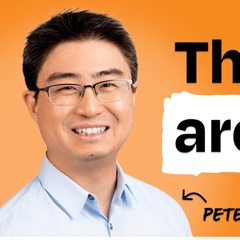
Peter Deng
General Partner at Felicis; former VP of Product at OpenAI, Head of Product at Instagram, Head of Rider product at Uber, CPO at Airtable
Where to hear and read about Peter Deng1 episode or test

Peter Deng is a General Partner at Felicis who led product on Facebook News Feed and Messenger, Instagram, Uber's Rider app and ChatGPT. The lesson most worth taking from him is to assemble a team of people with different strengths who can soon run on their own, and to build systems before you scale.
In six months, if I'm telling you what to do, I've hired the wrong person.
From ChatGPT to Instagram to Uber: The quiet architect behind the world’s most popular products
Peter Deng: the story and the lessons
1Peter Deng's path from Facebook to Instagram, Uber and OpenAI
Deng left a booming Google to join early Facebook. Facebook was then seen as a college site, but Deng had studied psychology and saw a team building around how people are wired. Its mission of an open and connected world drew him.
Friendster's and MySpace's mission statements felt vapid to him next to Facebook's.
He spent nearly ten years at Facebook as its 4th product manager. He built News Feed, the standalone Messenger app, photos, groups and profiles. He stayed nine and a half years but changed roles about every two and a half.
He then ran product at Instagram, Uber, Oculus, Airtable and OpenAI. He was Instagram's first Head of Product, ran the Rider app at Uber, led product management at Oculus and was Chief Product Officer at Airtable. At OpenAI he was VP of product for ChatGPT and built the first growth team.
His OpenAI team shipped ChatGPT Enterprise, voice, memory, desktop and custom GPTs.
Deng now invests in seed, seed plus and Series A founders. As General Partner at Felicis he looks for unique data with a data flywheel, a crafted workflow, and insight into which product details matter and which don't.
He says he invests early because he can help founders see the next stage, scaling from one to 10 and 10 to 100.
He picks roles by learning, human insight and a clear point of view. His questions before a move: will I learn more, does it match human behavior, is the insight unique, and do I care?
He values what Instagram's founders said: "we may not be right, but at least we're not confused." He says indecision is what bites you.
2What Deng says makes a product win
Deng says great products connect existing technology to a human need. Uber did not invent GPS. It joined the GPS phones and cars people already had, and Deng calls it largely an operations company.
At Uber the price and the ETA were the product, so fixing a pixel-level bug mattered less than people expect. In B2B, a product users love still has to make business sense.
Facebook and Instagram won by polishing simple ideas. News Feed and photo tagging came from watching what people wanted. Instagram's idea was simply photos and visual sharing, and Kevin and Mike's hard work and taste made it take off.
Deng says any other company could have built it. Their conviction about a certain vibe set it apart.
Deng bets craft beats an early technology lead and beats distribution. Even a big breakthrough fades, because people soon want something more ergonomic. Granola beats Google Meet, Teams and Zoom through small, delightful details.
The product has to be so much better that switching is worth it.
He built Uber Reserve around peace of mind. The insight was that someone with a 6 AM flight wants certainty a car will come and will pay for it. The product warns when pickup timing is too tight and accounts for driver incentives so drivers do not cancel.
Last Deng heard, Reserve approaches a $5 billion a year business and is one of Uber's highest-margin ones.
Deng cares about craft but knows which details do not matter. Early on he obsessed over small details and later saw the time was wasted. He says he has gone through cycles of going deep, then stepping back to find what mattered more.
"You really have to give a crap about the product that you're building, but you also have to have the perspective and business know-how."
He feels the customer's pain firsthand before building. Before joining Uber he leased a white VW, put an Uber sticker on it and drove for two weeks. He also flew to LA with Kevin Systrom to watch Instagram users through one-way glass.
From IDEO's stages he stresses the first two, empathize and define. He says you cannot empathize with a ChatGPT summary of interviews, so be in the room with no phones.
3How Deng scales a product from one to 100
Deng builds systems before the load arrives, not throwaway MVPs. After product market fit he plans many moves ahead, like chess, and invests in the core loop, information architecture and reusable abstractions. Instagram usage quadrupled in two years.
"Sometimes you have to go slow to go fast." He compares it to a rocket launch, where a pilot at 35,000 feet does not feel the G-forces of takeoff.
He credits News Feed's longevity to a carefully designed sharing loop. The loop runs from posting, to appearing in the feed, to a like, to the red notification, and around again. The feed is little changed after about 12 years.
The team also worked out the information architecture and how people wanted to consume content.
Unglamorous systems work let Uber scale across countries. In places like India with few street signs, a team worked on pickups and drop-offs, finding the right abstraction for venues. That made airport pickups configurable and tied to Uber's 4x user growth in two years.
The Rider app also had spaghetti code, which was re-architected around core components so it could scale worldwide.
Messenger reached 4.7 billion messages a day in about two and a half years. Early push notification infrastructure helped the growth.
Deng hires a growth leader first, before an analytics team. Between one and ten he says to measure everything, like flying with instruments. At Instagram, when he asked how many users there were, the answer was that they didn't really know.
A growth PM asks why something is happening, which exposes what is not logged. Because they own outcomes, people listen. He built growth teams at Instagram, Uber, Airtable and ChatGPT.
He treats long-term work as a portfolio ramp, not a switch. He shifts resources as the product needs them. Google's 70-20-10 split may suit a mature company, while a startup might run closer to 50/50.
4How Peter Deng builds and hires teams
Deng sorts product managers into five archetypes. Consumer (half designer), growth (half data scientist), business or GM (half MBA), platform (builds tools for others) and research (part researcher, part engineer). Each person leads with one and has a second that balances them.
The framework came out of a jam session at Uber to help with hiring. He uses it to show who is missing from a team and to judge founder-market fit.
He staffs teams so people pull in different directions. He gives one person the charge to grow the product and another to guard design and craft, then settles the disagreements. He set this up at Facebook, Instagram, Airtable and ChatGPT.
He compares it to an RPG where everyone has different sliders. He says hiring for natural wiring lasts longer than setting incentives.
Deng tells every hire that in six months he should not be directing them. The rule keeps his bar high, tells the hire what success looks like, and moves one-on-ones from hitting an OKR to calibrating toward autonomy. It sits in his personal working doc, the PXD API.
He says it helped him build the ChatGPT leadership team.
His final interview tests only growth mindset. He asks for the candidate's most painful mistake and how they work differently now, and shares one of his own to make it safe. Others assess product sense, design, execution and metrics.
A bad Facebook hire who lacked growth mindset taught him this. He calls its absence the meta blocker, because feedback and new skills both stall.
He spent as much time on recruiting as on product at OpenAI. He told the team it was his last operating role and treated the team as a product that needs craft. He says he is prouder of that team than of the products.
He makes friends with recruiters everywhere because the team has to be built together.
Deng turned Joanne Jang's rare blend of skills into a new role. She had deep technical skill and product taste, so he asked her to write a job description for it. It became the model designer role, and OpenAI hired its first two model designers.
He credits ChatGPT's tone and vibe largely to this role. He says writing makes an intuition communicable.
5How Deng communicates and leads
Deng says what he will do, is doing and did. He writes the goal in dense, punchy words, repeats it in one-on-ones and all-hands, then says when it is done. A manager can then say a goal no longer matters before work is wasted.
He learned it from Jill, who runs PR, comms and policy at Uber: "Repetition doesn't spoil the prayer." Joanne Jang said it changed how she managed up at OpenAI.
The same repetition makes quieter people's work visible. The last step makes sure people know the impact you had. Deng says introverts who avoid attention tend to get lost in organizations, so they most need it.
He takes no ownership of the phrase and thinks he absorbed it from the classic presentation rule.
He obsesses over the words in docs and slides. Language shapes thought, so a wrong word in a vision doc or PRD gets misread and the effect spreads downstream. He recently gave a class talk with about 20 words on the whole deck and spent hours on them.
He took a college class, Language and Thought, with Herbert Clark, and grew up speaking Chinese, which made him feel he thought differently after learning English.
6Deng on building AI products
Deng says AI startups need a data flywheel and a workflow that fits real work. Proprietary data is a start, and the flywheel is how you keep generating more. Windsurf learned from which suggestions users accept and reject, then launched its own model.
Cursor, Windsurf, Lovable and Bolt beat Copilot despite Microsoft's distribution because their product craft was far better.
He pairs PMs with post-training at model companies. His OpenAI team worked closely with post-training and he credits that tie for ChatGPT's gains. Anthropic's Mike Krieger independently found PMs paired with researchers drove more wins than front-end product.
The work shifts from raw intelligence to fine-tuning what resonates with people.
Deng sees AGI as necessary but not sufficient. He compares it to databases, which builders turned into products. Builders still have to channel the energy into something people love to use.
He sees people moving from fear to familiarity to mastery as they co-evolve with technology. He expects the key skill to become asking good questions at a higher level of abstraction.
His nine-year-old son showed him how AI rewires thinking. The boy built a custom GPT that writes a sentence using every letter of the alphabet on any topic. Normal code can hardly do this, yet he thought of it as a prompt.
Deng does not expect his son to need to code as an adult, though programming still teaches structured thinking.
7What Deng learned from failure
Instagram's Bolt failed on retention despite top craft. Bolt was a camera-first app meant to reduce the pressure to share, tested in New Zealand or Australia. It was well designed and fast, but cohorted retention never flattened.
Some Bolt technology was ported to the main app and nobody wallowed. Deng quotes Jay-Z: "It ain't a loss, it's a lesson."
He judges products by cohort retention, not user volume. He checks whether the curve flattens, meaning people keep using the product over time. If it doesn't, the product is not working however well designed.
"Retention is the key indicator in any product that you build, it's not the number of users, not the volume." He says even the best team cannot predict a hit on the first try.
A Facebook hire without growth mindset changed how he interviews. The result was difficult, and since then he has run a growth-mindset interview for every org he built.

From ChatGPT to Instagram to Uber: The quiet architect behind the world’s most popular products
Peter Deng shares lessons from scaling Facebook News Feed, Messenger, Instagram, Uber and ChatGPT: how to build teams of different PM types, hire for autonomy and growth mindset, and scale products from 1 to 100. The result worth hearing: Uber Reserve grew into a business approaching $5 billion a year by focusing on one human need, peace of mind.
Deng left a booming Google to join early Facebook. Facebook was then seen as a college site, but Deng had studied psychology and saw a team building around how people are wired. Its mission of an open and connected world drew him.
Friendster's and MySpace's mission statements felt vapid to him next to Facebook's.
He spent nearly ten years at Facebook as its 4th product manager. He built News Feed, the standalone Messenger app, photos, groups and profiles. He stayed nine and a half years but changed roles about every two and a half.
He then ran product at Instagram, Uber, Oculus, Airtable and OpenAI. He was Instagram's first Head of Product, ran the Rider app at Uber, led product management at Oculus and was Chief Product Officer at Airtable. At OpenAI he was VP of product for ChatGPT and built the first growth team.
His OpenAI team shipped ChatGPT Enterprise, voice, memory, desktop and custom GPTs.
Deng now invests in seed, seed plus and Series A founders. As General Partner at Felicis he looks for unique data with a data flywheel, a crafted workflow, and insight into which product details matter and which don't.
He says he invests early because he can help founders see the next stage, scaling from one to 10 and 10 to 100.
He picks roles by learning, human insight and a clear point of view. His questions before a move: will I learn more, does it match human behavior, is the insight unique, and do I care?
He values what Instagram's founders said: "we may not be right, but at least we're not confused." He says indecision is what bites you.
Deng says great products connect existing technology to a human need. Uber did not invent GPS. It joined the GPS phones and cars people already had, and Deng calls it largely an operations company.
At Uber the price and the ETA were the product, so fixing a pixel-level bug mattered less than people expect. In B2B, a product users love still has to make business sense.
Facebook and Instagram won by polishing simple ideas. News Feed and photo tagging came from watching what people wanted. Instagram's idea was simply photos and visual sharing, and Kevin and Mike's hard work and taste made it take off.
Deng says any other company could have built it. Their conviction about a certain vibe set it apart.
Deng bets craft beats an early technology lead and beats distribution. Even a big breakthrough fades, because people soon want something more ergonomic. Granola beats Google Meet, Teams and Zoom through small, delightful details.
The product has to be so much better that switching is worth it.
He built Uber Reserve around peace of mind. The insight was that someone with a 6 AM flight wants certainty a car will come and will pay for it. The product warns when pickup timing is too tight and accounts for driver incentives so drivers do not cancel.
Last Deng heard, Reserve approaches a $5 billion a year business and is one of Uber's highest-margin ones.
Deng cares about craft but knows which details do not matter. Early on he obsessed over small details and later saw the time was wasted. He says he has gone through cycles of going deep, then stepping back to find what mattered more.
"You really have to give a crap about the product that you're building, but you also have to have the perspective and business know-how."
He feels the customer's pain firsthand before building. Before joining Uber he leased a white VW, put an Uber sticker on it and drove for two weeks. He also flew to LA with Kevin Systrom to watch Instagram users through one-way glass.
From IDEO's stages he stresses the first two, empathize and define. He says you cannot empathize with a ChatGPT summary of interviews, so be in the room with no phones.
Deng builds systems before the load arrives, not throwaway MVPs. After product market fit he plans many moves ahead, like chess, and invests in the core loop, information architecture and reusable abstractions. Instagram usage quadrupled in two years.
"Sometimes you have to go slow to go fast." He compares it to a rocket launch, where a pilot at 35,000 feet does not feel the G-forces of takeoff.
He credits News Feed's longevity to a carefully designed sharing loop. The loop runs from posting, to appearing in the feed, to a like, to the red notification, and around again. The feed is little changed after about 12 years.
The team also worked out the information architecture and how people wanted to consume content.
Unglamorous systems work let Uber scale across countries. In places like India with few street signs, a team worked on pickups and drop-offs, finding the right abstraction for venues. That made airport pickups configurable and tied to Uber's 4x user growth in two years.
The Rider app also had spaghetti code, which was re-architected around core components so it could scale worldwide.
Messenger reached 4.7 billion messages a day in about two and a half years. Early push notification infrastructure helped the growth.
Deng hires a growth leader first, before an analytics team. Between one and ten he says to measure everything, like flying with instruments. At Instagram, when he asked how many users there were, the answer was that they didn't really know.
A growth PM asks why something is happening, which exposes what is not logged. Because they own outcomes, people listen. He built growth teams at Instagram, Uber, Airtable and ChatGPT.
He treats long-term work as a portfolio ramp, not a switch. He shifts resources as the product needs them. Google's 70-20-10 split may suit a mature company, while a startup might run closer to 50/50.
Deng sorts product managers into five archetypes. Consumer (half designer), growth (half data scientist), business or GM (half MBA), platform (builds tools for others) and research (part researcher, part engineer). Each person leads with one and has a second that balances them.
The framework came out of a jam session at Uber to help with hiring. He uses it to show who is missing from a team and to judge founder-market fit.
He staffs teams so people pull in different directions. He gives one person the charge to grow the product and another to guard design and craft, then settles the disagreements. He set this up at Facebook, Instagram, Airtable and ChatGPT.
He compares it to an RPG where everyone has different sliders. He says hiring for natural wiring lasts longer than setting incentives.
Deng tells every hire that in six months he should not be directing them. The rule keeps his bar high, tells the hire what success looks like, and moves one-on-ones from hitting an OKR to calibrating toward autonomy. It sits in his personal working doc, the PXD API.
He says it helped him build the ChatGPT leadership team.
His final interview tests only growth mindset. He asks for the candidate's most painful mistake and how they work differently now, and shares one of his own to make it safe. Others assess product sense, design, execution and metrics.
A bad Facebook hire who lacked growth mindset taught him this. He calls its absence the meta blocker, because feedback and new skills both stall.
He spent as much time on recruiting as on product at OpenAI. He told the team it was his last operating role and treated the team as a product that needs craft. He says he is prouder of that team than of the products.
He makes friends with recruiters everywhere because the team has to be built together.
Deng turned Joanne Jang's rare blend of skills into a new role. She had deep technical skill and product taste, so he asked her to write a job description for it. It became the model designer role, and OpenAI hired its first two model designers.
He credits ChatGPT's tone and vibe largely to this role. He says writing makes an intuition communicable.
Deng says what he will do, is doing and did. He writes the goal in dense, punchy words, repeats it in one-on-ones and all-hands, then says when it is done. A manager can then say a goal no longer matters before work is wasted.
He learned it from Jill, who runs PR, comms and policy at Uber: "Repetition doesn't spoil the prayer." Joanne Jang said it changed how she managed up at OpenAI.
The same repetition makes quieter people's work visible. The last step makes sure people know the impact you had. Deng says introverts who avoid attention tend to get lost in organizations, so they most need it.
He takes no ownership of the phrase and thinks he absorbed it from the classic presentation rule.
He obsesses over the words in docs and slides. Language shapes thought, so a wrong word in a vision doc or PRD gets misread and the effect spreads downstream. He recently gave a class talk with about 20 words on the whole deck and spent hours on them.
He took a college class, Language and Thought, with Herbert Clark, and grew up speaking Chinese, which made him feel he thought differently after learning English.
Deng says AI startups need a data flywheel and a workflow that fits real work. Proprietary data is a start, and the flywheel is how you keep generating more. Windsurf learned from which suggestions users accept and reject, then launched its own model.
Cursor, Windsurf, Lovable and Bolt beat Copilot despite Microsoft's distribution because their product craft was far better.
He pairs PMs with post-training at model companies. His OpenAI team worked closely with post-training and he credits that tie for ChatGPT's gains. Anthropic's Mike Krieger independently found PMs paired with researchers drove more wins than front-end product.
The work shifts from raw intelligence to fine-tuning what resonates with people.
Deng sees AGI as necessary but not sufficient. He compares it to databases, which builders turned into products. Builders still have to channel the energy into something people love to use.
He sees people moving from fear to familiarity to mastery as they co-evolve with technology. He expects the key skill to become asking good questions at a higher level of abstraction.
His nine-year-old son showed him how AI rewires thinking. The boy built a custom GPT that writes a sentence using every letter of the alphabet on any topic. Normal code can hardly do this, yet he thought of it as a prompt.
Deng does not expect his son to need to code as an adult, though programming still teaches structured thinking.
Instagram's Bolt failed on retention despite top craft. Bolt was a camera-first app meant to reduce the pressure to share, tested in New Zealand or Australia. It was well designed and fast, but cohorted retention never flattened.
Some Bolt technology was ported to the main app and nobody wallowed. Deng quotes Jay-Z: "It ain't a loss, it's a lesson."
He judges products by cohort retention, not user volume. He checks whether the curve flattens, meaning people keep using the product over time. If it doesn't, the product is not working however well designed.
"Retention is the key indicator in any product that you build, it's not the number of users, not the volume." He says even the best team cannot predict a hit on the first try.
A Facebook hire without growth mindset changed how he interviews. The result was difficult, and since then he has run a growth-mindset interview for every org he built.