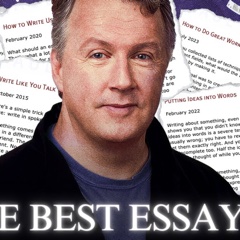
Paul Graham
Essayist and co-founder of Y Combinator
Where to hear and read about Paul Graham1 episode or test

Paul Graham is an essayist and co-founder of Y Combinator whose free essays on the open internet drew in YC's first founders. The most useful thing to learn from him is his writing method: plain words, ruthless rewriting, and publishing only what survives.
The only style worth having is the one you can't help.
The King of Internet Writing | Paul Graham | How I Write Podcast
Paul Graham: the story and the lessons
1How Paul Graham's essays built Y Combinator
Graham's essay How to Start a Startup brought in YC's first founders. He posted it free on his site, and its readers were among the first YC applicants. The first batch included the founders of Reddit and Twitch, and Sam Altman, who later became YC's president.
His writing also drew Patrick Collison, founder of Stripe, and YC invested in Stripe very early. YC grew out of an essay, not a book or a white paper.
Graham wrote about startups because he was busy building them. His essays came out of building Viaweb, selling it to Yahoo, and running YC. Talking with thousands of founders gave him hunches his answers could not yet express, so he went to the keyboard.
He did not devote his life to writing. His work supplied the material, and he found time for essay after essay while running YC.
Graham became a startup authority by writing about startups. He says he is an expert on startups because he has written so much about them, not the other way round. Readers now borrow his words for how startups get built.
He talked through the ideas in Hackers and Painters with friends for years before writing the book.
Graham studied painting and dropped out of two art schools. He studied painting in Florence and at RISD, left both, and spent his time on still lifes. He says painting forces you to look closely at things people take for granted.
He sees much good writing as good seeing: the reader recognizes something they always knew but never had words for. One-liners like Make something people want distill what everyone half-knew.
2Paul Graham's rules for writing plainly
Graham learned to write plainly after years of trying to impress. As a boy he wrote plotless stories full of strong feelings, thinking that made them deep. For his art school application he wrote an intellectual essay on Cézanne, trying to sound as smart as possible.
He concluded that complexity hurts communication.
Graham says complex ideas don't need complex sentences. Readers have a limited energy budget, so effort spent decoding fancy words is taken from the ideas. Being forced to be simple makes a writer face what they actually mean.
"you don't need complex sentences to express complex ideas."
Graham wants writing brief, which is not the same as short. His advice is to say what you mean and say it briefly. Many of his essays are long, but each section carries no wasted words.
He finds shorter code is often more correct because conflicting assumptions disappear.
Graham refuses to cultivate a personal style. He watched art school painters chase a signature look like Picasso's and found it a gimmick. He holds that if you try to make good things, they come out distinctive, as each person's walk does.
Style is a by-product of trying to do good work, so he just writes well and writes truth.
3How Graham edits: rewrite, cut, publish only the best
Graham rereads each essay about 50 times. His rule is that good writing is rewriting. He treats early versions as disposable, the way Leonardo's drawings show five, six or seven attempts at one line.
Redesign also produces discoveries. He notes the Porsche 911's distinctive back came from redesigning an awkward prototype.
Graham cuts anything that isn't right, however much it cost. He says one of the most dangerous temptations is keeping a passage because it has a few good bits or took effort. He compares his essays to Leonardo's line drawings, where one stroke out of place makes the whole thing collapse.
The cutting is invisible, so readers underestimate how much he deleted. "You want to be quick to cut."
Graham aims for everything he publishes to be great. He does not expect everything he writes to be great. Readers only see the small share that survives editing.
This frees a writer to draft badly, since the reputation comes from the cutting.
Graham lowers the stakes of a first draft. He treats a painting as a sketch, software as hacking and an essay as a letter to friends. Most projects look lame at the start, and fear of that holds writers back.
A low standard gets words onto the page, and the standard rises in editing.
Graham prints his draft and highlights every place he stumbles. He reads start to finish and marks each spot where he feels stuck, stopping only to highlight. He fixes the marked spots later on the computer.
Fixing on screen pulls you out of reading flow, so reading and fixing happen at different times.
Graham asks friends two questions about a draft. He asks what bored them and what seemed unconvincing. His readers include Patrick Collison, Sam Altman and Robert Morris, and Jessica Livingston, all credited at the foot of his essays.
Boring parts get cut. For unconvincing parts he talks the idea through with others until it is clear.
4How Graham finds ideas worth writing
Graham starts writing before he knows what he thinks. He says the first words he chooses are usually wrong, and about half the ideas in an essay come while he is writing it. Early ideas on a new topic are largely mistaken, which he treats as normal.
He rereads and asks whether each idea is correct and complete. "Half the ideas that end up in an essay will be ones that you thought of while you were writing it."
Graham tests ideas for being both general and surprising. Surprise without generality is gossip, and generality without surprise is a platitude like work hard. A real surprise contradicts something you thought you knew.
He starts from a small wedge, such as an odd question about something others take for granted, and expands it.
Graham writes about shower thoughts, not boardroom thoughts. He says it is hard to do a really good job on anything you don't think about in the shower. He loves questions that seem naughty: counterintuitive, over-ambitious or heterodox, ideally all three.
He points to curiosity about an apparently minor question as an exciting sign, as with Darwin asking why the Galapagos birds were all finches.
Graham treats a reader's laugh as a sign of real surprise. He says it is a good sign when people laugh or chuckle while reading a draft, because surprises make us laugh.
What surprises someone who has thought hard about a topic will probably surprise most readers.
Graham gets ideas from generative people, not merely smart ones. His generative partner is Robert Morris, a YC co-founder credited at the bottom of many essays. A generative person leaves you with new ideas and energy.
"It's about talking to the kinds of people who help you have new ideas."
5How Graham builds taste
Graham holds that quality is real, not just subjective. If you get better at something, your old ways were worse, not merely different. Copying Rembrandt and Da Vinci showed him they were simply better than he was.
The task is to find the trick or skill that makes them better.
Graham copies only what he genuinely likes. He first imitated school short stories and philosophy papers because they seemed high status, and found the philosophy papers wordy and confusing. He then decided to copy only things he truly enjoys.
Living in Florence taught him not to trust authorities on what is good. "I'm only going to copy things that I genuinely like."
Graham looks to guilty pleasures for what to imitate. He separates books you enjoy having read from books you enjoy reading. A book you are sad to be halfway through is the better model.
He wrote school papers for fun, even for classes he wasn't taking. Strange, low-status interests are more likely to hold something real.

The King of Internet Writing | Paul Graham | How I Write Podcast
David Perell walks through eleven lessons from Paul Graham's essays and interviews: write plain, edit hard, let writing generate ideas, and chase ideas that are general and surprising. The most useful habit is to print the draft, highlight every spot where you stumble, and fix only afterward, and to publish only what survives that process.
Graham's essay How to Start a Startup brought in YC's first founders. He posted it free on his site, and its readers were among the first YC applicants. The first batch included the founders of Reddit and Twitch, and Sam Altman, who later became YC's president.
His writing also drew Patrick Collison, founder of Stripe, and YC invested in Stripe very early. YC grew out of an essay, not a book or a white paper.
Graham wrote about startups because he was busy building them. His essays came out of building Viaweb, selling it to Yahoo, and running YC. Talking with thousands of founders gave him hunches his answers could not yet express, so he went to the keyboard.
He did not devote his life to writing. His work supplied the material, and he found time for essay after essay while running YC.
Graham became a startup authority by writing about startups. He says he is an expert on startups because he has written so much about them, not the other way round. Readers now borrow his words for how startups get built.
He talked through the ideas in Hackers and Painters with friends for years before writing the book.
Graham studied painting and dropped out of two art schools. He studied painting in Florence and at RISD, left both, and spent his time on still lifes. He says painting forces you to look closely at things people take for granted.
He sees much good writing as good seeing: the reader recognizes something they always knew but never had words for. One-liners like Make something people want distill what everyone half-knew.
Graham learned to write plainly after years of trying to impress. As a boy he wrote plotless stories full of strong feelings, thinking that made them deep. For his art school application he wrote an intellectual essay on Cézanne, trying to sound as smart as possible.
He concluded that complexity hurts communication.
Graham says complex ideas don't need complex sentences. Readers have a limited energy budget, so effort spent decoding fancy words is taken from the ideas. Being forced to be simple makes a writer face what they actually mean.
"you don't need complex sentences to express complex ideas."
Graham wants writing brief, which is not the same as short. His advice is to say what you mean and say it briefly. Many of his essays are long, but each section carries no wasted words.
He finds shorter code is often more correct because conflicting assumptions disappear.
Graham refuses to cultivate a personal style. He watched art school painters chase a signature look like Picasso's and found it a gimmick. He holds that if you try to make good things, they come out distinctive, as each person's walk does.
Style is a by-product of trying to do good work, so he just writes well and writes truth.
Graham rereads each essay about 50 times. His rule is that good writing is rewriting. He treats early versions as disposable, the way Leonardo's drawings show five, six or seven attempts at one line.
Redesign also produces discoveries. He notes the Porsche 911's distinctive back came from redesigning an awkward prototype.
Graham cuts anything that isn't right, however much it cost. He says one of the most dangerous temptations is keeping a passage because it has a few good bits or took effort. He compares his essays to Leonardo's line drawings, where one stroke out of place makes the whole thing collapse.
The cutting is invisible, so readers underestimate how much he deleted. "You want to be quick to cut."
Graham aims for everything he publishes to be great. He does not expect everything he writes to be great. Readers only see the small share that survives editing.
This frees a writer to draft badly, since the reputation comes from the cutting.
Graham lowers the stakes of a first draft. He treats a painting as a sketch, software as hacking and an essay as a letter to friends. Most projects look lame at the start, and fear of that holds writers back.
A low standard gets words onto the page, and the standard rises in editing.
Graham prints his draft and highlights every place he stumbles. He reads start to finish and marks each spot where he feels stuck, stopping only to highlight. He fixes the marked spots later on the computer.
Fixing on screen pulls you out of reading flow, so reading and fixing happen at different times.
Graham asks friends two questions about a draft. He asks what bored them and what seemed unconvincing. His readers include Patrick Collison, Sam Altman and Robert Morris, and Jessica Livingston, all credited at the foot of his essays.
Boring parts get cut. For unconvincing parts he talks the idea through with others until it is clear.
Graham starts writing before he knows what he thinks. He says the first words he chooses are usually wrong, and about half the ideas in an essay come while he is writing it. Early ideas on a new topic are largely mistaken, which he treats as normal.
He rereads and asks whether each idea is correct and complete. "Half the ideas that end up in an essay will be ones that you thought of while you were writing it."
Graham tests ideas for being both general and surprising. Surprise without generality is gossip, and generality without surprise is a platitude like work hard. A real surprise contradicts something you thought you knew.
He starts from a small wedge, such as an odd question about something others take for granted, and expands it.
Graham writes about shower thoughts, not boardroom thoughts. He says it is hard to do a really good job on anything you don't think about in the shower. He loves questions that seem naughty: counterintuitive, over-ambitious or heterodox, ideally all three.
He points to curiosity about an apparently minor question as an exciting sign, as with Darwin asking why the Galapagos birds were all finches.
Graham treats a reader's laugh as a sign of real surprise. He says it is a good sign when people laugh or chuckle while reading a draft, because surprises make us laugh.
What surprises someone who has thought hard about a topic will probably surprise most readers.
Graham gets ideas from generative people, not merely smart ones. His generative partner is Robert Morris, a YC co-founder credited at the bottom of many essays. A generative person leaves you with new ideas and energy.
"It's about talking to the kinds of people who help you have new ideas."
Graham holds that quality is real, not just subjective. If you get better at something, your old ways were worse, not merely different. Copying Rembrandt and Da Vinci showed him they were simply better than he was.
The task is to find the trick or skill that makes them better.
Graham copies only what he genuinely likes. He first imitated school short stories and philosophy papers because they seemed high status, and found the philosophy papers wordy and confusing. He then decided to copy only things he truly enjoys.
Living in Florence taught him not to trust authorities on what is good. "I'm only going to copy things that I genuinely like."
Graham looks to guilty pleasures for what to imitate. He separates books you enjoy having read from books you enjoy reading. A book you are sad to be halfway through is the better model.
He wrote school papers for fun, even for classes he wasn't taking. Strange, low-status interests are more likely to hold something real.