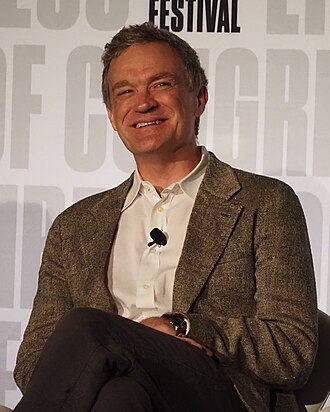
Patrick Radden Keefe
Staff writer at The New Yorker and author of six nonfiction books
Where to hear and read about Patrick Radden Keefe1 episode or test

Patrick Radden Keefe is a New Yorker staff writer of 20 years and the author of six narrative nonfiction books, including Say Nothing. The thing most worth learning from him is to plan the story's structure while still reporting, so every choice about people, scenes and openings earns the reader's next minute.
you're always sort of making down payments on saying to people, give me your time and I will take you to places you're not expecting.
New Yorker Writer Teaches the Craft of Writing (Patrick Radden Keefe Interview)
Patrick Radden Keefe: the story and the lessons
1How Patrick Radden Keefe reports on people who won't talk
Keefe treats a subject's refusal as where the story starts. His signature method is the write-around: finishing the piece when a wealthy or powerful subject says no. The Sackler family threatened to sue him over his book about them.
He always asks first and tells the subject the story is coming anyway, with the line "the train is leaving the station." Art dealer Larry Gagosian said yes to a profile Keefe had expected to be a write-around.
Keefe interviewed Mark Burnett's ex-wives instead of Burnett. Burnett, who cast Trump in The Apprentice, declined to talk. For the Sackler book, with three generations refusing, Keefe talked to college roommates, assistants, yoga instructors and doormen.
Subjects with PR people and lawyers give scripted talking points, so the outside view can be fuller and truer. He said he would always choose "the ex-wives" over a sit-down with Burnett.
Keefe aims for a painting of his subject, not a photograph. He warns subjects the piece will be filtered through his sensibility, even in a friendly profile: "It's going to look like a painting of you."
Success means people who know the subject say he captured their essence. He calls matching a person's self-image the job of a PR person.
Keefe picks stories with a mystery in them. He grew up on the Hardy Boys, Sherlock Holmes and Agatha Christie, and his father read Robert Parker and Elmore Leonard paperbacks. In Say Nothing, a 1972 murder, he did not know at the start whether he would learn who did it.
He only worked out the answer at the very end, and the book ends with a satisfying click when the killer is identified.
Keefe manages danger with caution, not bravado. He trained as a lawyer, has a wife and kids, and calls himself risk-averse. Before meeting a just-released gangster in a coffee shop, he told people what to do if they did not hear back.
The gangster shook his hand, then asked after his wife and children by name. Keefe had never told him their names.
2How Keefe plans a story before the reporting is done
Keefe sketches eight or nine story beats on an envelope mid-reporting. He once reported everything into a big compost heap and structured at the very end. Now, while still reporting, he jots the start, the end, the big moments and where he wants to flip the reader's belief.
Research then fills in beneath the beats, so he sits down to write with a road map. His beats are reader-minded: believe one thing until halfway, then switch.
Keefe cuts interesting people who do not fit the story. A current New Yorker piece started with about 50 possible characters, and he wants five to carry it. The morning of the interview he met a fascinating person and passed: "nope, interesting guy, doesn't fit here."
He calls shoehorning someone in just because they are interesting an amateurish mistake he used to make. Having beats on paper gives him the discipline to say no.
Keefe treats nonfiction as a fixed deck of cards. Because he cannot invent anything, his material is only the quotes, facts, anecdotes and scenes he brought home. The art is in when each one is dealt.
He is stubbornly non-linear and dislikes the "and then, and then" structure.
Keefe spends about 90% of the time researching, then writes fast. He says "For me, it's 90% research." The writing is a fast burst at the end, in a kind of fugue state where he does nothing else.
When it goes well he dreams about the piece and wakes at night to leave himself notes. He says this differs for everybody.
Keefe splits his week into outward days and quiet days. He lives a quiet, almost monastic life in the suburbs and goes into New York City two days a week, meeting people from lunch to evening.
Unbroken stillness lets him hold a whole article or book in his head. When he went out four nights a week, it hurt his ability to do the work.
3How Keefe hooks readers and keeps them reading
Keefe opens with a small mystery that makes readers ask how. His El Chapo piece opens in Amsterdam's Schiphol Airport, where a travel-loving cartel assassin who posted vacation photos on Instagram was arrested. A reader expecting Mexican landscapes wonders how this gets back to Mexico.
He once saw a woman on the subway turn to the next article after one paragraph of his, and says it still haunts him. His answer is one withheld piece of information, not a whodunit.
Keefe makes down payments so readers trust him with their time. Streaming shows can ask for ten hours before they get good, and print cannot. He skips the two pages of landscape that mid-century New Yorker writers used.
His Bourdain piece opens on Obama's armored limousine, the Beast, in Hanoi, with gee-whiz facts such as emergency blood in the car.
Keefe plants an image early and pays it off late. In the Bourdain piece, Hanoi's scooters rush through intersections "like floodwaters" in the opening. Late in the piece Bourdain takes him for a ride on a rented Vespa, which shows his freedom.
Keefe realized that night that Bourdain, a writer, knew he needed a scene. He thought he might die, since Bourdain was no careful driver.
Keefe chooses specific details over generic ones. A green sofa tells the reader nothing. An old Victrola and a vintage TWA poster of London are concrete and say something about a person.
He applies the same idea to place: London Falling traces the family histories of the three men in the apartment, who came from India, Uganda and wartime Eastern Europe.
Keefe mixes quotes, scenes, exposition and statistics like a mixed-media artist. Long dense exposition feels like quicksand and too many numbers create a cognitive load problem. He keeps a quote never far away, because "the quotes kind of air out a story."
He turned 200 yards of stopping distance for a loaded truck into two football fields, because it works better in the reader's mind.
Keefe enters scenes late, leaves early and cuts away on a question. Screenwriting taught him that a page of script is about a minute, so a four-minute scene is already long. He has written many screenplays, none produced.
After the cut he delivers needed exposition and trusts readers to return. He boils a 300-page court transcript down to about five pages in a book.
4Keefe on characters, truth and endings
Keefe introduces fewer characters and does it well. Editor Daniel Zalewski told him to cull the herd of five or six FBI agents in his first piece for him, on Sister Ping. It became his second book, The Snakehead.
Keefe thinks of every new person or place as context load that costs the reader memory. He spaces out introductions, and a minor agent can be just one of McMurray's colleagues.
Keefe borrowed Lawrence Wright's idea of finding a donkey. A donkey is a character who captures the reader's imagination and pulls them through complicated material. It need not be a single person.
As long as readers feel they are following someone, he says, you can tell a very complex story.
Keefe builds a subject's voice from testimony and verbal tics. Zalewski's first note on The Snakehead was that Sister Ping barely spoke. She would not talk, so Keefe used her court testimony and asked others what she said, and found her gruff and utilitarian.
She answered his jail interview request with "What's in it for me?" He quoted Carl Icahn's "At the risk of being immodest" twice without comment so readers would notice.
Keefe keeps nonfiction true and cites it with endnotes. He calls Capote's In Cold Blood a masterpiece he revisits every few years, but Capote invented quotes and scenes. Keefe holds himself to a stricter standard and puts endnotes at the back of his books.
The endnotes answer the skeptic who asks how he knows two dead people he never interviewed had a fantastic sex life.
Keefe lets ambiguity stand instead of tying a neat bow. He warned the family in London Falling that solving the case in Say Nothing did not mean he would solve theirs. An article costs a reader about 45 minutes and a book 14 or 15 hours, so the ending must not over-promise.
Readers accept ambiguity when it is handled with care, he says, but dislike having it cleaned up "for the sake of narrative coherence."
Keefe places a shocking moment differently in an article and a book. In the 14,000-word article, Zach Butler's throttling of his mother rings like a bell you can't unring. In the book it comes 200 pages in, where the reader can digest it in context.
He left one detail out of the article because so early it would have colored everything.
5Keefe's advice on learning to write
Keefe tells writers to think like readers. He gets 5,000-word email pitches for The New Yorker, where an editor receives a hundred emails a day. His answer is three tight paragraphs that leave the editor wanting more.
Many people who write treat writing and reading as separate activities.
Keefe says to take apart writing that works and steal from it. Pick pieces that absorb and inspire you, ask why they work, and treat them like a magic trick or a Swiss watch to find the machinery.
His advice is "steal, steal, steal": adopt the techniques and make them your own. He would teach a semester around close reading.
Keefe writes to seduce readers who might leave. A friend feeds 10,000-word New Yorker pieces into ChatGPT for 4,000-word summaries. Keefe told him he was using it wrong, because the value is the storytelling.
He wants the opening paragraphs to intrigue readers enough to keep going, and says "I want to seduce you with this narrative." Some readers always leave, and he fights for the ones who stay.
Keefe's editors shaped his instincts over 20 years. Daniel Zalewski, features director at The New Yorker, is there when ideas begin, and feature pieces take three months to a year or more.
After 20 years Keefe edits in his head first, so his first draft is not really a first draft.

New Yorker Writer Teaches the Craft of Writing (Patrick Radden Keefe Interview)
Patrick Radden Keefe explains how he builds narrative nonfiction: he plans the structure while still reporting, opens with small mysteries, and writes around subjects who will not talk. His habit of sketching eight or nine story beats on the back of an envelope before the research is finished shows how structure can focus a year of reporting.
Keefe treats a subject's refusal as where the story starts. His signature method is the write-around: finishing the piece when a wealthy or powerful subject says no. The Sackler family threatened to sue him over his book about them.
He always asks first and tells the subject the story is coming anyway, with the line "the train is leaving the station." Art dealer Larry Gagosian said yes to a profile Keefe had expected to be a write-around.
Keefe interviewed Mark Burnett's ex-wives instead of Burnett. Burnett, who cast Trump in The Apprentice, declined to talk. For the Sackler book, with three generations refusing, Keefe talked to college roommates, assistants, yoga instructors and doormen.
Subjects with PR people and lawyers give scripted talking points, so the outside view can be fuller and truer. He said he would always choose "the ex-wives" over a sit-down with Burnett.
Keefe aims for a painting of his subject, not a photograph. He warns subjects the piece will be filtered through his sensibility, even in a friendly profile: "It's going to look like a painting of you."
Success means people who know the subject say he captured their essence. He calls matching a person's self-image the job of a PR person.
Keefe picks stories with a mystery in them. He grew up on the Hardy Boys, Sherlock Holmes and Agatha Christie, and his father read Robert Parker and Elmore Leonard paperbacks. In Say Nothing, a 1972 murder, he did not know at the start whether he would learn who did it.
He only worked out the answer at the very end, and the book ends with a satisfying click when the killer is identified.
Keefe manages danger with caution, not bravado. He trained as a lawyer, has a wife and kids, and calls himself risk-averse. Before meeting a just-released gangster in a coffee shop, he told people what to do if they did not hear back.
The gangster shook his hand, then asked after his wife and children by name. Keefe had never told him their names.
Keefe sketches eight or nine story beats on an envelope mid-reporting. He once reported everything into a big compost heap and structured at the very end. Now, while still reporting, he jots the start, the end, the big moments and where he wants to flip the reader's belief.
Research then fills in beneath the beats, so he sits down to write with a road map. His beats are reader-minded: believe one thing until halfway, then switch.
Keefe cuts interesting people who do not fit the story. A current New Yorker piece started with about 50 possible characters, and he wants five to carry it. The morning of the interview he met a fascinating person and passed: "nope, interesting guy, doesn't fit here."
He calls shoehorning someone in just because they are interesting an amateurish mistake he used to make. Having beats on paper gives him the discipline to say no.
Keefe treats nonfiction as a fixed deck of cards. Because he cannot invent anything, his material is only the quotes, facts, anecdotes and scenes he brought home. The art is in when each one is dealt.
He is stubbornly non-linear and dislikes the "and then, and then" structure.
Keefe spends about 90% of the time researching, then writes fast. He says "For me, it's 90% research." The writing is a fast burst at the end, in a kind of fugue state where he does nothing else.
When it goes well he dreams about the piece and wakes at night to leave himself notes. He says this differs for everybody.
Keefe splits his week into outward days and quiet days. He lives a quiet, almost monastic life in the suburbs and goes into New York City two days a week, meeting people from lunch to evening.
Unbroken stillness lets him hold a whole article or book in his head. When he went out four nights a week, it hurt his ability to do the work.
Keefe opens with a small mystery that makes readers ask how. His El Chapo piece opens in Amsterdam's Schiphol Airport, where a travel-loving cartel assassin who posted vacation photos on Instagram was arrested. A reader expecting Mexican landscapes wonders how this gets back to Mexico.
He once saw a woman on the subway turn to the next article after one paragraph of his, and says it still haunts him. His answer is one withheld piece of information, not a whodunit.
Keefe makes down payments so readers trust him with their time. Streaming shows can ask for ten hours before they get good, and print cannot. He skips the two pages of landscape that mid-century New Yorker writers used.
His Bourdain piece opens on Obama's armored limousine, the Beast, in Hanoi, with gee-whiz facts such as emergency blood in the car.
Keefe plants an image early and pays it off late. In the Bourdain piece, Hanoi's scooters rush through intersections "like floodwaters" in the opening. Late in the piece Bourdain takes him for a ride on a rented Vespa, which shows his freedom.
Keefe realized that night that Bourdain, a writer, knew he needed a scene. He thought he might die, since Bourdain was no careful driver.
Keefe chooses specific details over generic ones. A green sofa tells the reader nothing. An old Victrola and a vintage TWA poster of London are concrete and say something about a person.
He applies the same idea to place: London Falling traces the family histories of the three men in the apartment, who came from India, Uganda and wartime Eastern Europe.
Keefe mixes quotes, scenes, exposition and statistics like a mixed-media artist. Long dense exposition feels like quicksand and too many numbers create a cognitive load problem. He keeps a quote never far away, because "the quotes kind of air out a story."
He turned 200 yards of stopping distance for a loaded truck into two football fields, because it works better in the reader's mind.
Keefe enters scenes late, leaves early and cuts away on a question. Screenwriting taught him that a page of script is about a minute, so a four-minute scene is already long. He has written many screenplays, none produced.
After the cut he delivers needed exposition and trusts readers to return. He boils a 300-page court transcript down to about five pages in a book.
Keefe introduces fewer characters and does it well. Editor Daniel Zalewski told him to cull the herd of five or six FBI agents in his first piece for him, on Sister Ping. It became his second book, The Snakehead.
Keefe thinks of every new person or place as context load that costs the reader memory. He spaces out introductions, and a minor agent can be just one of McMurray's colleagues.
Keefe borrowed Lawrence Wright's idea of finding a donkey. A donkey is a character who captures the reader's imagination and pulls them through complicated material. It need not be a single person.
As long as readers feel they are following someone, he says, you can tell a very complex story.
Keefe builds a subject's voice from testimony and verbal tics. Zalewski's first note on The Snakehead was that Sister Ping barely spoke. She would not talk, so Keefe used her court testimony and asked others what she said, and found her gruff and utilitarian.
She answered his jail interview request with "What's in it for me?" He quoted Carl Icahn's "At the risk of being immodest" twice without comment so readers would notice.
Keefe keeps nonfiction true and cites it with endnotes. He calls Capote's In Cold Blood a masterpiece he revisits every few years, but Capote invented quotes and scenes. Keefe holds himself to a stricter standard and puts endnotes at the back of his books.
The endnotes answer the skeptic who asks how he knows two dead people he never interviewed had a fantastic sex life.
Keefe lets ambiguity stand instead of tying a neat bow. He warned the family in London Falling that solving the case in Say Nothing did not mean he would solve theirs. An article costs a reader about 45 minutes and a book 14 or 15 hours, so the ending must not over-promise.
Readers accept ambiguity when it is handled with care, he says, but dislike having it cleaned up "for the sake of narrative coherence."
Keefe places a shocking moment differently in an article and a book. In the 14,000-word article, Zach Butler's throttling of his mother rings like a bell you can't unring. In the book it comes 200 pages in, where the reader can digest it in context.
He left one detail out of the article because so early it would have colored everything.
Keefe tells writers to think like readers. He gets 5,000-word email pitches for The New Yorker, where an editor receives a hundred emails a day. His answer is three tight paragraphs that leave the editor wanting more.
Many people who write treat writing and reading as separate activities.
Keefe says to take apart writing that works and steal from it. Pick pieces that absorb and inspire you, ask why they work, and treat them like a magic trick or a Swiss watch to find the machinery.
His advice is "steal, steal, steal": adopt the techniques and make them your own. He would teach a semester around close reading.
Keefe writes to seduce readers who might leave. A friend feeds 10,000-word New Yorker pieces into ChatGPT for 4,000-word summaries. Keefe told him he was using it wrong, because the value is the storytelling.
He wants the opening paragraphs to intrigue readers enough to keep going, and says "I want to seduce you with this narrative." Some readers always leave, and he fights for the ones who stay.
Keefe's editors shaped his instincts over 20 years. Daniel Zalewski, features director at The New Yorker, is there when ideas begin, and feature pieces take three months to a year or more.
After 20 years Keefe edits in his head first, so his first draft is not really a first draft.