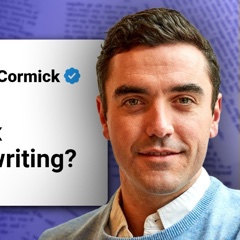
Packy McCormick
Writer of the Not Boring newsletter and founder of Not Boring Capital
Where to hear and read about Packy McCormick1 episode or test

Packy McCormick writes Not Boring, a weekly newsletter of 5,000 to 10,000 word essays, and runs Not Boring Capital. The thing most worth learning from him is a loop of writing while excited, researching the gaps and restarting fresh drafts, on topics he is truly fascinated by.
if you're skiing a fresh run, figuring out your line ahead of time is really important.
Packy McCormick: A Tactical Masterclass in Online Writing
Packy McCormick: the story and the lessons
1How Packy McCormick started Not Boring
McCormick began Not Boring as a class assignment needing 20 subscribers. He was a student in the very first Write of Passage cohort. His first essay, on Ben Thompson, drew praise from David Perell.
Early pieces broke down billboard and subway ad costs and covered natively integrated, full-stack companies.
His weekly five-link email came from a fear of forgetting. He started it after his grandmother's Alzheimer's, as a way to keep track of what he read.
He positioned against Ben Thompson with jokes and pop culture. He admired Thompson but knew he could not out-Thompson him. His first 10 essays each paired a pop culture idea with business strategy, including creative destruction compared to the Mickey Mouse Club.
The idea of a personal monopoly came from Write of Passage: combine a few things you care about. His version sat at jokes, pop culture, business strategy and technology. "what if I counter position against him?"
He named it Not Boring because business writing about geniuses is dry. The people building these companies seemed remarkable to him, and the writing about them was dull. He wants readers to say they learned a lot, like after dinner with a funny friend who got really into something.
A weekly deadline took him from one essay in three months to weekly. The 11,000-word Scenius piece paralyzed him, and editor Tom White helped him through it. After that he moved to 5,000 to 10,000 words every week.
He wonders whether to schedule less and craft one piece to break the internet, but he hasn't tried it.
2McCormick's essay process, step by step
McCormick types the title first and leaves the image for last. He puts the title at the top of the doc with "Title image" in brackets below it. Sometimes the title is the reason he wants to write the piece at all.
The image is a last-minute job, drawn by hand or made in DALL-E. Twitter throttles links, so he spends less time on thumbnails.
He spends most of his writing time on the first few paragraphs. The introduction sets his line through the essay. Once the framing is fixed, the definitions to include and the old way of thinking to knock down fall into place.
"if you're skiing a fresh run, figuring out your line ahead of time is really important." He says he is not good at the first sentence and avoids hooky openings that embarrass him.
He drafts while excited, researches gaps, then restarts in a fresh doc. The first file, V0, holds everything cut from later versions. He keeps only the good sections and writes the rest fresh without editing, through about six versions over four to seven days.
Each restart leaves him understanding the topic a little better. "I'm just going to try to capture that excitement and just start typing again."
He rewrites the whole essay in the last hours before sending. For roughly his last 10 essays he rewrote from 4:30 to 8:55 AM while texting his brother Dan about sponsor timing. The angle for deep dives is fixed a couple of days early, so the last day is only editing.
He doesn't know if the rush makes essays better and rawer or just worse, but he says he needs the time pressure. He panics less now, from repetition.
He moved sending to Tuesday to keep writing stress off the weekend. Before kids he wrote all weekend. After kids he asked his wife Pooja for six hours, saying "My golf is writing", but he sat with the family on edge.
Sending on Tuesday instead of Monday buys one more day of drafts.
He talks ideas out loud on walks until the structure appears. An epiphany arrives as one sentence. He says it aloud three times, compressing each time, then sends the structure to his computer and types it up. He holds the phone under his mouth like a voice memo.
Perell says voice transcription doubled his words per session, at the cost of more editing: "I'm not trying to make a statue, I just need marble."
He uses AI to attack his drafts and to find words, not to write. He finds Claude and ChatGPT flattering as editors, but ChatGPT works when told to cynically attack the argument and find where he went wrong. For word choice he pastes a sentence with the word blanked out and describes the tone.
The risk of the attack check is piling on qualifiers until the piece loses its point of view. He now uses AI images about once per piece instead of five or six, because they all look alike.
3What McCormick tries to put on the page
McCormick aims to change how readers see an idea, not to post beta takes. He calls "AI is going to change the world" beta content, since another piece on it won't make anyone smarter. Over 10,000 words and a strong introduction he wants to shift how someone sees an idea, even if they forget the details.
"maybe it'll just shake something loose in your brain"
He tries to write the best piece ever written on a company. His Stripe essay was given to new Stripe employees. The common reaction is "Finally, my mom understands what I do."
He sees himself as the "dumb guy" who learns just ahead of the audience, because someone too deep in an industry struggles to explain it. Early on he wrote about public companies through metaphors, since he could not out-analyze the analysts.
He treats readers as smart and uses hyperlinks to carry context. A link lets him skip the explanation and attract curious readers. He checks which links get clicked, and a clicked 2,000-word explainer deep in a piece tells him readers are still working through it.
"the big advantage that we have as online writers is the hyperlink"
He builds datasets and gives readers the link. In early COVID he spent two days cross-referencing Chinese-language sites into a spreadsheet of Tencent's investments. Later he pasted about 3,000 sci-fi ideas from technovelgy.com into a sheet and had Claude check which had come true.
The Tencent link mattered more to readers than anything he wrote in the piece, and people still share the sci-fi idea bank.
The Great Online Game was written in one day and became his most-cited piece. A Saturday draft was weak, so he threw it out and wrote a new one Sunday morning, from his in-laws' basement. Fewer than 50,000 people read Not Boring then.
He thinks it spread because it named something readers had noticed and gave them something to go play. "putting into words the thing that I had noticed that didn't have a name"
He writes only what fascinates him, even when it breaks growth advice. He hops from biotech to space each week, which audience-building advice warns against. Perell's point is that you can lie to yourself for piece one, but not for piece 200.
Switching topics weekly also keeps him from becoming a caricature of what the audience expects.
He says overthinking and sounding smarter than he is make writing flat. When he over-intellectualizes, the piece loses the excitement that made him pick the topic. He asks how to get that excitement onto the page.
He quotes Kevin Kelly's advice to tell your story with uncommon honesty.
4How writing, sponsors and the fund fit together for McCormick
McCormick chose ads over a paywall to keep growing. He expected to choose subscription, but feared that paywalling even half the content would cut growth. The audience grew bigger than he expected, so ad revenue was enough.
Early on it paid rent and "a latte every day".
Sponsored deep dives give him inside access and founders like them. He tried the first one reluctantly, expecting readers to hate it, and they found it interesting. About 20 companies ask for one for every one he writes.
A Ramp piece showed how it splits engineers: careful ones own anything that touches money, competitive coders ship features that can break without harm. He says he wouldn't get that access without these posts. Some readers quit at the sponsor label, and he accepts that.
He filters sponsors by picking the company, not by hedging inside the piece. He writes fewer sponsored pieces now because each takes so much time.
The fund gives him skin in the game, and writing opens doors. His ideal life was to write, talk to smart people and invest, and Not Boring Capital lets him do all three. Founders who read the newsletter already know how he thinks.
He worked in startups first and dislikes commenting without taking a stance. In three days he spoke with a mining, an energy and a biotech company, each trying to explain its worldview fast.
He wants to protect his spikiest ideas as the audience grows. He says audiences get less weird as they grow, and he wants to add variants of the spikiest ideas to what people see.
Perell adds that online the job is to attract the right readers and repel the wrong ones, as Tyler Cowen's idiosyncratic blog does. "With the internet, the word is attract."
5Perell's writing advice in the conversation with McCormick
Perell says to write for one person, not the stadium. His best writing is a daily 200 to 250 word journal to one friend, about an hour and a half. Writing for an audience loses the intimacy of a letter.
"when you try to write for the stadium, you don't hit the stadium." McCormick says he might have written The Great Online Game differently had he known its reach.
Perell says good editors give a fix, not just a verdict. A bare "Unclear" gives the writer no momentum. He suggests a three-line summary of the three habits to stop.
McCormick credits Tom White for making the 11,000-word Scenius essay feel manageable.
6How McCormick stays fresh, and where he says he is limited
He refreshes by speed-reading five to ten great older essays. When writing feels stale he tweets for favorite essays more than a couple of years old. One tweet gave him a list of over 100 he keeps returning to.
His favorite is Becoming a Magician by Autotranslucence, which defines a magician as different from you in kind, not quantity. He rereads it for the feeling, not one sentence.
He gave up memorizing and collects strange, well-made ideas instead. His memory jumbles, unlike the framework-style minds he sees in Ben Thompson, Byrne Hobart and Marc Andreessen. Spaced repetition felt like banging his head against a wall.
He hopes ideas bump into each other and surface at random. Sci-fi lets him live 100 or 1,000 years out, so ideas a year or two away look obvious.
He admits his technical depth is thin. He can spot what matters and explain it back, but three levels down he is lost.
Perell says he leans into who he is, optimism included, instead of fighting it.
He has doubts about audience expectations and being dunked on. Moving from outsider to insider changed his voice, and being dunked on added a defensiveness he wants to remove. The pop culture pairing faded but the playful voice stayed.
One Twitter account mocked his phrase "cost physics", and now he doubts whether to write about it. He plans to reread old pieces to recover some early freshness.

Packy McCormick: A Tactical Masterclass in Online Writing
Packy McCormick explains how he turned a pop culture, jokes and business voice into a weekly newsletter of 5,000 to 10,000 word essays read by hundreds of thousands. The technique worth hearing is his loop of writing while excited, researching the gaps and restarting fresh drafts, then rewriting in the last hours before a deadline.
McCormick began Not Boring as a class assignment needing 20 subscribers. He was a student in the very first Write of Passage cohort. His first essay, on Ben Thompson, drew praise from David Perell.
Early pieces broke down billboard and subway ad costs and covered natively integrated, full-stack companies.
His weekly five-link email came from a fear of forgetting. He started it after his grandmother's Alzheimer's, as a way to keep track of what he read.
He positioned against Ben Thompson with jokes and pop culture. He admired Thompson but knew he could not out-Thompson him. His first 10 essays each paired a pop culture idea with business strategy, including creative destruction compared to the Mickey Mouse Club.
The idea of a personal monopoly came from Write of Passage: combine a few things you care about. His version sat at jokes, pop culture, business strategy and technology. "what if I counter position against him?"
He named it Not Boring because business writing about geniuses is dry. The people building these companies seemed remarkable to him, and the writing about them was dull. He wants readers to say they learned a lot, like after dinner with a funny friend who got really into something.
A weekly deadline took him from one essay in three months to weekly. The 11,000-word Scenius piece paralyzed him, and editor Tom White helped him through it. After that he moved to 5,000 to 10,000 words every week.
He wonders whether to schedule less and craft one piece to break the internet, but he hasn't tried it.
McCormick types the title first and leaves the image for last. He puts the title at the top of the doc with "Title image" in brackets below it. Sometimes the title is the reason he wants to write the piece at all.
The image is a last-minute job, drawn by hand or made in DALL-E. Twitter throttles links, so he spends less time on thumbnails.
He spends most of his writing time on the first few paragraphs. The introduction sets his line through the essay. Once the framing is fixed, the definitions to include and the old way of thinking to knock down fall into place.
"if you're skiing a fresh run, figuring out your line ahead of time is really important." He says he is not good at the first sentence and avoids hooky openings that embarrass him.
He drafts while excited, researches gaps, then restarts in a fresh doc. The first file, V0, holds everything cut from later versions. He keeps only the good sections and writes the rest fresh without editing, through about six versions over four to seven days.
Each restart leaves him understanding the topic a little better. "I'm just going to try to capture that excitement and just start typing again."
He rewrites the whole essay in the last hours before sending. For roughly his last 10 essays he rewrote from 4:30 to 8:55 AM while texting his brother Dan about sponsor timing. The angle for deep dives is fixed a couple of days early, so the last day is only editing.
He doesn't know if the rush makes essays better and rawer or just worse, but he says he needs the time pressure. He panics less now, from repetition.
He moved sending to Tuesday to keep writing stress off the weekend. Before kids he wrote all weekend. After kids he asked his wife Pooja for six hours, saying "My golf is writing", but he sat with the family on edge.
Sending on Tuesday instead of Monday buys one more day of drafts.
He talks ideas out loud on walks until the structure appears. An epiphany arrives as one sentence. He says it aloud three times, compressing each time, then sends the structure to his computer and types it up. He holds the phone under his mouth like a voice memo.
Perell says voice transcription doubled his words per session, at the cost of more editing: "I'm not trying to make a statue, I just need marble."
He uses AI to attack his drafts and to find words, not to write. He finds Claude and ChatGPT flattering as editors, but ChatGPT works when told to cynically attack the argument and find where he went wrong. For word choice he pastes a sentence with the word blanked out and describes the tone.
The risk of the attack check is piling on qualifiers until the piece loses its point of view. He now uses AI images about once per piece instead of five or six, because they all look alike.
McCormick aims to change how readers see an idea, not to post beta takes. He calls "AI is going to change the world" beta content, since another piece on it won't make anyone smarter. Over 10,000 words and a strong introduction he wants to shift how someone sees an idea, even if they forget the details.
"maybe it'll just shake something loose in your brain"
He tries to write the best piece ever written on a company. His Stripe essay was given to new Stripe employees. The common reaction is "Finally, my mom understands what I do."
He sees himself as the "dumb guy" who learns just ahead of the audience, because someone too deep in an industry struggles to explain it. Early on he wrote about public companies through metaphors, since he could not out-analyze the analysts.
He treats readers as smart and uses hyperlinks to carry context. A link lets him skip the explanation and attract curious readers. He checks which links get clicked, and a clicked 2,000-word explainer deep in a piece tells him readers are still working through it.
"the big advantage that we have as online writers is the hyperlink"
He builds datasets and gives readers the link. In early COVID he spent two days cross-referencing Chinese-language sites into a spreadsheet of Tencent's investments. Later he pasted about 3,000 sci-fi ideas from technovelgy.com into a sheet and had Claude check which had come true.
The Tencent link mattered more to readers than anything he wrote in the piece, and people still share the sci-fi idea bank.
The Great Online Game was written in one day and became his most-cited piece. A Saturday draft was weak, so he threw it out and wrote a new one Sunday morning, from his in-laws' basement. Fewer than 50,000 people read Not Boring then.
He thinks it spread because it named something readers had noticed and gave them something to go play. "putting into words the thing that I had noticed that didn't have a name"
He writes only what fascinates him, even when it breaks growth advice. He hops from biotech to space each week, which audience-building advice warns against. Perell's point is that you can lie to yourself for piece one, but not for piece 200.
Switching topics weekly also keeps him from becoming a caricature of what the audience expects.
He says overthinking and sounding smarter than he is make writing flat. When he over-intellectualizes, the piece loses the excitement that made him pick the topic. He asks how to get that excitement onto the page.
He quotes Kevin Kelly's advice to tell your story with uncommon honesty.
McCormick chose ads over a paywall to keep growing. He expected to choose subscription, but feared that paywalling even half the content would cut growth. The audience grew bigger than he expected, so ad revenue was enough.
Early on it paid rent and "a latte every day".
Sponsored deep dives give him inside access and founders like them. He tried the first one reluctantly, expecting readers to hate it, and they found it interesting. About 20 companies ask for one for every one he writes.
A Ramp piece showed how it splits engineers: careful ones own anything that touches money, competitive coders ship features that can break without harm. He says he wouldn't get that access without these posts. Some readers quit at the sponsor label, and he accepts that.
He filters sponsors by picking the company, not by hedging inside the piece. He writes fewer sponsored pieces now because each takes so much time.
The fund gives him skin in the game, and writing opens doors. His ideal life was to write, talk to smart people and invest, and Not Boring Capital lets him do all three. Founders who read the newsletter already know how he thinks.
He worked in startups first and dislikes commenting without taking a stance. In three days he spoke with a mining, an energy and a biotech company, each trying to explain its worldview fast.
He wants to protect his spikiest ideas as the audience grows. He says audiences get less weird as they grow, and he wants to add variants of the spikiest ideas to what people see.
Perell adds that online the job is to attract the right readers and repel the wrong ones, as Tyler Cowen's idiosyncratic blog does. "With the internet, the word is attract."
Perell says to write for one person, not the stadium. His best writing is a daily 200 to 250 word journal to one friend, about an hour and a half. Writing for an audience loses the intimacy of a letter.
"when you try to write for the stadium, you don't hit the stadium." McCormick says he might have written The Great Online Game differently had he known its reach.
Perell says good editors give a fix, not just a verdict. A bare "Unclear" gives the writer no momentum. He suggests a three-line summary of the three habits to stop.
McCormick credits Tom White for making the 11,000-word Scenius essay feel manageable.
He refreshes by speed-reading five to ten great older essays. When writing feels stale he tweets for favorite essays more than a couple of years old. One tweet gave him a list of over 100 he keeps returning to.
His favorite is Becoming a Magician by Autotranslucence, which defines a magician as different from you in kind, not quantity. He rereads it for the feeling, not one sentence.
He gave up memorizing and collects strange, well-made ideas instead. His memory jumbles, unlike the framework-style minds he sees in Ben Thompson, Byrne Hobart and Marc Andreessen. Spaced repetition felt like banging his head against a wall.
He hopes ideas bump into each other and surface at random. Sci-fi lets him live 100 or 1,000 years out, so ideas a year or two away look obvious.
He admits his technical depth is thin. He can spot what matters and explain it back, but three levels down he is lost.
Perell says he leans into who he is, optimism included, instead of fighting it.
He has doubts about audience expectations and being dunked on. Moving from outsider to insider changed his voice, and being dunked on added a defensiveness he wants to remove. The pop culture pairing faded but the playful voice stayed.
One Twitter account mocked his phrase "cost physics", and now he doubts whether to write about it. He plans to reread old pieces to recover some early freshness.