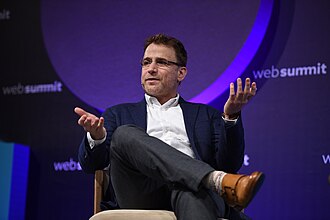
Noah Weiss
Chief Product Officer at Slack, formerly SVP of Product at Foursquare and PM at Google
Where to hear and read about Noah Weiss1 episode or test

Noah Weiss is Chief Product Officer at Slack, after product roles at Foursquare and Google, and he has spent 15 years building products by moving to the next hill instead of polishing the current one. The most useful thing to learn from him is to trade short-term impact for fast learning with real customers whenever growth stalls or the audience changes.
for the next couple quarters we're going to sacrifice impact for the sake of learning
The 10 traits of great PMs, AI, and Slack’s approach to product | Noah Weiss (Slack, Google)
Noah Weiss: the story and the lessons
1Noah Weiss's path from Google to Foursquare to Slack
Weiss has built products by climbing to the next hill. He has been Slack's chief product officer for seven years. Before that he was head of product at Foursquare and a PM at Google and Fox Creek Software.
His phrase for the habit is that teams crawl up one hill and miss the range behind it.
He has worked with AI for about 15 years. At Google he worked on knowledge graph and natural language work, aiming for direct answers instead of ten blue links. Large language models now add language generation to that work.
His example queries were the tallest mountains in Europe and popular beaches in Southern California.
He has worked closely with strongly product-minded founders. These include Stewart Butterfield at Slack and Dennis Crowley at Foursquare.
He says a founder who is expert in your function teaches you the most and frustrates you the most, and that you should expect less agency.
2What Weiss learned from Foursquare's lost lead
Foursquare picked the wrong unit of sharing. It bet on a person at a place when users wanted to share a moment. Requiring a physical place to check in cost the social side.
Instagram's founders built on the Foursquare API before Facebook bought them. People mainly used Foursquare for local discovery: recommendations, tips and push notifications.
Google copied Foursquare's utility in a couple of years. Google Maps had over a billion users across Android and iOS, so it could replicate the features quickly.
Weiss credits luck and timing as much as strategy.
He values B2B for how fast it shows whether people will pay. Consumer means building reach and hoping to add ads later. B2B shows willingness to pay quickly.
Foursquare is now a B2B data and API company.
3How Weiss restarted Slack's plateaued self-serve business
Weiss treats product market fit as expiring when the audience widens. In 2019 Slack's self-serve cohort curves were weaker than before, because newer customers were less technical than the early adopters.
He describes fit as stacked S curves: you saturate one group, then jump to the next, such as non-developer teams or large enterprises abroad.
Self-serve stalled because Slack stopped watching it. From about 2014 to 2017 the business was almost all self-serve and grew on its own. Then sales and enterprise took the company's attention, and by 2019 almost every sophisticated tech company already used Slack.
The change was to stop optimizing what worked and go looking for new levers.
He threw out the roadmap and optimized for learning. The team wrote hypotheses about new levers and accepted roughly six months with no expected impact. They roughly doubled the rate of new paid customer growth in the year, and again a couple of years later.
The old optimizations had stopped working for the new audience.
He diagnosed new-user problems as comprehension and desirability. New users must first understand what the product is for and how it works, then find a reason to care. Slack split its fixes roughly 60/40 between early-journey work and foundational product features.
The foundations included WYSIWYG message composition (people had been writing in markdown), offline mobile, and sidebar notification controls. The day one journey really ran to about day 30.
He saw a trial of paid Slack as one of the ripest levers. Slack had been freemium for years but never built a trial strategy, so users were either free or paying.
Weiss wanted "a taste of the full premium slack experience so that they would never want to go back".
Weiss's team found an activation metric that predicts upgrades. Data science found "successful teams": five people using Slack for most of their work week. Those teams were 400% more likely to upgrade over the next six months.
Before, the metrics were paid customers at the very end and created teams at the very start. The new one sits earlier in the funnel, so every team in the company could move it, not just self-serve.
Slack grew because users staked their own reputation on it. Customers loved it enough to bring in coworkers, and it was easy enough that a team could pay by card without a salesperson. Enterprise sales grew out of small teams that had already adopted it.
The first enterprise sales exercise was to sort customer domains by active users and call them in that order. The original pitch deck said Slack was for companies of 5 to 50 people.
4How Weiss's teams stay close to real customers
He runs complaint storms on other products first. The team projects one screen and everyone logs each confusing step from the website to the first moment of value. Starting on someone else's product makes harsh critique feel safe before turning to Slack's own.
It began around 2019 or early 2020, when the team was building for the next million customers. It also calibrates the team on quality and helps when a team is stuck. Stripe's similar practice is called friction logging.
Teams get two-week customer love sprints for small fixes. Design, product and engineering work together on a list of low-effort, high-impact fixes, and the goal is to ship all of them. User-facing teams run one at least quarterly, others about twice a year.
Most roadmap time goes to big features, so this protects room for small polish and changes the pace of the quarter.
All hands show real tweets, including the meanest ones. As the user base grows, teams design less for themselves, so Weiss wants a steady pulse of what people say in the wild.
He wants Slack data informed, not so data driven that it loses its feel for real users.
Weiss has the team live-comment on usability sessions in one thread. PMs, engineers, designers and researchers dial in and write reactions in a single Slack thread. The thread becomes the source of truth the research report links back to.
It gets people to attend research, and watching real users is humbling.
He replaced internal dogfooding with a diverse customer pilot program. Slack runs pilots with thousands of customers under agreements, rolled out progressively with surveys. Launches have worked for about a thousand companies in 50 countries and 20 industries.
Pilot customers are chosen for diversity in industry, size and location, and for risk tolerance, since a feature may be killed. Weiss says working well internally is "no longer that predictive".
5How Weiss runs big bets, competition and AI at Slack
Weiss tells teams to take bigger, bolder bets. Chasing a KPI up one percent a quarter hides the horizon. New teams for huddles and clips started from scratch during the pandemic, when customers felt disconnected from teammates.
They get a pass on normal planning and quarterly reviews and are measured on the pace of learning. Then they pilot with customers.
He stays customer obsessed but only competitor aware. Slack beat HipChat and Campfire by being about 10x better on a few axes: mobile that synced across clients, search that worked, and consumer messaging features like emoji and reactions.
Slack never set out to kill HipChat. It stays focused on groups doing work, a different job from Discord's communities, and positions itself as connected tissue alongside Microsoft Teams.
He pairs a central ML team with parallel AI prototype teams. A central machine learning and search team builds shared infrastructure, and separate teams prototype on different customer problems. Capabilities and risks change "literally every month", so the setup is deliberately ad hoc.
The end state is an AI roadmap inside every product area, like mobile.
Weiss makes AI interfaces promise only what the data can deliver. LLMs sound supremely confident even when hallucinating. Showing where data comes from and acknowledging uncertainty builds trust.
He favors designs that capture training data as a byproduct of normal use, as Netflix ratings do. Slack's North Star for AI is a personal chief of staff that summarizes what matters across channels.
6Weiss on working with founders, principles and prototypes
He wants a founder deeply involved at the start and end only. Plot involvement as a U: agree principles, goals and anti-goals early, let the team run in the middle, then the founder tastes the soup at the end.
Skipping the final step makes launch more painful because the founder never co-created the product. Slack ran a joint bug bash with engineering, design, product, research and Stewart Butterfield.
He turns founder taste into five shared principles. They include be a great host, Don't Make Me Think, and take bigger bolder bets. Without shared language every review becomes a Goldilocks loop of going back to the CEO.
Be a great host means saving people steps, like clean towels on the bed. Don't Make Me Think fights the owner's delusion that others care about details as much as you do. More clicks can be fine when they give confidence.
Slack stopped polishing static mocks and prototypes in real software. Weiss calls this the biggest recent change in how Slack executes. A messy prototype that gets thrown away beats months of design debate.
His reason: "you gotta kind of live and touch and smell the software you can't just look at it."
7Noah Weiss's view of what makes a great product manager
Weiss calls "mini CEO" the most dangerous advice in product. It breeds PMs who act like dictators, and their teams reject them. A PM's job is to facilitate the pace and quality of decisions.
He says impact solves all PM issues: if the team consistently builds things people love and changes the business, everything else is an input.
Impeccable execution means nothing on your plate gets dropped. Ben Horowitz's rule at Foursquare was to say what you will do, do it, and if you can't, explain why.
Saying "I won't get to this, let's re-prioritize" builds trust. The PM is the team's shock absorber.
He wants PMs to live in the future and work backwards. That means carving out time to think six months to two years ahead, not only the next two weeks. Google reviews asked how to get 100x the scale.
He says ideas come from immersing yourself in the problem space, as Paul Graham argues.
Early-career PMs build credibility through execution, impact and data fluency. Execution comes first because it is the skill they control most, then a drive for impact even if local, then fluency in data and research.
PMs do not need to be statisticians, but should know experimentation, correlation versus causation and statistical significance. He calls taste plus data fluency "a pretty powerful combo".
Senior PMs should shift to long-term strategy and writing. They own the longer-term strategy that realizes the founder's vision, and must keep the whole organization unblocked.
Weiss calls writing the highest-leverage use of a senior PM's time because it scales influence. His advice on writing is to practice and to cut, and he recommends Stephen King's On Writing.

The 10 traits of great PMs, AI, and Slack’s approach to product | Noah Weiss (Slack, Google)
Noah Weiss shares how Slack builds product: shared principles, complaint storms, customer love sprints, pilot programs, and an activation metric that predicts upgrades. He also explains how Slack restarted a plateaued self-serve business and doubled its new paid customer growth.
Weiss has built products by climbing to the next hill. He has been Slack's chief product officer for seven years. Before that he was head of product at Foursquare and a PM at Google and Fox Creek Software.
His phrase for the habit is that teams crawl up one hill and miss the range behind it.
He has worked with AI for about 15 years. At Google he worked on knowledge graph and natural language work, aiming for direct answers instead of ten blue links. Large language models now add language generation to that work.
His example queries were the tallest mountains in Europe and popular beaches in Southern California.
He has worked closely with strongly product-minded founders. These include Stewart Butterfield at Slack and Dennis Crowley at Foursquare.
He says a founder who is expert in your function teaches you the most and frustrates you the most, and that you should expect less agency.
Foursquare picked the wrong unit of sharing. It bet on a person at a place when users wanted to share a moment. Requiring a physical place to check in cost the social side.
Instagram's founders built on the Foursquare API before Facebook bought them. People mainly used Foursquare for local discovery: recommendations, tips and push notifications.
Google copied Foursquare's utility in a couple of years. Google Maps had over a billion users across Android and iOS, so it could replicate the features quickly.
Weiss credits luck and timing as much as strategy.
He values B2B for how fast it shows whether people will pay. Consumer means building reach and hoping to add ads later. B2B shows willingness to pay quickly.
Foursquare is now a B2B data and API company.
Weiss treats product market fit as expiring when the audience widens. In 2019 Slack's self-serve cohort curves were weaker than before, because newer customers were less technical than the early adopters.
He describes fit as stacked S curves: you saturate one group, then jump to the next, such as non-developer teams or large enterprises abroad.
Self-serve stalled because Slack stopped watching it. From about 2014 to 2017 the business was almost all self-serve and grew on its own. Then sales and enterprise took the company's attention, and by 2019 almost every sophisticated tech company already used Slack.
The change was to stop optimizing what worked and go looking for new levers.
He threw out the roadmap and optimized for learning. The team wrote hypotheses about new levers and accepted roughly six months with no expected impact. They roughly doubled the rate of new paid customer growth in the year, and again a couple of years later.
The old optimizations had stopped working for the new audience.
He diagnosed new-user problems as comprehension and desirability. New users must first understand what the product is for and how it works, then find a reason to care. Slack split its fixes roughly 60/40 between early-journey work and foundational product features.
The foundations included WYSIWYG message composition (people had been writing in markdown), offline mobile, and sidebar notification controls. The day one journey really ran to about day 30.
He saw a trial of paid Slack as one of the ripest levers. Slack had been freemium for years but never built a trial strategy, so users were either free or paying.
Weiss wanted "a taste of the full premium slack experience so that they would never want to go back".
Weiss's team found an activation metric that predicts upgrades. Data science found "successful teams": five people using Slack for most of their work week. Those teams were 400% more likely to upgrade over the next six months.
Before, the metrics were paid customers at the very end and created teams at the very start. The new one sits earlier in the funnel, so every team in the company could move it, not just self-serve.
Slack grew because users staked their own reputation on it. Customers loved it enough to bring in coworkers, and it was easy enough that a team could pay by card without a salesperson. Enterprise sales grew out of small teams that had already adopted it.
The first enterprise sales exercise was to sort customer domains by active users and call them in that order. The original pitch deck said Slack was for companies of 5 to 50 people.
He runs complaint storms on other products first. The team projects one screen and everyone logs each confusing step from the website to the first moment of value. Starting on someone else's product makes harsh critique feel safe before turning to Slack's own.
It began around 2019 or early 2020, when the team was building for the next million customers. It also calibrates the team on quality and helps when a team is stuck. Stripe's similar practice is called friction logging.
Teams get two-week customer love sprints for small fixes. Design, product and engineering work together on a list of low-effort, high-impact fixes, and the goal is to ship all of them. User-facing teams run one at least quarterly, others about twice a year.
Most roadmap time goes to big features, so this protects room for small polish and changes the pace of the quarter.
All hands show real tweets, including the meanest ones. As the user base grows, teams design less for themselves, so Weiss wants a steady pulse of what people say in the wild.
He wants Slack data informed, not so data driven that it loses its feel for real users.
Weiss has the team live-comment on usability sessions in one thread. PMs, engineers, designers and researchers dial in and write reactions in a single Slack thread. The thread becomes the source of truth the research report links back to.
It gets people to attend research, and watching real users is humbling.
He replaced internal dogfooding with a diverse customer pilot program. Slack runs pilots with thousands of customers under agreements, rolled out progressively with surveys. Launches have worked for about a thousand companies in 50 countries and 20 industries.
Pilot customers are chosen for diversity in industry, size and location, and for risk tolerance, since a feature may be killed. Weiss says working well internally is "no longer that predictive".
Weiss tells teams to take bigger, bolder bets. Chasing a KPI up one percent a quarter hides the horizon. New teams for huddles and clips started from scratch during the pandemic, when customers felt disconnected from teammates.
They get a pass on normal planning and quarterly reviews and are measured on the pace of learning. Then they pilot with customers.
He stays customer obsessed but only competitor aware. Slack beat HipChat and Campfire by being about 10x better on a few axes: mobile that synced across clients, search that worked, and consumer messaging features like emoji and reactions.
Slack never set out to kill HipChat. It stays focused on groups doing work, a different job from Discord's communities, and positions itself as connected tissue alongside Microsoft Teams.
He pairs a central ML team with parallel AI prototype teams. A central machine learning and search team builds shared infrastructure, and separate teams prototype on different customer problems. Capabilities and risks change "literally every month", so the setup is deliberately ad hoc.
The end state is an AI roadmap inside every product area, like mobile.
Weiss makes AI interfaces promise only what the data can deliver. LLMs sound supremely confident even when hallucinating. Showing where data comes from and acknowledging uncertainty builds trust.
He favors designs that capture training data as a byproduct of normal use, as Netflix ratings do. Slack's North Star for AI is a personal chief of staff that summarizes what matters across channels.
He wants a founder deeply involved at the start and end only. Plot involvement as a U: agree principles, goals and anti-goals early, let the team run in the middle, then the founder tastes the soup at the end.
Skipping the final step makes launch more painful because the founder never co-created the product. Slack ran a joint bug bash with engineering, design, product, research and Stewart Butterfield.
He turns founder taste into five shared principles. They include be a great host, Don't Make Me Think, and take bigger bolder bets. Without shared language every review becomes a Goldilocks loop of going back to the CEO.
Be a great host means saving people steps, like clean towels on the bed. Don't Make Me Think fights the owner's delusion that others care about details as much as you do. More clicks can be fine when they give confidence.
Slack stopped polishing static mocks and prototypes in real software. Weiss calls this the biggest recent change in how Slack executes. A messy prototype that gets thrown away beats months of design debate.
His reason: "you gotta kind of live and touch and smell the software you can't just look at it."
Weiss calls "mini CEO" the most dangerous advice in product. It breeds PMs who act like dictators, and their teams reject them. A PM's job is to facilitate the pace and quality of decisions.
He says impact solves all PM issues: if the team consistently builds things people love and changes the business, everything else is an input.
Impeccable execution means nothing on your plate gets dropped. Ben Horowitz's rule at Foursquare was to say what you will do, do it, and if you can't, explain why.
Saying "I won't get to this, let's re-prioritize" builds trust. The PM is the team's shock absorber.
He wants PMs to live in the future and work backwards. That means carving out time to think six months to two years ahead, not only the next two weeks. Google reviews asked how to get 100x the scale.
He says ideas come from immersing yourself in the problem space, as Paul Graham argues.
Early-career PMs build credibility through execution, impact and data fluency. Execution comes first because it is the skill they control most, then a drive for impact even if local, then fluency in data and research.
PMs do not need to be statisticians, but should know experimentation, correlation versus causation and statistical significance. He calls taste plus data fluency "a pretty powerful combo".
Senior PMs should shift to long-term strategy and writing. They own the longer-term strategy that realizes the founder's vision, and must keep the whole organization unblocked.
Weiss calls writing the highest-leverage use of a senior PM's time because it scales influence. His advice on writing is to practice and to cut, and he recommends Stephen King's On Writing.
 Slack