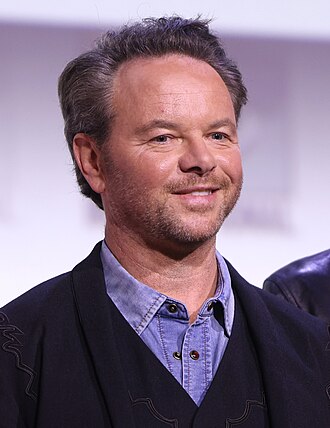
Noah Hawley
Emmy-winning writer, showrunner and novelist
Where to hear and read about Noah Hawley1 episode or test

Noah Hawley is an Emmy-winning writer, showrunner and novelist behind Fargo, Legion and Alien: Earth, plus novels such as The Good Father and Before the Fall. The habit most worth copying is making the pitch, outline and script carry the same voice as the story, while being easy enough to work with that he keeps getting to make things.
The ending of a story is what gives the story meaning.
Emmy Award-Winner Teaches Writing (Noah Hawley Interview)
Noah Hawley: the story and the lessons
1How Noah Hawley starts a story
Hawley starts with an image that holds a question. Fargo season 1 began with two men meeting in an emergency room, one civilized and one the opposite. Another image was a woman driving home with a man sticking out of her windshield and making dinner.
The story then becomes the answer. His first novel, A Conspiracy of Tall Men, asked what Americans are so afraid of that they keep cycling through paranoia.
Each Fargo season carries a question about the world. Fargo always asks how decency can beat cynicism. Season 3 came after the 2016 election and asked how laws work if nobody agrees what reality is.
The characters take part in that conversation, ideally invisibly to the audience.
He asks what he is taking for granted. On Lucy in the Sky with Natalie Portman, he took the movie theater itself for granted, then used screen size and sound as tools. The aspect and sound shifted with her emotional state.
"My first question is always what am I taking for granted in approaching the story."
He bends a genre's familiar form to carry his idea. Legion's heightened genre kept the audience unsure whether David had powers or was crazy. That allowed an episode inside his mind, where he sits in an ice cube with Jemaine Clement.
A straight drama could not personify things like that. Memento did something similar by telling a detective story backwards.
Hawley wants to know the ending before committing. Lost was such a hit that Damon Lindelof was never given an end date, and by season 3 characters were literally trapped in a cage.
Hawley sold Fargo to FX as an anthology, so each season is a new story and he decides its length.
2How Hawley writes scripts, pitches and novels
His pitches and outlines sound like the show they sell. He once opened a pitch by musing aloud about how to segue into it, mentioning a burglary and Bill Murray in Stripes. The executives were baffled, then saw the segue was the pitch: a 70s-style crime story about an anti-hero.
"If you have like an irreverent comedy that you're writing, well, your outline better be irreverent."
He writes scripts the way he will shoot them. He watches the movie in his mind and writes angles and close-ups, such as angle on him and close-up on the glass. He writes every genre this way, horror or dialogue-heavy.
Department heads and set builders can see how he plans to shoot it, and studio and actors feel the tone in the document.
He sprints through a rough first draft and enjoys it. For a novel he uses a three-month gap and aims for 100 to 110 pages, enough to see the voice and characters years later. At 25 pages he says he lost it.
He wrote The Good Father in the three-month 2007 Hollywood writers' strike, mostly in Austin, with a newborn daughter.
He keeps stakes on the character, not the plot. In the last chapters of A Conspiracy of Tall Men he felt he was just writing what happens next, so he moved to emotional thrillers.
The question that matters is whether the character will be okay. The Good Father, Before the Fall and Anthem all follow that approach.
He lets a scene refuse to be the one he planned. In the last Fargo season he expected another set piece when a man who tried to kidnap Juno Temple's character waits in her house. Instead he asked what if she refuses to play his scene.
She has him help make biscuits and the scene turns on forgiveness, ending with him tearing up over a bite of roll. The tension holds because he is always a hair away from violence.
3How Hawley builds a season of Fargo
Hawley steers his writers' room toward theme, not plot. A writers' room speaks plot, which uses the list-making part of the brain. When he can't attend, he tells the writers not to discuss what happens next.
They explore a theme instead, such as how assimilation runs through a season of Fargo.
He builds Fargo on pieces colliding, not on showdowns. Reality rarely ends in a showdown, so many pieces head for collision and nobody knows which will meet or when. In season 2, viewers root for Kirsten Dunst and Jesse Plemons, then dread the arrival of the young man who wants to prove he's a man.
Audiences are trained to see violence as progress. When it comes, he wants them to ask why they wanted it.
He designs each new season around the story, not the cast. Returning characters become obligations in a second season, which produces C story romances only because two actors have nothing to do. He picks the characters who fit and pauses the rest, or brings them back later.
He is applying this to the second season of Alien Earth.
He fixes the late middle by changing the story's shape. Fargo season 1 jumped ahead a year in episode eight. In season 2, Ed and Peggy went on the run in episode seven.
He treats constraints as a spur: a talking-in-a-room episode can have more interesting talk or more urgency in one location.
He retuned Fargo's length and pace as viewers changed. In 2018 episodes ran 60 minutes because viewers wanted more, and season 4 ran 11 episodes with the shortest about 55 minutes. Season 5 has no episode longer than 44 minutes.
He calls the new approach verb driven, meaning things happen, yet he still kept a 10-minute puppet show in one episode. His own taste moved from experimentation to wanting plot.
He treats Fargo as a recipe and still brings originality. Fargo mixes comedy, violence, philosophy and spiritualism in a different measure each season. Every season gets the note that it doesn't feel like last time.
Season 2 was a 1979 crime epic about corporate America, and he promised the same feelings in new places. His career is built on existing IP (Fargo, Alien, Legion), brought with the originality he would give his own story.
4How Hawley shapes feeling with sound, space and restraint
He holds music back until the payoff moment. In Fargo season 3 he left a cop's confession scene dry and scored only the triumph when the automatic soap dispenser finally worked for her. He says most shows over-score, with 38 minutes of music in a 42-minute episode.
When a scene mixes drama, comedy and violence, scoring one kills another: "A lot of the times it's where music doesn't go."
He plans the sound before the script exists. He has used the same composer, Jeff Russo, on everything. Before Fargo had a script, they talked about its sound, and on the first scout in Calgary he listened to ten of Russo's pieces while driving the landscape.
For Legion the brief was Dark Side of the Moon, the closest sound to mental illness, and Russo tracked down a 1979 patch-cord synthesizer. Needle drops were chosen to sound like score so the tone never broke.
He leaves space so the audience supplies the fear. Horror gets its biggest emotion from the least money because the audience's imagination does the work. A wide shot held on a character with his back turned lets viewers work themselves up.
Paranormal Activity cost about $15,000 and unsettled his hard-to-scare daughter by showing a couple asleep.
He tests horror on live audiences because he can't scare himself. He can choke up or laugh at his own scenes but cannot feel suspense, since he knows the payoff. Test screenings show whether to wait longer for a bigger jump or whether he has waited too long.
The screening is the valuable part. He says the focus groups after it are not, since studios add people who hated it.
He adapts by rebuilding a source's feelings, not its plot. For Alien he did not rewatch the film. He asked what feelings it left in him, thought of them as a paint swatch of emotions, and built a different story to produce them.
A high school assignment to write a Catch-22 chapter taught him to capture a book's spirit without copying it.
He builds mixed feelings that pay off in catharsis. He likes a mix of feelings that finally releases, so that from sadness comes happiness. Networks fear this, because some viewers feel one thing and others another.
At ABC, emotionality meant simulated emotion, like sad music starting before the sad moment.
5How Noah Hawley works inside the business
His career rule has three steps. Be good enough to get in the room, be good in the room, then deliver after you leave.
Talent gets him in the room, but pitching well and finishing on time keep him there.
He pitches himself as the safest risk. TV and film cost 40 to 200 million dollars, so the corporation wants profit. He presents himself as experimental but on time and on budget.
He says an author only has to promote a book if they want to write another.
He welcomes notes that name a problem and rejects story swaps. A note like that's confusing is useful. I would do it differently is just a different story, which he compares to complaining about too few vegetables in a candy store.
He never gives way on anything truly meaningful, but he avoids war, since artists who fight the network over a first show often never make another.
He turns a bad note into a puzzle and plays. The puzzle is how to get what he wants while the network thinks it got what it asked for. He says rarely is the answer to yell.
He writes the script, then plays with the material on set with the actors. The goal is to seem easy to work with while the story he wanted still ends up on screen.
He talks early about what the film is. The worst case is discovering late that you are making a different movie than the studio wants, which can mean rewriting and reshooting half of it.
Early conversation avoids the 11th-hour editing-room standoff.
He uses AI to react against, not to write. He does not use AI to write, but uses it for research and to bounce ideas, since it removes the blank page. He thinks formulaic work like Law & Order is most replaceable, and inventive work is not.
Seeing a wrong draft can show you what you want. He compares it to visual effects, once said to ruin cinema and now just a tool.
6How Hawley learned his voice and keeps it fed
He learned to write by writing badly, then less badly. He has no MFA or film school. He wrote a terrible book, then a less terrible one, and read constantly.
His voice blends science fiction, British comedy, New York wise-guy humor and DeLillo.
Great books showed him what a story could be. DeLillo's White Noise (1984) showed him a book could have a point of view and be about something. Vonnegut mixed genres that shouldn't work, and Hawley reread him before writing Anthem to learn how to be a narrator inside his own book.
Vonnegut's simple morality is what makes the wild structure feel meaningful.
He feeds heavy output with deliberate input. After the school drop-off he takes a second breakfast with a book of ideas or magazine articles until something interests him. One triggered thought is enough to get going.
Some days, after leaving it all on the page the day before, the answer is not to write. Paolo Sorrentino's The Great Beauty opened a part of his brain that stays open.
He lowers the stakes of an impossible day. His line is Don't climb four flights of stairs to get to the second floor. Every shoot day is impossible on paper and the crew does it anyway.
He told a nervous Jason Schwartzman that I could have been a contender was shot on a Tuesday between 4 and 8 p.m. If a scene falls short, he will find a way to take another shot.
He values the patience novels demand. In Hollywood the phone rings daily with praise, while writing a novel means sitting in a room while the phone doesn't ring.
A book takes two to five years, and a TV season can be on air within 18 months.

Emmy Award-Winner Teaches Writing (Noah Hawley Interview)
Noah Hawley explains how he starts stories from a question, writes fast first drafts, and shapes feeling through theme, tone and restraint. The habit worth hearing is writing the pitch, outline and script in the same voice as the story itself, while staying easy enough to work with that he gets to keep making things.
Hawley starts with an image that holds a question. Fargo season 1 began with two men meeting in an emergency room, one civilized and one the opposite. Another image was a woman driving home with a man sticking out of her windshield and making dinner.
The story then becomes the answer. His first novel, A Conspiracy of Tall Men, asked what Americans are so afraid of that they keep cycling through paranoia.
Each Fargo season carries a question about the world. Fargo always asks how decency can beat cynicism. Season 3 came after the 2016 election and asked how laws work if nobody agrees what reality is.
The characters take part in that conversation, ideally invisibly to the audience.
He asks what he is taking for granted. On Lucy in the Sky with Natalie Portman, he took the movie theater itself for granted, then used screen size and sound as tools. The aspect and sound shifted with her emotional state.
"My first question is always what am I taking for granted in approaching the story."
He bends a genre's familiar form to carry his idea. Legion's heightened genre kept the audience unsure whether David had powers or was crazy. That allowed an episode inside his mind, where he sits in an ice cube with Jemaine Clement.
A straight drama could not personify things like that. Memento did something similar by telling a detective story backwards.
Hawley wants to know the ending before committing. Lost was such a hit that Damon Lindelof was never given an end date, and by season 3 characters were literally trapped in a cage.
Hawley sold Fargo to FX as an anthology, so each season is a new story and he decides its length.
His pitches and outlines sound like the show they sell. He once opened a pitch by musing aloud about how to segue into it, mentioning a burglary and Bill Murray in Stripes. The executives were baffled, then saw the segue was the pitch: a 70s-style crime story about an anti-hero.
"If you have like an irreverent comedy that you're writing, well, your outline better be irreverent."
He writes scripts the way he will shoot them. He watches the movie in his mind and writes angles and close-ups, such as angle on him and close-up on the glass. He writes every genre this way, horror or dialogue-heavy.
Department heads and set builders can see how he plans to shoot it, and studio and actors feel the tone in the document.
He sprints through a rough first draft and enjoys it. For a novel he uses a three-month gap and aims for 100 to 110 pages, enough to see the voice and characters years later. At 25 pages he says he lost it.
He wrote The Good Father in the three-month 2007 Hollywood writers' strike, mostly in Austin, with a newborn daughter.
He keeps stakes on the character, not the plot. In the last chapters of A Conspiracy of Tall Men he felt he was just writing what happens next, so he moved to emotional thrillers.
The question that matters is whether the character will be okay. The Good Father, Before the Fall and Anthem all follow that approach.
He lets a scene refuse to be the one he planned. In the last Fargo season he expected another set piece when a man who tried to kidnap Juno Temple's character waits in her house. Instead he asked what if she refuses to play his scene.
She has him help make biscuits and the scene turns on forgiveness, ending with him tearing up over a bite of roll. The tension holds because he is always a hair away from violence.
Hawley steers his writers' room toward theme, not plot. A writers' room speaks plot, which uses the list-making part of the brain. When he can't attend, he tells the writers not to discuss what happens next.
They explore a theme instead, such as how assimilation runs through a season of Fargo.
He builds Fargo on pieces colliding, not on showdowns. Reality rarely ends in a showdown, so many pieces head for collision and nobody knows which will meet or when. In season 2, viewers root for Kirsten Dunst and Jesse Plemons, then dread the arrival of the young man who wants to prove he's a man.
Audiences are trained to see violence as progress. When it comes, he wants them to ask why they wanted it.
He designs each new season around the story, not the cast. Returning characters become obligations in a second season, which produces C story romances only because two actors have nothing to do. He picks the characters who fit and pauses the rest, or brings them back later.
He is applying this to the second season of Alien Earth.
He fixes the late middle by changing the story's shape. Fargo season 1 jumped ahead a year in episode eight. In season 2, Ed and Peggy went on the run in episode seven.
He treats constraints as a spur: a talking-in-a-room episode can have more interesting talk or more urgency in one location.
He retuned Fargo's length and pace as viewers changed. In 2018 episodes ran 60 minutes because viewers wanted more, and season 4 ran 11 episodes with the shortest about 55 minutes. Season 5 has no episode longer than 44 minutes.
He calls the new approach verb driven, meaning things happen, yet he still kept a 10-minute puppet show in one episode. His own taste moved from experimentation to wanting plot.
He treats Fargo as a recipe and still brings originality. Fargo mixes comedy, violence, philosophy and spiritualism in a different measure each season. Every season gets the note that it doesn't feel like last time.
Season 2 was a 1979 crime epic about corporate America, and he promised the same feelings in new places. His career is built on existing IP (Fargo, Alien, Legion), brought with the originality he would give his own story.
He holds music back until the payoff moment. In Fargo season 3 he left a cop's confession scene dry and scored only the triumph when the automatic soap dispenser finally worked for her. He says most shows over-score, with 38 minutes of music in a 42-minute episode.
When a scene mixes drama, comedy and violence, scoring one kills another: "A lot of the times it's where music doesn't go."
He plans the sound before the script exists. He has used the same composer, Jeff Russo, on everything. Before Fargo had a script, they talked about its sound, and on the first scout in Calgary he listened to ten of Russo's pieces while driving the landscape.
For Legion the brief was Dark Side of the Moon, the closest sound to mental illness, and Russo tracked down a 1979 patch-cord synthesizer. Needle drops were chosen to sound like score so the tone never broke.
He leaves space so the audience supplies the fear. Horror gets its biggest emotion from the least money because the audience's imagination does the work. A wide shot held on a character with his back turned lets viewers work themselves up.
Paranormal Activity cost about $15,000 and unsettled his hard-to-scare daughter by showing a couple asleep.
He tests horror on live audiences because he can't scare himself. He can choke up or laugh at his own scenes but cannot feel suspense, since he knows the payoff. Test screenings show whether to wait longer for a bigger jump or whether he has waited too long.
The screening is the valuable part. He says the focus groups after it are not, since studios add people who hated it.
He adapts by rebuilding a source's feelings, not its plot. For Alien he did not rewatch the film. He asked what feelings it left in him, thought of them as a paint swatch of emotions, and built a different story to produce them.
A high school assignment to write a Catch-22 chapter taught him to capture a book's spirit without copying it.
He builds mixed feelings that pay off in catharsis. He likes a mix of feelings that finally releases, so that from sadness comes happiness. Networks fear this, because some viewers feel one thing and others another.
At ABC, emotionality meant simulated emotion, like sad music starting before the sad moment.
His career rule has three steps. Be good enough to get in the room, be good in the room, then deliver after you leave.
Talent gets him in the room, but pitching well and finishing on time keep him there.
He pitches himself as the safest risk. TV and film cost 40 to 200 million dollars, so the corporation wants profit. He presents himself as experimental but on time and on budget.
He says an author only has to promote a book if they want to write another.
He welcomes notes that name a problem and rejects story swaps. A note like that's confusing is useful. I would do it differently is just a different story, which he compares to complaining about too few vegetables in a candy store.
He never gives way on anything truly meaningful, but he avoids war, since artists who fight the network over a first show often never make another.
He turns a bad note into a puzzle and plays. The puzzle is how to get what he wants while the network thinks it got what it asked for. He says rarely is the answer to yell.
He writes the script, then plays with the material on set with the actors. The goal is to seem easy to work with while the story he wanted still ends up on screen.
He talks early about what the film is. The worst case is discovering late that you are making a different movie than the studio wants, which can mean rewriting and reshooting half of it.
Early conversation avoids the 11th-hour editing-room standoff.
He uses AI to react against, not to write. He does not use AI to write, but uses it for research and to bounce ideas, since it removes the blank page. He thinks formulaic work like Law & Order is most replaceable, and inventive work is not.
Seeing a wrong draft can show you what you want. He compares it to visual effects, once said to ruin cinema and now just a tool.
He learned to write by writing badly, then less badly. He has no MFA or film school. He wrote a terrible book, then a less terrible one, and read constantly.
His voice blends science fiction, British comedy, New York wise-guy humor and DeLillo.
Great books showed him what a story could be. DeLillo's White Noise (1984) showed him a book could have a point of view and be about something. Vonnegut mixed genres that shouldn't work, and Hawley reread him before writing Anthem to learn how to be a narrator inside his own book.
Vonnegut's simple morality is what makes the wild structure feel meaningful.
He feeds heavy output with deliberate input. After the school drop-off he takes a second breakfast with a book of ideas or magazine articles until something interests him. One triggered thought is enough to get going.
Some days, after leaving it all on the page the day before, the answer is not to write. Paolo Sorrentino's The Great Beauty opened a part of his brain that stays open.
He lowers the stakes of an impossible day. His line is Don't climb four flights of stairs to get to the second floor. Every shoot day is impossible on paper and the crew does it anyway.
He told a nervous Jason Schwartzman that I could have been a contender was shot on a Tuesday between 4 and 8 p.m. If a scene falls short, he will find a way to take another shot.
He values the patience novels demand. In Hollywood the phone rings daily with praise, while writing a novel means sitting in a room while the phone doesn't ring.
A book takes two to five years, and a TV season can be on air within 18 months.