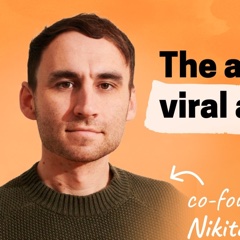
Nikita Bier
Consumer app founder and growth advisor; co-founder of TBH and Gas, former Facebook product manager
Where to hear and read about Nikita Bier1 episode or test

Nikita Bier is a consumer app founder and growth advisor who co-founded TBH and Gas, and sold TBH to Facebook for over $30 million and Gas to Discord. The thing most worth learning from him is that viral apps can be pursued on purpose: find latent demand among teens, run a repeatable test process, and take many well-run shots.
If you actually focus more on your process for taking many shots at bat, that's what actually reduces the risk more than anything.
How to consistently go viral: Nikita Bier’s playbook for winning at consumer apps
Nikita Bier: the story and the lessons
1Nikita Bier's path from Politify to consumer apps
Bier's first hit was a policy calculator built in college. Politify showed voters in dollars how a candidate's policies would hit them, and reached 4 million users in one election season.
He built it in his last year of college after noticing that voters often back policies against their own finances. It also ran policies against the tax returns of every zip code.
A canceled government contract showed him his real skill was virality. Politify became a company called Outline, with the Massachusetts governor set to be the first customer and an Obama administration contract in the pipeline. A government shutdown canceled one contract and he quit selling to governments.
He offered to return the investors' money and none of them took it.
Five Labs proved he could make products spread. The app read your Facebook posts and inferred your personality from your language, reaching tens of millions of profiles in about three days.
The next four or five years went into maps, chat and event apps, which built a muscle for judging demand and testing growth.
Bier had to retrain his web instincts for mobile. He had grown web businesses since age 12, including a store selling pirated games, but on mobile users leave at the first friction.
He calls every tap a miracle for the product developer. Fourteen launched apps were duds before TBH, and the failures pushed the team to focus on teens.
2How Bier built TBH and sold it to Facebook
TBH launched the day before Bier planned to dissolve the company. A key teammate had given notice and Bier had asked a lawyer how to dissolve the company. TBH was app number 15, launched in a Georgia school picked for the earliest start date in the country.
The departing teammate said the chances of it charting were nil. 40% of the school downloaded it in 24 hours and it spread to neighboring schools.
He built TBH from latent demand he saw in teen behavior. Sarahah, an anonymous app entirely in Arabic, was the number one US app, which showed demand for anonymous feedback. Bier answered it with positive-only polls.
One school sent 450,000 messages in seven days, and users sent 60 messages on day one against the usual three or four. A high school senior had described a Snapchat trend also called TBH, which he read as teens wanting a vehicle for disclosure.
Growth forced a sale before the money ran out. He projected the number one US spot within six days, while the Amazon bill hit about $120,000 against $150,000 in the bank. He asked the team to pause for two months, raised a round and ran a competitive bidding process.
He won over an LA founder by showing a live install map, where his block lit up as school let out. TBH peaked at 360,000 installs per day and sold to Facebook for over $30 million nine weeks after launch.
Facebook sent 80 people to buy a team of four. Bier was the only person on his side. They met in an Oakland office that rented for $1,800 a month and asked if this was really the number one app in the US.
He later built about eight standalone apps in Facebook's new product experimentation group, and felt his design skills atrophy over four years.
Breakout growth made every system break within days. The first customer support system broke after three days and its replacement broke seven days later. Geofencing TBH school by school gave the team slack to keep servers online.
The geofence was a controversial call internally. He says first-time founders underestimate how draining and spread thin this makes you.
3Rebuilding as Gas, surviving a hoax and selling to Discord
A market crash and one support message sent Bier back to TBH. The market crashed, rates rose and his portfolio was down about 30%. The top TBH support message was whether users could pay to see who sent them polls.
Zay Turner, an engineer from Paparazzi, began the rebuild at Bier's house. The test was whether an anonymous polling app still mattered to kids five years later.
Gas had to reinvent its growth system from scratch. Texts can no longer be sent from a server, so invites had to go from the user's own device. Users sent fewer invites, and it took about nine launches, including a rename, to make it grow again.
Each hurdle was solved separately: many messages first, then spread within a school, then hopping between schools.
Renaming Crush to Gas lifted invites. Boys invite boys and girls invite girls, and the app skewed 60 to 65% women. Under the name Crush with a pink icon, boys would not send invites, so the team moved to a black flame icon and the name Gas.
Earlier names included Crush and Melt. Crush had a great domain, but invitations dropped under it.
Bier fought a human trafficking hoax on every front. A made-up rumor nearly killed Gas. He got the Washington Post headline to say the app is not for trafficking, had schools and a police chief retract posts, and showed a debunking video to users who deleted. Daily deletions fell from 3% to 0.1%.
He slept three hours a day for three months while the team worked 9 a.m. to midnight, seven days a week. He reached the TikTok CEO to remove hoax videos.
Gas ran on vendor credits and sold to Discord. Gas grew bigger than TBH with no investors, running almost entirely on credits from AWS and Mixpanel after Bier negotiated every vendor bill down. It sold after about 10 million downloads and $11 million in sales.
Three companies wanted to buy it, though the team had not planned to sell.
Bier built Gas so teens would feel better. Names appeared in polls more often if they had not been voted on recently, so everyone got a vote.
A user wrote in every day to say the app made them reconsider suicide or self-harm, and watching it lift 10 million kids motivated him to keep growing it.
4Bier's rules for testing consumer apps
Bier builds a repeatable process so he can take many shots. His first mobile app took about a year and the last took about two weeks. The team learned to seed apps into schools and hobby groups.
He says many founders build on theories with no empirical evidence, so he sat and watched teens use the apps.
He seeds a whole school at once to get a clean signal. People need to see a marketing message about three times, so the team ran ads aimed at one school and followed students from a dedicated Instagram account.
This reached only the first 100 users, and the app was meant to grow on its own after that. Founders who copied it at 15 schools and failed missed the point.
He validates one stage at a time at full effort. With Gas, polling and notifications were perfected first, then sharing and virality. He asks what must be true next and keeps it to about four conditions.
Everything else can be half-done. Solving everything at once causes scope creep and muddy signal.
He searches for latent demand where people work hard for value. The way he looks for product ideas is to find things people already struggle to get, like anonymous feedback in Sarahah.
He had long avoided anonymous apps because of the harm they cause, until polls let him keep the format with only positive content.
He puts round-the-clock live chat inside the app. It gives users a white glove experience, so a bad reaction can't be blamed on poor treatment, and it is the best user research.
Michael Gutierrez has run community and support at all of Bier's companies and pasted interesting feedback into Slack, some of which became features.
Bier treats product-market fit as binary. Founder Roger Dickey told him that if your product's working you'll know, and if there's any uncertainty it's not working. TBH tracked hourly actives per day instead of daily actives.
Having to geofence the app to keep it from crashing was a sign of fit.
5What Bier knows about virality and activation
Bier builds for teens because they invite and see each other daily. In his apps, invites per user drop about 20% for each year of age from 13 to 18. His teams found that after about 22, people stop adopting new products.
A Spanish study found the number of people you text climbs from 14 and peaks around 21. An adult app has to buy users with ads, which takes heavy venture money.
He gets users to the aha moment within about three seconds. Dupe won because typing dupe.com before any product URL found the cheapest version of the product. It reached millions in ARR in under 60 days.
The founder bought Dupe.com and a couple of videos went viral. Bier says cutting features you think people need takes ruthlessness.
He favors contact sync because one tap beats typing usernames. Building a 50-person friend list by usernames takes about 10,000 taps versus one. Contact sync also ranks people not yet on the app who have many friends there.
He calls the username-exchange idea the most unrealistic thing founders suggest.
He treats ads, onboarding and invites as one system. If you target a community, the ads should show it, the app should let people join it, and invites should mention it.
Bier says many founders split top-of-funnel marketing from product growth, and that this is a mistake.
Bier refuses hidden growth tactics that wrong users. Gas made clear how invites worked. He tells founders that using contact data quietly or inviting people on a user's behalf burns users and brings trouble later.
Clones wrongly assumed TBH texted people when they were voted on, which it never did. His warning: "the internet will come back and get even and defend itself."
He argues PMs on consumer apps should design the product. On a standalone app the PM should design the hierarchy, pixels and flows, because products live and die in the pixels.
He sees himself as a designer who is good at growth. He says big-tech PMs mostly write documents and collect approvals, though Lenny noted this is an extreme version and Bier agreed it is exaggerated.
6Bier on big tech, venture money and lasting products
Bier explains why incumbents take 12 to 24 months to respond. A chart-topping app triggers a PM post, a market study, a framing deck and VP reviews, then six to 12 months of development.
Bonuses and reviews reward defensible bets, so the safe pitch is the number one app in the United States that we don't own. New concepts are hard to rally an organization around.
He prefers lean teams over the venture path. After seven rounds of dilution, founders' IPO proceeds can match what his apps earn in 90 days. A venture path means signing up for about 10 years.
He would only do it with strict operating principles like Elon Musk's thin teams. Facebook VPs envied his quality of life.
He thinks growth is a science but durability is a black swan. Bier sees one lasting social product per decade. Messaging and stories are locked up by large moats, and beating them by ten times is non-trivial.
Scott Belsky asked why quick-sensation apps are more like summer songs than enduring businesses. Bier is driven by building fast with a tiny team.
Bier expects iOS 18 contact permissions to favor incumbents. Apps average about 65% approval on the contacts screen, and the new flow adds a second step where users pick contacts from an alphabetical list that most will not finish.
He tweeted that it was game over, and is working with companies on replacements, though the leads are not yet promising. Whoever cracks one gets a huge advantage.
7How Bier advises founders
He starts every engagement with analytics and the activation milestone. He advises about 35 or 36 companies, from concept stage to billion-dollar ventures, including Flo, Citizen, BeReal, Locket and Wealthsimple.
He checks how the app is distributed, what milestone activates a user, what blocks it, and every funnel users come through.
Bier clears table stakes, then finds two or three big product changes. He works in Figma in live sessions and estimates conversion for each change. Clients are mostly post-series A, with some seed-stage companies.
His advising aims to return ten times the fee within 30 days, and he says everyone who has met him has made back ten times.
He says about half the companies he advises fail outright. Roughly half hit big success, which fits his view that lasting retention is mostly randomness and the edge is taking many well-run shots.
He has invested in about 10% of the companies that seek his advice, and Dupe was one of his clients.

How to consistently go viral: Nikita Bier’s playbook for winning at consumer apps
Nikita Bier explains how he found, tested and grew teen social apps TBH and Gas to number one in the App Store, and what he tells founders about virality, activation and testing. He sold TBH to Facebook for over $30 million nine weeks after launch, and Gas to Discord after about 10 million downloads and $11 million in sales.
Bier's first hit was a policy calculator built in college. Politify showed voters in dollars how a candidate's policies would hit them, and reached 4 million users in one election season.
He built it in his last year of college after noticing that voters often back policies against their own finances. It also ran policies against the tax returns of every zip code.
A canceled government contract showed him his real skill was virality. Politify became a company called Outline, with the Massachusetts governor set to be the first customer and an Obama administration contract in the pipeline. A government shutdown canceled one contract and he quit selling to governments.
He offered to return the investors' money and none of them took it.
Five Labs proved he could make products spread. The app read your Facebook posts and inferred your personality from your language, reaching tens of millions of profiles in about three days.
The next four or five years went into maps, chat and event apps, which built a muscle for judging demand and testing growth.
Bier had to retrain his web instincts for mobile. He had grown web businesses since age 12, including a store selling pirated games, but on mobile users leave at the first friction.
He calls every tap a miracle for the product developer. Fourteen launched apps were duds before TBH, and the failures pushed the team to focus on teens.
TBH launched the day before Bier planned to dissolve the company. A key teammate had given notice and Bier had asked a lawyer how to dissolve the company. TBH was app number 15, launched in a Georgia school picked for the earliest start date in the country.
The departing teammate said the chances of it charting were nil. 40% of the school downloaded it in 24 hours and it spread to neighboring schools.
He built TBH from latent demand he saw in teen behavior. Sarahah, an anonymous app entirely in Arabic, was the number one US app, which showed demand for anonymous feedback. Bier answered it with positive-only polls.
One school sent 450,000 messages in seven days, and users sent 60 messages on day one against the usual three or four. A high school senior had described a Snapchat trend also called TBH, which he read as teens wanting a vehicle for disclosure.
Growth forced a sale before the money ran out. He projected the number one US spot within six days, while the Amazon bill hit about $120,000 against $150,000 in the bank. He asked the team to pause for two months, raised a round and ran a competitive bidding process.
He won over an LA founder by showing a live install map, where his block lit up as school let out. TBH peaked at 360,000 installs per day and sold to Facebook for over $30 million nine weeks after launch.
Facebook sent 80 people to buy a team of four. Bier was the only person on his side. They met in an Oakland office that rented for $1,800 a month and asked if this was really the number one app in the US.
He later built about eight standalone apps in Facebook's new product experimentation group, and felt his design skills atrophy over four years.
Breakout growth made every system break within days. The first customer support system broke after three days and its replacement broke seven days later. Geofencing TBH school by school gave the team slack to keep servers online.
The geofence was a controversial call internally. He says first-time founders underestimate how draining and spread thin this makes you.
A market crash and one support message sent Bier back to TBH. The market crashed, rates rose and his portfolio was down about 30%. The top TBH support message was whether users could pay to see who sent them polls.
Zay Turner, an engineer from Paparazzi, began the rebuild at Bier's house. The test was whether an anonymous polling app still mattered to kids five years later.
Gas had to reinvent its growth system from scratch. Texts can no longer be sent from a server, so invites had to go from the user's own device. Users sent fewer invites, and it took about nine launches, including a rename, to make it grow again.
Each hurdle was solved separately: many messages first, then spread within a school, then hopping between schools.
Renaming Crush to Gas lifted invites. Boys invite boys and girls invite girls, and the app skewed 60 to 65% women. Under the name Crush with a pink icon, boys would not send invites, so the team moved to a black flame icon and the name Gas.
Earlier names included Crush and Melt. Crush had a great domain, but invitations dropped under it.
Bier fought a human trafficking hoax on every front. A made-up rumor nearly killed Gas. He got the Washington Post headline to say the app is not for trafficking, had schools and a police chief retract posts, and showed a debunking video to users who deleted. Daily deletions fell from 3% to 0.1%.
He slept three hours a day for three months while the team worked 9 a.m. to midnight, seven days a week. He reached the TikTok CEO to remove hoax videos.
Gas ran on vendor credits and sold to Discord. Gas grew bigger than TBH with no investors, running almost entirely on credits from AWS and Mixpanel after Bier negotiated every vendor bill down. It sold after about 10 million downloads and $11 million in sales.
Three companies wanted to buy it, though the team had not planned to sell.
Bier built Gas so teens would feel better. Names appeared in polls more often if they had not been voted on recently, so everyone got a vote.
A user wrote in every day to say the app made them reconsider suicide or self-harm, and watching it lift 10 million kids motivated him to keep growing it.
Bier builds a repeatable process so he can take many shots. His first mobile app took about a year and the last took about two weeks. The team learned to seed apps into schools and hobby groups.
He says many founders build on theories with no empirical evidence, so he sat and watched teens use the apps.
He seeds a whole school at once to get a clean signal. People need to see a marketing message about three times, so the team ran ads aimed at one school and followed students from a dedicated Instagram account.
This reached only the first 100 users, and the app was meant to grow on its own after that. Founders who copied it at 15 schools and failed missed the point.
He validates one stage at a time at full effort. With Gas, polling and notifications were perfected first, then sharing and virality. He asks what must be true next and keeps it to about four conditions.
Everything else can be half-done. Solving everything at once causes scope creep and muddy signal.
He searches for latent demand where people work hard for value. The way he looks for product ideas is to find things people already struggle to get, like anonymous feedback in Sarahah.
He had long avoided anonymous apps because of the harm they cause, until polls let him keep the format with only positive content.
He puts round-the-clock live chat inside the app. It gives users a white glove experience, so a bad reaction can't be blamed on poor treatment, and it is the best user research.
Michael Gutierrez has run community and support at all of Bier's companies and pasted interesting feedback into Slack, some of which became features.
Bier treats product-market fit as binary. Founder Roger Dickey told him that if your product's working you'll know, and if there's any uncertainty it's not working. TBH tracked hourly actives per day instead of daily actives.
Having to geofence the app to keep it from crashing was a sign of fit.
Bier builds for teens because they invite and see each other daily. In his apps, invites per user drop about 20% for each year of age from 13 to 18. His teams found that after about 22, people stop adopting new products.
A Spanish study found the number of people you text climbs from 14 and peaks around 21. An adult app has to buy users with ads, which takes heavy venture money.
He gets users to the aha moment within about three seconds. Dupe won because typing dupe.com before any product URL found the cheapest version of the product. It reached millions in ARR in under 60 days.
The founder bought Dupe.com and a couple of videos went viral. Bier says cutting features you think people need takes ruthlessness.
He favors contact sync because one tap beats typing usernames. Building a 50-person friend list by usernames takes about 10,000 taps versus one. Contact sync also ranks people not yet on the app who have many friends there.
He calls the username-exchange idea the most unrealistic thing founders suggest.
He treats ads, onboarding and invites as one system. If you target a community, the ads should show it, the app should let people join it, and invites should mention it.
Bier says many founders split top-of-funnel marketing from product growth, and that this is a mistake.
Bier refuses hidden growth tactics that wrong users. Gas made clear how invites worked. He tells founders that using contact data quietly or inviting people on a user's behalf burns users and brings trouble later.
Clones wrongly assumed TBH texted people when they were voted on, which it never did. His warning: "the internet will come back and get even and defend itself."
He argues PMs on consumer apps should design the product. On a standalone app the PM should design the hierarchy, pixels and flows, because products live and die in the pixels.
He sees himself as a designer who is good at growth. He says big-tech PMs mostly write documents and collect approvals, though Lenny noted this is an extreme version and Bier agreed it is exaggerated.
Bier explains why incumbents take 12 to 24 months to respond. A chart-topping app triggers a PM post, a market study, a framing deck and VP reviews, then six to 12 months of development.
Bonuses and reviews reward defensible bets, so the safe pitch is the number one app in the United States that we don't own. New concepts are hard to rally an organization around.
He prefers lean teams over the venture path. After seven rounds of dilution, founders' IPO proceeds can match what his apps earn in 90 days. A venture path means signing up for about 10 years.
He would only do it with strict operating principles like Elon Musk's thin teams. Facebook VPs envied his quality of life.
He thinks growth is a science but durability is a black swan. Bier sees one lasting social product per decade. Messaging and stories are locked up by large moats, and beating them by ten times is non-trivial.
Scott Belsky asked why quick-sensation apps are more like summer songs than enduring businesses. Bier is driven by building fast with a tiny team.
Bier expects iOS 18 contact permissions to favor incumbents. Apps average about 65% approval on the contacts screen, and the new flow adds a second step where users pick contacts from an alphabetical list that most will not finish.
He tweeted that it was game over, and is working with companies on replacements, though the leads are not yet promising. Whoever cracks one gets a huge advantage.
He starts every engagement with analytics and the activation milestone. He advises about 35 or 36 companies, from concept stage to billion-dollar ventures, including Flo, Citizen, BeReal, Locket and Wealthsimple.
He checks how the app is distributed, what milestone activates a user, what blocks it, and every funnel users come through.
Bier clears table stakes, then finds two or three big product changes. He works in Figma in live sessions and estimates conversion for each change. Clients are mostly post-series A, with some seed-stage companies.
His advising aims to return ten times the fee within 30 days, and he says everyone who has met him has made back ten times.
He says about half the companies he advises fail outright. Roughly half hit big success, which fits his view that lasting retention is mostly randomness and the edge is taking many well-run shots.
He has invested in about 10% of the companies that seek his advice, and Dupe was one of his clients.