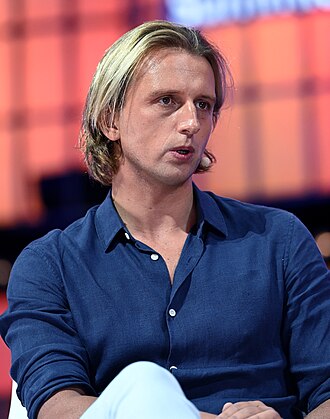
Nik Storonsky
Co-founder and CEO of Revolut
Where to hear and read about Nik Storonsky1 episode or test

Nik Storonsky is the co-founder and CEO of Revolut, which grew from a no-fee travel card into a digital bank live in 38 countries with a goal of being number one in at least 100. The most useful thing to learn from him is how to run a company as a measured machine: fix one bottleneck at a time, fund bets by the numbers rather than intuition, and hire people who need almost no managing.
Every day you need to be like almost 100% every day.
Competition, Intensity & Building a $115 Billion Global Bank | Nik Storonsky, Revolut
Nik Storonsky: the story and the lessons
1Nik Storonsky's path from competitive kid to Revolut
Storonsky has needed to win since childhood. He swam, boxed and entered olympiads from age 6, and says he is extremely pissed off when he finishes second.
He puts it down to character and genes rather than sport alone, saying some people are extremely competitive and some not at all.
Trading taught him to quantify everything. His trading background gave him risk management and a habit of measuring every decision.
The bank he worked at had a professional CEO, no real metrics and a lot of politics, which he later designed Revolut to avoid.
Revolut started as a card for spending abroad without bank fees. It offered interbank rates abroad, then added credit, wealth, trading, crypto, business accounts, stays and e-sims.
Because every country has 10 to 50 fragmented banks, he believes one global bank can win on price and service.
COVID nearly broke the travel-card business. Revenues fell about 70% in 2021 because Revolut was still mainly a travel card, and the company optimized heavily to survive.
He now aims at Jamie Dimon's whole bank. Beyond retail, he is targeting enterprise banking and thinks manual, expensive investment banking can be made much cheaper.
Asked about investment banks, his answer was "Why not?"
2Revolut's biggest mistake: the late banking license
Storonsky chose a fast e-money license over a full bank license. The e-money license took about 1 year against 3 to 4 years for a bank license, so he picked speed.
Applying with 7 million customers made approval far harder. The UK banking license took almost 5 years, and no company with 7 or 8 million UK customers had applied before.
A regulator sees more risk in an applicant with millions of customers, since blame lands on them if it goes wrong. "The entity with a zero customers is less riskier compared to an entity with a millions of customers."
He believes fintechs without a license stay niche. He calls Chime and Cash App skipping the license a big mistake: they reach early adopters but can never become a prime bank account for 40 to 70% of people.
Customers must trust a bank with salaries, savings and trades. Revolut reaches about 80% of adults in Ireland, near 20% in the UK and France, and 30 to 40% in Spain and others.
3How Storonsky runs Revolut as a machine
He fixes the company one bottleneck at a time. When growth past 10 to 30 people slowed the team, he split work into small independent teams, then built regulatory affairs, then a hiring process.
"You build something, then you hit a bottleneck, right? You identify the problem, you solve the problem, you go again."
Metrics and KPIs replace opinions and politics. Every contributor and manager is judged on whether they hit their goal and, if not, why not.
He says intuition is often simply wrong, so correct evaluation needs numbers. "Metrics and KPIs that actually kills politics within an organization."
Product bets are funded like a trading book. A committee approves a bet, a team of up to 10 builds it in 9 to 18 months, and gross profit decides its fate; the bottom 25% are cut.
Of about 50 bets in 10 years, the top 10 grow 10 to 20% a month and earn 1 to 3 million in gross profit monthly each, growing into departments and P&L lines. He says he does not trust his own intuition on products because he has often been wrong.
Good ideas in one team get standardized everywhere. One team prompted an LLM with the design system at code level to produce clickable interfaces, three to four times faster than Figma, and he is pushing it to all designers.
Everyone uses the same toolset so teams do not reinvent their own tools. "If you spot innovation in certain part of the machine, you need to spread it as fast as possible."
He competes against himself, not rivals. He says he does not really watch competitors and instead asks what would beat Revolut.
Giving almost 100% every day means that even if he loses, he cannot blame himself.
4Nik Storonsky on hiring and leading
He hires self-guided people so he can have about 50 direct reports. Excellent people set and reach their own goals; good ones need a goal; average ones need weekly iteration; below average ones miss anyway.
Average people are let go too because they cost management time. "Self-guided people are like self-guided missiles, right?"
Managers who only relay numbers were removed. Passing data between contributors and stakeholders changes no direction, so those roles were eliminated, and he talks directly to designers and developers below his reports.
He kept only 2 of about 50 experienced executives. Following VC advice, he hired roughly 50 senior executives in the first five years and kept two within a year.
Past success may not carry over, and the truly excellent already run their own business or retired. "There is a negative selection bias, because people who extremely good already made it." He now hires the top 1% of career progression at 25 to 30 and grows with them.
Executives are judged on winning, not likability. The goal is to win with the fewest resources; many good executives struggle because they care more about empathy than winning.
He agrees with Musk that engineers who like their manager can signal a manager doing the wrong job. Most of his direct reports work very long hours, and he calls Revolut one of the hardest-working companies in Europe.
5Why Storonsky thinks founders and constraints win
Professional bank CEOs play defense and leave the market open. He argues they stay 3 to 4 years, collect bonuses and protect their jobs, while a founder treats self and company as one entity.
Incumbents avoid migrating legacy core systems because it adds risk. When regulators call him a risk taker, he answers that as the one person who most wants Revolut to survive, he will not take stupid risks.
A winning bank leader must be both tough manager and product person. He says banking is building tech as much as regulation, and non-technical executives who do not use products default to doing nothing.
Easy money makes founders weaker. He criticizes founders who, at 1 million ARR, hire an expensive VP of sales to hire 50 reps instead of first building a cheap, repeatable sales system.
Money-first founders skip the resourcefulness scarcity forces and are unprepared when money disappears.
Europe's limits trained Revolut to win on every detail. Gross margin was negative for three to five years before reaching 80%, under EU interchange caps of 20 basis points against about 100 in the US.
Capped credit, local branches per country and strict employment laws forced the company to optimize every problem, skills rivals in easier markets never built. Of 140 companies in his first co-working space, three survived five years and two survived ten; the survivors worked weekends.
6Storonsky on investors and his Quantum Light fund
He removed every VC from Revolut's board. Early UK investors demanded liquidation preferences, board seats and reduced founder voting rights; he cut VC seats in every round and wants operators instead.
One investor pushed him to fire his best person for being too hardcore; he refused. "You effectively have cheerleaders who look at the match instead of professional players."
Founders should keep investors purely financial. He advises scrutinizing the shareholder agreement so investors get no voting rights or decision-making seat.
A fight with a big investor led him to start a rival fund. An investor who came in at a $33 billion valuation used legal rights to block shareholder agreement changes, so he started Quantum Light around 2022 or 2023.
"Out of my frustration I started the fund as well." It is a separate company run by someone else.
Quantum Light picks startups with models, not judgment. Machine learning picks 30 to 40 companies over two to three years with equal checks, and founders get operating playbooks plus Revolut as a client.
The $250 million first fund is fully invested at a 56% IRR, and a $500 million second fund targets series C. One model signal is partner age, favoring partners aged 30 to 40.
7How Revolut scales: marketing, one ledger and AI
Revolut ran seven years before doing any marketing. After COVID he built a scientific marketing machine hired from gaming, where budgets exceed $1 billion and margins for error are smallest.
The first gaming hire was fired; the second worked. The focus became performance marketing, lifetime value and payback.
He bought cheap physical impressions to build trust. Revolut ads now appear in almost 50% of European airports, and a Barcelona Rev experience shop works like an Apple store.
A branchless bank is trusted less than HSBC or JP Morgan, and physical space was cheaper per impression than digital. "There is arbitrage to performance marketing."
One ledger makes each new country mostly configuration. Revolut is live in 38 countries and adds 10 to 15 markets every one to two years by swapping config such as onboarding rules.
Banks grown by acquisition run many systems and take months to pull one report. One system needs far fewer people, allowing lower prices and reuse of product and marketing knowledge.
AI is shrinking teams from ten people to two or three. About 90% of customer support is automated, down from over 5,000 people, and engineers are 30% faster.
The goal is a full-stack AI employee with email, Slack and back-office access that joins calls and does real work.
Banking cash flow is meant to fund moonshots. He wants to fund deep tech bets, possibly data centers, that may not show profit for two to five years.
The first step is Pragma, a transformer trained on Revolut's 30 million daily transactions, aimed at fraud, credit scoring and possibly investing.

Competition, Intensity & Building a $115 Billion Global Bank | Nik Storonsky, Revolut
Storonsky built Revolut from a no-fee travel card into a digital bank in 38 countries by running the company as a machine: metrics over politics, algorithmic funding of bets, self-guided hires and no VC power. His story is worth hearing for what he learned from a 5-year UK banking license wait, a negative gross margin that grew to 80%, and the discipline of fixing one bottleneck at a time.
Storonsky has needed to win since childhood. He swam, boxed and entered olympiads from age 6, and says he is extremely pissed off when he finishes second.
He puts it down to character and genes rather than sport alone, saying some people are extremely competitive and some not at all.
Trading taught him to quantify everything. His trading background gave him risk management and a habit of measuring every decision.
The bank he worked at had a professional CEO, no real metrics and a lot of politics, which he later designed Revolut to avoid.
Revolut started as a card for spending abroad without bank fees. It offered interbank rates abroad, then added credit, wealth, trading, crypto, business accounts, stays and e-sims.
Because every country has 10 to 50 fragmented banks, he believes one global bank can win on price and service.
COVID nearly broke the travel-card business. Revenues fell about 70% in 2021 because Revolut was still mainly a travel card, and the company optimized heavily to survive.
He now aims at Jamie Dimon's whole bank. Beyond retail, he is targeting enterprise banking and thinks manual, expensive investment banking can be made much cheaper.
Asked about investment banks, his answer was "Why not?"
Storonsky chose a fast e-money license over a full bank license. The e-money license took about 1 year against 3 to 4 years for a bank license, so he picked speed.
Applying with 7 million customers made approval far harder. The UK banking license took almost 5 years, and no company with 7 or 8 million UK customers had applied before.
A regulator sees more risk in an applicant with millions of customers, since blame lands on them if it goes wrong. "The entity with a zero customers is less riskier compared to an entity with a millions of customers."
He believes fintechs without a license stay niche. He calls Chime and Cash App skipping the license a big mistake: they reach early adopters but can never become a prime bank account for 40 to 70% of people.
Customers must trust a bank with salaries, savings and trades. Revolut reaches about 80% of adults in Ireland, near 20% in the UK and France, and 30 to 40% in Spain and others.
He fixes the company one bottleneck at a time. When growth past 10 to 30 people slowed the team, he split work into small independent teams, then built regulatory affairs, then a hiring process.
"You build something, then you hit a bottleneck, right? You identify the problem, you solve the problem, you go again."
Metrics and KPIs replace opinions and politics. Every contributor and manager is judged on whether they hit their goal and, if not, why not.
He says intuition is often simply wrong, so correct evaluation needs numbers. "Metrics and KPIs that actually kills politics within an organization."
Product bets are funded like a trading book. A committee approves a bet, a team of up to 10 builds it in 9 to 18 months, and gross profit decides its fate; the bottom 25% are cut.
Of about 50 bets in 10 years, the top 10 grow 10 to 20% a month and earn 1 to 3 million in gross profit monthly each, growing into departments and P&L lines. He says he does not trust his own intuition on products because he has often been wrong.
Good ideas in one team get standardized everywhere. One team prompted an LLM with the design system at code level to produce clickable interfaces, three to four times faster than Figma, and he is pushing it to all designers.
Everyone uses the same toolset so teams do not reinvent their own tools. "If you spot innovation in certain part of the machine, you need to spread it as fast as possible."
He competes against himself, not rivals. He says he does not really watch competitors and instead asks what would beat Revolut.
Giving almost 100% every day means that even if he loses, he cannot blame himself.
He hires self-guided people so he can have about 50 direct reports. Excellent people set and reach their own goals; good ones need a goal; average ones need weekly iteration; below average ones miss anyway.
Average people are let go too because they cost management time. "Self-guided people are like self-guided missiles, right?"
Managers who only relay numbers were removed. Passing data between contributors and stakeholders changes no direction, so those roles were eliminated, and he talks directly to designers and developers below his reports.
He kept only 2 of about 50 experienced executives. Following VC advice, he hired roughly 50 senior executives in the first five years and kept two within a year.
Past success may not carry over, and the truly excellent already run their own business or retired. "There is a negative selection bias, because people who extremely good already made it." He now hires the top 1% of career progression at 25 to 30 and grows with them.
Executives are judged on winning, not likability. The goal is to win with the fewest resources; many good executives struggle because they care more about empathy than winning.
He agrees with Musk that engineers who like their manager can signal a manager doing the wrong job. Most of his direct reports work very long hours, and he calls Revolut one of the hardest-working companies in Europe.
Professional bank CEOs play defense and leave the market open. He argues they stay 3 to 4 years, collect bonuses and protect their jobs, while a founder treats self and company as one entity.
Incumbents avoid migrating legacy core systems because it adds risk. When regulators call him a risk taker, he answers that as the one person who most wants Revolut to survive, he will not take stupid risks.
A winning bank leader must be both tough manager and product person. He says banking is building tech as much as regulation, and non-technical executives who do not use products default to doing nothing.
Easy money makes founders weaker. He criticizes founders who, at 1 million ARR, hire an expensive VP of sales to hire 50 reps instead of first building a cheap, repeatable sales system.
Money-first founders skip the resourcefulness scarcity forces and are unprepared when money disappears.
Europe's limits trained Revolut to win on every detail. Gross margin was negative for three to five years before reaching 80%, under EU interchange caps of 20 basis points against about 100 in the US.
Capped credit, local branches per country and strict employment laws forced the company to optimize every problem, skills rivals in easier markets never built. Of 140 companies in his first co-working space, three survived five years and two survived ten; the survivors worked weekends.
He removed every VC from Revolut's board. Early UK investors demanded liquidation preferences, board seats and reduced founder voting rights; he cut VC seats in every round and wants operators instead.
One investor pushed him to fire his best person for being too hardcore; he refused. "You effectively have cheerleaders who look at the match instead of professional players."
Founders should keep investors purely financial. He advises scrutinizing the shareholder agreement so investors get no voting rights or decision-making seat.
A fight with a big investor led him to start a rival fund. An investor who came in at a $33 billion valuation used legal rights to block shareholder agreement changes, so he started Quantum Light around 2022 or 2023.
"Out of my frustration I started the fund as well." It is a separate company run by someone else.
Quantum Light picks startups with models, not judgment. Machine learning picks 30 to 40 companies over two to three years with equal checks, and founders get operating playbooks plus Revolut as a client.
The $250 million first fund is fully invested at a 56% IRR, and a $500 million second fund targets series C. One model signal is partner age, favoring partners aged 30 to 40.
Revolut ran seven years before doing any marketing. After COVID he built a scientific marketing machine hired from gaming, where budgets exceed $1 billion and margins for error are smallest.
The first gaming hire was fired; the second worked. The focus became performance marketing, lifetime value and payback.
He bought cheap physical impressions to build trust. Revolut ads now appear in almost 50% of European airports, and a Barcelona Rev experience shop works like an Apple store.
A branchless bank is trusted less than HSBC or JP Morgan, and physical space was cheaper per impression than digital. "There is arbitrage to performance marketing."
One ledger makes each new country mostly configuration. Revolut is live in 38 countries and adds 10 to 15 markets every one to two years by swapping config such as onboarding rules.
Banks grown by acquisition run many systems and take months to pull one report. One system needs far fewer people, allowing lower prices and reuse of product and marketing knowledge.
AI is shrinking teams from ten people to two or three. About 90% of customer support is automated, down from over 5,000 people, and engineers are 30% faster.
The goal is a full-stack AI employee with email, Slack and back-office access that joins calls and does real work.
Banking cash flow is meant to fund moonshots. He wants to fund deep tech bets, possibly data centers, that may not show profit for two to five years.
The first step is Pragma, a transformer trained on Revolut's 30 million daily transactions, aimed at fraud, credit scoring and possibly investing.