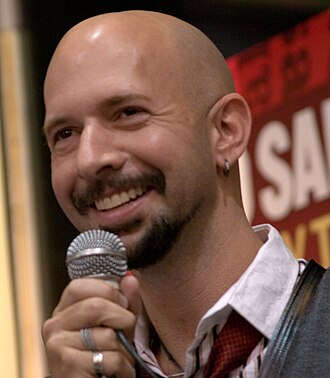
Neil Strauss
New York Times bestselling author, journalist and ghostwriter
Where to hear and read about Neil Strauss1 episode or test

Neil Strauss is a New York Times bestselling author, journalist and ghostwriter who wrote The Game, and he now makes a podcast, To Die For. The thing most worth learning from him is to write the honest draft for yourself first, then reshape it so a reader who starts out not caring wants to go on.
If you start from the premise that nobody cares, then your job as a writer is to think, how do I make them care?
The FBI Called This Writer About Seduction Training — Neil Strauss
Neil Strauss: the story and the lessons
1Neil Strauss and how he learned to write
Strauss learned to observe because he grew up without much of a voice. He was raised without much of a voice, so he spent his early years watching and noticing. He sums the craft up as observing and noticing, then sharing.
He thinks narcissists make poor writers because they don't observe or notice.
His first Village Voice editor told him to brush off the academic dust. His early writing still read like school essays, and that editor pushed him out of it.
He credits editors with something at stake, whose names ride on the piece, for making him better.
He has written for Rolling Stone, the New York Times and in books. He wrote Rolling Stone profiles of Howard Stern and Hugh Hefner, and a weekly New York Times column. His books include The Truth, and he is now making To Die For, a 12-episode documentary-style podcast.
The podcast's teaser starts from a real call: the FBI asked him to teach seduction.
2Strauss's three drafts: honest, reader, critic
Strauss writes a vomit draft that is only for himself. He names names and says what he would never say, because nobody will see it. The second draft is for the reader and the third for the critic.
Every book he has written, and every writer he knows, has had passages that felt vital to the writer but had to go in the reader draft. "The first draft is just for you."
He treats vulnerability as a craft, not a dump of raw thoughts. Step one is being vulnerable. Step two is being vulnerable in a way that interests others, by asking where a dark thought comes from and what it says about you.
Half-baked diary entries don't count. The material has to become an insight or a story with rhythm.
Telling secrets gives him relief, and the fear signals something worth saying. Once he shares a secret he feels seen and safe, though it can feel like losing a part of himself for a few days. He cites the AA line "You're as sick as your secrets."
Everyone he has made a book with was terrified before publication, and one co-author told the publisher he would kill himself if it came out. Strauss has never seen a worst case happen.
The reader draft cuts what only matters to Strauss. A 50-page chunk on communal living in The Truth shrank to a two-page illustration. A beautiful paragraph on healthy relationships fit nowhere and went too, though readers would have underlined it.
He says the book starts telling you what it wants to be, so you cut what doesn't serve it.
He saves the critic for last and answers attacks inside the book. Worries about what people will think, legal risk or whether the science holds wait until the book is as good as he can make it. Then he acknowledges likely objections in the text, such as a scientist who disagrees.
The order is fixed: honest draft, reader draft, critic draft, then the lawyer's read. He quotes Kevin Hart: "Take the bullets out of the gun." He goes super extreme on fact checking.
3How Neil Strauss builds an opening
Strauss assumes nobody cares and designs every opening to earn attention. A book or long essay asks a reader for anywhere from one to twenty hours. His test of an interesting passage is whether he wants to read it aloud to a friend.
Like a line he admires: "I start from the principle that nobody cares."
His first sentence raises a question the reader needs answered. He admires Orwell's clocks striking thirteen, Camus's mother who died today or maybe yesterday, and Hurston's ships carrying every man's wish. Each one gives something the reader hasn't thought before.
His own teaser opens with the FBI calling him, which makes a listener ask why, then adds the twist that the topic is seduction.
He opens with one crisp story and lets the idea arrive slowly. He calls cramming the whole idea into the opening one of the biggest mistakes. A single lunch in Knoxville, Tennessee can open a piece about the whole United States.
Once the reader is inside the house, they want to explore the rooms, so odd small details come later.
He plays the opening moment down instead of overselling it. New writers stack adjectives on a crisp, sharp morning and fill the moment with air. Strauss keeps it plain and saves fine details for later.
"Adding extra descriptions is not necessarily writing."
He polishes the first chapter before the rough draft. The first pages fix the tone, sentence length and what is possible. He treats the chapter as a container to hold the mess.
It usually ends up in the middle of the book, because only at the end do you know what the book is.
He asks how to express an idea clearly, not how to write. Thinking about being a writer gets in the way. He also holds that pushing to be interesting puts you on the wrong path, so at the keyboard he explores and tries to entertain himself.
He compares showing off to someone who flaunts a Bugatti and loses the credibility the car would have given them.
4How Strauss built the To Die For trailer
He tested many openings and kept the one that excited him. Once the first 25-second piece worked, he built the rest after it. Layering the whole trailer took about 20 drafts.
In audio he controls pacing: pauses are placed with the producer after the voiceover is recorded, and background sentences have pauses removed so they go by fast.
The trailer runs as hook, twist, proof, bridge and payoff. The twist is that the FBI wanted seduction training. The FBI agent's voice proves the preposterous claim, and the payoff is one quote that shows who the spy is.
The payoff runs on three music cues.
Strauss added a bridge when the jump to the Russian spy felt jarring. Going straight from the FBI call to the Russian seduction spy felt too quick and made the first half pointless. He added a line where the agent says to wait and see what the Russians do.
"That's often the hardest part."
He manages energy like an accordion and edits the spaces. He listens to each part for energy and fixes any dip, even a small one. The composer changed the music at the Russian line because removing layered tracks felt like a dip.
He edits the best takes first, then the length of each pause. He kept a guest's hesitation, three dates and then minimum an hour, despite editors, because it rings true.
5How Strauss cuts and gets edited
He cuts far past comfortable, then puts back only what must stay. He borrows the method from Rick Rubin, who tells an artist with 20 recorded songs to cut to 10 for a 15-song album. One student's eight-paragraph ending became one paragraph and was much better.
"Just take everything out you can, then put back what only really, really needs to be there."
He keeps a cuts file so deleting never feels permanent. For a German edition he had to cut a third of a finished book because German words run longer, and he thought it came out better.
He says you usually get closer to your point by removing more. "I always have a cuts file."
He treats revising as where the real writing happens. His first drafts would be horrible and unpublishable. He often finishes a draft thinking it's great, then rereads it and finds it isn't.
He pictures editing as ironing a shirt, going back and forth over one stubborn wrinkle.
When an editor's fix feels wrong, he works on the problem it flags. He ignores the proposed solution and focuses on the problem it is meant to address, since something is not working even if the fix is wrong. He treats the editor as a teammate.
He has stopped reading friends' manuscripts because they defend every line instead of weighing the note.
He asks editors what recurs in his writing. One note, to drop the reason is because, changed his writing for good.
He prefers editors with something at stake, since their name rides on the piece. A hired editor just does the job.
He gives readers his draft with no instructions. He doesn't tell readers what to look for, because real readers get no guidance from his voice. He lets the work speak, then asks his questions.
"All your intention should be in the work, not in your explanation."
6Strauss on noticing, note-taking and profiles
Strauss writes a full brain dump within 24 hours of any experience. He says none of his books would exist without it. For the commune story in The Truth, his hands slid off the keyboard from tiredness and he wrote anyway.
He and his son's mother rereading the birth account found they had forgotten nine tenths of it, especially the emotion. He also keeps a nightly diary of his 8-year-old son's life.
He takes no notes during interviews and writes in layers. Note-taking makes people self-conscious, so he remembers everything and writes it down in the bathroom afterward. First come a few words, then a full write-up at night.
He sometimes uses the peg system, a mnemonic that lets him memorize 100 words and decode them later.
He notices a concrete detail, then connects it to his subject. On the last day of a trip in Oaxaca he wrote that the sidewalks were wide, then narrowed until you had to step into the street. That becomes a metaphor for a life that began with purpose and lost its way.
For a stuck intro on AI, he suggests walking outside and drawing three parallels between what you see and the topic.
He opens profiles with the moment that holds the person's essence. His Howard Stern opening has Stern asking a guest a crude question, then reveals the guest is Strauss himself. The Hugh Hefner opening lists his Viagra and three girlfriends and ends He is 72 years old.
He says sentences carry the DNA of the whole piece, so a striking opening with none of the subject's spirit fails.
He sees a profile as two jobs: build trust, then shape the material. An editor told him the job is to find out what makes someone tick. Part one is rapport and real curiosity, part two is what you do with what you got.
Observation matters more than volume. A writer can build a piece from what they notice even when a band like Mazzy Star says little.
7Strauss's rules for focus, deadlines and writer's block
Strauss uses systems because he thinks willpower fails. He deleted every messaging app except texts. An assistant sends a Notion digest every other day, and he answers it in 20 minutes.
He creates first and handles reactive messages at day's end. Batching means everyone gets an answer, and a better one. "Create systems to protect you from your lower self."
He stays inside a long project and captures ideas the moment they land. He says leaving a book too long, even two weeks, can lose the thread. A new idea has a creative life force right after inspiration that never fully returns, so he records it on his phone if he can't write.
His epiphanies usually solve problems inside a book rather than start a new one.
He calls writer's block performance pressure and puts the doubts into the draft. Titles, renaming a person, legal rules, qualifications and whether to write a proposal first are procrastination. He urges finishing the book first so you know what it is.
A writer who took that advice landed a six-figure deal, though he admits most agents disagree. "Put them in the work. Don't use them as excuses not to work."
He says great writers need deadlines as well as editors. During his weekly New York Times column, mornings with no idea pushed him to think outside the box. Those pieces were sometimes among his best.
He writes for readers who share his taste, not for everyone. He writes the book he wants to read, in the spirit of works like A Clockwork Orange and Ask the Dust. Work meant to be universal will likely be loved by nobody.
Bukowski found Fante's Ask the Dust in the New York Public Library and began writing in that style. Strauss quotes the idea that the personal is the universal.

The FBI Called This Writer About Seduction Training — Neil Strauss
Neil Strauss explains how to be honest on the page without being boring: write a private vomit draft, then a reader draft, then a critic draft, and open every piece with a hook that makes strangers care. He walks through a podcast teaser line by line and shares how he edits, takes notes and gets edited.
Strauss learned to observe because he grew up without much of a voice. He was raised without much of a voice, so he spent his early years watching and noticing. He sums the craft up as observing and noticing, then sharing.
He thinks narcissists make poor writers because they don't observe or notice.
His first Village Voice editor told him to brush off the academic dust. His early writing still read like school essays, and that editor pushed him out of it.
He credits editors with something at stake, whose names ride on the piece, for making him better.
He has written for Rolling Stone, the New York Times and in books. He wrote Rolling Stone profiles of Howard Stern and Hugh Hefner, and a weekly New York Times column. His books include The Truth, and he is now making To Die For, a 12-episode documentary-style podcast.
The podcast's teaser starts from a real call: the FBI asked him to teach seduction.
Strauss writes a vomit draft that is only for himself. He names names and says what he would never say, because nobody will see it. The second draft is for the reader and the third for the critic.
Every book he has written, and every writer he knows, has had passages that felt vital to the writer but had to go in the reader draft. "The first draft is just for you."
He treats vulnerability as a craft, not a dump of raw thoughts. Step one is being vulnerable. Step two is being vulnerable in a way that interests others, by asking where a dark thought comes from and what it says about you.
Half-baked diary entries don't count. The material has to become an insight or a story with rhythm.
Telling secrets gives him relief, and the fear signals something worth saying. Once he shares a secret he feels seen and safe, though it can feel like losing a part of himself for a few days. He cites the AA line "You're as sick as your secrets."
Everyone he has made a book with was terrified before publication, and one co-author told the publisher he would kill himself if it came out. Strauss has never seen a worst case happen.
The reader draft cuts what only matters to Strauss. A 50-page chunk on communal living in The Truth shrank to a two-page illustration. A beautiful paragraph on healthy relationships fit nowhere and went too, though readers would have underlined it.
He says the book starts telling you what it wants to be, so you cut what doesn't serve it.
He saves the critic for last and answers attacks inside the book. Worries about what people will think, legal risk or whether the science holds wait until the book is as good as he can make it. Then he acknowledges likely objections in the text, such as a scientist who disagrees.
The order is fixed: honest draft, reader draft, critic draft, then the lawyer's read. He quotes Kevin Hart: "Take the bullets out of the gun." He goes super extreme on fact checking.
Strauss assumes nobody cares and designs every opening to earn attention. A book or long essay asks a reader for anywhere from one to twenty hours. His test of an interesting passage is whether he wants to read it aloud to a friend.
Like a line he admires: "I start from the principle that nobody cares."
His first sentence raises a question the reader needs answered. He admires Orwell's clocks striking thirteen, Camus's mother who died today or maybe yesterday, and Hurston's ships carrying every man's wish. Each one gives something the reader hasn't thought before.
His own teaser opens with the FBI calling him, which makes a listener ask why, then adds the twist that the topic is seduction.
He opens with one crisp story and lets the idea arrive slowly. He calls cramming the whole idea into the opening one of the biggest mistakes. A single lunch in Knoxville, Tennessee can open a piece about the whole United States.
Once the reader is inside the house, they want to explore the rooms, so odd small details come later.
He plays the opening moment down instead of overselling it. New writers stack adjectives on a crisp, sharp morning and fill the moment with air. Strauss keeps it plain and saves fine details for later.
"Adding extra descriptions is not necessarily writing."
He polishes the first chapter before the rough draft. The first pages fix the tone, sentence length and what is possible. He treats the chapter as a container to hold the mess.
It usually ends up in the middle of the book, because only at the end do you know what the book is.
He asks how to express an idea clearly, not how to write. Thinking about being a writer gets in the way. He also holds that pushing to be interesting puts you on the wrong path, so at the keyboard he explores and tries to entertain himself.
He compares showing off to someone who flaunts a Bugatti and loses the credibility the car would have given them.
He tested many openings and kept the one that excited him. Once the first 25-second piece worked, he built the rest after it. Layering the whole trailer took about 20 drafts.
In audio he controls pacing: pauses are placed with the producer after the voiceover is recorded, and background sentences have pauses removed so they go by fast.
The trailer runs as hook, twist, proof, bridge and payoff. The twist is that the FBI wanted seduction training. The FBI agent's voice proves the preposterous claim, and the payoff is one quote that shows who the spy is.
The payoff runs on three music cues.
Strauss added a bridge when the jump to the Russian spy felt jarring. Going straight from the FBI call to the Russian seduction spy felt too quick and made the first half pointless. He added a line where the agent says to wait and see what the Russians do.
"That's often the hardest part."
He manages energy like an accordion and edits the spaces. He listens to each part for energy and fixes any dip, even a small one. The composer changed the music at the Russian line because removing layered tracks felt like a dip.
He edits the best takes first, then the length of each pause. He kept a guest's hesitation, three dates and then minimum an hour, despite editors, because it rings true.
He cuts far past comfortable, then puts back only what must stay. He borrows the method from Rick Rubin, who tells an artist with 20 recorded songs to cut to 10 for a 15-song album. One student's eight-paragraph ending became one paragraph and was much better.
"Just take everything out you can, then put back what only really, really needs to be there."
He keeps a cuts file so deleting never feels permanent. For a German edition he had to cut a third of a finished book because German words run longer, and he thought it came out better.
He says you usually get closer to your point by removing more. "I always have a cuts file."
He treats revising as where the real writing happens. His first drafts would be horrible and unpublishable. He often finishes a draft thinking it's great, then rereads it and finds it isn't.
He pictures editing as ironing a shirt, going back and forth over one stubborn wrinkle.
When an editor's fix feels wrong, he works on the problem it flags. He ignores the proposed solution and focuses on the problem it is meant to address, since something is not working even if the fix is wrong. He treats the editor as a teammate.
He has stopped reading friends' manuscripts because they defend every line instead of weighing the note.
He asks editors what recurs in his writing. One note, to drop the reason is because, changed his writing for good.
He prefers editors with something at stake, since their name rides on the piece. A hired editor just does the job.
He gives readers his draft with no instructions. He doesn't tell readers what to look for, because real readers get no guidance from his voice. He lets the work speak, then asks his questions.
"All your intention should be in the work, not in your explanation."
Strauss writes a full brain dump within 24 hours of any experience. He says none of his books would exist without it. For the commune story in The Truth, his hands slid off the keyboard from tiredness and he wrote anyway.
He and his son's mother rereading the birth account found they had forgotten nine tenths of it, especially the emotion. He also keeps a nightly diary of his 8-year-old son's life.
He takes no notes during interviews and writes in layers. Note-taking makes people self-conscious, so he remembers everything and writes it down in the bathroom afterward. First come a few words, then a full write-up at night.
He sometimes uses the peg system, a mnemonic that lets him memorize 100 words and decode them later.
He notices a concrete detail, then connects it to his subject. On the last day of a trip in Oaxaca he wrote that the sidewalks were wide, then narrowed until you had to step into the street. That becomes a metaphor for a life that began with purpose and lost its way.
For a stuck intro on AI, he suggests walking outside and drawing three parallels between what you see and the topic.
He opens profiles with the moment that holds the person's essence. His Howard Stern opening has Stern asking a guest a crude question, then reveals the guest is Strauss himself. The Hugh Hefner opening lists his Viagra and three girlfriends and ends He is 72 years old.
He says sentences carry the DNA of the whole piece, so a striking opening with none of the subject's spirit fails.
He sees a profile as two jobs: build trust, then shape the material. An editor told him the job is to find out what makes someone tick. Part one is rapport and real curiosity, part two is what you do with what you got.
Observation matters more than volume. A writer can build a piece from what they notice even when a band like Mazzy Star says little.
Strauss uses systems because he thinks willpower fails. He deleted every messaging app except texts. An assistant sends a Notion digest every other day, and he answers it in 20 minutes.
He creates first and handles reactive messages at day's end. Batching means everyone gets an answer, and a better one. "Create systems to protect you from your lower self."
He stays inside a long project and captures ideas the moment they land. He says leaving a book too long, even two weeks, can lose the thread. A new idea has a creative life force right after inspiration that never fully returns, so he records it on his phone if he can't write.
His epiphanies usually solve problems inside a book rather than start a new one.
He calls writer's block performance pressure and puts the doubts into the draft. Titles, renaming a person, legal rules, qualifications and whether to write a proposal first are procrastination. He urges finishing the book first so you know what it is.
A writer who took that advice landed a six-figure deal, though he admits most agents disagree. "Put them in the work. Don't use them as excuses not to work."
He says great writers need deadlines as well as editors. During his weekly New York Times column, mornings with no idea pushed him to think outside the box. Those pieces were sometimes among his best.
He writes for readers who share his taste, not for everyone. He writes the book he wants to read, in the spirit of works like A Clockwork Orange and Ask the Dust. Work meant to be universal will likely be loved by nobody.
Bukowski found Fante's Ask the Dust in the New York Public Library and began writing in that style. Strauss quotes the idea that the personal is the universal.