Nathan Hudson
Founder of Perceptycs, a mobile growth consultancy
Where to hear and read about Nathan Hudson1 episode or test
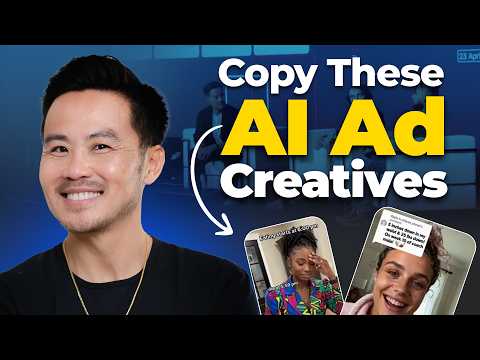
Nathan Hudson is the founder of Perceptycs, a mobile growth consultancy, and a heavy user of AI to build ad creatives. The most useful idea from him is to stop trying to predict which ads will win, and instead make creatives cheaply and in volume while spending his own time on strong concepts.
Anyone who claims that they can predict a winner is lying, because otherwise there should be someone out there with like a lifetime 80% plus win rate.
The AIGC Ad Creatives Crushing It vs. The Ones Flopping
Nathan Hudson: the story and the lessons
1How Nathan Hudson builds ad creatives with AI
Hudson made 20 ads in about 15 minutes. Most of that time was spent waiting for generation. A one-line prompt produced a usable runner-app ad with no editing.
He chose the one-shot runner ad for its wow factor. He thinks another ad was arguably better but needed tweaks, and he admits the script is not that strong.
Hudson generates many versions of each ad because models are inconsistent. Of 20 versions of one voice-over ad, 19 were bad, with odd clothing and a shoe landing on the actor's head. A more complex Zumba ad also had 19 of 20 versions fail.
His line: "the models are not consistent right yet". The fix is to generate many and pick the best.
Hudson rates Claude the most useful AI tool of the past year. He says growth teams can now launch onboarding and paywall experiments themselves, without waiting for developers.
Developers stay free to build core features. He rates it mainly from the development side and uses it for many jobs across the business.
Hudson adds a tool only if it solves a real workflow problem. He skips tools that merely repeat what he already has. His test is whether there is a need and whether it will genuinely improve the workflow.
He has learned that viral comment-bait posts promising a tool usually disappoint.
Hudson does not worry about rising model prices. He points to strong open-source models in coding and expects open-source image and video models to follow the same path.
He would rather wait longer for a good generation than worry about price.
2Why Hudson stopped trying to predict winning ads
Hudson says nobody can reliably predict a winning ad. A 10 to 15% win rate is considered standard. Reface's cheap one-click generated static ads often beat its long, carefully storytold real-person ads.
His argument is that if prediction were possible, someone would have a lifetime win rate of 80% or more.
Hudson no longer reverse engineers why an ad won. A year ago he argued the opposite and dug into hook rate and hold rate. He still tracks those rates, but no longer asks whether accent, tone, clothing or lighting caused a win.
Across clients and apps the supposed winning traits did not transfer, and trends moved on. He now says "it's way more efficient for me to focus my time on coming up with really killer concepts".
Hudson targets cost per creative, not cost per winner. He asks why teams obsess over predicting when no one can. Cost per winner is the next step up, and cost per creative is the level below it.
His Zumba ad ran on broad targeting, so Meta decides who sees it. His question: what if you could spend half a million on creatives?
Hudson judges AI creative by winners found, not production savings. Production was never the main cost, because ad spend is far larger. Going from 1,000 to 5,000 a month on production is fine against a million in ad spend, if results improve.
Early Sora 2 tests in October gave cheaper creatives, but it was unclear they won. He made the ad shown that morning at 2 a.m.: "We just want winners."
Hudson stays unattached to any single creative. He hasn't run his Zumba ads yet and doesn't mind whether they win. Little time went into each script.
He compares it to how he now feels about code. Not being precious about each ad frees time for better concepts.
3Where Hudson says humans still lead
Hudson says AI cannot yet be truly innovative on demand. AI is nearly always the best tool, except for original ideas. He frames the work as humans and AI together, not AI alone.
He ties it to human taste and adds "for now at least".
Hudson builds concepts by sparring with his AI agent. His Zumba try-on haul began as his own concept. The first video was generated end to end, from idea to script to storyboard.
For the second, he sparred with the AI on hooks and script and added a voice-over himself.
Hudson sees openly AI ads working as entertainment. He separates AI ads that pose as human from ones that are plainly synthetic. Viewers don't care whether a studio or AI made an entertaining ad.
Both a real-person authentic approach and openly fake ads can work.
4Hudson's bets on teams and process
Hudson bets small teams of A players will beat large ones. He expects three to five A players using AI fully to beat a team of 50 working the old way.
He calls this team-size shift the big bet he is making for next year. Distribution is where the competition moves as building apps gets cheap.
Hudson names clinging to old processes as the biggest mistake. His team first dismissed AI creative. Veo 3 looked like trash, then Sora 2 changed their view.
His line on competitors: "your competitor doesn't care" about your process. The race is who adapts fastest.
Hudson says motivation matters more than prompting skill. He backs hiring for curiosity and drive over AI skills. People from unrelated jobs joined, showed energy and learned fast.
He adds: "I can't teach hustle", only skills.

The AIGC Ad Creatives Crushing It vs. The Ones Flopping
Two growth operators show real AI-generated ad creatives and explain how they build, test and scale them, from UGC anchors with swapped backgrounds to fully prompted videos. The takeaway is that creative production is cheap, winners cannot be predicted, and the edge comes from concept, volume and distribution.
Hudson made 20 ads in about 15 minutes. Most of that time was spent waiting for generation. A one-line prompt produced a usable runner-app ad with no editing.
He chose the one-shot runner ad for its wow factor. He thinks another ad was arguably better but needed tweaks, and he admits the script is not that strong.
Hudson generates many versions of each ad because models are inconsistent. Of 20 versions of one voice-over ad, 19 were bad, with odd clothing and a shoe landing on the actor's head. A more complex Zumba ad also had 19 of 20 versions fail.
His line: "the models are not consistent right yet". The fix is to generate many and pick the best.
Hudson rates Claude the most useful AI tool of the past year. He says growth teams can now launch onboarding and paywall experiments themselves, without waiting for developers.
Developers stay free to build core features. He rates it mainly from the development side and uses it for many jobs across the business.
Hudson adds a tool only if it solves a real workflow problem. He skips tools that merely repeat what he already has. His test is whether there is a need and whether it will genuinely improve the workflow.
He has learned that viral comment-bait posts promising a tool usually disappoint.
Hudson does not worry about rising model prices. He points to strong open-source models in coding and expects open-source image and video models to follow the same path.
He would rather wait longer for a good generation than worry about price.
Hudson says nobody can reliably predict a winning ad. A 10 to 15% win rate is considered standard. Reface's cheap one-click generated static ads often beat its long, carefully storytold real-person ads.
His argument is that if prediction were possible, someone would have a lifetime win rate of 80% or more.
Hudson no longer reverse engineers why an ad won. A year ago he argued the opposite and dug into hook rate and hold rate. He still tracks those rates, but no longer asks whether accent, tone, clothing or lighting caused a win.
Across clients and apps the supposed winning traits did not transfer, and trends moved on. He now says "it's way more efficient for me to focus my time on coming up with really killer concepts".
Hudson targets cost per creative, not cost per winner. He asks why teams obsess over predicting when no one can. Cost per winner is the next step up, and cost per creative is the level below it.
His Zumba ad ran on broad targeting, so Meta decides who sees it. His question: what if you could spend half a million on creatives?
Hudson judges AI creative by winners found, not production savings. Production was never the main cost, because ad spend is far larger. Going from 1,000 to 5,000 a month on production is fine against a million in ad spend, if results improve.
Early Sora 2 tests in October gave cheaper creatives, but it was unclear they won. He made the ad shown that morning at 2 a.m.: "We just want winners."
Hudson stays unattached to any single creative. He hasn't run his Zumba ads yet and doesn't mind whether they win. Little time went into each script.
He compares it to how he now feels about code. Not being precious about each ad frees time for better concepts.
Hudson says AI cannot yet be truly innovative on demand. AI is nearly always the best tool, except for original ideas. He frames the work as humans and AI together, not AI alone.
He ties it to human taste and adds "for now at least".
Hudson builds concepts by sparring with his AI agent. His Zumba try-on haul began as his own concept. The first video was generated end to end, from idea to script to storyboard.
For the second, he sparred with the AI on hooks and script and added a voice-over himself.
Hudson sees openly AI ads working as entertainment. He separates AI ads that pose as human from ones that are plainly synthetic. Viewers don't care whether a studio or AI made an entertaining ad.
Both a real-person authentic approach and openly fake ads can work.
Hudson bets small teams of A players will beat large ones. He expects three to five A players using AI fully to beat a team of 50 working the old way.
He calls this team-size shift the big bet he is making for next year. Distribution is where the competition moves as building apps gets cheap.
Hudson names clinging to old processes as the biggest mistake. His team first dismissed AI creative. Veo 3 looked like trash, then Sora 2 changed their view.
His line on competitors: "your competitor doesn't care" about your process. The race is who adapts fastest.
Hudson says motivation matters more than prompting skill. He backs hiring for curiosity and drive over AI skills. People from unrelated jobs joined, showed energy and learned fast.
He adds: "I can't teach hustle", only skills.