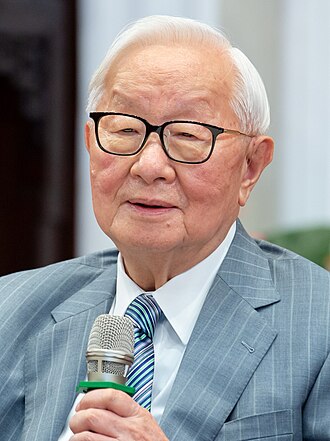
Morris Chang
Founder of TSMC
Where to hear and read about Morris Chang2 episodes and tests


Morris Chang founded TSMC in 1987 at age 56, after his American corporate career stalled, and built it into the pure-play chip foundry that makes most of the world's leading-edge chips. The lesson most worth taking from him is to bet ahead of demand on volume and the learning curve, and to earn customer trust by never competing with customers and treating them fairly in a crisis.
I was a serious student of the learning curve, and I would never stop at just two fabs.
TSMC founder Morris Chang
Morris Chang: the story and the lessons
1Morris Chang's path from war refugee to Texas Instruments
Chang grew up fleeing three wars before reaching America at 18. Born in Ningbo in 1931, he lived through the Sino-Japanese War, World War II and the Chinese Civil War, moving between Hong Kong and Shanghai with his mother.
An uncle in Boston helped him into Harvard, which he called "sheer ecstasy." What he valued was stability: you could count on the same structures existing ten years on.
A failed PhD exam pushed him into the chip industry. He finished a bachelor's and master's in mechanical engineering at MIT in three years, then failed the PhD qualifying exam twice and joined Sylvania's semiconductor division.
He left after hearing a manager say Sylvania "cannot make what we can sell, and we cannot sell what we can make."
He taught himself electronics from a textbook and a colleague at the bar. Each evening he studied Shockley's transistor text in his hotel room, then bought drinks for a senior engineer and questioned him, for three years.
Of the engineer he said: "didn't solve all my problems but he solved enough so that I could move ahead."
At TI he lifted a dead production line above IBM's own yields. Joining Texas Instruments in 1958, he took a second-source line for an IBM mainframe from near 0% yield to 20% in four months, while IBM's own plant ran about 10%.
IBM thought he was lucky until he explained his theories to its engineers. The win got him his first management job, and TI then paid for a Stanford PhD he finished in two and a half years.
By 1972 he ran all of TI's semiconductors. His low-price, high-volume strategy helped make TI the biggest and most profitable integrated circuit business in the world, and he became the obvious next TI chief.
2How Morris Chang's American career stalled
TI moved him to consumer products, where he could not win. In 1978 TI put him in charge of a struggling consumer products push; in 1983, five years without a turnaround, he was demoted to head of quality and people effectiveness.
Chang says the CEO wrongly believed "a good manager could manage anything." Chips are technology and costs, while consumer products depend on appeal to buyers, a different skill.
TI lost its chip lead while he was away. Its best MOS engineers left, many to Motorola, and in 1980 IBM's PC team chose Intel's 8088 over TI.
General Instrument was a poor fit, and he quit within a year. He took the number two job in New York with the CEO role possibly to follow, but GI behaved like an early private equity firm, buying, fixing and selling chip businesses.
After the two setbacks he says he no longer thought "my aspiration to be the CEO of a major US company was in the cards."
At GI he glimpsed the fabless chip company before it existed. Gordon Campbell asked GI for $50 million to start a company, then said he needed only $5 million because he would not build a fab. Another founder asked GI to make his wafers.
That second founder and GI's fab manager fought over whose way the fab ran, which showed Chang a foundry's core tension: a fab runs only one way, yet many customers each want it theirs.
3Why Morris Chang invented the pure-play foundry
Chang went to Taiwan in 1985 expecting a quiet research job. Minister K.T. Li recruited him to run ITRI, Taiwan's government research institute, against the advice of his colleagues and wife.
Chang had no tie to Taiwan and called it a strange land. Staff saw him as "the foreigner who suddenly became their boss."
Li ordered a world-class chip company, an offer Chang could not refuse. Li wanted an Intel or an IBM and gave him about three days for a plan; it was Chang's third job in three years, so failing would end his career.
The foundry model was Chang's own idea, not Li's.
He designed TSMC around Taiwan's one real strength, making wafers. Taiwan had no chip design, IP or marketing strength, and its companies earned 4 to 5% gross margins, so he picked the business that fit manufacturing and avoided the weaknesses.
His question was "what kind of company would you create to fit that strength and avoid all the other weaknesses." His original pitch deck already listed a "dedicated pure play foundry." Competing with Intel crossed his mind and he dropped it.
He bet on a market of chip designers that did not yet exist. At TI and GI he had seen designers who wanted to start companies but could not raise money for a fab; a foundry would let them start for 10 to 20% of the capital.
The industry norm was Jerry Sanders' "real men have fabs," and Chang himself called the lack of customers a possibly fatal problem. Nvidia later raised only $20 million and never built a fab.
Only Philips joined, and Chang took no equity. The $220 million came from the government (50%), Philips (28%) and Taiwanese business leaders pressed by the premier; Intel and TI declined.
Chang received a government salary and later bought TSMC shares with his own cash before the 1994 Taiwan and 1997 NYSE listings.
TSMC lived on rivals' leftover orders for its first years. Chang personally asked old colleagues at Intel, TI and Motorola for overflow work, mostly unprofitable chips they pulled back once their own capacity came online.
He called it "it wasn't a stable Market." For roughly five years TSMC waited on this while the fabless customers arrived.
TSMC never competes with or outshines its customers. Rivals renting spare fab capacity demanded the right to sell customers' products under their own brand; TSMC never did, and lets customers like Apple take the credit.
Incumbents could not copy this without giving up the margin they made from integrating design and manufacturing.
4Morris Chang's learning curve and the logic of one winner
Chang refined the learning curve at TI alongside Bill Bain of BCG. Around 1970 Bain sat in an office next to Chang's for about two years, flying to Dallas every Monday, to apply the experience curve to chips.
Chang warns that anyone who stops at "more output means lower unit cost" hasn't learned anything at all; he used it as a thinking tool ever since.
He priced low from the start to fill fabs and learn faster. Instead of charging high prices on new fabs, he set low starting prices and cut them every quarter, even when the market did not demand it.
Many thought it foolish. The point was full capacity at once, faster learning and fixed costs spread over more units.
Taking the curve seriously meant never stopping at two fabs. Stopping after Fab 2 was "only the very initial plan," and Chang says the curve lets you see a single manufacturing winner coming.
He adds that he could not have named TSMC as that winner in advance.
Fabless growth funded the flywheel that put TSMC ahead. Roughly 50% gross and 40% operating margins paid for better process technology, which brought more customers; TSMC went from behind to ahead in about ten years.
Leading-edge producers fell from 22 in the early 2000s to just TSMC and Samsung at 5 nanometers.
Chang sees chipmaking as a treadmill that keeps speeding up. In 2020 TSMC put $17 billion of its $20 billion operating profit into capex, then planned $100 billion over three years.
Falling a step behind on the treadmill means you fall off. Rising fab costs plus falling unit costs favor whoever is most profitable.
5How Morris Chang took back TSMC in 2009
Chang returned as CEO at 78 after his successor stumbled. He had retired in 2005 and handed TSMC to Rick Tsai, staying chairman; in summer 2009 he came back citing "golden opportunities" in smartphones and the cloud.
The triggers were unresolved 40nm yield problems, an unpaid Nvidia grievance, falling margins and a layoff he opposed.
He let successors make their own mistakes unless the company was sinking. When Tsai split operations into advanced and mainstream groups in 2005, Chang disagreed but let it stand.
His rule: "let the CEO make his own mistakes and learn from them," unless the whole company is going down the drain.
Chang refuses to lay people off by performance rating. His successor cut 600 to 700 of the lowest-rated staff after the 2008 crisis and called it performance management, sidestepping Chang's order to bring any layoff to the board.
Ratings from 700 different supervisors are subjective, and separation plus retraining costs a year of pay, so rehiring within a year makes no sense. He had been the only top TI manager to oppose the same plan in the early 1970s.
Protests at his home hastened his return. More than 100 laid-off workers and 50 or 60 police gathered at his home, and a month later about 25 slept in a nearby park.
At 6 a.m. his wife bought them fried bread and soy milk; they thanked her and dropped plans to march on the president's palace. Chang offered to rehire anyone who wanted to return.
He kept the ousted executive as a possible successor. The former CEO kept his grade, salary and bonus as president of new businesses, solar cells and LEDs.
Those businesses never took off: China subsidized solar and a few firms held the LED patents, while chips grew into a $600 billion market.
6How Morris Chang settled with Nvidia
Chang answered a letter from a nearly bankrupt Nvidia in 1997. Nvidia had 50 or 60 employees and wrote because TSMC's San Jose office ignored it; Chang, irritated, called the number on the letterhead.
Jensen Huang answered himself and promised a games chip that would make Nvidia a major customer, meaning at least $50 million a year. Within two or three years Nvidia was a top-five TSMC customer.
He treated the 2009 40nm grievance as a money problem to solve. The previous CEO had offered Nvidia nothing; Chang spent almost half his first four or five weeks back studying the problem and Nvidia's own customer pressure.
40nm mattered because TSMC could only do 28nm if it did 40nm well.
He made one fair offer with a 48-hour deadline. Over pizza and talks at Huang's home, he offered more than $100 million, with no bargaining and arbitration as the only alternative.
"We are not going to argue we're not going to bargain." Huang accepted within two days, and many billions of dollars of business followed.
7Morris Chang's bet on 28nm
Chang fixed R&D at 8% of revenue to end yearly fights. R&D had run at 6 to 7% and was renegotiated every year; he set 8%, to hold even in a recession.
At TI he had asked to raise R&D from 4.8% to 5.5% and was refused every time. TSMC's R&D chief called the fixed share the best thing done for his team.
He tripled capex on his engineers' conviction that 28nm was the sweet spot. Capex jumped from about $2 to 2.5 billion a year to almost $6 billion in 2010, backed by R&D, market forecasting and business development inputs.
He quoted Shakespeare's tide in the affairs of men: 28nm was the tide. He did not foresee that smartphones would drive the demand.
He overruled independent directors who were not convinced. They called the general counsel a week before the meeting to object; Chang said he was responsible for running the company, and they accepted.
He says you cannot really convince anyone of this kind of bet. Before every meeting he hosts the independent directors, three quarters of the board, at an off-the-record dinner.
8How Morris Chang won Apple
Apple arrived unannounced, through his wife's cousin. Foxconn founder Terry Gou invited himself to dinner and brought Apple COO Jeff Williams, who pitched for most of the evening.
Chang's rule on Apple: it is a closed-mouth company that comes to you when it is ready.
Williams offered a 40% margin below what TSMC already earned. TSMC was at 45% and Chang was pushing for 50%; he said nothing, because dinner was not the time for pricing.
Price starts from cost, with yields the main input, and the split between foundry and designer has no formula. Chang never reached 50% before retiring.
He took half the volume Apple asked for and borrowed to fund it. Apple wanted an unplanned 20nm half step, roughly $10 billion more; with Goldman Sachs he rejected cutting the dividend or issuing stock, and borrowed billions.
Apple's purchasing staff called it crazy, so Chang flew to Cupertino. Williams accepted and only suggested dropping the dividend; Chang refused, since a third of shareholders cared about it.
He planted the Goldman Sachs relationship years before needing it. He did TSMC's New York ADR listing with Goldman and sat on its board, expecting TSMC would one day need top-level bank advice.
He stayed calm when Intel courted Apple. In February 2011 Apple paused talks for two months after CEO Paul Otellini approached Tim Cook; Chang rated TSMC equal on technology and ahead on manufacturing and trust.
Cook then told him over a cafeteria lunch that Intel does not know how to be a foundry. Chang reads that as service: answering every customer request courteously.
The 20nm detour cost TSMC Apple's first 16nm orders. R&D could not run two nodes at once, so 16nm slipped and Samsung, which skipped 20nm, won Apple's first 16nm order.
Chang called it a real shock, with 80 to 90% of the equipment meant to convert to 16nm. Williams flew over and kept his promise; TSMC's 16nm came about six months later and won most of Apple's needs.
TSMC built a dedicated $9 billion plant for Apple. It committed 6,000 employees and built the plant in 11 months; Apple had no backup plan.
By the iPhone 6, all iPhone chips were reportedly made by TSMC.
9Morris Chang's rules for running a foundry
Chang organizes a foundry by function, never by division. In 1996 he rejected splitting TSMC by fab because the same customers move between fabs; McKinsey reached the same answer after a month or two and a couple of million dollars.
Boeing does not split the 707 from the 757, he says. He merged Tsai's advanced and mainstream groups back together in 2009.
He built a real marketing function and gave it to C.C. Wei. He made business development TSMC's strategic marketing arm; Mark Liu refused it for having 60 to 70 people versus his 10,000.
Chang countered with Kissinger, who had fewer people than the Secretary of State but more power. Wei took the job, and Chang gave up the customer travel he loved. Wei is now chairman and CEO.
Deposits kept customers honest about what they ordered. Short of capacity for its first 10 to 15 years, TSMC required deposits and warned they might be "confiscated."
It never confiscated one; in the 2001 to 2003 downturn it let customers delay and they used up their deposits.
He refused IBM's co-development offer to keep TSMC's own process. In 1999 IBM proposed co-developing 130nm as senior partner; Chang declined without a second thought, and UMC accepted and later regretted it.
He had already read IBM's decline when Qualcomm shifted its orders to TSMC after 1997.
Old fabs are kept running rather than scrapped. Fabs 2 and 3, TSMC's first, still run, fully depreciated, making camera sensors and replacement parts at very high margin.

TSMC founder Morris Chang
Morris Chang built TSMC by taking decisions other executives avoid: fixing R&D as a share of revenue, betting the balance sheet on one node, and settling a customer fight with a firm, fair offer. The 2009 to 2011 stretch, covering the Nvidia settlement, the 28nm bet and the Apple 20nm deal, shows how a pure play foundry earned the trust that made it the leader.
At GI he glimpsed the fabless chip company before it existed. Gordon Campbell asked GI for $50 million to start a company, then said he needed only $5 million because he would not build a fab. Another founder asked GI to make his wafers.
That second founder and GI's fab manager fought over whose way the fab ran, which showed Chang a foundry's core tension: a fab runs only one way, yet many customers each want it theirs.
He designed TSMC around Taiwan's one real strength, making wafers. Taiwan had no chip design, IP or marketing strength, and its companies earned 4 to 5% gross margins, so he picked the business that fit manufacturing and avoided the weaknesses.
His question was "what kind of company would you create to fit that strength and avoid all the other weaknesses." His original pitch deck already listed a "dedicated pure play foundry." Competing with Intel crossed his mind and he dropped it.
TSMC lived on rivals' leftover orders for its first years. Chang personally asked old colleagues at Intel, TI and Motorola for overflow work, mostly unprofitable chips they pulled back once their own capacity came online.
He called it "it wasn't a stable Market." For roughly five years TSMC waited on this while the fabless customers arrived.
Chang refined the learning curve at TI alongside Bill Bain of BCG. Around 1970 Bain sat in an office next to Chang's for about two years, flying to Dallas every Monday, to apply the experience curve to chips.
Chang warns that anyone who stops at "more output means lower unit cost" hasn't learned anything at all; he used it as a thinking tool ever since.
He priced low from the start to fill fabs and learn faster. Instead of charging high prices on new fabs, he set low starting prices and cut them every quarter, even when the market did not demand it.
Many thought it foolish. The point was full capacity at once, faster learning and fixed costs spread over more units.
Taking the curve seriously meant never stopping at two fabs. Stopping after Fab 2 was "only the very initial plan," and Chang says the curve lets you see a single manufacturing winner coming.
He adds that he could not have named TSMC as that winner in advance.
Chang returned as CEO at 78 after his successor stumbled. He had retired in 2005 and handed TSMC to Rick Tsai, staying chairman; in summer 2009 he came back citing "golden opportunities" in smartphones and the cloud.
The triggers were unresolved 40nm yield problems, an unpaid Nvidia grievance, falling margins and a layoff he opposed.
He let successors make their own mistakes unless the company was sinking. When Tsai split operations into advanced and mainstream groups in 2005, Chang disagreed but let it stand.
His rule: "let the CEO make his own mistakes and learn from them," unless the whole company is going down the drain.
Chang refuses to lay people off by performance rating. His successor cut 600 to 700 of the lowest-rated staff after the 2008 crisis and called it performance management, sidestepping Chang's order to bring any layoff to the board.
Ratings from 700 different supervisors are subjective, and separation plus retraining costs a year of pay, so rehiring within a year makes no sense. He had been the only top TI manager to oppose the same plan in the early 1970s.
Protests at his home hastened his return. More than 100 laid-off workers and 50 or 60 police gathered at his home, and a month later about 25 slept in a nearby park.
At 6 a.m. his wife bought them fried bread and soy milk; they thanked her and dropped plans to march on the president's palace. Chang offered to rehire anyone who wanted to return.
He kept the ousted executive as a possible successor. The former CEO kept his grade, salary and bonus as president of new businesses, solar cells and LEDs.
Those businesses never took off: China subsidized solar and a few firms held the LED patents, while chips grew into a $600 billion market.
Chang answered a letter from a nearly bankrupt Nvidia in 1997. Nvidia had 50 or 60 employees and wrote because TSMC's San Jose office ignored it; Chang, irritated, called the number on the letterhead.
Jensen Huang answered himself and promised a games chip that would make Nvidia a major customer, meaning at least $50 million a year. Within two or three years Nvidia was a top-five TSMC customer.
He treated the 2009 40nm grievance as a money problem to solve. The previous CEO had offered Nvidia nothing; Chang spent almost half his first four or five weeks back studying the problem and Nvidia's own customer pressure.
40nm mattered because TSMC could only do 28nm if it did 40nm well.
He made one fair offer with a 48-hour deadline. Over pizza and talks at Huang's home, he offered more than $100 million, with no bargaining and arbitration as the only alternative.
"We are not going to argue we're not going to bargain." Huang accepted within two days, and many billions of dollars of business followed.
Chang fixed R&D at 8% of revenue to end yearly fights. R&D had run at 6 to 7% and was renegotiated every year; he set 8%, to hold even in a recession.
At TI he had asked to raise R&D from 4.8% to 5.5% and was refused every time. TSMC's R&D chief called the fixed share the best thing done for his team.
He tripled capex on his engineers' conviction that 28nm was the sweet spot. Capex jumped from about $2 to 2.5 billion a year to almost $6 billion in 2010, backed by R&D, market forecasting and business development inputs.
He quoted Shakespeare's tide in the affairs of men: 28nm was the tide. He did not foresee that smartphones would drive the demand.
He overruled independent directors who were not convinced. They called the general counsel a week before the meeting to object; Chang said he was responsible for running the company, and they accepted.
He says you cannot really convince anyone of this kind of bet. Before every meeting he hosts the independent directors, three quarters of the board, at an off-the-record dinner.
Apple arrived unannounced, through his wife's cousin. Foxconn founder Terry Gou invited himself to dinner and brought Apple COO Jeff Williams, who pitched for most of the evening.
Chang's rule on Apple: it is a closed-mouth company that comes to you when it is ready.
Williams offered a 40% margin below what TSMC already earned. TSMC was at 45% and Chang was pushing for 50%; he said nothing, because dinner was not the time for pricing.
Price starts from cost, with yields the main input, and the split between foundry and designer has no formula. Chang never reached 50% before retiring.
He took half the volume Apple asked for and borrowed to fund it. Apple wanted an unplanned 20nm half step, roughly $10 billion more; with Goldman Sachs he rejected cutting the dividend or issuing stock, and borrowed billions.
Apple's purchasing staff called it crazy, so Chang flew to Cupertino. Williams accepted and only suggested dropping the dividend; Chang refused, since a third of shareholders cared about it.
He planted the Goldman Sachs relationship years before needing it. He did TSMC's New York ADR listing with Goldman and sat on its board, expecting TSMC would one day need top-level bank advice.
He stayed calm when Intel courted Apple. In February 2011 Apple paused talks for two months after CEO Paul Otellini approached Tim Cook; Chang rated TSMC equal on technology and ahead on manufacturing and trust.
Cook then told him over a cafeteria lunch that Intel does not know how to be a foundry. Chang reads that as service: answering every customer request courteously.
The 20nm detour cost TSMC Apple's first 16nm orders. R&D could not run two nodes at once, so 16nm slipped and Samsung, which skipped 20nm, won Apple's first 16nm order.
Chang called it a real shock, with 80 to 90% of the equipment meant to convert to 16nm. Williams flew over and kept his promise; TSMC's 16nm came about six months later and won most of Apple's needs.
Chang organizes a foundry by function, never by division. In 1996 he rejected splitting TSMC by fab because the same customers move between fabs; McKinsey reached the same answer after a month or two and a couple of million dollars.
Boeing does not split the 707 from the 757, he says. He merged Tsai's advanced and mainstream groups back together in 2009.
He built a real marketing function and gave it to C.C. Wei. He made business development TSMC's strategic marketing arm; Mark Liu refused it for having 60 to 70 people versus his 10,000.
Chang countered with Kissinger, who had fewer people than the Secretary of State but more power. Wei took the job, and Chang gave up the customer travel he loved. Wei is now chairman and CEO.
Deposits kept customers honest about what they ordered. Short of capacity for its first 10 to 15 years, TSMC required deposits and warned they might be "confiscated."
It never confiscated one; in the 2001 to 2003 downturn it let customers delay and they used up their deposits.
He refused IBM's co-development offer to keep TSMC's own process. In 1999 IBM proposed co-developing 130nm as senior partner; Chang declined without a second thought, and UMC accepted and later regretted it.
He had already read IBM's decline when Qualcomm shifted its orders to TSMC after 1997.
Old fabs are kept running rather than scrapped. Fabs 2 and 3, TSMC's first, still run, fully depreciated, making camera sensors and replacement parts at very high margin.
TSMC
After being passed over for CEO at Texas Instruments, Morris Chang founded TSMC in 1987 at age 56 as the first pure play chip foundry, betting that a market of fabless chip designers would appear. Reinvesting profits into ever larger fabs turned a commodity manufacturing business into one with 40% operating margins and roughly 90% of the leading edge.
Chang grew up fleeing three wars before reaching America at 18. Born in Ningbo in 1931, he lived through the Sino-Japanese War, World War II and the Chinese Civil War, moving between Hong Kong and Shanghai with his mother.
An uncle in Boston helped him into Harvard, which he called "sheer ecstasy." What he valued was stability: you could count on the same structures existing ten years on.
A failed PhD exam pushed him into the chip industry. He finished a bachelor's and master's in mechanical engineering at MIT in three years, then failed the PhD qualifying exam twice and joined Sylvania's semiconductor division.
He left after hearing a manager say Sylvania "cannot make what we can sell, and we cannot sell what we can make."
He taught himself electronics from a textbook and a colleague at the bar. Each evening he studied Shockley's transistor text in his hotel room, then bought drinks for a senior engineer and questioned him, for three years.
Of the engineer he said: "didn't solve all my problems but he solved enough so that I could move ahead."
At TI he lifted a dead production line above IBM's own yields. Joining Texas Instruments in 1958, he took a second-source line for an IBM mainframe from near 0% yield to 20% in four months, while IBM's own plant ran about 10%.
IBM thought he was lucky until he explained his theories to its engineers. The win got him his first management job, and TI then paid for a Stanford PhD he finished in two and a half years.
By 1972 he ran all of TI's semiconductors. His low-price, high-volume strategy helped make TI the biggest and most profitable integrated circuit business in the world, and he became the obvious next TI chief.
TI moved him to consumer products, where he could not win. In 1978 TI put him in charge of a struggling consumer products push; in 1983, five years without a turnaround, he was demoted to head of quality and people effectiveness.
Chang says the CEO wrongly believed "a good manager could manage anything." Chips are technology and costs, while consumer products depend on appeal to buyers, a different skill.
TI lost its chip lead while he was away. Its best MOS engineers left, many to Motorola, and in 1980 IBM's PC team chose Intel's 8088 over TI.
General Instrument was a poor fit, and he quit within a year. He took the number two job in New York with the CEO role possibly to follow, but GI behaved like an early private equity firm, buying, fixing and selling chip businesses.
After the two setbacks he says he no longer thought "my aspiration to be the CEO of a major US company was in the cards."
Chang went to Taiwan in 1985 expecting a quiet research job. Minister K.T. Li recruited him to run ITRI, Taiwan's government research institute, against the advice of his colleagues and wife.
Chang had no tie to Taiwan and called it a strange land. Staff saw him as "the foreigner who suddenly became their boss."
Li ordered a world-class chip company, an offer Chang could not refuse. Li wanted an Intel or an IBM and gave him about three days for a plan; it was Chang's third job in three years, so failing would end his career.
The foundry model was Chang's own idea, not Li's.
He designed TSMC around Taiwan's one real strength, making wafers. Taiwan had no chip design, IP or marketing strength, and its companies earned 4 to 5% gross margins, so he picked the business that fit manufacturing and avoided the weaknesses.
His question was "what kind of company would you create to fit that strength and avoid all the other weaknesses." His original pitch deck already listed a "dedicated pure play foundry." Competing with Intel crossed his mind and he dropped it.
He bet on a market of chip designers that did not yet exist. At TI and GI he had seen designers who wanted to start companies but could not raise money for a fab; a foundry would let them start for 10 to 20% of the capital.
The industry norm was Jerry Sanders' "real men have fabs," and Chang himself called the lack of customers a possibly fatal problem. Nvidia later raised only $20 million and never built a fab.
Only Philips joined, and Chang took no equity. The $220 million came from the government (50%), Philips (28%) and Taiwanese business leaders pressed by the premier; Intel and TI declined.
Chang received a government salary and later bought TSMC shares with his own cash before the 1994 Taiwan and 1997 NYSE listings.
TSMC lived on rivals' leftover orders for its first years. Chang personally asked old colleagues at Intel, TI and Motorola for overflow work, mostly unprofitable chips they pulled back once their own capacity came online.
He called it "it wasn't a stable Market." For roughly five years TSMC waited on this while the fabless customers arrived.
TSMC never competes with or outshines its customers. Rivals renting spare fab capacity demanded the right to sell customers' products under their own brand; TSMC never did, and lets customers like Apple take the credit.
Incumbents could not copy this without giving up the margin they made from integrating design and manufacturing.
He priced low from the start to fill fabs and learn faster. Instead of charging high prices on new fabs, he set low starting prices and cut them every quarter, even when the market did not demand it.
Many thought it foolish. The point was full capacity at once, faster learning and fixed costs spread over more units.
Fabless growth funded the flywheel that put TSMC ahead. Roughly 50% gross and 40% operating margins paid for better process technology, which brought more customers; TSMC went from behind to ahead in about ten years.
Leading-edge producers fell from 22 in the early 2000s to just TSMC and Samsung at 5 nanometers.
Chang sees chipmaking as a treadmill that keeps speeding up. In 2020 TSMC put $17 billion of its $20 billion operating profit into capex, then planned $100 billion over three years.
Falling a step behind on the treadmill means you fall off. Rising fab costs plus falling unit costs favor whoever is most profitable.
Chang returned as CEO at 78 after his successor stumbled. He had retired in 2005 and handed TSMC to Rick Tsai, staying chairman; in summer 2009 he came back citing "golden opportunities" in smartphones and the cloud.
The triggers were unresolved 40nm yield problems, an unpaid Nvidia grievance, falling margins and a layoff he opposed.
TSMC built a dedicated $9 billion plant for Apple. It committed 6,000 employees and built the plant in 11 months; Apple had no backup plan.
By the iPhone 6, all iPhone chips were reportedly made by TSMC.