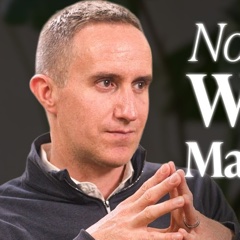
Morgan Housel
Author of The Psychology of Money and Same as Ever
Where to hear and read about Morgan Housel2 episodes and tests

 How I WriteWhy Selfish Writing Is Better Writing (Morgan Housel Interview)
 How I WriteHow to Write Insanely Well (Morgan Housel Interview)
Morgan Housel is the author of The Psychology of Money and Same as Ever, a former Motley Fool columnist who built his career on short, story-led writing. The thing most worth learning from him is that you need no new idea, only a true story told in few words, written for yourself.
you don't need to say something new. You just need to say it well.
Why Selfish Writing Is Better Writing (Morgan Housel Interview)
Morgan Housel: the story and the lessons
1How Morgan Housel became a writer by accident
Housel started writing in 2007 out of desperation, not ambition. The economy was cracking and almost no one was hiring. A friend at The Motley Fool pointed him there, and he planned to stay six months.
He wanted to be a hedge fund manager and found journalism humiliating. He was an economics major who had never really written, and his mom asked 'Do you know how to write?' He says she was right.
He wrote three articles a day at The Motley Fool for nine years. That came to about 3,500 articles, and hundreds of readers critiqued each one.
Readers said bluntly when something was bad, and he had thin skin. His wife could read a bad comment day on his face. He still refused to take direction from the crowd.
Telling stories was how he survived among thousands of data writers. Thousands of writers post that the Dow went up a hundred points, so data alone never stands out. He wrote instead about what goes on inside people's heads.
He says he wanted to keep his job, not get better in the abstract. The first year felt like a paycheck, and it took about five years to feel that writing was what he does.
His first big article predicted the US economy's destruction and was wrong. Late 2007, titled 'The impending destruction of the US economy', it was picked up by other outlets. The crash came a year later, for different reasons.
Half the time readers were right that his analysis was off, and the rest was style. His early writing was one-sided, with titles like 'All the universities are gonna die', and bold predictions humbled him.
The 2008 scar still drives him. With the economy collapsed and no other jobs, writing had to work, so he treated it as a profession and not a side experiment.
He calls himself a worst-case-scenario worrier and cites Sequoia's Michael Moritz on always being scared of going out of business. The moment you lose that fear, he says, you can count the days to the end.
2How The Psychology of Money got made
His first plan for the book failed because it was not his voice. He planned 10 chapters of 6,000 words and wrote two, and neither made the book. Friends independently wrote back asking what it was and said it was not him.
He compares moving from 1,500-word blogs to long chapters to moving from jazz to heavy metal. Chasing the word count made him pad with examples just to stretch the idea.
He owned being a blogger and wrote blog-length chapters. Twenty long posts felt doable, where a 75,000-word book felt daunting. Both books ended under 50,000 words: 48,000 and 47,500, with chapters under 2,000 words.
Each chapter is a story, then a lesson. The first book is about the individual and Same as Ever is about the collective. His fix for padding was to make the point, wrap it up and move on.
The title arrived before he knew what the book would hold. The Psychology of Money came in 2017, and at a lunch with Patrick O'Shaughnessy he had no idea what it was about.
It began as 'Psychology of Investing', a 'shameless' copy of Charlie Munger's talk on human misjudgment, before he widened it. He knew it would work before he knew what would be in it.
Every US publisher rejected it, and he holds no grudge. They saw a random collection of essays, and only Harriman House, a British publisher, gave it a chance. It later sold more than 8 million copies.
His answer to the connecting-theme complaint was that the collection is what is good about it. He feels no 'you idiots' toward the publishers who passed, because no one knows what will hit.
Audio and international sales surprised him. Of the first million copies, 440,000 were international, 250,000 paperback, 75,000 ebook and 200,000 audio. The audiobook now outsells print two to one.
He had expected 98 percent print and thought Kindle would kill it. Audible keeps roughly 70 percent, so margins are low.
He waited 14 years for a book and chose timeless topics. A book written in 2010 would have been bad. He will not write anything that won't matter in ten years, because few people pay $30 for content they usually get free.
Marketing launches a book and word of mouth sustains it. Jason Zweig told him a good book needs no marketing and a bad one can't be saved by it, which Housel says is about 80% true.
He gives a book one common theme, then varies the stories. The Art of Spending Money argues money is an art, not a science, and goes in 47 directions so it is not an article stretched over 300 pages.
Without a common theme a book is a hodgepodge of random ideas. The Psychology of Money was about 21 essays whose common thread, building wealth, was not planned.
3Why Housel tells stories instead of giving data
Housel opens with one specific story, like the Vanderbilts. 'Rich families often go broke' is bland. The Vanderbilts held about $300 billion in today's money, and almost all of it was gone within 60 years.
Anderson Cooper was the first heir to get no inheritance, and Housel guesses he is the happiest in 150 years. Money decided the family's personality, home and spouse, giving them financial independence but no other kind.
He finds the story first, then draws the lesson. He has never started with a concept like competitive advantage and then hunted for a story. He asks what broader lesson the story holds.
His new book at the time had about 140 stories in 210 pages. A story lets readers place their own lives in the scene, which a data dump cannot do.
He writes about one person, not groups. A group becomes 'them' and invites apathy. A reader who feels they are looking in a mirror is far more likely to stay hooked.
He ties this to the line that one death is a tragedy and a million is a statistic, and to People magazine's huge audience.
He keeps the hook honest. Hooking readers is a skill with a moral and an immoral version. The immoral one is hyperbole that detaches from the truth.
A hook stays honest when the story is true and not inflated.
Housel believes delivery beats novelty. He felt shame turning in The Psychology of Money because nothing in it was original. It worked because he said it differently.
He points to Ken Burns's Civil War series, which had almost no new facts yet drew more American viewers in 1990 than the Super Bowl. He also cites Bill Bryson making an anatomy textbook, The Body, a book of the year.
He quotes people more credible than himself, liberally. 'X is true' is easy to doubt, and 'according to Warren Buffett, X is true' is believed. He says a young writer gains authority by deferring to people with more experience.
He mines interviews for stories because numbers are a commodity. The Steve Jobs Stanford speech holds most of what you need from Jobs.
4Housel's rules for sentences and cutting
He keeps a bird on his shoulder asking 'What's your point?'. Readers decide fast. One publisher saw the average reader leave by the third sentence, so the headline and first two sentences must hook.
His rule: 'Make the point and get out of the way.'
He asks whether he needs a sentence, not whether it is good. He pretends every word costs $100. A clever sentence still goes if it only rambles.
He credits this for his biggest improvement: about 100 words now where he once used 1,000.
Concise does not mean short. Doris Kearns Goodwin's No Ordinary Time runs about 800 pages and has no word to cut, while a 500-word essay can carry 495 unneeded words.
The skill is sensing the exhaustion point. He pushes event planners from 60-minute keynotes to 30 minutes, citing Seinfeld's point that a comic can hold a room for an hour but loses it by 90 minutes.
He treats a reader's rereading as the writer's fault. A paragraph that needs four rereads has failed, however deep. He says no points are awarded for difficulty, and deep and clear can go together.
He holds up Erik Larson, who writes 200 chapters of a page and a half each and covers what other historians need 17 or 46 pages for.
He writes for a high density of memorable sentences. People remember sentences, not books, so he asks whether a line is worth highlighting in Kindle and cuts it if not.
Raising the density of memorable sentences even 10 percent lifts the whole piece. Of a 70,000-word book you can usually recite three or four sentences.
He varies sentence and paragraph length to give prose a beat. If every sentence is 10 words the writing turns robotic. A long sentence followed by a four-word one can stop a reader cold.
Paragraph breaks also tell readers how to read: a one-sentence paragraph flags an important line. A D-Day book's 'most of them died' after a long setup is his model of punch, and he says elegance means having what it needs and no more.
He puts abnormal effort into the first and last lines. The last sentence of The Psychology of Money repeats the title of its first chapter, 'No One's Crazy', on purpose.
He says the worst possible ending is a summary and an ending should land an emotion. Robert Caro writes toward his last sentence so the whole book leads to it.
He tests material on live audiences, as Mark Twain did. Twain read aloud to his family and cut whatever made their faces go slack. Housel's talks hold three or four short stories, 80 to 90 percent memorized word for word.
He finds speech compresses ideas better than writing, because people can cut a talk to 20 seconds more easily than a 3,000-word essay to 500 words.
Cutting is the craft, and he keeps the scraps. A Google doc called Scrap Bits holds close to 100,000 words, about two books. An anecdote that failed in one piece has worked perfectly five years later in another.
He cites Ken Burns on 40 gallons of sap making one gallon of syrup. When a publisher said a Same as Ever chapter wouldn't work, he knew they were right but had polished every sentence.
5How Housel works week to week
He types about one day a week and treats the rest as the job. A week is two days of thinking, one day of writing, a day of staring at the piece, then a sentence or two of edits. He calls typing about 2 percent of the job.
He has worked from home since 2007 and can only write in his own home office. The rest is reading, couch thinking, talking to friends and walking.
He structures unstructured time, because ideas cannot be scheduled. Both book titles came during idle moments, and hooks arrive in the shower, on dog walks and at 2 a.m. He walks 20 to 30 minutes two or three times a day when hunting for an idea.
He emails himself short notes, sometimes 15 on one walk. 'I structure unstructuredness.' His wife still asks what he is doing on the couch after 20 years, and he says it is his most productive work.
He starts pieces from a title and lets research change the thesis. His 'Laws of Getting Rich' piece began as a title emailed from a treadmill. He noticed most of his notes were downsides of wealth, and that became the angle.
He starts most pieces with only a title. Sometimes research flips his thesis and he writes about the opposite.
He plays 'I spy' and takes notes mid-conversation. A friend taught him to name 20 things in a sandwich shop, which trains observation. He interrupts dinners about every 5 minutes to record a line he'd otherwise forget.
Over years of constant note-taking he has built a stock of insights and anecdotes to draw on.
He keeps his calendar empty of tasks as success grows. He cites Jerry Seinfeld ending his show in 1998 partly because fame stopped him and Larry David from watching people in delis. Founder CEOs face the same trap.
A schedule full of tasks cuts out the reading and thinking that made the work good.
He edits each sentence as he types, then publishes at the bottom. He rereads and tweaks every line right after writing it and never rereads the whole piece. At the Wall Street Journal, six or seven editors each thought a piece was perfect, then rewrote 80%.
Nothing is objectively finished, so he picks a point and calls it good enough. A book is harder: two months before Same as Ever went to print he lay awake over a paragraph in chapter eight.
6Why Housel writes selfishly and how he judges ideas
He stopped writing for an audience after reading comments on 4,000 posts. He saw he could not please everyone, so he decided to please himself. Only about 1% of his writing has been edited by someone else.
His test is whether he likes the story and whether the joke makes him laugh. He reached this stance after 20 years of writing.
He writes only about what he is trying to figure out. He says 'know your audience' turns quickly into pandering. Putting a hunch into words either shows it is silly or makes it something you can act on.
He took the idea from Howard Marks, whose client memos went unread for years and later became The Most Important Thing. He also says thinking is horizontal and writing is vertical, so writing forces a deep dive.
He reads writer's block as a sign the idea is bad. Every idea that felt good was easy to write, and every block meant the idea was wrong. His proudest posts took a couple of hours.
The ones he labored over for a week were his biggest disappointments.
He refuses topics before typing a letter. Experience now lets him judge whether a piece will work, so he is better at not writing the thing that won't. Ideas suggested by non-writers are almost always bad for him.
If a piece is hard from the first sentence he drops it, like a first date you read in five minutes. A good start that struggles later can be fixed, but a hard start cannot.
He takes feedback only from people who want him to succeed. A troll doesn't care about you, while a best friend wants you to win and still says when you're wrong. He credits the advice to Derek Thompson.
Early comments hurt, but only became useful once the wound healed.
7How Housel reads and researches
He starts many books and quits fast. He borrows Patrick O'Shaughnessy's wide funnel and tight filter, starting anything that looks 1% interesting and using the free 10% Kindle sample. He finishes only a single-digit percentage of what he starts.
People who say they hate reading are often forcing themselves through the wrong books.
He now reads slowly, one or two books a month. He once bragged about nine a month, but speed meant no thinking. Now he pauses to ask whether a paragraph is true.
Early heavy reading built the skill to skim and showed him what he likes.
He explores raw archives and keeps hindsight out of history. He uses FRED, the free Federal Reserve data site, and read random 1922 New York Times issues at the Library of Congress with no goal. He warns that data can prove anything, so ask what you are trying to prove.
Citing David McCullough, he says great historians make readers feel people then did not know the outcome. In 1932, with unemployment at 25% and stocks down 91%, many thought capitalism had broken.
He copied admired writers to find his voice. He tried to write like Bill Bonner, Felix Salmon and Michael Lewis, and says he can trace pieces of his style to each, plus Bethany McLean.
He admires McLean for trusting her own eyes on Enron in her late 20s. He also studies WWII history for emotion, not strategy.
He uses AI for research and never for writing. He types every word because the process of writing is what gets the author thinking. His use went from once a week to twice an hour in 18 months.
He calls it a 'Google on steroids', but it can hallucinate and was poor at typos and grammar. As an editor it is only decent at the big picture.
8What Housel expects to lose, and why books matter
He expects most of his work to miss. Of roughly 4,000 posts he is proud of about 10, and at The Motley Fool he'd be proud of maybe five articles a year.
He cites Walt Disney's one Snow White among about 30 films, and Stephen King's fame resting on about three of 50 books. He thinks 90% of virality is luck.
He sees books as the Super Bowl of writing. Social media is spring training, blogs the regular season and a book the Super Bowl. A bad blog post fades, while a fumbled book marks a career.
Readers who pay for a book will stay with a deeper story, though he still hears a little bird telling him to wrap it up.
He quits while ahead. Seinfeld ended in 1998 at the top, while The Simpsons kept going and its recent ratings are poor.
Housel says being forced out is among the worst things that can happen to you. He admits the second book scares him.
Why Selfish Writing Is Better Writing (Morgan Housel Interview)
Housel argues that you do not need new ideas, only a clearer, more story-driven way of saying them, and that the writer's job is to get to the point and cut anything that loses the reader. The habit worth hearing is his deliberately unstructured life of reading, wandering, and taking notes mid-conversation, because his best titles and stories arrive when he is not trying.
He wrote three articles a day at The Motley Fool for nine years. That came to about 3,500 articles, and hundreds of readers critiqued each one.
Readers said bluntly when something was bad, and he had thin skin. His wife could read a bad comment day on his face. He still refused to take direction from the crowd.
The title arrived before he knew what the book would hold. The Psychology of Money came in 2017, and at a lunch with Patrick O'Shaughnessy he had no idea what it was about.
It began as 'Psychology of Investing', a 'shameless' copy of Charlie Munger's talk on human misjudgment, before he widened it. He knew it would work before he knew what would be in it.
Every US publisher rejected it, and he holds no grudge. They saw a random collection of essays, and only Harriman House, a British publisher, gave it a chance. It later sold more than 8 million copies.
His answer to the connecting-theme complaint was that the collection is what is good about it. He feels no 'you idiots' toward the publishers who passed, because no one knows what will hit.
He gives a book one common theme, then varies the stories. The Art of Spending Money argues money is an art, not a science, and goes in 47 directions so it is not an article stretched over 300 pages.
Without a common theme a book is a hodgepodge of random ideas. The Psychology of Money was about 21 essays whose common thread, building wealth, was not planned.
Housel opens with one specific story, like the Vanderbilts. 'Rich families often go broke' is bland. The Vanderbilts held about $300 billion in today's money, and almost all of it was gone within 60 years.
Anderson Cooper was the first heir to get no inheritance, and Housel guesses he is the happiest in 150 years. Money decided the family's personality, home and spouse, giving them financial independence but no other kind.
He finds the story first, then draws the lesson. He has never started with a concept like competitive advantage and then hunted for a story. He asks what broader lesson the story holds.
His new book at the time had about 140 stories in 210 pages. A story lets readers place their own lives in the scene, which a data dump cannot do.
He writes about one person, not groups. A group becomes 'them' and invites apathy. A reader who feels they are looking in a mirror is far more likely to stay hooked.
He ties this to the line that one death is a tragedy and a million is a statistic, and to People magazine's huge audience.
He keeps the hook honest. Hooking readers is a skill with a moral and an immoral version. The immoral one is hyperbole that detaches from the truth.
A hook stays honest when the story is true and not inflated.
Housel believes delivery beats novelty. He felt shame turning in The Psychology of Money because nothing in it was original. It worked because he said it differently.
He points to Ken Burns's Civil War series, which had almost no new facts yet drew more American viewers in 1990 than the Super Bowl. He also cites Bill Bryson making an anatomy textbook, The Body, a book of the year.
He quotes people more credible than himself, liberally. 'X is true' is easy to doubt, and 'according to Warren Buffett, X is true' is believed. He says a young writer gains authority by deferring to people with more experience.
He mines interviews for stories because numbers are a commodity. The Steve Jobs Stanford speech holds most of what you need from Jobs.
He keeps a bird on his shoulder asking 'What's your point?'. Readers decide fast. One publisher saw the average reader leave by the third sentence, so the headline and first two sentences must hook.
His rule: 'Make the point and get out of the way.'
Concise does not mean short. Doris Kearns Goodwin's No Ordinary Time runs about 800 pages and has no word to cut, while a 500-word essay can carry 495 unneeded words.
The skill is sensing the exhaustion point. He pushes event planners from 60-minute keynotes to 30 minutes, citing Seinfeld's point that a comic can hold a room for an hour but loses it by 90 minutes.
He treats a reader's rereading as the writer's fault. A paragraph that needs four rereads has failed, however deep. He says no points are awarded for difficulty, and deep and clear can go together.
He holds up Erik Larson, who writes 200 chapters of a page and a half each and covers what other historians need 17 or 46 pages for.
He varies sentence and paragraph length to give prose a beat. If every sentence is 10 words the writing turns robotic. A long sentence followed by a four-word one can stop a reader cold.
Paragraph breaks also tell readers how to read: a one-sentence paragraph flags an important line. A D-Day book's 'most of them died' after a long setup is his model of punch, and he says elegance means having what it needs and no more.
He tests material on live audiences, as Mark Twain did. Twain read aloud to his family and cut whatever made their faces go slack. Housel's talks hold three or four short stories, 80 to 90 percent memorized word for word.
He finds speech compresses ideas better than writing, because people can cut a talk to 20 seconds more easily than a 3,000-word essay to 500 words.
He structures unstructured time, because ideas cannot be scheduled. Both book titles came during idle moments, and hooks arrive in the shower, on dog walks and at 2 a.m. He walks 20 to 30 minutes two or three times a day when hunting for an idea.
He emails himself short notes, sometimes 15 on one walk. 'I structure unstructuredness.' His wife still asks what he is doing on the couch after 20 years, and he says it is his most productive work.
He plays 'I spy' and takes notes mid-conversation. A friend taught him to name 20 things in a sandwich shop, which trains observation. He interrupts dinners about every 5 minutes to record a line he'd otherwise forget.
Over years of constant note-taking he has built a stock of insights and anecdotes to draw on.
He keeps his calendar empty of tasks as success grows. He cites Jerry Seinfeld ending his show in 1998 partly because fame stopped him and Larry David from watching people in delis. Founder CEOs face the same trap.
A schedule full of tasks cuts out the reading and thinking that made the work good.
He stopped writing for an audience after reading comments on 4,000 posts. He saw he could not please everyone, so he decided to please himself. Only about 1% of his writing has been edited by someone else.
His test is whether he likes the story and whether the joke makes him laugh. He reached this stance after 20 years of writing.
He reads writer's block as a sign the idea is bad. Every idea that felt good was easy to write, and every block meant the idea was wrong. His proudest posts took a couple of hours.
The ones he labored over for a week were his biggest disappointments.
He refuses topics before typing a letter. Experience now lets him judge whether a piece will work, so he is better at not writing the thing that won't. Ideas suggested by non-writers are almost always bad for him.
If a piece is hard from the first sentence he drops it, like a first date you read in five minutes. A good start that struggles later can be fixed, but a hard start cannot.
He starts many books and quits fast. He borrows Patrick O'Shaughnessy's wide funnel and tight filter, starting anything that looks 1% interesting and using the free 10% Kindle sample. He finishes only a single-digit percentage of what he starts.
People who say they hate reading are often forcing themselves through the wrong books.
He uses AI for research and never for writing. He types every word because the process of writing is what gets the author thinking. His use went from once a week to twice an hour in 18 months.
He calls it a 'Google on steroids', but it can hallucinate and was poor at typos and grammar. As an editor it is only decent at the big picture.
He sees books as the Super Bowl of writing. Social media is spring training, blogs the regular season and a book the Super Bowl. A bad blog post fades, while a fumbled book marks a career.
Readers who pay for a book will stay with a deeper story, though he still hears a little bird telling him to wrap it up.
How to Write Insanely Well (Morgan Housel Interview)
Morgan Housel explains how he writes short, story-led pieces that get to the point fast, and why he treats the sentence as the unit of good writing. The habit worth hearing is that he spends most of his week walking and thinking, emailing himself notes, and then writes a piece in one day, editing each sentence as he goes.
Housel started writing in 2007 out of desperation, not ambition. The economy was cracking and almost no one was hiring. A friend at The Motley Fool pointed him there, and he planned to stay six months.
He wanted to be a hedge fund manager and found journalism humiliating. He was an economics major who had never really written, and his mom asked 'Do you know how to write?' He says she was right.
He wrote three articles a day at The Motley Fool for nine years. That came to about 3,500 articles, and hundreds of readers critiqued each one.
Readers said bluntly when something was bad, and he had thin skin. His wife could read a bad comment day on his face. He still refused to take direction from the crowd.
Telling stories was how he survived among thousands of data writers. Thousands of writers post that the Dow went up a hundred points, so data alone never stands out. He wrote instead about what goes on inside people's heads.
He says he wanted to keep his job, not get better in the abstract. The first year felt like a paycheck, and it took about five years to feel that writing was what he does.
His first big article predicted the US economy's destruction and was wrong. Late 2007, titled 'The impending destruction of the US economy', it was picked up by other outlets. The crash came a year later, for different reasons.
Half the time readers were right that his analysis was off, and the rest was style. His early writing was one-sided, with titles like 'All the universities are gonna die', and bold predictions humbled him.
The 2008 scar still drives him. With the economy collapsed and no other jobs, writing had to work, so he treated it as a profession and not a side experiment.
He calls himself a worst-case-scenario worrier and cites Sequoia's Michael Moritz on always being scared of going out of business. The moment you lose that fear, he says, you can count the days to the end.
His first plan for the book failed because it was not his voice. He planned 10 chapters of 6,000 words and wrote two, and neither made the book. Friends independently wrote back asking what it was and said it was not him.
He compares moving from 1,500-word blogs to long chapters to moving from jazz to heavy metal. Chasing the word count made him pad with examples just to stretch the idea.
He owned being a blogger and wrote blog-length chapters. Twenty long posts felt doable, where a 75,000-word book felt daunting. Both books ended under 50,000 words: 48,000 and 47,500, with chapters under 2,000 words.
Each chapter is a story, then a lesson. The first book is about the individual and Same as Ever is about the collective. His fix for padding was to make the point, wrap it up and move on.
The title arrived before he knew what the book would hold. The Psychology of Money came in 2017, and at a lunch with Patrick O'Shaughnessy he had no idea what it was about.
It began as 'Psychology of Investing', a 'shameless' copy of Charlie Munger's talk on human misjudgment, before he widened it. He knew it would work before he knew what would be in it.
Every US publisher rejected it, and he holds no grudge. They saw a random collection of essays, and only Harriman House, a British publisher, gave it a chance. It later sold more than 8 million copies.
His answer to the connecting-theme complaint was that the collection is what is good about it. He feels no 'you idiots' toward the publishers who passed, because no one knows what will hit.
Audio and international sales surprised him. Of the first million copies, 440,000 were international, 250,000 paperback, 75,000 ebook and 200,000 audio. The audiobook now outsells print two to one.
He had expected 98 percent print and thought Kindle would kill it. Audible keeps roughly 70 percent, so margins are low.
He waited 14 years for a book and chose timeless topics. A book written in 2010 would have been bad. He will not write anything that won't matter in ten years, because few people pay $30 for content they usually get free.
Marketing launches a book and word of mouth sustains it. Jason Zweig told him a good book needs no marketing and a bad one can't be saved by it, which Housel says is about 80% true.
He finds the story first, then draws the lesson. He has never started with a concept like competitive advantage and then hunted for a story. He asks what broader lesson the story holds.
His new book at the time had about 140 stories in 210 pages. A story lets readers place their own lives in the scene, which a data dump cannot do.
Housel believes delivery beats novelty. He felt shame turning in The Psychology of Money because nothing in it was original. It worked because he said it differently.
He points to Ken Burns's Civil War series, which had almost no new facts yet drew more American viewers in 1990 than the Super Bowl. He also cites Bill Bryson making an anatomy textbook, The Body, a book of the year.
He quotes people more credible than himself, liberally. 'X is true' is easy to doubt, and 'according to Warren Buffett, X is true' is believed. He says a young writer gains authority by deferring to people with more experience.
He mines interviews for stories because numbers are a commodity. The Steve Jobs Stanford speech holds most of what you need from Jobs.
He keeps a bird on his shoulder asking 'What's your point?'. Readers decide fast. One publisher saw the average reader leave by the third sentence, so the headline and first two sentences must hook.
His rule: 'Make the point and get out of the way.'
He asks whether he needs a sentence, not whether it is good. He pretends every word costs $100. A clever sentence still goes if it only rambles.
He credits this for his biggest improvement: about 100 words now where he once used 1,000.
He writes for a high density of memorable sentences. People remember sentences, not books, so he asks whether a line is worth highlighting in Kindle and cuts it if not.
Raising the density of memorable sentences even 10 percent lifts the whole piece. Of a 70,000-word book you can usually recite three or four sentences.
He varies sentence and paragraph length to give prose a beat. If every sentence is 10 words the writing turns robotic. A long sentence followed by a four-word one can stop a reader cold.
Paragraph breaks also tell readers how to read: a one-sentence paragraph flags an important line. A D-Day book's 'most of them died' after a long setup is his model of punch, and he says elegance means having what it needs and no more.
He puts abnormal effort into the first and last lines. The last sentence of The Psychology of Money repeats the title of its first chapter, 'No One's Crazy', on purpose.
He says the worst possible ending is a summary and an ending should land an emotion. Robert Caro writes toward his last sentence so the whole book leads to it.
He tests material on live audiences, as Mark Twain did. Twain read aloud to his family and cut whatever made their faces go slack. Housel's talks hold three or four short stories, 80 to 90 percent memorized word for word.
He finds speech compresses ideas better than writing, because people can cut a talk to 20 seconds more easily than a 3,000-word essay to 500 words.
Cutting is the craft, and he keeps the scraps. A Google doc called Scrap Bits holds close to 100,000 words, about two books. An anecdote that failed in one piece has worked perfectly five years later in another.
He cites Ken Burns on 40 gallons of sap making one gallon of syrup. When a publisher said a Same as Ever chapter wouldn't work, he knew they were right but had polished every sentence.
He types about one day a week and treats the rest as the job. A week is two days of thinking, one day of writing, a day of staring at the piece, then a sentence or two of edits. He calls typing about 2 percent of the job.
He has worked from home since 2007 and can only write in his own home office. The rest is reading, couch thinking, talking to friends and walking.
He structures unstructured time, because ideas cannot be scheduled. Both book titles came during idle moments, and hooks arrive in the shower, on dog walks and at 2 a.m. He walks 20 to 30 minutes two or three times a day when hunting for an idea.
He emails himself short notes, sometimes 15 on one walk. 'I structure unstructuredness.' His wife still asks what he is doing on the couch after 20 years, and he says it is his most productive work.
He starts pieces from a title and lets research change the thesis. His 'Laws of Getting Rich' piece began as a title emailed from a treadmill. He noticed most of his notes were downsides of wealth, and that became the angle.
He starts most pieces with only a title. Sometimes research flips his thesis and he writes about the opposite.
He edits each sentence as he types, then publishes at the bottom. He rereads and tweaks every line right after writing it and never rereads the whole piece. At the Wall Street Journal, six or seven editors each thought a piece was perfect, then rewrote 80%.
Nothing is objectively finished, so he picks a point and calls it good enough. A book is harder: two months before Same as Ever went to print he lay awake over a paragraph in chapter eight.
He writes only about what he is trying to figure out. He says 'know your audience' turns quickly into pandering. Putting a hunch into words either shows it is silly or makes it something you can act on.
He took the idea from Howard Marks, whose client memos went unread for years and later became The Most Important Thing. He also says thinking is horizontal and writing is vertical, so writing forces a deep dive.
He refuses topics before typing a letter. Experience now lets him judge whether a piece will work, so he is better at not writing the thing that won't. Ideas suggested by non-writers are almost always bad for him.
If a piece is hard from the first sentence he drops it, like a first date you read in five minutes. A good start that struggles later can be fixed, but a hard start cannot.
He takes feedback only from people who want him to succeed. A troll doesn't care about you, while a best friend wants you to win and still says when you're wrong. He credits the advice to Derek Thompson.
Early comments hurt, but only became useful once the wound healed.
He now reads slowly, one or two books a month. He once bragged about nine a month, but speed meant no thinking. Now he pauses to ask whether a paragraph is true.
Early heavy reading built the skill to skim and showed him what he likes.
He explores raw archives and keeps hindsight out of history. He uses FRED, the free Federal Reserve data site, and read random 1922 New York Times issues at the Library of Congress with no goal. He warns that data can prove anything, so ask what you are trying to prove.
Citing David McCullough, he says great historians make readers feel people then did not know the outcome. In 1932, with unemployment at 25% and stocks down 91%, many thought capitalism had broken.
He copied admired writers to find his voice. He tried to write like Bill Bonner, Felix Salmon and Michael Lewis, and says he can trace pieces of his style to each, plus Bethany McLean.
He admires McLean for trusting her own eyes on Enron in her late 20s. He also studies WWII history for emotion, not strategy.
He expects most of his work to miss. Of roughly 4,000 posts he is proud of about 10, and at The Motley Fool he'd be proud of maybe five articles a year.
He cites Walt Disney's one Snow White among about 30 films, and Stephen King's fame resting on about three of 50 books. He thinks 90% of virality is luck.
He quits while ahead. Seinfeld ended in 1998 at the top, while The Simpsons kept going and its recent ratings are poor.
Housel says being forced out is among the worst things that can happen to you. He admits the second book scares him.