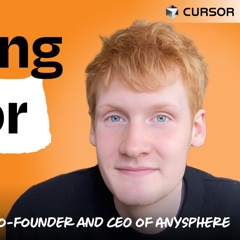
Michael Truell
Co-founder and CEO of Anysphere
Where to hear and read about Michael Truell1 episode or test

Michael Truell is co-founder and CEO of Anysphere, the company behind the AI code editor Cursor, which reached $100 million ARR 20 months after launch and $300 million two years in. The most useful thing to learn from him is to build a tool you use every day yourself, keep humans in control, and hire level-headed people instead of adding process.
no matter what entrenchment you build, you can be leapfrogged.
The rise of Cursor: The $300M ARR AI tool that engineers can’t stop using | Michael Truell
Michael Truell: the story and the lessons
1How Michael Truell and his co-founders landed on Cursor
Truell came to Cursor after about ten years of working on AI. He studied computer science and math at MIT and did AI research at MIT and Google. He rarely does podcasts and has done only one other, Lex Fridman's.
At an early biotech job he built internal tools and saw demand far outstrip what he could build. That experience shapes his view that engineers will be needed more, not less.
Copilot's first beta and scaling papers convinced them useful AI products were possible. At the end of 2021 and start of 2022, Copilot was the first AI product they used that was truly useful, not vaporware. Scaling papers showed AI improving just by scaling models and data.
They deliberately chose a knowledge-work field to apply this to, rather than just talking about making models.
The founders first spent four months on mechanical engineering tools and got it wrong. They avoided coding at first, assuming it was too crowded. They picked a field that looked sleepy, but they were not mechanical engineers and 3D model data is scarce and hard to source.
Truell calls it a "blind man and the elephant" problem. They left once they decided it was not what they wanted to dedicate their lives to: "we came to our senses".
They returned to coding because incumbents in programming tools lacked ambition. Little had changed in programming tools, and the people working on them seemed unambitious. AI has an unusually high ceiling, so a leapfrog was possible.
Truell shipped a from-scratch editor within about three months, fearing private building. The first version needed language support, navigation, error tracking, an integrated command line and remote servers. After about five weeks the team lived in it full time, then ran a short beta.
They expected a couple hundred users for a long time and got an immediate rush of interest. Feedback pushed them to rebase on VS Code, the way many browsers build on Chromium.
2Why Cursor grew by improving the product, not selling
The team used Cursor daily and shipped nothing useless to themselves. Being the end users made them realistic about where the technology really was. That realism led them to keep humans in the driver's seat instead of building end-to-end automation.
"we never wanted to ship anything that wasn't useful to us"
Truell let sales and marketing burn while the team focused on the product. Growth was a steady month-over-month exponential that felt slow when the numbers were small. Cursor hit $100M ARR in about 20 months and $300M at two years, with about 60 people.
They still put real time into team building and support rotations. Launches sped growth up at times, and the overall speed still surprises the team.
Dissatisfaction with the product kept Truell's team improving it. The three-month version was not very good, and the end goal still feels far away.
They built something they liked first, then adjusted it for a set of users.
3Truell's view of where programming is heading
Truell expects code to become a terse, English-like description of logic. He rejects both visions: that software stays formal text in TypeScript, Go, C and Rust, and that people simply message a chatbot. He expects programming languages to evolve toward pseudocode that people can edit and point at.
He describes the move as going from "crazy, hard to understand" toward human-readable and human-editable.
Truell says a chatbot box lacks the precision software needs. People need to gesture at exactly what should change, not type into a text box far from the app. Cursor wants a fast iteration loop with the human in control, not a slow background agent that takes weeks.
Background agents suit tasks that are easy to specify and easy to check, like bug fixes, which is not all of programming.
He built a full editor because the form of programming will change. Existing coding environments can only be extended so far. If the interface has to change, Cursor needs control of the whole application, with background and foreground work in one place.
Teams building only a model or an end-to-end agent picture AI making all the decisions. Cursor wants humans controlling every decision.
Truell thinks taste will matter more than carefulness for future engineers. Engineers become logic designers, specifying the whats more than the hows. Taste means having the right idea for what should be built, not only visual polish.
He admits "taste" is a bit of a misnomer. Carefulness still matters a lot today, and the shift is far off.
He advises working in small specify-then-review steps with AI. The most successful customers scope down what they hand over, specifying a little, letting the AI write, reviewing and repeating. Total specifying time stays about the same but is spread out.
One giant spec with the whole result accepted or rejected is "a recipe for disaster right now".
He tells developers to push models to failure on a side project. Much of the skill is a feel for what task complexity a model can handle. Truell says developers should "explicitly try to fall on their face" in a safe setting.
Juniors lean on AI for everything, which fails in long-lived shared code bases. Seniors on average underrate AI and stick to old workflows.
4Why Cursor became a model company
Cursor trained its own models only where foundation models failed on speed or cost. Autocomplete needs completions within 300 milliseconds and predicts diffs across files on every keystroke. No foundation model could serve that for cost or speed.
The team had done the math on training from scratch and ruled it out. The first custom model served a case where no big model made sense, so they moved to the next case. Truell says every magic moment in Cursor involves a custom model.
Small custom models sit on both sides of the large ones. On input, a model acts like a mini Google search over the code base. On output, the smartest models spend a few tokens sketching and small fast models fill in the full diffs.
The models are mostly built on open source models, and sometimes the team tunes closed models in partnership with their makers. They care about post-training, not reading weights line by line.
Truell picks spots that complement the big models' weaknesses. Pre-training would only replicate what other players had already done. Cursor sits between a normal software company and a foundation model company, and both sides must be excellent.
5How Truell reads the AI coding market
Truell believes the best product wins because the ceiling is so high. He compares the market to search in 1999 and early personal computers. Cursor's moat is closer to a consumer one than to Salesforce-style company-wide contracts.
Big R&D investment keeps paying off, and more distribution improves the product through user feedback, so scale itself becomes defensible.
He sees Copilot's stall as proof that this market resists incumbents. Incumbents win when products commoditize, bundle easily, or switching is painful. Here a user can try several tools and pick the best.
Most of the team behind the first Copilot has moved on, and coordinating across Microsoft's departments is hard. Truell still calls Copilot a big inspiration.
Truell sizes the market by what could be built, not past editor revenue. People pointed to the fragmented 2010s editor market, where one company made modest money. Those editors only added navigation, error checking and debugging, while AI can automate knowledge work far more deeply.
He expects one general tool to build almost all the world's software, calls it "generationally big", and says it is not yet decided that Cursor will be the one.
He expects AI to be bigger than the internet but to take decades. Truell rejects both "it's all hype" and "it will all happen fast". He thinks the companies that own both the technology and the product for one area of knowledge work will matter most.
Demand for software far exceeds what can be built, since even simple software costs about as much as a blockbuster movie. He expects engineers to be needed more, not less.
6How Truell hires and keeps the team focused
Truell recruits world-class people patiently, in some cases for years. Hiring is what Cursor fussed over most, and it still erred by being too slow. The team looked for curiosity, experimentation, intellectual honesty, bluntness and a little pessimism.
Early on the team was bad at pitching people who were not looking. Cursor is going on 60 people, mostly engineers, researchers and designers.
He corrected an early bias toward young, famous-school candidates. Cursor first leaned toward the archetype of a well-known school and very young, high-credential candidates. Later-career people turned out to be fantastic.
They have also hired excellent young people who look "slightly different from being straight out of central casting".
Cursor's core interview is a two-day on-site work test. Candidates do a real mini project from the code base, largely alone with some collaboration. Two days and several meals show whether you want to be around this person.
Truell expected it not to scale past a few people, but it has lasted. When the product was weak, it let candidates meet the team, which was the main selling point.
Truell hires level-headed people instead of adding process. Cursor looks for people who care less about outside validation and more about high quality work, with highs that are not very high and lows that are not very low.
That is why engineering has needed little process for its size, though he says it probably needs a bit more now. His general rule: hire people who already show the behavior a tool is meant to produce.
Years of AI experience taught his team to filter hype. The team has worked on AI since 2021 and 2022. Through GPT-3, ChatGPT, GPT-4, image and video models, only a very small number of developments really affected the business.
Deep learning research shows the same pattern: a few simple, elegant ideas drove most of the progress. The team also studies histories of influential old computer companies to learn how great firms reinvent themselves.

The rise of Cursor: The $300M ARR AI tool that engineers can’t stop using | Michael Truell
Michael Truell explains how Cursor was built by dogfooding, why it ended up training its own models, and how it hired and stayed focused while growing very fast. Cursor reached $100 million ARR 20 months after launch and $300 million two years in, with about 60 people and almost no sales or marketing early on.
Truell came to Cursor after about ten years of working on AI. He studied computer science and math at MIT and did AI research at MIT and Google. He rarely does podcasts and has done only one other, Lex Fridman's.
At an early biotech job he built internal tools and saw demand far outstrip what he could build. That experience shapes his view that engineers will be needed more, not less.
Copilot's first beta and scaling papers convinced them useful AI products were possible. At the end of 2021 and start of 2022, Copilot was the first AI product they used that was truly useful, not vaporware. Scaling papers showed AI improving just by scaling models and data.
They deliberately chose a knowledge-work field to apply this to, rather than just talking about making models.
The founders first spent four months on mechanical engineering tools and got it wrong. They avoided coding at first, assuming it was too crowded. They picked a field that looked sleepy, but they were not mechanical engineers and 3D model data is scarce and hard to source.
Truell calls it a "blind man and the elephant" problem. They left once they decided it was not what they wanted to dedicate their lives to: "we came to our senses".
They returned to coding because incumbents in programming tools lacked ambition. Little had changed in programming tools, and the people working on them seemed unambitious. AI has an unusually high ceiling, so a leapfrog was possible.
Truell shipped a from-scratch editor within about three months, fearing private building. The first version needed language support, navigation, error tracking, an integrated command line and remote servers. After about five weeks the team lived in it full time, then ran a short beta.
They expected a couple hundred users for a long time and got an immediate rush of interest. Feedback pushed them to rebase on VS Code, the way many browsers build on Chromium.
The team used Cursor daily and shipped nothing useless to themselves. Being the end users made them realistic about where the technology really was. That realism led them to keep humans in the driver's seat instead of building end-to-end automation.
"we never wanted to ship anything that wasn't useful to us"
Truell let sales and marketing burn while the team focused on the product. Growth was a steady month-over-month exponential that felt slow when the numbers were small. Cursor hit $100M ARR in about 20 months and $300M at two years, with about 60 people.
They still put real time into team building and support rotations. Launches sped growth up at times, and the overall speed still surprises the team.
Dissatisfaction with the product kept Truell's team improving it. The three-month version was not very good, and the end goal still feels far away.
They built something they liked first, then adjusted it for a set of users.
Truell expects code to become a terse, English-like description of logic. He rejects both visions: that software stays formal text in TypeScript, Go, C and Rust, and that people simply message a chatbot. He expects programming languages to evolve toward pseudocode that people can edit and point at.
He describes the move as going from "crazy, hard to understand" toward human-readable and human-editable.
Truell says a chatbot box lacks the precision software needs. People need to gesture at exactly what should change, not type into a text box far from the app. Cursor wants a fast iteration loop with the human in control, not a slow background agent that takes weeks.
Background agents suit tasks that are easy to specify and easy to check, like bug fixes, which is not all of programming.
He built a full editor because the form of programming will change. Existing coding environments can only be extended so far. If the interface has to change, Cursor needs control of the whole application, with background and foreground work in one place.
Teams building only a model or an end-to-end agent picture AI making all the decisions. Cursor wants humans controlling every decision.
Truell thinks taste will matter more than carefulness for future engineers. Engineers become logic designers, specifying the whats more than the hows. Taste means having the right idea for what should be built, not only visual polish.
He admits "taste" is a bit of a misnomer. Carefulness still matters a lot today, and the shift is far off.
He advises working in small specify-then-review steps with AI. The most successful customers scope down what they hand over, specifying a little, letting the AI write, reviewing and repeating. Total specifying time stays about the same but is spread out.
One giant spec with the whole result accepted or rejected is "a recipe for disaster right now".
He tells developers to push models to failure on a side project. Much of the skill is a feel for what task complexity a model can handle. Truell says developers should "explicitly try to fall on their face" in a safe setting.
Juniors lean on AI for everything, which fails in long-lived shared code bases. Seniors on average underrate AI and stick to old workflows.
Cursor trained its own models only where foundation models failed on speed or cost. Autocomplete needs completions within 300 milliseconds and predicts diffs across files on every keystroke. No foundation model could serve that for cost or speed.
The team had done the math on training from scratch and ruled it out. The first custom model served a case where no big model made sense, so they moved to the next case. Truell says every magic moment in Cursor involves a custom model.
Small custom models sit on both sides of the large ones. On input, a model acts like a mini Google search over the code base. On output, the smartest models spend a few tokens sketching and small fast models fill in the full diffs.
The models are mostly built on open source models, and sometimes the team tunes closed models in partnership with their makers. They care about post-training, not reading weights line by line.
Truell picks spots that complement the big models' weaknesses. Pre-training would only replicate what other players had already done. Cursor sits between a normal software company and a foundation model company, and both sides must be excellent.
Truell believes the best product wins because the ceiling is so high. He compares the market to search in 1999 and early personal computers. Cursor's moat is closer to a consumer one than to Salesforce-style company-wide contracts.
Big R&D investment keeps paying off, and more distribution improves the product through user feedback, so scale itself becomes defensible.
He sees Copilot's stall as proof that this market resists incumbents. Incumbents win when products commoditize, bundle easily, or switching is painful. Here a user can try several tools and pick the best.
Most of the team behind the first Copilot has moved on, and coordinating across Microsoft's departments is hard. Truell still calls Copilot a big inspiration.
Truell sizes the market by what could be built, not past editor revenue. People pointed to the fragmented 2010s editor market, where one company made modest money. Those editors only added navigation, error checking and debugging, while AI can automate knowledge work far more deeply.
He expects one general tool to build almost all the world's software, calls it "generationally big", and says it is not yet decided that Cursor will be the one.
He expects AI to be bigger than the internet but to take decades. Truell rejects both "it's all hype" and "it will all happen fast". He thinks the companies that own both the technology and the product for one area of knowledge work will matter most.
Demand for software far exceeds what can be built, since even simple software costs about as much as a blockbuster movie. He expects engineers to be needed more, not less.
Truell recruits world-class people patiently, in some cases for years. Hiring is what Cursor fussed over most, and it still erred by being too slow. The team looked for curiosity, experimentation, intellectual honesty, bluntness and a little pessimism.
Early on the team was bad at pitching people who were not looking. Cursor is going on 60 people, mostly engineers, researchers and designers.
He corrected an early bias toward young, famous-school candidates. Cursor first leaned toward the archetype of a well-known school and very young, high-credential candidates. Later-career people turned out to be fantastic.
They have also hired excellent young people who look "slightly different from being straight out of central casting".
Cursor's core interview is a two-day on-site work test. Candidates do a real mini project from the code base, largely alone with some collaboration. Two days and several meals show whether you want to be around this person.
Truell expected it not to scale past a few people, but it has lasted. When the product was weak, it let candidates meet the team, which was the main selling point.
Truell hires level-headed people instead of adding process. Cursor looks for people who care less about outside validation and more about high quality work, with highs that are not very high and lows that are not very low.
That is why engineering has needed little process for its size, though he says it probably needs a bit more now. His general rule: hire people who already show the behavior a tool is meant to produce.
Years of AI experience taught his team to filter hype. The team has worked on AI since 2021 and 2022. Through GPT-3, ChatGPT, GPT-4, image and video models, only a very small number of developments really affected the business.
Deep learning research shows the same pattern: a few simple, elegant ideas drove most of the progress. The team also studies histories of influential old computer companies to learn how great firms reinvent themselves.