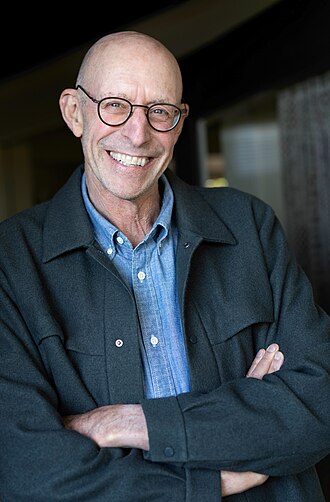
Michael Pollan
Author and journalist, writes about food, plants and consciousness; has taught nonfiction writing at Harvard and UC Berkeley
Where to hear and read about Michael Pollan1 episode or test

Michael Pollan is a journalist and author of The Omnivore's Dilemma and A World Appears, who has taught nonfiction writing at Harvard and UC Berkeley. The thing most worth learning from him is to build every piece around a plain question, put yourself inside the story, and treat the writing itself as the way you think.
Writing is a form of thinking. It's not just a form of expression.
Harvard Professor Teaches Writing (Michael Pollan Interview)
Michael Pollan: the story and the lessons
1How Michael Pollan reports a story
Pollan turns his curiosity into an adventure, then reports back. He experiences things, talks to people and learns, then puts it all into a book. He has done this on food, nature and consciousness for decades.
He edited at Harper's Magazine for about ten years before writing, and his tone is a friendly arm around the reader's shoulder.
He frames each piece around a plain question the reader cares about. Almost everything he writes is a quest to answer one question or several. The question also creates suspense, because readers wonder whether he can answer it.
He calls it a principle of exclusion: "Does this contribute to answering this question?" If material doesn't, it stays out.
Pollan bought a steer to find the story of the meat industry. For a New York Times Magazine cover story he paid $600 of his own money for steer 534. Feedlot staff and ranchers treated him more like a client and were less guarded.
Owning the animal gave him decisions to write about, such as a $15 hormone implant that added about $50 in weight. The rancher, not Pollan, suggested buying the animal. He took the participatory idea from George Plimpton's Paper Lion: "Finding the way to put myself in the story is finding the story."
He researches in two phases: the general case, then a case study. First he learns how the system works and what is typical. Then he looks for access to a specific case, such as a rancher who gives good quotes, an animal, a feedlot and a slaughterhouse.
Four companies slaughter about 85% of US beef. He started with ranchers, who are the feedlots' customers, instead of their PR departments, and that got him in.
Pollan looks for the central conflict in a field to organize a story. He says narrative depends on conflict. Among beekeepers, localists and globalists hate each other, and he found the same kind of split among scientists.
A World Appears opens with a bet between Christof Koch and David Chalmers over whether the neural correlates of consciousness would be found in 25 years. The stake was a case of fine wine, and a simple bet carries readers for 20 pages.
He picks characters who speak vividly, have authority and play against type. He checks interview quotes for who sings and who halts and bores. A rancher can turn out to be a bookkeeper in a visor rather than a cowboy.
He points to Michael Lewis, who keeps finding quirky nonconformists in Moneyball and The Big Short.
2Pollan's laundry line, metaphors and voice
Pollan hangs his facts on a narrative line like laundry. The life of steer 534 was the line, and the themes of corn, drugs and pollution hung on it. His editor Jerry Marzorati suggested following one animal.
Spacing matters: "if you clump it all together, it sags." He allows ten or twenty steps off the path to look at a mushroom, but never loses it. The suspense of the coming slaughter bought him room for exposition.
He uses fair, vivid metaphors to persuade without arguing. He set a sunlight-based food chain against an oil-based one, and readers chose the sunlight themselves. He says a vivid and fair metaphor does about 90% of the work.
A metaphor implies an equation, so it has to be accurate too. He argues "the brain is a computer" leads to "consciousness is software," which makes conscious AI look easy.
He writes as a curious guide who starts naive. Pollan thinks readers dislike being lectured from the summit of the writer's conclusions. He opens with more questions than answers and lets the voice grow more sophisticated.
Feigned ignorance isn't dishonest, he says. Like holding back a joke's punchline, you recreate your earlier curiosity even though you know the ending.
He writes in the first person because an omniscient voice fakes authority. Editor Lewis Lapham asked of every Harper's pitch: who is this person and why do they care? The answer had to appear on the first page, lightly and not as confession.
Pollan also borrowed the over-the-back-fence tone of garden writing, which lets him speak directly to the reader.
3How Michael Pollan writes an introduction
Pollan usually writes the introduction last and rewrites it many times. He rewrote the introduction to The Botany of Desire 25 to 30 times, with editor Ann Godoff and friend Paul Tough. For A World Appears he drafted it first and rewrote it at the end.
A good one gives an origin story, the questions, a preview and a pull forward, while withholding the answer. It should promise only what the book delivers. "Very important decisions about your book will be made based on the introduction and nothing else."
He uses the introduction to say what the book is not. A Place of My Own first came out without one, and a reviewer faulted it for not giving enough information to build the same building. Pollan added an introduction ten years later.
A line like "This is not a book that does X" heads off criticism of the book you didn't write.
4Pollan's writing day and working habits
He starts every writing day by re-editing the piece from page one. He prints the pages, marks them up by hand for one to two hours, enters the changes, then adds a few new pages. His session runs from about 9:30 to 1:00.
The edit primes the pump, and the beginnings end up heavily refined: "Every morning, I'm starting at the beginning." He tells students it is not the only way, since some friends write a rough draft without looking back.
Pollan keeps one searchable journal per project and writes in it daily. During research it holds quotes, readings and interview highlights, with full interviews in separate files. After any experience he writes down everything he remembers that night.
He says his memory is poor, so the journal holds what he needs. He uses only a fraction of it, and the rest is composted.
He steps away from too much material and lets forgetting edit it. He is not a writer who vomits a first draft. When material overwhelms him, he leaves it for days or weeks and works from what sticks.
He cites cannabis scientist Raphael Mechoulam's point that nobody wants to remember every face on the subway. He is doing this now on a microbiome piece that brings about 20 new items a day.
Pollan reads novels while drafting to absorb cadence and metaphor. Once research is done he stops taking in information and reads fiction, which he thinks is generally better written than nonfiction. He believes what he reads before bed shapes the next day's prose.
He names Ted Hoagland as a help on his most nature-heavy writing and admires the sturdy sentences of Wendell Berry.
He expects writing to stay hard and bargains with himself. Unlike woodworking, writing never becomes second nature, and he still struggles after about 40 years. He sets small goals, such as how much to write before a snack.
"Just because you find it difficult doesn't mean you're not born to do it."
5Why Pollan treats writing as thinking
Pollan discovers ideas while drafting that outlining never gave him. He says that comparing what you planned with what you wrote would surprise you. His wife, a painter, works the same way: one mark leads to the next.
The thrill is learning something during the day's writing. He warns that handing the work to AI costs students that discovery.
He uses AI only for definitions and origins, and distrusts the rest. Gemini and ChatGPT have made huge mistakes in his hands. They did help him learn that electromagnetism was discovered only about 200 years ago, with Michael Faraday.
He used that as an analogy for panpsychism, which sounds crazy but resembles another quality once added to matter. He never took high school physics, so he hadn't known the history.

Harvard Professor Teaches Writing (Michael Pollan Interview)
Pollan shows how a nonfiction piece is built from a framing question, a narrative spine he calls the laundry line, and a persuasive metaphor, with the writer put inside the story. The habit worth hearing is his morning routine of re-editing the piece from page one before drafting forward, plus a daily research journal.
Pollan turns his curiosity into an adventure, then reports back. He experiences things, talks to people and learns, then puts it all into a book. He has done this on food, nature and consciousness for decades.
He edited at Harper's Magazine for about ten years before writing, and his tone is a friendly arm around the reader's shoulder.
He frames each piece around a plain question the reader cares about. Almost everything he writes is a quest to answer one question or several. The question also creates suspense, because readers wonder whether he can answer it.
He calls it a principle of exclusion: "Does this contribute to answering this question?" If material doesn't, it stays out.
Pollan bought a steer to find the story of the meat industry. For a New York Times Magazine cover story he paid $600 of his own money for steer 534. Feedlot staff and ranchers treated him more like a client and were less guarded.
Owning the animal gave him decisions to write about, such as a $15 hormone implant that added about $50 in weight. The rancher, not Pollan, suggested buying the animal. He took the participatory idea from George Plimpton's Paper Lion: "Finding the way to put myself in the story is finding the story."
He researches in two phases: the general case, then a case study. First he learns how the system works and what is typical. Then he looks for access to a specific case, such as a rancher who gives good quotes, an animal, a feedlot and a slaughterhouse.
Four companies slaughter about 85% of US beef. He started with ranchers, who are the feedlots' customers, instead of their PR departments, and that got him in.
Pollan looks for the central conflict in a field to organize a story. He says narrative depends on conflict. Among beekeepers, localists and globalists hate each other, and he found the same kind of split among scientists.
A World Appears opens with a bet between Christof Koch and David Chalmers over whether the neural correlates of consciousness would be found in 25 years. The stake was a case of fine wine, and a simple bet carries readers for 20 pages.
He picks characters who speak vividly, have authority and play against type. He checks interview quotes for who sings and who halts and bores. A rancher can turn out to be a bookkeeper in a visor rather than a cowboy.
He points to Michael Lewis, who keeps finding quirky nonconformists in Moneyball and The Big Short.
Pollan hangs his facts on a narrative line like laundry. The life of steer 534 was the line, and the themes of corn, drugs and pollution hung on it. His editor Jerry Marzorati suggested following one animal.
Spacing matters: "if you clump it all together, it sags." He allows ten or twenty steps off the path to look at a mushroom, but never loses it. The suspense of the coming slaughter bought him room for exposition.
He uses fair, vivid metaphors to persuade without arguing. He set a sunlight-based food chain against an oil-based one, and readers chose the sunlight themselves. He says a vivid and fair metaphor does about 90% of the work.
A metaphor implies an equation, so it has to be accurate too. He argues "the brain is a computer" leads to "consciousness is software," which makes conscious AI look easy.
He writes as a curious guide who starts naive. Pollan thinks readers dislike being lectured from the summit of the writer's conclusions. He opens with more questions than answers and lets the voice grow more sophisticated.
Feigned ignorance isn't dishonest, he says. Like holding back a joke's punchline, you recreate your earlier curiosity even though you know the ending.
He writes in the first person because an omniscient voice fakes authority. Editor Lewis Lapham asked of every Harper's pitch: who is this person and why do they care? The answer had to appear on the first page, lightly and not as confession.
Pollan also borrowed the over-the-back-fence tone of garden writing, which lets him speak directly to the reader.
Pollan usually writes the introduction last and rewrites it many times. He rewrote the introduction to The Botany of Desire 25 to 30 times, with editor Ann Godoff and friend Paul Tough. For A World Appears he drafted it first and rewrote it at the end.
A good one gives an origin story, the questions, a preview and a pull forward, while withholding the answer. It should promise only what the book delivers. "Very important decisions about your book will be made based on the introduction and nothing else."
He uses the introduction to say what the book is not. A Place of My Own first came out without one, and a reviewer faulted it for not giving enough information to build the same building. Pollan added an introduction ten years later.
A line like "This is not a book that does X" heads off criticism of the book you didn't write.
He starts every writing day by re-editing the piece from page one. He prints the pages, marks them up by hand for one to two hours, enters the changes, then adds a few new pages. His session runs from about 9:30 to 1:00.
The edit primes the pump, and the beginnings end up heavily refined: "Every morning, I'm starting at the beginning." He tells students it is not the only way, since some friends write a rough draft without looking back.
Pollan keeps one searchable journal per project and writes in it daily. During research it holds quotes, readings and interview highlights, with full interviews in separate files. After any experience he writes down everything he remembers that night.
He says his memory is poor, so the journal holds what he needs. He uses only a fraction of it, and the rest is composted.
He steps away from too much material and lets forgetting edit it. He is not a writer who vomits a first draft. When material overwhelms him, he leaves it for days or weeks and works from what sticks.
He cites cannabis scientist Raphael Mechoulam's point that nobody wants to remember every face on the subway. He is doing this now on a microbiome piece that brings about 20 new items a day.
Pollan reads novels while drafting to absorb cadence and metaphor. Once research is done he stops taking in information and reads fiction, which he thinks is generally better written than nonfiction. He believes what he reads before bed shapes the next day's prose.
He names Ted Hoagland as a help on his most nature-heavy writing and admires the sturdy sentences of Wendell Berry.
He expects writing to stay hard and bargains with himself. Unlike woodworking, writing never becomes second nature, and he still struggles after about 40 years. He sets small goals, such as how much to write before a snack.
"Just because you find it difficult doesn't mean you're not born to do it."
Pollan discovers ideas while drafting that outlining never gave him. He says that comparing what you planned with what you wrote would surprise you. His wife, a painter, works the same way: one mark leads to the next.
The thrill is learning something during the day's writing. He warns that handing the work to AI costs students that discovery.
He uses AI only for definitions and origins, and distrusts the rest. Gemini and ChatGPT have made huge mistakes in his hands. They did help him learn that electromagnetism was discovered only about 200 years ago, with Michael Faraday.
He used that as an analogy for panpsychism, which sounds crazy but resembles another quality once added to matter. He never took high school physics, so he hadn't known the history.