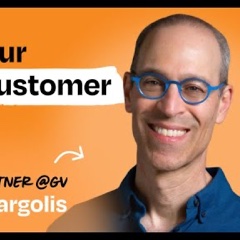
Michael Margolis
UX Research Partner at GV (Google Ventures)
Where to hear and read about Michael Margolis1 episode or test

Michael Margolis is a UX research partner at GV who has run over 300 hands-on research sprints with startups. The thing most worth learning from him is to pick a comically narrow bullseye customer, then test it in one day with five interviews and three simple prototypes that the whole team watches live.
Build only as much as you actually need to answer the question you're trying to answer.
Identify your bullseye customer in one day | Michael Margolis (UX Research Partner at GV)
Michael Margolis: the story and the lessons
1Michael Margolis: from anthropology to 300 research sprints
Margolis learned slow, deep research first, then learned to make it fast. He studied anthropology, and his first job was editing educational software, which introduced him to usability testing. Next came a boutique design studio serving Alcoa, DuPont and Ericsson, with long, expensive ethnographic projects.
Thirty years of research moved from slow, deep studies to fast ones, and that path shaped the sprint.
Walmart.com forced him to compress research to fit a culture of speed. He had to fit ethnographic techniques to a culture of execution, scale and speed, and learned to combine discovery with usability work.
Walmart gave him 'lots and lots of reps'. At Gmail in 2006 he used one-way mirrors and streamed video so product teams could watch sessions live.
He became GV's first UX research partner in venture capital. He joined in 2010, perhaps one of only two such people in venture capital then. He has run over 300 hands-on sprints plus many office hours, across biotech, healthcare, security and food, including farmers.
He describes the sprint as a recombination of pieces gathered over 30-plus years, tested over fourteen years at GV.
2Why Margolis starts with a comically narrow customer
Margolis says products start with a narrow group, not everybody. Amazon began with books and Facebook with college student profiles. Gong began with English-speaking software firms selling by video conference, and Linear with two-to-five-person startups using GitHub.
Founders want to build for everybody and GV wants them to reach huge markets, but 'it doesn't start there.' Margolis would make even those first customers more concrete.
A narrow bullseye filters both the roadmap and the feedback. Early input pours in from investors, friends and family, and people who only seem to be in the market. The bullseye lets a team answer them with 'We'll get to you'.
The same choice sets what to build, which questions to ask and who to set aside until later.
Too much variation in the sample turns results to mush. Andy Johns says the target should feel comically narrow. The aim is a person everyone agrees would say 'I need this thing'.
With varied samples you can't tell mixed feelings from inconsistent customers.
The bullseye is for learning, and the broader ICP is for selling. You learn from the people who love the product most, then widen the target to pitch. The team is expert, so the definition is only an informed guess.
A main outcome of the sprint is adjusting the definition, often after spotting a trait nobody expected.
He treats a group you cannot find, or cannot excite, as a warning. If you can't find anyone thrilled, or can't recruit the group at all, doubt that the group exists. A founder who killed his project after three rounds avoided building hardware, software and a subscription model.
His words, as Margolis tells it: 'Now I know what no looks like.'
3How Margolis defines a bullseye customer
He starts from what keeps the team up at night. A 45-minute meeting with the core team surfaces key assumptions, what would have to be true for success, and the nagging debates the team keeps repeating.
Those questions decide who to talk to: new customers for onboarding questions, existing customers for a feature already in the product.
He describes the bullseye with about seven concrete traits. The traits split into inclusion criteria, exclusion criteria and triggers, which are events that make someone ripe to buy, like a new cybersecurity chief arriving.
In the insurance example, millennials all said they should buy life insurance, but those with a trigger like a new baby or marriage were the real bullseye.
He spends the most brainstorming time on exclusions. Teams find inclusion quick and hate setting people aside. Exclusions can include people locked into a competitor's product, or for a fintech product someone in bankruptcy or with stolen identity.
'You want to help them, but not first.'
He gives teams a standard attribute list to work through. Prompts include new or existing user, sector, company size, title, geography, buyer or end user, budget, work setting, trigger events and VIP.
VIP came from asking one early-stage company what makes one customer more valuable to it, as a way to find a pattern among many personas.
In medication delivery, a small subset felt a far bigger need. Patients cared more about a predictable delivery window than speed, and the need was sharpest for refrigerated cold chain medications. The team re-recruited that group and the second round confirmed it.
Criteria had included prior use of something like Uber Eats, long-term use of the medication, and managing their own prescriptions.
4How Margolis runs the one-day sprint
The formula is five bullseye customers and three simple prototypes. Five one-hour interviews fit in a day, or two days across time zones. Five usually reaches data saturation, where teams hear the same things repeatedly.
Clumping the interviews makes patterns obvious, where spreading them over a week blurs the signal. It won't answer every question, but it shows whether the main idea worked.
Agreeing on the five people beforehand makes results hard to dismiss. The choice of five is the team's hypothesis, written down before any interview. If everyone agrees these are the people who would want this, nobody can wave away the feedback.
A negative reaction is acceptable, because the team set out to learn exactly that.
He runs a sprint before building, when expanding, or when traction stalls. Triggers include moving from the UK to the US, shifting from white-glove enterprise sales to self-serve, and launching to weak traction.
Polite, encouraging feedback can hide a real no, and a sprint helps find out. It can be repeated as often as needed.
He recruits with screeners that do not give away answers. Criteria must be concrete and measurable, so 'active shopper' becomes buying a defined item three times a week. Panels such as User Interviews and Respondent let him recruit in three or four days.
Advertising $125 for product managers who listen to a podcast draws people who just want the money, so he asks open questions. Hard-to-reach groups like oncologists need forums, conferences, associations or snowball recruiting.
He pays about $125 an hour and chases every NDA signature. He paid about $400 an hour for attorneys. Reminders go out all week, a silent person is swapped out, and he uses no backup participants yet gets very high follow-through.
The $125 comes from an Alphabet policy. 'I'm not giving $20 Starbucks cards, because somebody's going to blow you off.'
5Margolis's rules for prototypes and interviews
Three different prototypes beat one polished concept. Each prototype mixes the variables differently, such as pharmacist, courier or drone delivery, and a 15-minute window versus as soon as possible.
Like shopping for a couch, one option gets opinions and three give reference points. He is collecting the best Lego pieces, not picking a winner.
He writes prototypes as flat, blunt value proposition pages. They are mostly PDFs or images shown over Zoom, built like a product home page. Each stands alone with no narrating, in plain language rather than marketing speak.
Colors like green, blue and red replace A, B and C. Someone outside the project proofreads every version, since typos undermine credibility. AI makes functional prototypes easy, but he builds only what the question needs.
He treats a competitor's product as a free prototype. He watches how real people respond to competitors' products, not only goes through them himself.
Teams skip this because it feels like cheating or copying, and miss what people already react to.
Each interview has a discovery half, then a prototype half. The first half asks about past experiences, such as a time it totally went sideways. The second half shows each prototype and asks people to compare and contrast.
Teams push to skip to the prototypes, but a distrust of one may trace back to an earlier delivery that went wrong.
He interviews in learning mode, using humble inquiry rather than selling. He starts with a big smile and small talk, makes clear the participant is the expert, and digs into odd answers with 'Why do you think that?'
He puts on a 'listener character' before each interview, far from his skeptical self. Having interviewed thousands of people, his kids hardly recognize the voice. He cites Ed Schein: humble inquiry is the gentle art of asking instead of telling.
6How Margolis runs the watch party instead of writing a report
He has not written a research report in about ten years. The sprint is livestreamed over Zoom with the core team watching, and a design partner such as Kate Aronowitz or Vanessa Cho runs the back room. The record attendance was 40 people.
The core product team attends every interview, since it will own the build and decisions. Watching together replaces persuading anyone.
The team takes notes by hand and debriefs between interviews. A half-hour debrief fills a spreadsheet with key questions as rows and participants as columns, led by the founder or owner. A Google Form at day's end collects takeaways, bullseye changes and next steps.
There is no AI note-taker, because manual notes keep people from leaning out to check email. Teams usually reach strong consensus.
He has the team write specific predictions before the day. A prediction must be specific, such as 'People will prefer ASAP delivery.' Comparing results afterward counters hindsight bias and checks that the guide targets what the team wants to learn.
'It's very difficult to remember that you didn't already know this.' Being right is fine too, since the team then moves twice as fast.
He expects expert teams to overestimate their customers. Teams overestimate how much customers know, how big they see the problem, how much they will pay and how ready they are to buy.
Margolis shows up as the newcomer, so he sees what the experts can't.
7What Margolis trusts, and where his sprints went wrong
He weights past behavior over what people say they will do. He anchors on what a participant has actually done and is skeptical when a prototype reaction contradicts it. Teammates jokingly call out confirmation bias during the watch party.
'We're all terrible at this, predicting what we're going to do.'
He trusts only extreme excitement as a sign of a match. Match looks like people asking 'Is this available? Can I sign up?' A casual 'I would totally do this' that contradicts earlier answers deserves skepticism.
If you can't tell whether they are excited, it's probably a no. He says this is also how product-market fit is said to feel.
His weak sprints came from recruiting that was not picky enough. Teams took over recruiting and let in experts they already talk to, which gave mushy samples and mushy conclusions.
He blames himself: 'I just wasn't picky enough.' The fix is discipline about who gets a slot.
Over time one or two attributes become the real filter. Those attributes help prioritize leads and streamline sales. Linear used its launch wait list as a screener survey asking about auth and code hosting, and admitted the people who best matched what the product could do that day.
He sees the method carrying over to biotech. Once the science is done, biotech teams must fit a therapy into a physician's workflow and recruit people onto trials. Margolis treats a clinical trial as a product to streamline and calls the area greenfield.
The book, demo interview videos and worksheets are free at learnmorefaster.com, and GV open-sourced the method.

Identify your bullseye customer in one day | Michael Margolis (UX Research Partner at GV)
A step-by-step method for finding your bullseye customer, the narrow group most likely to adopt your product first, in a single day using five interviews, three simple prototypes and a team watch party. It comes from over 300 hands-on research sprints with startups, and it can save a team from building something nobody wants.
Margolis learned slow, deep research first, then learned to make it fast. He studied anthropology, and his first job was editing educational software, which introduced him to usability testing. Next came a boutique design studio serving Alcoa, DuPont and Ericsson, with long, expensive ethnographic projects.
Thirty years of research moved from slow, deep studies to fast ones, and that path shaped the sprint.
Walmart.com forced him to compress research to fit a culture of speed. He had to fit ethnographic techniques to a culture of execution, scale and speed, and learned to combine discovery with usability work.
Walmart gave him 'lots and lots of reps'. At Gmail in 2006 he used one-way mirrors and streamed video so product teams could watch sessions live.
He became GV's first UX research partner in venture capital. He joined in 2010, perhaps one of only two such people in venture capital then. He has run over 300 hands-on sprints plus many office hours, across biotech, healthcare, security and food, including farmers.
He describes the sprint as a recombination of pieces gathered over 30-plus years, tested over fourteen years at GV.
Margolis says products start with a narrow group, not everybody. Amazon began with books and Facebook with college student profiles. Gong began with English-speaking software firms selling by video conference, and Linear with two-to-five-person startups using GitHub.
Founders want to build for everybody and GV wants them to reach huge markets, but 'it doesn't start there.' Margolis would make even those first customers more concrete.
A narrow bullseye filters both the roadmap and the feedback. Early input pours in from investors, friends and family, and people who only seem to be in the market. The bullseye lets a team answer them with 'We'll get to you'.
The same choice sets what to build, which questions to ask and who to set aside until later.
Too much variation in the sample turns results to mush. Andy Johns says the target should feel comically narrow. The aim is a person everyone agrees would say 'I need this thing'.
With varied samples you can't tell mixed feelings from inconsistent customers.
The bullseye is for learning, and the broader ICP is for selling. You learn from the people who love the product most, then widen the target to pitch. The team is expert, so the definition is only an informed guess.
A main outcome of the sprint is adjusting the definition, often after spotting a trait nobody expected.
He treats a group you cannot find, or cannot excite, as a warning. If you can't find anyone thrilled, or can't recruit the group at all, doubt that the group exists. A founder who killed his project after three rounds avoided building hardware, software and a subscription model.
His words, as Margolis tells it: 'Now I know what no looks like.'
He starts from what keeps the team up at night. A 45-minute meeting with the core team surfaces key assumptions, what would have to be true for success, and the nagging debates the team keeps repeating.
Those questions decide who to talk to: new customers for onboarding questions, existing customers for a feature already in the product.
He describes the bullseye with about seven concrete traits. The traits split into inclusion criteria, exclusion criteria and triggers, which are events that make someone ripe to buy, like a new cybersecurity chief arriving.
In the insurance example, millennials all said they should buy life insurance, but those with a trigger like a new baby or marriage were the real bullseye.
He spends the most brainstorming time on exclusions. Teams find inclusion quick and hate setting people aside. Exclusions can include people locked into a competitor's product, or for a fintech product someone in bankruptcy or with stolen identity.
'You want to help them, but not first.'
He gives teams a standard attribute list to work through. Prompts include new or existing user, sector, company size, title, geography, buyer or end user, budget, work setting, trigger events and VIP.
VIP came from asking one early-stage company what makes one customer more valuable to it, as a way to find a pattern among many personas.
In medication delivery, a small subset felt a far bigger need. Patients cared more about a predictable delivery window than speed, and the need was sharpest for refrigerated cold chain medications. The team re-recruited that group and the second round confirmed it.
Criteria had included prior use of something like Uber Eats, long-term use of the medication, and managing their own prescriptions.
The formula is five bullseye customers and three simple prototypes. Five one-hour interviews fit in a day, or two days across time zones. Five usually reaches data saturation, where teams hear the same things repeatedly.
Clumping the interviews makes patterns obvious, where spreading them over a week blurs the signal. It won't answer every question, but it shows whether the main idea worked.
Agreeing on the five people beforehand makes results hard to dismiss. The choice of five is the team's hypothesis, written down before any interview. If everyone agrees these are the people who would want this, nobody can wave away the feedback.
A negative reaction is acceptable, because the team set out to learn exactly that.
He runs a sprint before building, when expanding, or when traction stalls. Triggers include moving from the UK to the US, shifting from white-glove enterprise sales to self-serve, and launching to weak traction.
Polite, encouraging feedback can hide a real no, and a sprint helps find out. It can be repeated as often as needed.
He recruits with screeners that do not give away answers. Criteria must be concrete and measurable, so 'active shopper' becomes buying a defined item three times a week. Panels such as User Interviews and Respondent let him recruit in three or four days.
Advertising $125 for product managers who listen to a podcast draws people who just want the money, so he asks open questions. Hard-to-reach groups like oncologists need forums, conferences, associations or snowball recruiting.
He pays about $125 an hour and chases every NDA signature. He paid about $400 an hour for attorneys. Reminders go out all week, a silent person is swapped out, and he uses no backup participants yet gets very high follow-through.
The $125 comes from an Alphabet policy. 'I'm not giving $20 Starbucks cards, because somebody's going to blow you off.'
Three different prototypes beat one polished concept. Each prototype mixes the variables differently, such as pharmacist, courier or drone delivery, and a 15-minute window versus as soon as possible.
Like shopping for a couch, one option gets opinions and three give reference points. He is collecting the best Lego pieces, not picking a winner.
He writes prototypes as flat, blunt value proposition pages. They are mostly PDFs or images shown over Zoom, built like a product home page. Each stands alone with no narrating, in plain language rather than marketing speak.
Colors like green, blue and red replace A, B and C. Someone outside the project proofreads every version, since typos undermine credibility. AI makes functional prototypes easy, but he builds only what the question needs.
He treats a competitor's product as a free prototype. He watches how real people respond to competitors' products, not only goes through them himself.
Teams skip this because it feels like cheating or copying, and miss what people already react to.
Each interview has a discovery half, then a prototype half. The first half asks about past experiences, such as a time it totally went sideways. The second half shows each prototype and asks people to compare and contrast.
Teams push to skip to the prototypes, but a distrust of one may trace back to an earlier delivery that went wrong.
He interviews in learning mode, using humble inquiry rather than selling. He starts with a big smile and small talk, makes clear the participant is the expert, and digs into odd answers with 'Why do you think that?'
He puts on a 'listener character' before each interview, far from his skeptical self. Having interviewed thousands of people, his kids hardly recognize the voice. He cites Ed Schein: humble inquiry is the gentle art of asking instead of telling.
He has not written a research report in about ten years. The sprint is livestreamed over Zoom with the core team watching, and a design partner such as Kate Aronowitz or Vanessa Cho runs the back room. The record attendance was 40 people.
The core product team attends every interview, since it will own the build and decisions. Watching together replaces persuading anyone.
The team takes notes by hand and debriefs between interviews. A half-hour debrief fills a spreadsheet with key questions as rows and participants as columns, led by the founder or owner. A Google Form at day's end collects takeaways, bullseye changes and next steps.
There is no AI note-taker, because manual notes keep people from leaning out to check email. Teams usually reach strong consensus.
He has the team write specific predictions before the day. A prediction must be specific, such as 'People will prefer ASAP delivery.' Comparing results afterward counters hindsight bias and checks that the guide targets what the team wants to learn.
'It's very difficult to remember that you didn't already know this.' Being right is fine too, since the team then moves twice as fast.
He expects expert teams to overestimate their customers. Teams overestimate how much customers know, how big they see the problem, how much they will pay and how ready they are to buy.
Margolis shows up as the newcomer, so he sees what the experts can't.
He weights past behavior over what people say they will do. He anchors on what a participant has actually done and is skeptical when a prototype reaction contradicts it. Teammates jokingly call out confirmation bias during the watch party.
'We're all terrible at this, predicting what we're going to do.'
He trusts only extreme excitement as a sign of a match. Match looks like people asking 'Is this available? Can I sign up?' A casual 'I would totally do this' that contradicts earlier answers deserves skepticism.
If you can't tell whether they are excited, it's probably a no. He says this is also how product-market fit is said to feel.
His weak sprints came from recruiting that was not picky enough. Teams took over recruiting and let in experts they already talk to, which gave mushy samples and mushy conclusions.
He blames himself: 'I just wasn't picky enough.' The fix is discipline about who gets a slot.
Over time one or two attributes become the real filter. Those attributes help prioritize leads and streamline sales. Linear used its launch wait list as a screener survey asking about auth and code hosting, and admitted the people who best matched what the product could do that day.
He sees the method carrying over to biotech. Once the science is done, biotech teams must fit a therapy into a physician's workflow and recruit people onto trials. Margolis treats a clinical trial as a product to streamline and calls the area greenfield.
The book, demo interview videos and worksheets are free at learnmorefaster.com, and GV open-sourced the method.