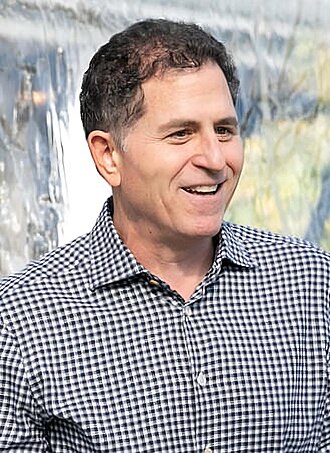
Michael Dell
Founder, chairman and CEO of Dell Technologies
Where to hear and read about Michael Dell1 episode or test

Michael Dell has run Dell Technologies for 41 years, starting with $1,000 in a University of Texas dorm room and outlasting thousands of American computer makers. The lesson most worth taking from him is that taking things apart to understand true costs can turn a lack of capital into a structural advantage rivals cannot see or copy.
In business, it's better if the competitor doesn't understand or doesn't see you.
Michael Dell, Dell Technologies | David Senra
Michael Dell: the story and the lessons
1How Michael Dell's need to take things apart started early
Dell's obsession with understanding things began around age 11 or 12. He dates it to about a decade before the company existed, so it spans about 50 years. Riding the bus to summer classes at Rice University, he stayed on to roam downtown Houston alone and found the stock exchange, its tickers running.
His parents talked about financial markets at dinner, and the tickers got him studying the stock market. He describes it as going deep on a few topics rather than being interested in many.
He learned how things work by opening them up. He took apart things around the house, and sometimes they still worked afterward. At about 12 he saved up for an Apple II and took it apart as soon as it came home.
He wanted to know why each part was chosen over the alternatives. "How can you understand something without taking it apart?" His son Zach calls him addicted to puzzles and says the only way to stop him is "You have to kill him."
Seeing Steve Jobs at 15 made starting a company feel possible. Jobs spoke to his Apple user group when Dell was about 15. Jobs and Bill Gates were only about 10 years older than him.
His takeaway: "Maybe I've got a shot." He also read about Charles Schwab, Fred Smith, Sam Walton and telecom pioneers, studying how founders struggled whether they succeeded or failed.
His parents' pushback turned a hobby into a commitment. They wanted him to become a doctor, and his mother cried. He quit computers for 10 days, then decided he had to build the company.
"This is more than a little hobby or a side thing. This is just like, I have to go do this." Asked how many hours he worked at the start, he answered, "All of them."
2How Michael Dell reverse-engineered IBM's PC
Inside the IBM PC, Dell found no parts IBM made itself. The chips, disk drives and power supply were all bought in. IBM was then the most valuable company in the world and the first to a $100 billion market cap.
Because the PC used off-the-shelf chips rather than custom ASICs, he could follow the logic flow and see each chip's role.
He priced every component and saw a huge markup. Distributors quoted chip prices per 100 units, so he could add up the cost of the whole machine and compare it to IBM's price.
"Wow. They're really charging an incredible markup for this." The gap showed a newcomer could assemble the same thing.
3How Dell turned no capital into a negative cash conversion cycle
With no money, Dell built a business where growth produced cash. Dell shrank inventory, collected from customers fast and paid suppliers a little later. That meant little outside capital and a high return on the capital used.
"If you're growing and you have a negative cash conversion cycle, you actually generate a lot of cash."
Dell held about 5 days of inventory against rivals' 90. Rivals' chains of distributors and dealers created the 90 days. Since component prices fall steadily, Dell's fresher parts cost less and carried newer technology.
Selling direct also gave a constant feedback loop from customers. Dell's analogy: rivals were selling "90-day-old fish or bananas."
Chip date codes let Dell date competitors' inventory. Codes like 42-92 meant week 42 of 1992, so opening a rival's machine showed how old its stock was.
To Dell the codes were "right there," but only someone who takes computers apart would read them. During the Black Friday market scare, Lee Walker found him taking apart another computer.
Dell recruited Lee Walker to run what he found less interesting. At 21, Dell hired Walker, then about 45, to organize operations and finance. Walker later helped with the private placement and the IPO.
This freed Dell to focus on technology and customers. Walker's explanation for Dell's ease while he lost sleep was that Dell had built a business natural to him.
Walker unlocked credit by borrowing against big customers' receivables. Revenue was about $60 million a year while the bank held about $200,000, and banks would not trust a 21-year-old who started with $1,000. Walker pointed lenders to Texaco-sized purchase orders.
Lenders relied on the customers' credit, not the founder's, and the receivables-based financing broke the logjam.
4Why rivals underestimated Michael Dell
Compaq dismissed Dell as a mail-order garage operation. Dell found the insult motivating and wanted rivals to misunderstand the direct model. A $795 direct-sold Dell outperformed a $1,500 Compaq sold only in stores.
With no stores, rivals only noticed Dell if they ordered from it or paid close attention. Dell says that if being underestimated stopped motivating him, "I'd probably be dead."
Dell beat the mail-order label by just continuing to execute. Headlines read "Mail-order company Dell introduces server" even as Dell held about 30,000 patents. He never fought it with messaging.
"Just kept doing our thing." The internet eventually made the label meaningless.
Dell moved to the web early because it already sold direct. After rooms of fax machines and printed catalogs, Dell built its own online store around 1995 or 1996. His 1998 book ended every page with www.dell.com.
Before the web it tried catalogs on floppy disk and CD-ROM. People were stunned when Dell sold a $50,000 server online, and he calls the web "total rocket fuel" for a company selling direct worldwide.
Most of Dell's customers were businesses from the first year. Over 80% of the first full year's business went to businesses, with companies and universities buying 5 to 50 machines at a time.
Doctors, dentists and lawyers buying for work were also early customers.
5Michael Dell's rules for not killing your own company
Founders are mostly taken out by their own mistakes. Rivals that disappeared expanded too aggressively, made design errors or misread the competitive landscape.
His root fix is curiosity: not knowing why something is or isn't working leads to fatal errors. He agrees with Munger that leverage, liquor and ladies sink smart people, and stays away from them.
Dell warns against announcing products that kill current sales. Adam Osborne announced the Osborne 2 before it could ship, buyers stopped purchasing the Osborne 1, and the company went under.
"Fix your mistakes as fast as you find them."
He scales new ideas 2X, 10X, 100X or stops. New businesses have no playbook, and hiring from adjacent industries just recreates what those people did before. Dell forms a theory, tests it, and scales or restarts.
"You actually want to make mistakes. You just want to make them small, and iterate and fix them quickly."
Dell wants confidence without arrogance. At 19 with $1,000 he told his father he wanted to compete with IBM. Naivete freed him from conventional thinking, but he kept listening to the doubting voice.
He first ran the company as PCs Limited, partly out of doubt about naming it after himself. "You never sort of want to go over into the arrogant zone."
Fear of failure motivates him without paralyzing him. He agrees one hundred percent that fear of failure beats love of success as a motivator, and calls pain the best teacher.
He keeps bets incremental: "We're not betting the whole company on this decision. We're just experimenting."
6How Michael Dell is reinventing Dell for AI
Dell told employees to become the rival that would replace them. After ChatGPT arrived in November 2022, he plotted the improvement curve of LLMs and concluded a newcomer without legacy processes would soon do everything Dell does, faster and cheaper.
"If you don't have a crisis, make one, right?" He has led six or seven technology shifts and says each now arrives five to ten times faster than the internet did.
He treats adopting technology as an organizational problem. The technology exists for everyone. The hard part is motivating people, giving them tools and restructuring how they work together.
"People don't like to change, but you have to." IBM made the same error by calling the PC a fine terminal for the mainframe.
Dell is rebuilding every core process around its data. Software development, support, sales and supply chain are all in scope. The support tool Next Best Action uses telemetry, warranty data and call logs to guide agents to the fastest fix.
It draws on millions of documents no human could read, and agents say it feels like a "genius on my shoulders." His verdict on AI: "You have to do it. You have no choice."
He refuses to dismiss wild ideas. He notes that five years ago about 99 of 100 top AI researchers would have rejected what LLMs now do.
An idea can be right but early or in the wrong company, so he predicts where he can, runs many experiments and keeps an open mind.
7How Michael Dell passes on what he has learned
Dell wrote his book mainly for his own employees. After taking the company private and buying EMC and VMware, he used COVID time to document the good and the bad.
As a company grows the founder can't tell everyone its stories directly. "I want them to understand how we think about the business, and where it came from."
His son Zach uses him as a private advisor. Zach calls it the "Dad Terminal" and brings business problems to him, most recently supply chain. Dell shares his own mistakes and ones he saw others make.
He calls these some of his favorite times with Zach and hopes to save him pain along the way.

Michael Dell, Dell Technologies | David Senra
Michael Dell built a company that beat better-funded rivals by taking things apart, understanding true costs, and designing a supply chain that turned a lack of capital into a structural advantage. The story is worth hearing for the negative cash conversion cycle (5 days of inventory against rivals' 90) and for his habit of reinventing the company each time technology shifts.
Dell's obsession with understanding things began around age 11 or 12. He dates it to about a decade before the company existed, so it spans about 50 years. Riding the bus to summer classes at Rice University, he stayed on to roam downtown Houston alone and found the stock exchange, its tickers running.
His parents talked about financial markets at dinner, and the tickers got him studying the stock market. He describes it as going deep on a few topics rather than being interested in many.
He learned how things work by opening them up. He took apart things around the house, and sometimes they still worked afterward. At about 12 he saved up for an Apple II and took it apart as soon as it came home.
He wanted to know why each part was chosen over the alternatives. "How can you understand something without taking it apart?" His son Zach calls him addicted to puzzles and says the only way to stop him is "You have to kill him."
Seeing Steve Jobs at 15 made starting a company feel possible. Jobs spoke to his Apple user group when Dell was about 15. Jobs and Bill Gates were only about 10 years older than him.
His takeaway: "Maybe I've got a shot." He also read about Charles Schwab, Fred Smith, Sam Walton and telecom pioneers, studying how founders struggled whether they succeeded or failed.
His parents' pushback turned a hobby into a commitment. They wanted him to become a doctor, and his mother cried. He quit computers for 10 days, then decided he had to build the company.
"This is more than a little hobby or a side thing. This is just like, I have to go do this." Asked how many hours he worked at the start, he answered, "All of them."
Inside the IBM PC, Dell found no parts IBM made itself. The chips, disk drives and power supply were all bought in. IBM was then the most valuable company in the world and the first to a $100 billion market cap.
Because the PC used off-the-shelf chips rather than custom ASICs, he could follow the logic flow and see each chip's role.
He priced every component and saw a huge markup. Distributors quoted chip prices per 100 units, so he could add up the cost of the whole machine and compare it to IBM's price.
"Wow. They're really charging an incredible markup for this." The gap showed a newcomer could assemble the same thing.
With no money, Dell built a business where growth produced cash. Dell shrank inventory, collected from customers fast and paid suppliers a little later. That meant little outside capital and a high return on the capital used.
"If you're growing and you have a negative cash conversion cycle, you actually generate a lot of cash."
Dell held about 5 days of inventory against rivals' 90. Rivals' chains of distributors and dealers created the 90 days. Since component prices fall steadily, Dell's fresher parts cost less and carried newer technology.
Selling direct also gave a constant feedback loop from customers. Dell's analogy: rivals were selling "90-day-old fish or bananas."
Chip date codes let Dell date competitors' inventory. Codes like 42-92 meant week 42 of 1992, so opening a rival's machine showed how old its stock was.
To Dell the codes were "right there," but only someone who takes computers apart would read them. During the Black Friday market scare, Lee Walker found him taking apart another computer.
Dell recruited Lee Walker to run what he found less interesting. At 21, Dell hired Walker, then about 45, to organize operations and finance. Walker later helped with the private placement and the IPO.
This freed Dell to focus on technology and customers. Walker's explanation for Dell's ease while he lost sleep was that Dell had built a business natural to him.
Walker unlocked credit by borrowing against big customers' receivables. Revenue was about $60 million a year while the bank held about $200,000, and banks would not trust a 21-year-old who started with $1,000. Walker pointed lenders to Texaco-sized purchase orders.
Lenders relied on the customers' credit, not the founder's, and the receivables-based financing broke the logjam.
Compaq dismissed Dell as a mail-order garage operation. Dell found the insult motivating and wanted rivals to misunderstand the direct model. A $795 direct-sold Dell outperformed a $1,500 Compaq sold only in stores.
With no stores, rivals only noticed Dell if they ordered from it or paid close attention. Dell says that if being underestimated stopped motivating him, "I'd probably be dead."
Dell beat the mail-order label by just continuing to execute. Headlines read "Mail-order company Dell introduces server" even as Dell held about 30,000 patents. He never fought it with messaging.
"Just kept doing our thing." The internet eventually made the label meaningless.
Dell moved to the web early because it already sold direct. After rooms of fax machines and printed catalogs, Dell built its own online store around 1995 or 1996. His 1998 book ended every page with www.dell.com.
Before the web it tried catalogs on floppy disk and CD-ROM. People were stunned when Dell sold a $50,000 server online, and he calls the web "total rocket fuel" for a company selling direct worldwide.
Most of Dell's customers were businesses from the first year. Over 80% of the first full year's business went to businesses, with companies and universities buying 5 to 50 machines at a time.
Doctors, dentists and lawyers buying for work were also early customers.
Founders are mostly taken out by their own mistakes. Rivals that disappeared expanded too aggressively, made design errors or misread the competitive landscape.
His root fix is curiosity: not knowing why something is or isn't working leads to fatal errors. He agrees with Munger that leverage, liquor and ladies sink smart people, and stays away from them.
Dell warns against announcing products that kill current sales. Adam Osborne announced the Osborne 2 before it could ship, buyers stopped purchasing the Osborne 1, and the company went under.
"Fix your mistakes as fast as you find them."
He scales new ideas 2X, 10X, 100X or stops. New businesses have no playbook, and hiring from adjacent industries just recreates what those people did before. Dell forms a theory, tests it, and scales or restarts.
"You actually want to make mistakes. You just want to make them small, and iterate and fix them quickly."
Dell wants confidence without arrogance. At 19 with $1,000 he told his father he wanted to compete with IBM. Naivete freed him from conventional thinking, but he kept listening to the doubting voice.
He first ran the company as PCs Limited, partly out of doubt about naming it after himself. "You never sort of want to go over into the arrogant zone."
Fear of failure motivates him without paralyzing him. He agrees one hundred percent that fear of failure beats love of success as a motivator, and calls pain the best teacher.
He keeps bets incremental: "We're not betting the whole company on this decision. We're just experimenting."
Dell told employees to become the rival that would replace them. After ChatGPT arrived in November 2022, he plotted the improvement curve of LLMs and concluded a newcomer without legacy processes would soon do everything Dell does, faster and cheaper.
"If you don't have a crisis, make one, right?" He has led six or seven technology shifts and says each now arrives five to ten times faster than the internet did.
He treats adopting technology as an organizational problem. The technology exists for everyone. The hard part is motivating people, giving them tools and restructuring how they work together.
"People don't like to change, but you have to." IBM made the same error by calling the PC a fine terminal for the mainframe.
Dell is rebuilding every core process around its data. Software development, support, sales and supply chain are all in scope. The support tool Next Best Action uses telemetry, warranty data and call logs to guide agents to the fastest fix.
It draws on millions of documents no human could read, and agents say it feels like a "genius on my shoulders." His verdict on AI: "You have to do it. You have no choice."
He refuses to dismiss wild ideas. He notes that five years ago about 99 of 100 top AI researchers would have rejected what LLMs now do.
An idea can be right but early or in the wrong company, so he predicts where he can, runs many experiments and keeps an open mind.
Dell wrote his book mainly for his own employees. After taking the company private and buying EMC and VMware, he used COVID time to document the good and the bad.
As a company grows the founder can't tell everyone its stories directly. "I want them to understand how we think about the business, and where it came from."
His son Zach uses him as a private advisor. Zach calls it the "Dad Terminal" and brings business problems to him, most recently supply chain. Dell shares his own mistakes and ones he saw others make.
He calls these some of his favorite times with Zach and hopes to save him pain along the way.