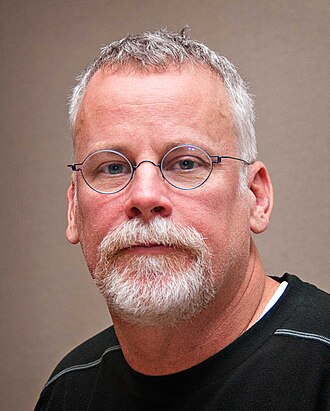
Michael Connelly
Crime novelist, author of the Harry Bosch and Lincoln Lawyer books
Where to hear and read about Michael Connelly1 episode or test
Michael Connelly is a crime novelist and former court reporter whose Harry Bosch and Lincoln Lawyer books have sold over 100 million copies and reached TV. The habit most worth stealing is rewriting yesterday's pages each morning and cutting every detail and line of dialogue down to what delivers character and keeps the story moving.
Instead of five details, you pick the one that says something about the situation, the character.
The Best Writing Advice He Ever Read (Michael Connelly Interview)
Michael Connelly: the story and the lessons
1Michael Connelly's path from crime reporter to Harry Bosch
Fourteen years of crime reporting gave Connelly his raw material. As a journalist he talked to 100 real detectives a week, and his press pass opened police stations. He covered courts and crime for 14 years.
That experience means he knows roughly how the work is done, so he can write first and check details later.
Chandler hooked him as a teenager and shaped how he saw Los Angeles. He read Chandler in Florida and did not come to LA until he was 30, but felt he knew the city through the books.
On arriving he drove the route of chapter 13 of The Little Sister, out through the Valley to Malibu and back through Santa Monica and Hollywood.
Connelly made Bosch an outsider with an insider's job. Bosch carries a badge and gun for the state yet is meant to feel like an outsider. Connelly decided on his love of jazz to deepen that feel, and made him a man of few words who nods.
An early editor counted the nods in the margin: 540 by page 200.
Connelly renamed his hero Pierce as Hieronymus Bosch. The first-draft hero was Pierce, echoing Chandler's idea of a detective piercing every level of society. Bosch came from the painter he met in a college humanities class, whose Garden of Earthly Delights fits LA as its modern version.
Readers who knew the painter would get it, and others would wonder where the name came from. The first Bosch novel came out in 1992.
Connelly's books grew into long-running TV series. Bosch ran for 98 episodes and 50 episodes of Lincoln Lawyer are planned. Connelly is executive producer and has written about 42 books.
He is deeply involved only in a show's first season, until he learns whom he can trust.
2How Connelly runs his writing day
Connelly writes before it is light, from about 6 to 11. Mornings have the fewest interruptions, so he protects them and saves afternoons for TV sets and interviews.
He meets sources for breakfast because he can't write while eating. A book takes him 10 to 11 months.
He starts each morning by rewriting yesterday's pages on paper. He prints the previous day's three to ten pages, marks them in pencil, then types in the changes. At the end of a book he prints and marks up the whole manuscript before editing.
Telling details usually arrive here, because by then he knows the full story and can set up something that pays off 100 pages later.
Connelly marks drafts with a personal margin code. RW means rewrite this paragraph and NSG means not so good, letting him mark a whole manuscript on paper before changing the file.
He took NSG from his mother, who wrote it in the margins of one of his manuscripts. He has never read an ebook.
Connelly does not outline or keep character journals. He won't look away from the screen to check an outline or whether a character had green eyes ten books ago. Two copy editors keep a Bible of the series and catch mismatches afterward.
A typical catch is something said ten books earlier that no longer fits. His reason is momentum: "I just don't want to take my eyes off the screen."
He arranges research so the writing never stops. Detectives, lawyers and judges answer his texts, emails and calls as he writes, and an internet researcher sends concise answers rather than pages.
His rule is: Always be writing.
Connelly tells young writers to write something every day. His college teacher Harry Crews said to write every day, even for 15 minutes. It is the one thing Connelly remembers from the three classes Crews showed up for.
Fifteen minutes keeps the story alive in your head, like being in a water tunnel with the story swirling around you. He also names journalism, TV and law as good training because they force clarity and winning people over.
3How Connelly delivers character on the page
Connelly treats character as the reason readers read. Plot and setting exist to serve it. Where realtors say location three times, his version is character, character, character.
He keeps asking how he is delivering the character to the reader.
He picks one telling detail instead of five. He gathers details by watching detectives, lawyers and judges, never by taking notes, because a notebook would freeze people. One detective chewed his glasses' earpiece at crime scenes, and the groove showed clenched teeth.
That single image was the whole description of the man, and it left the reader room to imagine the rest.
Connelly trims detail to protect momentum, then adds it back. Too many details become speed bumps. He strips scenes to what is needed in rewrites, and also adds or expands details once he knows the whole story.
All his descriptions of Bosch across more than 20 books add up to under five pages.
He plants an invented hero in verifiably real details. Bosch does not exist, so Connelly anchors him in real job details, geography, weather and history. He keeps the books contemporary and puts real events in to watch how his characters react.
Connelly uses place to trigger memory and reveal who Bosch is. Bosch walks into a restaurant or neighborhood and remembers his mother or his wife, which moves the story through time. Connelly asks what the physical city can do to deliver who Bosch or Haller is.
In nearly every book Bosch looks at the 101 freeway from his back deck and checks the traffic report.
Different characters give Connelly different lenses on the city. He has a woman's view of a male-dominated bureaucracy, and Bosch, now in his 70s, gives a view of wisdom. Mickey Haller, the Lincoln Lawyer, is his true outsider, hunting for cracks in the power of the state.
He rereads one Chandler chapter before starting every book. Chapter 13 of The Little Sister is about five pages of Marlowe driving and describing the city cynically, with no plot. Published in 1939, parts of it still fit today.
Connelly calls that "the definition of art."
4Connelly on conflict and dialogue
Connelly makes every character want something on every page. He passes on Kurt Vonnegut's advice that every character wants something, even a glass of water, and treats that want as conflict. He checks a page against it, and was more religious about it early on.
Bosch was made a smoker who always wanted a cigarette and could not have one.
He sets everyday frustrations beside the big conflict. About 99.9% of his readers have never solved a murder, so he adds frictions they know, such as traffic and bureaucrats who won't help because they don't have to.
The question is what the character does while stuck, which is why Bosch is so often on his deck watching the lights not move.
Connelly cuts dialogue in half almost as soon as he writes it. Newspaper editors gave him about six inches for a second-tier crime story, so a quoted detective had to say something the reader needed and the story had not already said. He did this for 14 years.
He still holds to it with 400 pages and 100,000 words to spend.
He writes conversations that are about one thing but mean another. Conflict works best when characters never name it. In a scene he wrote that morning, friends tell the 70-something Bosch, fresh from a knee replacement, to slow down, sounding excited while a few words show their worry.
Editors often want it more obvious and write notes in the margin. He trusts readers to pick up the nuance.
5Why Connelly writes Los Angeles and what drives his books
Connelly picked a city that never runs out of material. LA keeps changing, so in each of his roughly 42 books he aims to reach a neighborhood he hasn't used before. Places he wrote about in the early 90s are gone.
He says he will never cover it all because the city is too big and sprawling.
He looks for the friction in LA's divisions. Freeways and a mountain chain divide the city, which is segregated and full of people seeking second chances. Haves and have-nots show more clearly than in a city like Pittsburgh.
That friction is what he looks for in crime fiction.
Connelly sees a murder as a way into a whole society. Richard Price told him that circling a murder long enough teaches you a city. Chandler wrote that a detective, by position, can pierce all veils of society.
Connelly calls that an invitation he couldn't turn down.
Connelly writes the hero's cost and leaves villain psychology to others. He is interested in the sacrifices a hero makes, not in the motives behind violent crime. The theme under many books is the darkness that gets inside the hero, which he calls a kind of moral cancer.
He still keeps his friend Steven Bochco's sign in mind: "What's the bad guy thinking?" A bigger human question like this carries him through 10 to 11 months of writing.
He starts a book from an idea he wants to explore. His new legal thriller puts AI on trial, with witnesses standing for each side. The courtroom compresses a big idea into a contained space.
The book asks questions and does not tell anyone what to think. He finds courtroom thrillers repetitive because they end in guilty or not guilty.
6Connelly on hooking readers and moving between books and TV
Connelly lets the hook run longer as readers trust him. He once thought the slingshot had to be released within 10 pages, then 25, and now he does not count. At page 30 of his current book he wrote a lunch chapter that updates the reader on Bosch and does not advance the plot.
He would not have risked that fifteen or twenty years ago. He is gambling that he has earned the reader's patience.
TV teasers taught him to open with a self-contained story. A TV teaser is at most six script pages and releases the slingshot by its end. His new book opens with two chapters on an anecdote a detective told him about solving a case, unrelated to the rest of the plot.
Connelly says books hold thought and scripts can only show action. A script can never say what anyone is thinking, so TV asks what the bad guy is doing and a book asks what he is thinking. He says this is why he doesn't call himself a good scriptwriter.
Long streaming runs do give a character room to be shown in full.
He accepts that a screen Bosch breaks readers' picture of him. Readers built Bosch in their heads for more than two decades, and then a TV actor became exactly what he looks like. Some readers tell him they don't watch the shows for that reason.
Connelly says he respects that.
Connelly found the TV writer's room addictive but wrote alone. Seven to nine people sit around an oval table mapping episodes on 3x5 cards, and it brought back the newsroom camaraderie he lost as a novelist. The showrunner decides, and each writer drafts one episode alone.
He skipped the drafting part and kept it part-time: write at home in the morning, go in around 10, then return to his books.

The Best Writing Advice He Ever Read (Michael Connelly Interview)
Michael Connelly says every choice on the page, from a name to a nod to a single detail, should deliver character while keeping the story moving. His habit of rewriting yesterday's pages in pencil each morning, then cutting dialogue and details down to what carries information, is the part worth stealing.
Fourteen years of crime reporting gave Connelly his raw material. As a journalist he talked to 100 real detectives a week, and his press pass opened police stations. He covered courts and crime for 14 years.
That experience means he knows roughly how the work is done, so he can write first and check details later.
Chandler hooked him as a teenager and shaped how he saw Los Angeles. He read Chandler in Florida and did not come to LA until he was 30, but felt he knew the city through the books.
On arriving he drove the route of chapter 13 of The Little Sister, out through the Valley to Malibu and back through Santa Monica and Hollywood.
Connelly made Bosch an outsider with an insider's job. Bosch carries a badge and gun for the state yet is meant to feel like an outsider. Connelly decided on his love of jazz to deepen that feel, and made him a man of few words who nods.
An early editor counted the nods in the margin: 540 by page 200.
Connelly renamed his hero Pierce as Hieronymus Bosch. The first-draft hero was Pierce, echoing Chandler's idea of a detective piercing every level of society. Bosch came from the painter he met in a college humanities class, whose Garden of Earthly Delights fits LA as its modern version.
Readers who knew the painter would get it, and others would wonder where the name came from. The first Bosch novel came out in 1992.
Connelly's books grew into long-running TV series. Bosch ran for 98 episodes and 50 episodes of Lincoln Lawyer are planned. Connelly is executive producer and has written about 42 books.
He is deeply involved only in a show's first season, until he learns whom he can trust.
Connelly writes before it is light, from about 6 to 11. Mornings have the fewest interruptions, so he protects them and saves afternoons for TV sets and interviews.
He meets sources for breakfast because he can't write while eating. A book takes him 10 to 11 months.
He starts each morning by rewriting yesterday's pages on paper. He prints the previous day's three to ten pages, marks them in pencil, then types in the changes. At the end of a book he prints and marks up the whole manuscript before editing.
Telling details usually arrive here, because by then he knows the full story and can set up something that pays off 100 pages later.
Connelly marks drafts with a personal margin code. RW means rewrite this paragraph and NSG means not so good, letting him mark a whole manuscript on paper before changing the file.
He took NSG from his mother, who wrote it in the margins of one of his manuscripts. He has never read an ebook.
Connelly does not outline or keep character journals. He won't look away from the screen to check an outline or whether a character had green eyes ten books ago. Two copy editors keep a Bible of the series and catch mismatches afterward.
A typical catch is something said ten books earlier that no longer fits. His reason is momentum: "I just don't want to take my eyes off the screen."
He arranges research so the writing never stops. Detectives, lawyers and judges answer his texts, emails and calls as he writes, and an internet researcher sends concise answers rather than pages.
His rule is: Always be writing.
Connelly tells young writers to write something every day. His college teacher Harry Crews said to write every day, even for 15 minutes. It is the one thing Connelly remembers from the three classes Crews showed up for.
Fifteen minutes keeps the story alive in your head, like being in a water tunnel with the story swirling around you. He also names journalism, TV and law as good training because they force clarity and winning people over.
Connelly treats character as the reason readers read. Plot and setting exist to serve it. Where realtors say location three times, his version is character, character, character.
He keeps asking how he is delivering the character to the reader.
He picks one telling detail instead of five. He gathers details by watching detectives, lawyers and judges, never by taking notes, because a notebook would freeze people. One detective chewed his glasses' earpiece at crime scenes, and the groove showed clenched teeth.
That single image was the whole description of the man, and it left the reader room to imagine the rest.
Connelly trims detail to protect momentum, then adds it back. Too many details become speed bumps. He strips scenes to what is needed in rewrites, and also adds or expands details once he knows the whole story.
All his descriptions of Bosch across more than 20 books add up to under five pages.
He plants an invented hero in verifiably real details. Bosch does not exist, so Connelly anchors him in real job details, geography, weather and history. He keeps the books contemporary and puts real events in to watch how his characters react.
Connelly uses place to trigger memory and reveal who Bosch is. Bosch walks into a restaurant or neighborhood and remembers his mother or his wife, which moves the story through time. Connelly asks what the physical city can do to deliver who Bosch or Haller is.
In nearly every book Bosch looks at the 101 freeway from his back deck and checks the traffic report.
Different characters give Connelly different lenses on the city. He has a woman's view of a male-dominated bureaucracy, and Bosch, now in his 70s, gives a view of wisdom. Mickey Haller, the Lincoln Lawyer, is his true outsider, hunting for cracks in the power of the state.
He rereads one Chandler chapter before starting every book. Chapter 13 of The Little Sister is about five pages of Marlowe driving and describing the city cynically, with no plot. Published in 1939, parts of it still fit today.
Connelly calls that "the definition of art."
Connelly makes every character want something on every page. He passes on Kurt Vonnegut's advice that every character wants something, even a glass of water, and treats that want as conflict. He checks a page against it, and was more religious about it early on.
Bosch was made a smoker who always wanted a cigarette and could not have one.
He sets everyday frustrations beside the big conflict. About 99.9% of his readers have never solved a murder, so he adds frictions they know, such as traffic and bureaucrats who won't help because they don't have to.
The question is what the character does while stuck, which is why Bosch is so often on his deck watching the lights not move.
Connelly cuts dialogue in half almost as soon as he writes it. Newspaper editors gave him about six inches for a second-tier crime story, so a quoted detective had to say something the reader needed and the story had not already said. He did this for 14 years.
He still holds to it with 400 pages and 100,000 words to spend.
He writes conversations that are about one thing but mean another. Conflict works best when characters never name it. In a scene he wrote that morning, friends tell the 70-something Bosch, fresh from a knee replacement, to slow down, sounding excited while a few words show their worry.
Editors often want it more obvious and write notes in the margin. He trusts readers to pick up the nuance.
Connelly picked a city that never runs out of material. LA keeps changing, so in each of his roughly 42 books he aims to reach a neighborhood he hasn't used before. Places he wrote about in the early 90s are gone.
He says he will never cover it all because the city is too big and sprawling.
He looks for the friction in LA's divisions. Freeways and a mountain chain divide the city, which is segregated and full of people seeking second chances. Haves and have-nots show more clearly than in a city like Pittsburgh.
That friction is what he looks for in crime fiction.
Connelly sees a murder as a way into a whole society. Richard Price told him that circling a murder long enough teaches you a city. Chandler wrote that a detective, by position, can pierce all veils of society.
Connelly calls that an invitation he couldn't turn down.
Connelly writes the hero's cost and leaves villain psychology to others. He is interested in the sacrifices a hero makes, not in the motives behind violent crime. The theme under many books is the darkness that gets inside the hero, which he calls a kind of moral cancer.
He still keeps his friend Steven Bochco's sign in mind: "What's the bad guy thinking?" A bigger human question like this carries him through 10 to 11 months of writing.
He starts a book from an idea he wants to explore. His new legal thriller puts AI on trial, with witnesses standing for each side. The courtroom compresses a big idea into a contained space.
The book asks questions and does not tell anyone what to think. He finds courtroom thrillers repetitive because they end in guilty or not guilty.
Connelly lets the hook run longer as readers trust him. He once thought the slingshot had to be released within 10 pages, then 25, and now he does not count. At page 30 of his current book he wrote a lunch chapter that updates the reader on Bosch and does not advance the plot.
He would not have risked that fifteen or twenty years ago. He is gambling that he has earned the reader's patience.
TV teasers taught him to open with a self-contained story. A TV teaser is at most six script pages and releases the slingshot by its end. His new book opens with two chapters on an anecdote a detective told him about solving a case, unrelated to the rest of the plot.
Connelly says books hold thought and scripts can only show action. A script can never say what anyone is thinking, so TV asks what the bad guy is doing and a book asks what he is thinking. He says this is why he doesn't call himself a good scriptwriter.
Long streaming runs do give a character room to be shown in full.
He accepts that a screen Bosch breaks readers' picture of him. Readers built Bosch in their heads for more than two decades, and then a TV actor became exactly what he looks like. Some readers tell him they don't watch the shows for that reason.
Connelly says he respects that.
Connelly found the TV writer's room addictive but wrote alone. Seven to nine people sit around an oval table mapping episodes on 3x5 cards, and it brought back the newsroom camaraderie he lost as a novelist. The showrunner decides, and each writer drafts one episode alone.
He skipped the drafting part and kept it part-time: write at home in the morning, go in around 10, then return to his books.