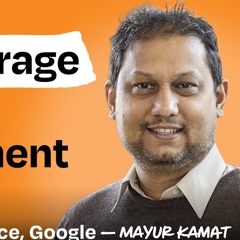
Mayur Kamat
Chief Product Officer at N26, formerly Global Head of Product at Binance
Where to hear and read about Mayur Kamat1 episode or test

Mayur Kamat is Chief Product Officer at N26 and was Global Head of Product at Binance, after product roles at Agoda, Google and Microsoft. The thing most worth learning from him is to treat strategy as how fast you can get from hypothesis to data, and to spend your own time on the few problems with 10x impact.
For most product managers, your strategy should be, how fast can I go from hypothesis to data?
Unconventional product lessons from Binance, N26, Google, more | Mayur Kamat (CPO at N26)
Mayur Kamat: the story and the lessons
1Mayur Kamat's path and how Binance ran product
Kamat has run product at Microsoft, Google, Agoda, Binance and N26. He is Chief Product Officer at N26 and was Global Head of Product at Binance. Before that he was VP of Product at Agoda and a PM at Google and Microsoft.
He has worked for founders for 17 of his 20 years. Founder-CEOs tell him they wish they had his job, because they spend 90% of their time on work they don't enjoy.
At Binance he worked inside an extremely flat company. Binance launched in 2017 as a crypto exchange, was number one within six months, and peaked at about $400 billion with 2,000 employees. CEO CZ had 55 direct reports, so there were no one-on-ones.
Teams of 10 to 20 people ran businesses with multi-billion dollar profits. Kamat's top KPI was trading volume, and his monthly KPI was in trillions of dollars.
A nightly 11 PM call meant no decision waited more than 24 hours. Leaders met at 11 PM Singapore time every day, including weekends and holidays. Each urgent problem got one owner with all hands on deck, who reported back on every call.
One assignment was to win 15 financial licenses in 15 countries within three months. Kamat calls this running products via daily meeting. The cost was randomization of teams' work when priorities weren't well thought through.
Kamat broke a KYC conversion collapse into about 500 cells. New KYC rules cut sign-up conversion from about 100% to 2%. The team tracked the top 50 countries by the top 10 document types and asked per cell whether to change vendor, imaging tech or SDK.
CZ's rule was no user left behind, so low-impact cells were not ignored. A Kazakhstan passport with poor conversion triggered the vendor and imaging questions. The KYC team grew from 20 to 500 people for three months.
He says the extreme Binance model only works under three conditions. The company must be growing fast, pay must be high enough that people care about KPIs over promotions, and the mission must be believed.
Bonuses ranged from 0% to 500%, so a 10% to 20% raise mattered little. The mission was that 80% of the world lacks trusted financial tools.
2Why Kamat treats strategy as hypothesis speed
Kamat says a PM's strategy is how fast hypothesis becomes data. He states a hypothesis with users, conversion, acquisition cost and LTV, tests it in the market, and the answer is only keep doing it or stop. Without tests, the loudest voice or biggest title wins.
Jonathan Rosenberg at Google told PMs: "Come to me with data. If you come to me with ideas, we'll go with mine." Kamat concedes strategy still matters for market expansion, investments, licenses and compliance.
He builds an experimentation culture first in any new product role. He brings culture, incentives and tools, with N26 using Statsig, and reviews dashboards for moved metrics, p-values and time to significance. Then he says do more of what works.
Evidence lets a PM reject a bad idea by saying it was run six times across user groups and failed. His line: "Nothing compounds wins faster than experiments."
He compares variant against control, not before against after. At Binance, overall conversion fell because Bitcoin crashed, but the variant still beat control. That showed the product changes were winning despite the market.
Where tests can't run, he does deeper pre-work on cohorts. Compliance, legal and European pricing are hard to test, while US pricing tests are possible. Irreversible or very slow decisions also need structured reasoning up front.
He looks at cohorts rather than a mixed pool of users over six months or ten years, because blended data leads to worse decisions.
Kamat now avoids projects of six months or more. Agoda's hotel payments idea started with $50 Android devices bought at a mall, scanning cards by camera, and thousands of hotels used them. Licenses stretched the full launch to six to nine months, and then COVID emptied the hotels.
His lesson: "Don't take on projects that are going to be six months, a year, because you just generally don't have control over the macro."
He treats reversible decisions as slow or fast, never right or wrong. A wrong decision made fast gets corrected sooner than a right one reached after months of deliberation.
He skips the rule where a mistake could kill a user or the company, as in healthcare, military or compliance. His test: it must not land you in jail or kill your company.
Hangouts taught him that company DNA can block a product. Hangouts had thousands of people and Larry Page's backing, yet never became a great messaging product, partly from solving for the wrong audience and against Google's DNA.
He cites Microsoft with mobile, Google with social and Facebook with enterprise. Google's enterprise business only took off after Larry Page was no longer CEO. The Hangouts team did invent WebRTC, which now runs calls in Meet, WhatsApp and Zoom.
3How Kamat spends his time and shapes products at N26
Kamat works only on problems with a 10x positive or negative impact. The multiple varies by business: 3 in some, 5 or 10 in others, 100 in finance. In most fintechs the 10x problems are growth or compliance.
The rule gets harder at CPO level because every problem that reaches him is already important.
He keeps his calendar open and digs into details himself. High-leverage problems are usually details, so he needs the humility to work below his title. His view: "A full calendar is a badge of shame, not a badge of honor."
He learned it from Alex Allgood, who moved a floating desk to the highest-leverage team and personally ran the SEO product for three months. Kamat had asked for a dedicated SEO PM, and Allgood took the role himself.
He moves on once the team has a problem under control. He might spend a month on how many sign-ups become long-term active users. Once the team's experiments run well, he turns to compliance and fraud issues in France.
N26 hedges its product lines against the interest rate cycle. About a year and a half ago N26 was largely a bank account with a card, then added a big lending line. Savings drew users while rates were high, and lending takes over as rates fall.
When rates rise, spending falls but deposits earn. When rates fall, spending rises and interchange grows.
Booking Holdings taught him growth comes from many small optimizations. Booking grew from about $10 billion to about $170 billion in ten years while still selling flights, hotels and cars. Compounding gains across the funnel beat a strategic pivot.
Kamat had never heard of Agoda, part of Booking Holdings, before taking the job there.
He points AI at developer productivity, support and fraud first. Copilots tied to large code bases give developers roughly 18 to 25% more productivity. AI automates about 60 to 70% of basic support questions, and at Binance it read language patterns to spot fraudsters in peer-to-peer crypto trades.
He has found no personal game changer for a CPO's own work, because humans still take the brunt of the impact of their decisions.
4Kamat's career advice for product managers
Kamat says join fast-growing companies so learning compounds. A low rate compounded daily beats the same rate compounded yearly. His Microsoft internship products had not shipped three or four years later, while Binance shipped every hour.
He calls category-defining companies like N26, the first mobile bank, strong PM schools because every trade-off between customer and regulator is existential.
He picks jobs by overlap with strengths, not by fixing weaknesses. Strengths are set early, so he looks for roles where success depends on his superpowers. Higher up, you can build a team that covers what you lack.
Agoda paid a psychologist $5,000 per PM candidate for a six-hour assessment, and Ray Dalio's tool costs about $50. His own results were "incredibly spot on". He also checks whether an employer is hiring you for tasks you did well but didn't love.
He tells PMs to ignore compensation in their first 15 years. About 90% of lifetime pay arrives in the last five years on a path to executive or founder. He compares offers on learning compounding, strengths overlap and fun, not a 10% to 20% pay gap.
Decide early whether you truly want the C-suite. Ambitious PMs drift toward CPO without questioning it. The alternatives are founding, a deep specialty such as KYC, fraud or retention, or a director career with meaning found outside work.
His test is whether the work fills your cup. In his words: "Determine very early in your career if you truly want to be a C-level someday."
Moving to Thailand multiplied his working hours and global judgment. In Seattle both parents worked, the kids were tiny and his daughter was constantly sick with asthma. Help at home freed hours once spent on dishes, laundry and the lawn, and the heat cured her asthma.
The cost was lower pay and a career ceiling that forced repeated moves: Bangkok, Singapore, back to Thailand, then Spain.

Unconventional product lessons from Binance, N26, Google, more | Mayur Kamat (CPO at N26)
Mayur Kamat explains how to run product through fast experimentation, daily ownership and a focus on the highest-leverage problems, drawing on Binance, Agoda, Google and N26. He also gives career advice on compounding learning, playing to strengths, and not optimizing for early compensation.
Kamat has run product at Microsoft, Google, Agoda, Binance and N26. He is Chief Product Officer at N26 and was Global Head of Product at Binance. Before that he was VP of Product at Agoda and a PM at Google and Microsoft.
He has worked for founders for 17 of his 20 years. Founder-CEOs tell him they wish they had his job, because they spend 90% of their time on work they don't enjoy.
At Binance he worked inside an extremely flat company. Binance launched in 2017 as a crypto exchange, was number one within six months, and peaked at about $400 billion with 2,000 employees. CEO CZ had 55 direct reports, so there were no one-on-ones.
Teams of 10 to 20 people ran businesses with multi-billion dollar profits. Kamat's top KPI was trading volume, and his monthly KPI was in trillions of dollars.
A nightly 11 PM call meant no decision waited more than 24 hours. Leaders met at 11 PM Singapore time every day, including weekends and holidays. Each urgent problem got one owner with all hands on deck, who reported back on every call.
One assignment was to win 15 financial licenses in 15 countries within three months. Kamat calls this running products via daily meeting. The cost was randomization of teams' work when priorities weren't well thought through.
Kamat broke a KYC conversion collapse into about 500 cells. New KYC rules cut sign-up conversion from about 100% to 2%. The team tracked the top 50 countries by the top 10 document types and asked per cell whether to change vendor, imaging tech or SDK.
CZ's rule was no user left behind, so low-impact cells were not ignored. A Kazakhstan passport with poor conversion triggered the vendor and imaging questions. The KYC team grew from 20 to 500 people for three months.
He says the extreme Binance model only works under three conditions. The company must be growing fast, pay must be high enough that people care about KPIs over promotions, and the mission must be believed.
Bonuses ranged from 0% to 500%, so a 10% to 20% raise mattered little. The mission was that 80% of the world lacks trusted financial tools.
Kamat says a PM's strategy is how fast hypothesis becomes data. He states a hypothesis with users, conversion, acquisition cost and LTV, tests it in the market, and the answer is only keep doing it or stop. Without tests, the loudest voice or biggest title wins.
Jonathan Rosenberg at Google told PMs: "Come to me with data. If you come to me with ideas, we'll go with mine." Kamat concedes strategy still matters for market expansion, investments, licenses and compliance.
He builds an experimentation culture first in any new product role. He brings culture, incentives and tools, with N26 using Statsig, and reviews dashboards for moved metrics, p-values and time to significance. Then he says do more of what works.
Evidence lets a PM reject a bad idea by saying it was run six times across user groups and failed. His line: "Nothing compounds wins faster than experiments."
He compares variant against control, not before against after. At Binance, overall conversion fell because Bitcoin crashed, but the variant still beat control. That showed the product changes were winning despite the market.
Where tests can't run, he does deeper pre-work on cohorts. Compliance, legal and European pricing are hard to test, while US pricing tests are possible. Irreversible or very slow decisions also need structured reasoning up front.
He looks at cohorts rather than a mixed pool of users over six months or ten years, because blended data leads to worse decisions.
Kamat now avoids projects of six months or more. Agoda's hotel payments idea started with $50 Android devices bought at a mall, scanning cards by camera, and thousands of hotels used them. Licenses stretched the full launch to six to nine months, and then COVID emptied the hotels.
His lesson: "Don't take on projects that are going to be six months, a year, because you just generally don't have control over the macro."
He treats reversible decisions as slow or fast, never right or wrong. A wrong decision made fast gets corrected sooner than a right one reached after months of deliberation.
He skips the rule where a mistake could kill a user or the company, as in healthcare, military or compliance. His test: it must not land you in jail or kill your company.
Hangouts taught him that company DNA can block a product. Hangouts had thousands of people and Larry Page's backing, yet never became a great messaging product, partly from solving for the wrong audience and against Google's DNA.
He cites Microsoft with mobile, Google with social and Facebook with enterprise. Google's enterprise business only took off after Larry Page was no longer CEO. The Hangouts team did invent WebRTC, which now runs calls in Meet, WhatsApp and Zoom.
Kamat works only on problems with a 10x positive or negative impact. The multiple varies by business: 3 in some, 5 or 10 in others, 100 in finance. In most fintechs the 10x problems are growth or compliance.
The rule gets harder at CPO level because every problem that reaches him is already important.
He keeps his calendar open and digs into details himself. High-leverage problems are usually details, so he needs the humility to work below his title. His view: "A full calendar is a badge of shame, not a badge of honor."
He learned it from Alex Allgood, who moved a floating desk to the highest-leverage team and personally ran the SEO product for three months. Kamat had asked for a dedicated SEO PM, and Allgood took the role himself.
He moves on once the team has a problem under control. He might spend a month on how many sign-ups become long-term active users. Once the team's experiments run well, he turns to compliance and fraud issues in France.
N26 hedges its product lines against the interest rate cycle. About a year and a half ago N26 was largely a bank account with a card, then added a big lending line. Savings drew users while rates were high, and lending takes over as rates fall.
When rates rise, spending falls but deposits earn. When rates fall, spending rises and interchange grows.
Booking Holdings taught him growth comes from many small optimizations. Booking grew from about $10 billion to about $170 billion in ten years while still selling flights, hotels and cars. Compounding gains across the funnel beat a strategic pivot.
Kamat had never heard of Agoda, part of Booking Holdings, before taking the job there.
He points AI at developer productivity, support and fraud first. Copilots tied to large code bases give developers roughly 18 to 25% more productivity. AI automates about 60 to 70% of basic support questions, and at Binance it read language patterns to spot fraudsters in peer-to-peer crypto trades.
He has found no personal game changer for a CPO's own work, because humans still take the brunt of the impact of their decisions.
Kamat says join fast-growing companies so learning compounds. A low rate compounded daily beats the same rate compounded yearly. His Microsoft internship products had not shipped three or four years later, while Binance shipped every hour.
He calls category-defining companies like N26, the first mobile bank, strong PM schools because every trade-off between customer and regulator is existential.
He picks jobs by overlap with strengths, not by fixing weaknesses. Strengths are set early, so he looks for roles where success depends on his superpowers. Higher up, you can build a team that covers what you lack.
Agoda paid a psychologist $5,000 per PM candidate for a six-hour assessment, and Ray Dalio's tool costs about $50. His own results were "incredibly spot on". He also checks whether an employer is hiring you for tasks you did well but didn't love.
He tells PMs to ignore compensation in their first 15 years. About 90% of lifetime pay arrives in the last five years on a path to executive or founder. He compares offers on learning compounding, strengths overlap and fun, not a 10% to 20% pay gap.
Decide early whether you truly want the C-suite. Ambitious PMs drift toward CPO without questioning it. The alternatives are founding, a deep specialty such as KYC, fraud or retention, or a director career with meaning found outside work.
His test is whether the work fills your cup. In his words: "Determine very early in your career if you truly want to be a C-level someday."
Moving to Thailand multiplied his working hours and global judgment. In Seattle both parents worked, the kids were tiny and his daughter was constantly sick with asthma. Help at home freed hours once spent on dishes, laundry and the lawn, and the heat cured her asthma.
The cost was lower pay and a career ceiling that forced repeated moves: Bangkok, Singapore, back to Thailand, then Spain.