Martin Macmillan
CEO and Co-Founder, Pollen VC
Where to hear and read about Martin Macmillan1 episode or test
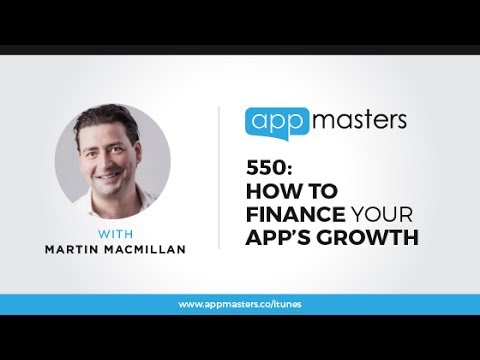
Martin Macmillan is CEO and co-founder of Pollen VC, which advances cash to app developers against their App Store and ad network receipts. The lesson to take from him is that if paid user acquisition returns more than a dollar per dollar, fund it by recycling earned revenue quickly instead of selling equity.
the whole thing is about velocity of money
How to Finance Your App’s Growth with Martin Macmillan
Martin Macmillan: the story and the lessons
1Martin Macmillan and the problem behind Pollen
Macmillan built Pollen after hitting the funding problem in his own app business. Pollen advances money against app store receipts so earnings can go straight back into ads. Advances can run daily, as fast as the revenue is earned, and the same logic applies to ad network revenue.
The alternatives he saw were a publisher's "crazy revenue share" or "a crazy dilution" from investors.
Macmillan treats earned but unpaid store revenue as an asset to borrow against. Apple pays up to about 67 days after a sale and Google up to about 45. Ad networks pay from net 15 up to net 60 or even 90 days.
He calls it likely the cheapest capital a growing app has, like a pile of cash in the corner that you can see but not touch. His phrase: "think of this as an asset in the mix".
Working with close to 100 developers led Pollen to build a free forecaster. Pollen has funded close to 100 developers and talked to several hundred. That showed him most developers could not calculate lifetime value, so Pollen built a free online tool.
The tool works as a traffic light, a quick check before any deeper modelling.
2How Macmillan tests whether paid acquisition works
Macmillan says spend on paid acquisition only when a dollar returns more than a dollar. Two variables decide it: lifetime value and cost per install. Spending a dollar and getting less back is, in his word, misery.
The one gray area he accepts is being slightly unprofitable when organic uplift from paid installs makes up the gap. The calculator gets 300 to 400 people a day, and for many it shows they are set to lose money.
Most developers cannot calculate lifetime value for a freemium app. He saw analytics staff and CEOs at companies with over $10 million raised argue over what the metrics meant. Paid apps are easy to model, freemium apps much harder.
Lenders look for a clear grasp of acquisition cost and strategy, the shape of the lifetime curve and when revenue arrives. Many developers instead max out credit cards or seek ad network credit lines with no trading history.
He builds the lifetime value curve from retention, install cost and organic uplift. Inputs are platforms, install cost, starting budget, organic uplift per paid user and the retention curve. In his example 95% of predicted lifetime value arrives by day 208, and the curve is almost flat from day 208 to day 330.
That flat tail can be ignored. He stresses the model is static, ignoring rising install costs as you buy more and changing retention, so it is a rough guide and not a forecast.
Macmillan treats payback time as a financing cycle, not a standalone metric. Find the day cost per install breaks even, then count how many times the same dollar can be recycled in a year. In his example, $1.20 per user breaks even at about day 38.
His question: "how many times can I do that in a year". Everything past break-even is profit.
He feeds the lifetime value curve back into game design. Once you know the curve, you can decide what to gate beyond a given level, such as level 25: ads or payment.
3Why Macmillan says recycle revenue instead of raising equity
Macmillan recycles revenue into ads as often as daily or weekly. In his model, $10,000 is spent over 7 days and then cash sits flat for 60 days. Reinvesting 50% of revenue every seven days gives a steeper cash curve and positive cash flow sooner.
The top line is already net of financing fees. Some fast-growing developers recycled daily using a feed taken directly from the app store, sometimes with money going straight to the ad networks. The reinvest rate can be dialled from 10% to 100% in more sophisticated models.
He says equity is the wrong money for a short, predictable acquisition cycle. Equity suits real risk: testing a market, finding product-market fit, hiring a team or making an acquisition. A 30 to 90 day cycle with a known return is not equity risk.
He cites developers who gave away another 25% of their company to a big-name VC when they could have paid a few percent in financing margin. Going to a VC with a working formula and asking for money to feed it "just seems crazy".
Macmillan notes that venture funds themselves prefer not to pay for marketing. Most of Pollen's deal flow comes from funds that back the team and IP but call marketing spend a silly way to deploy capital. His test case is 90% confidence that a dollar returns $1.50 within 30 to 45 days.
A SaaS product with a three to five year lifetime carries far more risk than a payback of 30 to 80 days, because more can go wrong over that time.
He calls the method just maths, which also helps ad networks. Acquire a user, know what they are worth, shorten the wait for payment and reinvest. No AI or machine learning is involved.
Ad networks want the calculator because a confident spender can grow from $10k to $100k, or $100k to $1,000,000, a month, and they prefer advertisers who will still be around next quarter.
4Pollen case studies: War Robots and a dating app
Pixonic grew War Robots through to a sale with no extra dilution. Pixonic had raised one round and found that each Facebook acquisition dollar returned $1.50. Its venture investor advised against a new round and sent it to Pollen in London.
Work began a couple of weeks later with no expensive due diligence. The game reached the top 100 grossing games and was bought by Mail.ru for about $30 million.
A UK subscription dating app showed the method works from a tiny start. It began with a couple of thousand pounds a week of acquisition spend and learned its metrics as it added users. It grew about 1,400% in a little under two years, to hundreds of thousands of dollars a month.
There was no additional dilution along the way.
Macmillan plans a separate calculator for subscription apps. Recurring revenue needs different parameters from freemium, so a general freemium model does not fit. Pollen also plans more content on capital efficiency, lifetime value modelling and when to raise money, and which type.

How to Finance Your App’s Growth with Martin Macmillan
Martin Macmillan explains how app developers can fund paid user acquisition by borrowing against their App Store and ad network receipts instead of raising equity or giving up revenue share. He shows how to model lifetime value, find payback time and recycle revenue quickly, with a case study (War Robots, Pixonic) that grew into a roughly $30 million acquisition with no extra dilution.
Macmillan built Pollen after hitting the funding problem in his own app business. Pollen advances money against app store receipts so earnings can go straight back into ads. Advances can run daily, as fast as the revenue is earned, and the same logic applies to ad network revenue.
The alternatives he saw were a publisher's "crazy revenue share" or "a crazy dilution" from investors.
Macmillan treats earned but unpaid store revenue as an asset to borrow against. Apple pays up to about 67 days after a sale and Google up to about 45. Ad networks pay from net 15 up to net 60 or even 90 days.
He calls it likely the cheapest capital a growing app has, like a pile of cash in the corner that you can see but not touch. His phrase: "think of this as an asset in the mix".
Working with close to 100 developers led Pollen to build a free forecaster. Pollen has funded close to 100 developers and talked to several hundred. That showed him most developers could not calculate lifetime value, so Pollen built a free online tool.
The tool works as a traffic light, a quick check before any deeper modelling.
Macmillan says spend on paid acquisition only when a dollar returns more than a dollar. Two variables decide it: lifetime value and cost per install. Spending a dollar and getting less back is, in his word, misery.
The one gray area he accepts is being slightly unprofitable when organic uplift from paid installs makes up the gap. The calculator gets 300 to 400 people a day, and for many it shows they are set to lose money.
Most developers cannot calculate lifetime value for a freemium app. He saw analytics staff and CEOs at companies with over $10 million raised argue over what the metrics meant. Paid apps are easy to model, freemium apps much harder.
Lenders look for a clear grasp of acquisition cost and strategy, the shape of the lifetime curve and when revenue arrives. Many developers instead max out credit cards or seek ad network credit lines with no trading history.
He builds the lifetime value curve from retention, install cost and organic uplift. Inputs are platforms, install cost, starting budget, organic uplift per paid user and the retention curve. In his example 95% of predicted lifetime value arrives by day 208, and the curve is almost flat from day 208 to day 330.
That flat tail can be ignored. He stresses the model is static, ignoring rising install costs as you buy more and changing retention, so it is a rough guide and not a forecast.
Macmillan treats payback time as a financing cycle, not a standalone metric. Find the day cost per install breaks even, then count how many times the same dollar can be recycled in a year. In his example, $1.20 per user breaks even at about day 38.
His question: "how many times can I do that in a year". Everything past break-even is profit.
He feeds the lifetime value curve back into game design. Once you know the curve, you can decide what to gate beyond a given level, such as level 25: ads or payment.
Macmillan recycles revenue into ads as often as daily or weekly. In his model, $10,000 is spent over 7 days and then cash sits flat for 60 days. Reinvesting 50% of revenue every seven days gives a steeper cash curve and positive cash flow sooner.
The top line is already net of financing fees. Some fast-growing developers recycled daily using a feed taken directly from the app store, sometimes with money going straight to the ad networks. The reinvest rate can be dialled from 10% to 100% in more sophisticated models.
He says equity is the wrong money for a short, predictable acquisition cycle. Equity suits real risk: testing a market, finding product-market fit, hiring a team or making an acquisition. A 30 to 90 day cycle with a known return is not equity risk.
He cites developers who gave away another 25% of their company to a big-name VC when they could have paid a few percent in financing margin. Going to a VC with a working formula and asking for money to feed it "just seems crazy".
Macmillan notes that venture funds themselves prefer not to pay for marketing. Most of Pollen's deal flow comes from funds that back the team and IP but call marketing spend a silly way to deploy capital. His test case is 90% confidence that a dollar returns $1.50 within 30 to 45 days.
A SaaS product with a three to five year lifetime carries far more risk than a payback of 30 to 80 days, because more can go wrong over that time.
He calls the method just maths, which also helps ad networks. Acquire a user, know what they are worth, shorten the wait for payment and reinvest. No AI or machine learning is involved.
Ad networks want the calculator because a confident spender can grow from $10k to $100k, or $100k to $1,000,000, a month, and they prefer advertisers who will still be around next quarter.
Pixonic grew War Robots through to a sale with no extra dilution. Pixonic had raised one round and found that each Facebook acquisition dollar returned $1.50. Its venture investor advised against a new round and sent it to Pollen in London.
Work began a couple of weeks later with no expensive due diligence. The game reached the top 100 grossing games and was bought by Mail.ru for about $30 million.
A UK subscription dating app showed the method works from a tiny start. It began with a couple of thousand pounds a week of acquisition spend and learned its metrics as it added users. It grew about 1,400% in a little under two years, to hundreds of thousands of dollars a month.
There was no additional dilution along the way.
Macmillan plans a separate calculator for subscription apps. Recurring revenue needs different parameters from freemium, so a general freemium model does not fit. Pollen also plans more content on capital efficiency, lifetime value modelling and when to raise money, and which type.