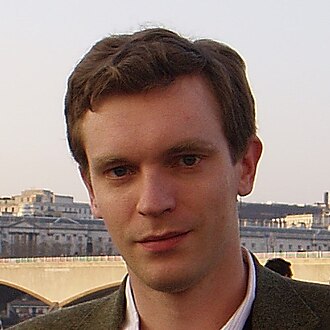
Mark Forsyth
Author and student of the figures of rhetoric
Where to hear and read about Mark Forsyth2 episodes and tests

 How I Write13 Writing Tricks Every Writer Should Know (Mark Forsyth Interview)
 How I WriteWriting Formulas Everybody Should Know (Mark Forsyth Interview)
Mark Forsyth is a British author who wrote The Elements of Eloquence, a book on the old figures of rhetoric behind the lines people remember, from Shakespeare to Taylor Swift. The most useful thing to learn from him is to take a plain sentence and reshape it with a figure such as repetition, a mirror flip or a group of three, then draft fast after thinking it through away from the desk.
writing for efficiency is like dressing for efficiency
13 Writing Tricks Every Writer Should Know (Mark Forsyth Interview)
Mark Forsyth: the story and the lessons
1How Mark Forsyth came to write The Elements of Eloquence
Forsyth wrote the rhetoric book he could not find at sixteen. He came to English late and wanted to examine a poem rigorously, not in an 'arty-farty' way. He asked why Shakespeare is better than other writers.
The figures were identified 2,500 years ago, yet almost no English books explained them. He found one from the early 20th century and one from the 1580s by Puttenham. He had first studied verse forms and iambic pentameter, then met the figures.
He built the book by listing every famous line he could recall. With no book to copy, he sat in the British Library staring at the ceiling. He went through every poem he knew and every film for memorable lines, plus the Bible, Shakespeare, hymns, jazz, advertising and politics, asking where each formula was used.
The best examples often arrived last, after he finished a chapter, such as 'Give us this day our daily bread'. He had overlooked the most familiar places.
He finished the book only about two weeks before publication. He finalized The Elements of Eloquence very late in publishing terms, writing in short prepared bursts.
He uses a Russian word for working hard to a deadline after months of nothing. How late he finishes varies by book: some he finishes quickly, others he is still writing very late.
2Forsyth's case for writing that enchants
Forsyth says writing for efficiency is like dressing for efficiency. He rejects the advice to use the plainest, most efficient words, comparing it to wearing high-visibility waterproofs. He likens plain writing to the Soylent drink, which feeds you but misses what makes food human.
Told to write plainly, Shakespeare and Dickens would never have existed. People decorate their homes, clothes and food, yet plain writing alone is expected to stay bare.
He keeps plain style for manuals and uses figures everywhere else. A dishwasher manual should be concise, and the beauty can be turned down for a quarterly report. For a novel, a poem, a best man speech or a text to someone you love, he says to go bigger.
He thinks the Romantic ideal of uncalculated passion hid the fact that the Romantics used the figures 'loads'.
He has never seen anyone overuse figures of rhetoric. Readers notice rhetoric but do not mind it, especially in a grand moment like Churchill's 'we will fight them on the beaches'.
He still admits there is a point where it becomes too much, and it is a matter of judgment. His advice is a few figures per paragraph, like chilies in a dish, since most people write too plainly.
He treats figures as a way of steering the reader's attention. A reader cannot be gripped all the time, so a writer calms things down and then uses build-up to say 'pay attention right here'.
A playlist of bass drops with no build-ups is 'horrible to listen to', and the same sounds feel almost divine when a slow build leads into them.
Forsyth sees figures as a kind of magic. Grammar once meant any book, and a glamour was a spell cast to enchant someone, so he treats the two as one word.
He argues school ruins poetry by turning it into an essay topic, when a poem should be judged by where it belongs. Twist and Shout belongs at a loud party, not in a 500-word essay.
3Forsyth on repetition: polyptoton, diacope, anaphora and epistrophe
Forsyth repeats a root word in two forms to make a phrase stick. This is polyptoton: dream the dream, walk the walk, talk the talk. It slips into a line with almost no effort and needs no new idea.
It runs from Shakespeare's 'alters when it alteration finds' and the Lord's Prayer to Taylor Swift's 'shake it off'. It packs a lot into three to five words, so it suits titles.
He wraps a phrase in repetition to make a verbal sandwich. Diacope repeats a word around a small interruption: 'Bond, James Bond', 'free at last, thank God Almighty, we are free at last', 'a horse, a horse, my kingdom for a horse'.
It is so strong that it changes memory. Everyone recalls 'fly my pretties, fly' from The Wizard of Oz, but the witch only says 'fly, fly, fly' in the film.
He starts every sentence the same way to carry readers along. Anaphora repeats the opening words of each sentence. Forsyth says it builds a hypnotic rhythm that lowers defenses, so the reader is receptive to what comes next.
Churchill gave the 'we shall fight' speech after the British army was turned back in France. The places come closer, from sea and air to beaches, fields, cities and hills, and it still sounds inspiring. Ecclesiastes' 'a time to be born, a time to die' works the same way.
He ends every part on the same words to make a text feel obsessive. Epistrophe is the backbone of pop songs, because verse and chorus always land in the same place. Each verse of 'Jailhouse Rock' differs, but all end on the same dancing line.
'Yesterday' starts and ends each verse on the same word, so the shape shows the stuckness the words describe. Forsyth says Lennon's complaint that the song goes nowhere is the very point.
4Forsyth on balance, opposites and threes
He flips a phrase into its mirror image to make it click. Chiasmus says something and then says it in reverse. Forsyth says it feels obviously right because people love symmetry.
His examples are Kennedy's 'ask not what your country can do for you' and Obama's 'you stood up for America, now America must stand up for you'. His advice is to write the plain claim, then swap its parts and see if a quotable line appears.
He balances two clauses of equal length so a claim sounds considered. Isocolon sets two phrases of the same length side by side, like a weighing scale. It is a looser cousin of chiasmus, with equal weight instead of exact mirroring.
Kennedy's 'not because it's easy, but because it's hard' is his example. 'Because it's hard, not easy' says the same thing and loses the balance.
Forsyth groups things in threes and lets the third one twist or grow. Three is the shortest group that can build to a conclusion. The third item is often longer or odder, as in 'the good, the bad and the ugly', where the first two are moral words and the third is aesthetic.
Memory polishes a tricolon. Churchill said 'blood, toil, tears and sweat', but we remember 'blood, sweat and tears'. Obama used 21 tricolons in his victory speech. Even one word said three times, as in 'location, location, location', works.
He strings opposites together to make a thin claim memorable. He calls this progressio, a long series of antitheses. Ecclesiastes could simply say there is a time for everything, but the back-and-forth pairs of weeping and rejoicing, building and casting down, are what stick.
The same move runs through Katy Perry's Hot N Cold, the opening of A Tale of Two Cities and the Church of England marriage service ('for richer for poorer, in sickness and in health').
He names each group instead of saying 'everybody'. 'Everybody' is too concise to make a reader stop and think. Listing the tall and the short, the old and the young, shows the fullness of what is meant.
Martin Luther King's 'black men and white men, Jews and Gentiles, Protestants and Catholics' makes readers pause in a way 'everybody' would not.
He holds the main verb back to build suspense. A periodic sentence piles up clauses and delays the verb until the end, so the reader gets a payoff they have been waiting for.
Kipling's 'If' stacks conditions until 'then yours is the world and everything that's in it'.
5Forsyth on surprise, image and exaggeration
He describes one sense in terms of another. Synesthesia jumps between senses to describe what is hard to describe. Raymond Chandler wrote that a woman smelled the way the Taj Mahal looks by moonlight.
It is not precise, but readers understand the jump and like it, and it reaches emotion more than reason. Forsyth's drill is to pick two senses, such as taste and looks: 'she looked the way chocolate tastes'.
He never describes a smell with a list of smells. Smell and taste are hard to write about, and listing ingredients gives forgettable prose. Wine-bottle notes like 'hints of walnut and badger' may be accurate but paint no picture.
He also passes on novelist Jilly Cooper's advice to put touch, scent and taste in every chapter, since writers lean on sight.
He turns an abstraction into a creature and asks what it wears. Personification gives an idea a body. Forsyth imagines far-eyed fury dressed in barbed wire with blood dripping from the spikes.
'Beware of jealousy' is flat, while Shakespeare's 'green-eyed monster which doth mock the meat it feeds on' has lasted to this day.
He drops the main verb for punchy openings and titles. Schesis onomaton breaks the school rule that every sentence needs a verb. Dickens opens Bleak House with the single word 'London', and Star Trek opens 'Space, the final frontier'.
Forsyth says 'This is space, which is the final frontier' would never have worked. A verbless phrase lands like a fist on the table, so it suits first lines, titles and slogans.
He makes a sensible idea sound senseless so the reader works it out. A paradox sticks because the reader must work out why it is true. Wilde's 'the only thing worse than being talked about is not being talked about' is his model.
Forsyth warns that paradox is hard to do well and should not be overused.
He shows a quality through an impossible feat, and commits fully. His favorite form of hyperbole is adynaton, the impossible thing, like 'when pigs fly'. Hammett's detective could have shadowed a drop of salt water from Golden Gate to Hong Kong, which says 'great detective' better than the plain phrase.
He says satire fails when it does not go far enough, because readers must see at once that it is not true. 'A sweltering furnace' beats 'about 100 degrees', and he riffs on a London heatwave as an air fryer, a casserole and the surface of the sun.
6How Mark Forsyth drafts and structures his writing
Forsyth thinks the piece through on a walk, then writes fast. He gets the next page or two clear in his head, with the facts and figures ready, then sits down and writes it in one go. He believes a quick draft flows into the reader instead of reading as jerky.
Writing fast lets voice show, since people without a voice tend to write slowly and ask whether each line is proper. He recalls a high school teacher with a bad stutter who was a fluent freestyle rapper.
He explains the idea aloud to an imaginary beginner first. He paces his room talking to nobody. If he can explain the subject to someone who knows nothing, he has it clear in his head, and he has already begun putting it into sentences.
He adds a warning: do not do this in the street.
He deletes a draft that reads wrong and runs up again. He reads only for typos and grammar. Stretching or trimming sentences one at a time ruins a rhythm that should have been there at first.
He compares it to a long jumper who fails the jump and goes back to retake the run-up until the distance is cleared.
He sets his voice in the first paragraph with word choice. 'A chap was walking' sounds English and posh, 'a dude' sounds American, and 'a man' has no voice at all. The first paragraph works like an establishing shot in a film.
Chandler gives the hard-bitten 1930s Los Angeles detective at once, and Elmore Leonard gives a man talking in a bar.
He writes for a reader who cannot hear his tone. Writing is radio without gestures, so tone has to be built into the words. Forsyth nodded in answer to questions on BBC Radio, forgetting that nobody could see it.
A novel he found dull came alive once the word 'drugstore' told him the author was American and he read it in that accent.
He keeps chapters short and about the same length. He wants a reader to think 'it's just 12 pages' and commit. Each chapter end then offers a natural place to stop and also a pull to read one more.
He jokes that this makes the author a sort of evil drug dealer offering one last dose.
He ends each chapter by pointing at the next. In nonfiction he uses a gentle bridge such as 'which leads us on to what was happening in France'. In his children's novel he overdoes it with cliffhangers, like a crocodile pit and a door.
7How Forsyth trains, borrows and collects
He practices his scales by improvising nonsense in iambic pentameter. He compares writing to jazz: years of drilling scales, then improvising from a well-trained head. He improvises nonsense in iambic pentameter, even walking down the street, until he can almost think in it.
Once you can write the lines and make them rhyme, he says, prose becomes easy. He quotes Pope: 'They walk best who have learned to dance'.
He tells people to read poetry aloud and tap the beat. English verse runs on five da-dums, and 'I really want a lovely cup of tea' fits the pattern. Reading aloud, even under your breath, finds it.
Dramatic pauses in the middle of a line break the beat. He says poetry is not only for English degrees: Shakespeare wrote for a mass market, and a ticket cost the same as a loaf of bread.
He says Shakespeare was a thief who improved the form. Shakespeare wrote with Plutarch open in front of him and reshaped it into iambic pentameter with added alliteration. Forsyth says the form was more original than the content.
'Full fathom five thy father lies' sticks, while 'your father is 9.8 metres underwater' means the same and does not.
He saw McCartney add a figure to lyrics after drafting them. On Paul McCartney's manuscripts at the British Library, Forsyth saw that McCartney wrote the lyrics first, then went back and deliberately put in anadiplosis, where the last word of one clause starts the next.
Forsyth's line is that McCartney may not know the word, 'but he knows how to use it'. Yoda's 'fear leads to hate, hate leads to anger' is the same figure.
He keeps a cheat sheet of formulas and ignores the Greek names. His book is essentially a big cheat sheet. He says the technical names do not matter, since the ancient Greeks could not agree on them either.
A short sheet of formulas with a few examples each is enough to consult while writing.
He mines old slang dictionaries for words and a world of detail. He loves dictionaries, especially old slang ones such as Grose's Dictionary of the Vulgar Tongue. Eighteenth-century thieves had 'dancing on nothing' for hanging, and 'feague' for putting a live eel up a horse to sell it.
He thought 'gongle', to stare idly at a canal, was dead until houseboat owners wrote to say it is standard canal-boat talk.
13 Writing Tricks Every Writer Should Know (Mark Forsyth Interview)
Forsyth shows that the lines people remember, from Shakespeare to Taylor Swift, are built from a small set of old rhetorical figures that anyone can reuse. The technique worth hearing is to take a plain sentence and rephrase it with a figure such as repetition, a mirror flip, a group of three or a paradox, so it sticks in the reader's mind.
He built the book by listing every famous line he could recall. With no book to copy, he sat in the British Library staring at the ceiling. He went through every poem he knew and every film for memorable lines, plus the Bible, Shakespeare, hymns, jazz, advertising and politics, asking where each formula was used.
The best examples often arrived last, after he finished a chapter, such as 'Give us this day our daily bread'. He had overlooked the most familiar places.
Forsyth says writing for efficiency is like dressing for efficiency. He rejects the advice to use the plainest, most efficient words, comparing it to wearing high-visibility waterproofs. He likens plain writing to the Soylent drink, which feeds you but misses what makes food human.
Told to write plainly, Shakespeare and Dickens would never have existed. People decorate their homes, clothes and food, yet plain writing alone is expected to stay bare.
He keeps plain style for manuals and uses figures everywhere else. A dishwasher manual should be concise, and the beauty can be turned down for a quarterly report. For a novel, a poem, a best man speech or a text to someone you love, he says to go bigger.
He thinks the Romantic ideal of uncalculated passion hid the fact that the Romantics used the figures 'loads'.
He has never seen anyone overuse figures of rhetoric. Readers notice rhetoric but do not mind it, especially in a grand moment like Churchill's 'we will fight them on the beaches'.
He still admits there is a point where it becomes too much, and it is a matter of judgment. His advice is a few figures per paragraph, like chilies in a dish, since most people write too plainly.
Forsyth sees figures as a kind of magic. Grammar once meant any book, and a glamour was a spell cast to enchant someone, so he treats the two as one word.
He argues school ruins poetry by turning it into an essay topic, when a poem should be judged by where it belongs. Twist and Shout belongs at a loud party, not in a 500-word essay.
Forsyth repeats a root word in two forms to make a phrase stick. This is polyptoton: dream the dream, walk the walk, talk the talk. It slips into a line with almost no effort and needs no new idea.
It runs from Shakespeare's 'alters when it alteration finds' and the Lord's Prayer to Taylor Swift's 'shake it off'. It packs a lot into three to five words, so it suits titles.
He starts every sentence the same way to carry readers along. Anaphora repeats the opening words of each sentence. Forsyth says it builds a hypnotic rhythm that lowers defenses, so the reader is receptive to what comes next.
Churchill gave the 'we shall fight' speech after the British army was turned back in France. The places come closer, from sea and air to beaches, fields, cities and hills, and it still sounds inspiring. Ecclesiastes' 'a time to be born, a time to die' works the same way.
He ends every part on the same words to make a text feel obsessive. Epistrophe is the backbone of pop songs, because verse and chorus always land in the same place. Each verse of 'Jailhouse Rock' differs, but all end on the same dancing line.
'Yesterday' starts and ends each verse on the same word, so the shape shows the stuckness the words describe. Forsyth says Lennon's complaint that the song goes nowhere is the very point.
He flips a phrase into its mirror image to make it click. Chiasmus says something and then says it in reverse. Forsyth says it feels obviously right because people love symmetry.
His examples are Kennedy's 'ask not what your country can do for you' and Obama's 'you stood up for America, now America must stand up for you'. His advice is to write the plain claim, then swap its parts and see if a quotable line appears.
He balances two clauses of equal length so a claim sounds considered. Isocolon sets two phrases of the same length side by side, like a weighing scale. It is a looser cousin of chiasmus, with equal weight instead of exact mirroring.
Kennedy's 'not because it's easy, but because it's hard' is his example. 'Because it's hard, not easy' says the same thing and loses the balance.
Forsyth groups things in threes and lets the third one twist or grow. Three is the shortest group that can build to a conclusion. The third item is often longer or odder, as in 'the good, the bad and the ugly', where the first two are moral words and the third is aesthetic.
Memory polishes a tricolon. Churchill said 'blood, toil, tears and sweat', but we remember 'blood, sweat and tears'. Obama used 21 tricolons in his victory speech. Even one word said three times, as in 'location, location, location', works.
He describes one sense in terms of another. Synesthesia jumps between senses to describe what is hard to describe. Raymond Chandler wrote that a woman smelled the way the Taj Mahal looks by moonlight.
It is not precise, but readers understand the jump and like it, and it reaches emotion more than reason. Forsyth's drill is to pick two senses, such as taste and looks: 'she looked the way chocolate tastes'.
He never describes a smell with a list of smells. Smell and taste are hard to write about, and listing ingredients gives forgettable prose. Wine-bottle notes like 'hints of walnut and badger' may be accurate but paint no picture.
He also passes on novelist Jilly Cooper's advice to put touch, scent and taste in every chapter, since writers lean on sight.
He turns an abstraction into a creature and asks what it wears. Personification gives an idea a body. Forsyth imagines far-eyed fury dressed in barbed wire with blood dripping from the spikes.
'Beware of jealousy' is flat, while Shakespeare's 'green-eyed monster which doth mock the meat it feeds on' has lasted to this day.
He drops the main verb for punchy openings and titles. Schesis onomaton breaks the school rule that every sentence needs a verb. Dickens opens Bleak House with the single word 'London', and Star Trek opens 'Space, the final frontier'.
Forsyth says 'This is space, which is the final frontier' would never have worked. A verbless phrase lands like a fist on the table, so it suits first lines, titles and slogans.
He makes a sensible idea sound senseless so the reader works it out. A paradox sticks because the reader must work out why it is true. Wilde's 'the only thing worse than being talked about is not being talked about' is his model.
Forsyth warns that paradox is hard to do well and should not be overused.
He shows a quality through an impossible feat, and commits fully. His favorite form of hyperbole is adynaton, the impossible thing, like 'when pigs fly'. Hammett's detective could have shadowed a drop of salt water from Golden Gate to Hong Kong, which says 'great detective' better than the plain phrase.
He says satire fails when it does not go far enough, because readers must see at once that it is not true. 'A sweltering furnace' beats 'about 100 degrees', and he riffs on a London heatwave as an air fryer, a casserole and the surface of the sun.
He keeps chapters short and about the same length. He wants a reader to think 'it's just 12 pages' and commit. Each chapter end then offers a natural place to stop and also a pull to read one more.
He jokes that this makes the author a sort of evil drug dealer offering one last dose.
He ends each chapter by pointing at the next. In nonfiction he uses a gentle bridge such as 'which leads us on to what was happening in France'. In his children's novel he overdoes it with cliffhangers, like a crocodile pit and a door.
He tells people to read poetry aloud and tap the beat. English verse runs on five da-dums, and 'I really want a lovely cup of tea' fits the pattern. Reading aloud, even under your breath, finds it.
Dramatic pauses in the middle of a line break the beat. He says poetry is not only for English degrees: Shakespeare wrote for a mass market, and a ticket cost the same as a loaf of bread.
Writing Formulas Everybody Should Know (Mark Forsyth Interview)
Forsyth shows that the most quoted lines in speeches, poems, songs and ads are built from a small set of rhetorical formulas that fit the shape of human memory. The habit that makes it worth hearing is to prepare your thinking away from the desk, then write fast, and to add a figure like chiasmus or a verbal sandwich deliberately.
Forsyth wrote the rhetoric book he could not find at sixteen. He came to English late and wanted to examine a poem rigorously, not in an 'arty-farty' way. He asked why Shakespeare is better than other writers.
The figures were identified 2,500 years ago, yet almost no English books explained them. He found one from the early 20th century and one from the 1580s by Puttenham. He had first studied verse forms and iambic pentameter, then met the figures.
He built the book by listing every famous line he could recall. With no book to copy, he sat in the British Library staring at the ceiling. He went through every poem he knew and every film for memorable lines, plus the Bible, Shakespeare, hymns, jazz, advertising and politics, asking where each formula was used.
The best examples often arrived last, after he finished a chapter, such as 'Give us this day our daily bread'. He had overlooked the most familiar places.
He finished the book only about two weeks before publication. He finalized The Elements of Eloquence very late in publishing terms, writing in short prepared bursts.
He uses a Russian word for working hard to a deadline after months of nothing. How late he finishes varies by book: some he finishes quickly, others he is still writing very late.
He keeps plain style for manuals and uses figures everywhere else. A dishwasher manual should be concise, and the beauty can be turned down for a quarterly report. For a novel, a poem, a best man speech or a text to someone you love, he says to go bigger.
He thinks the Romantic ideal of uncalculated passion hid the fact that the Romantics used the figures 'loads'.
He has never seen anyone overuse figures of rhetoric. Readers notice rhetoric but do not mind it, especially in a grand moment like Churchill's 'we will fight them on the beaches'.
He still admits there is a point where it becomes too much, and it is a matter of judgment. His advice is a few figures per paragraph, like chilies in a dish, since most people write too plainly.
He treats figures as a way of steering the reader's attention. A reader cannot be gripped all the time, so a writer calms things down and then uses build-up to say 'pay attention right here'.
A playlist of bass drops with no build-ups is 'horrible to listen to', and the same sounds feel almost divine when a slow build leads into them.
Forsyth repeats a root word in two forms to make a phrase stick. This is polyptoton: dream the dream, walk the walk, talk the talk. It slips into a line with almost no effort and needs no new idea.
It runs from Shakespeare's 'alters when it alteration finds' and the Lord's Prayer to Taylor Swift's 'shake it off'. It packs a lot into three to five words, so it suits titles.
He wraps a phrase in repetition to make a verbal sandwich. Diacope repeats a word around a small interruption: 'Bond, James Bond', 'free at last, thank God Almighty, we are free at last', 'a horse, a horse, my kingdom for a horse'.
It is so strong that it changes memory. Everyone recalls 'fly my pretties, fly' from The Wizard of Oz, but the witch only says 'fly, fly, fly' in the film.
He flips a phrase into its mirror image to make it click. Chiasmus says something and then says it in reverse. Forsyth says it feels obviously right because people love symmetry.
His examples are Kennedy's 'ask not what your country can do for you' and Obama's 'you stood up for America, now America must stand up for you'. His advice is to write the plain claim, then swap its parts and see if a quotable line appears.
Forsyth groups things in threes and lets the third one twist or grow. Three is the shortest group that can build to a conclusion. The third item is often longer or odder, as in 'the good, the bad and the ugly', where the first two are moral words and the third is aesthetic.
Memory polishes a tricolon. Churchill said 'blood, toil, tears and sweat', but we remember 'blood, sweat and tears'. Obama used 21 tricolons in his victory speech. Even one word said three times, as in 'location, location, location', works.
He strings opposites together to make a thin claim memorable. He calls this progressio, a long series of antitheses. Ecclesiastes could simply say there is a time for everything, but the back-and-forth pairs of weeping and rejoicing, building and casting down, are what stick.
The same move runs through Katy Perry's Hot N Cold, the opening of A Tale of Two Cities and the Church of England marriage service ('for richer for poorer, in sickness and in health').
He names each group instead of saying 'everybody'. 'Everybody' is too concise to make a reader stop and think. Listing the tall and the short, the old and the young, shows the fullness of what is meant.
Martin Luther King's 'black men and white men, Jews and Gentiles, Protestants and Catholics' makes readers pause in a way 'everybody' would not.
He holds the main verb back to build suspense. A periodic sentence piles up clauses and delays the verb until the end, so the reader gets a payoff they have been waiting for.
Kipling's 'If' stacks conditions until 'then yours is the world and everything that's in it'.
Forsyth thinks the piece through on a walk, then writes fast. He gets the next page or two clear in his head, with the facts and figures ready, then sits down and writes it in one go. He believes a quick draft flows into the reader instead of reading as jerky.
Writing fast lets voice show, since people without a voice tend to write slowly and ask whether each line is proper. He recalls a high school teacher with a bad stutter who was a fluent freestyle rapper.
He explains the idea aloud to an imaginary beginner first. He paces his room talking to nobody. If he can explain the subject to someone who knows nothing, he has it clear in his head, and he has already begun putting it into sentences.
He adds a warning: do not do this in the street.
He deletes a draft that reads wrong and runs up again. He reads only for typos and grammar. Stretching or trimming sentences one at a time ruins a rhythm that should have been there at first.
He compares it to a long jumper who fails the jump and goes back to retake the run-up until the distance is cleared.
He sets his voice in the first paragraph with word choice. 'A chap was walking' sounds English and posh, 'a dude' sounds American, and 'a man' has no voice at all. The first paragraph works like an establishing shot in a film.
Chandler gives the hard-bitten 1930s Los Angeles detective at once, and Elmore Leonard gives a man talking in a bar.
He writes for a reader who cannot hear his tone. Writing is radio without gestures, so tone has to be built into the words. Forsyth nodded in answer to questions on BBC Radio, forgetting that nobody could see it.
A novel he found dull came alive once the word 'drugstore' told him the author was American and he read it in that accent.
He practices his scales by improvising nonsense in iambic pentameter. He compares writing to jazz: years of drilling scales, then improvising from a well-trained head. He improvises nonsense in iambic pentameter, even walking down the street, until he can almost think in it.
Once you can write the lines and make them rhyme, he says, prose becomes easy. He quotes Pope: 'They walk best who have learned to dance'.
He says Shakespeare was a thief who improved the form. Shakespeare wrote with Plutarch open in front of him and reshaped it into iambic pentameter with added alliteration. Forsyth says the form was more original than the content.
'Full fathom five thy father lies' sticks, while 'your father is 9.8 metres underwater' means the same and does not.
He saw McCartney add a figure to lyrics after drafting them. On Paul McCartney's manuscripts at the British Library, Forsyth saw that McCartney wrote the lyrics first, then went back and deliberately put in anadiplosis, where the last word of one clause starts the next.
Forsyth's line is that McCartney may not know the word, 'but he knows how to use it'. Yoda's 'fear leads to hate, hate leads to anger' is the same figure.
He keeps a cheat sheet of formulas and ignores the Greek names. His book is essentially a big cheat sheet. He says the technical names do not matter, since the ancient Greeks could not agree on them either.
A short sheet of formulas with a few examples each is enough to consult while writing.
He mines old slang dictionaries for words and a world of detail. He loves dictionaries, especially old slang ones such as Grose's Dictionary of the Vulgar Tongue. Eighteenth-century thieves had 'dancing on nothing' for hanging, and 'feague' for putting a live eel up a horse to sell it.
He thought 'gongle', to stare idly at a canal, was dead until houseboat owners wrote to say it is standard canal-boat talk.