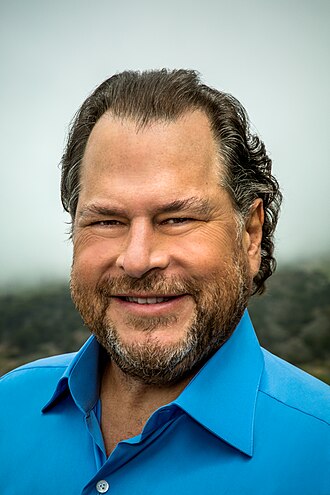
Marc Benioff
Co-founder and CEO, Salesforce
Where to hear and read about Marc Benioff1 episode or test

Marc Benioff co-founded Salesforce and still runs it as CEO, now pushing it into AI agents with Agentforce. The thing most worth learning from him is to keep a beginner's mind, test many tactics at once, and welcome the next technology wave instead of resenting it.
In the beginner's mind, I have every possibility, but in the expert's mind, I have few, and in some cases, maybe none.
Behind the founder: Marc Benioff
Marc Benioff: the story and the lessons
1Marc Benioff's path from Apple intern to Salesforce
Benioff has written software since he was 15. He started on a TRS-80 Model I with 4K of RAM and sold his first program, a juggling tutorial, to CLOAD Magazine for $75.
His parents did not understand it. He counts about 45 years in the industry, or four and a half decades.
At 19 he wrote Macintosh assembly examples during an Apple internship. In 1984 he wrote the first native assembly language examples for the Macintosh, and Steve Jobs became a mentor from those days.
The Apple campus had a juice fridge, a motorcycle in the lobby and a pirate flag on the roof.
Ten years at Oracle left him drained and ready for the internet. He joined Oracle in 1986 as a college graduate and worked for Larry Ellison. After ten years he was 'pretty trashed' and asked for time off, renting a small beach house in Hawaii.
He had worked on the internet at Oracle for a couple of years. Angel investments such as Siebel Systems and Saba Software were going public around then.
He bought domain names for companies that did not exist yet. In 1996, fascinated by the internet, he bought names including bill.com, you.com, code.com, appstore.com and salesforce.com.
He later bought einstein.com early as a name for AI. The habit was to buy the name for an idea he expected to become a company.
2How Benioff launched Salesforce with a fake protest
Benioff picketed a rival's conference with hired actors. Siebel held a user conference in San Francisco, and actors held Home Depot picket signs reading 'The end of software is near.'
Other actors posed as a news crew, 'KNMS, K No More Software', and interviewed the protesters. Tom Siebel came out upset and called the police.
The same night a launch event filled a top San Francisco theater. The launch, with a band, took place on February 22, 2000 and is remembered as one of the most legendary in startup history.
Benioff still calls Siebel 'one of the great entrepreneurs of our generation.'
He is hunting for a new 'KNMS moment' for Agentforce. He wants something viral and exciting to break through the noise, and he posts the ads on Twitter to get feedback before committing.
The aim is to show Salesforce is not just managing data but is a digital labor provider.
3What Steve Jobs taught Benioff
Jobs gave Benioff three orders, one of them cryptic. Jobs told him to grow 10 times in 24 months, sign a big customer like Avon, and build an 'application economy.'
Jobs offered help at a Pixar premiere dinner around 2000 or 2001 and gave no explanation: "I don't know, but you're going to go figure it out."
Benioff decoded 'application economy' as an app store. He concluded Jobs meant an app store, bought appstore.com and launched AppExchange around 2005 or 2006.
Focus groups rejected the name 'App Store' and customers called it an app exchange, so he went with AppExchange.
He gave Jobs the App Store name after Apple launched it. Benioff handed over the appstore.com URL and the trademark, which he had held for six years. Jobs thanked him but said the App Store would not be very big.
Jobs disliked enterprise software and tried to talk him out of it, yet kept supporting him. His last email said everything worked out 'so much better than we could have ever imagined.'
Jobs shaped his view that the stock is not the goal. Benioff says Jobs said it all the time: money arrives at the end of the journey, and the journey is the reward.
Jobs also visited the Zen temples in Kyoto that Benioff uses to clear his mind.
4How Benioff is launching Agentforce
Benioff tests many tactics and scales the one that sticks. He is running Matthew McConaughey and Woody Harrelson ads, a live help site, sales training and aggressive positioning against Microsoft Copilot at the same time.
He compares it to Chris Rock testing jokes in small clubs before a Netflix special: "I am looking to try to find the winning tactic and turn it into a winning strategy."
Salesforce is its own first customer for Agentforce. It moved its whole help infrastructure to Agentforce and made help.salesforce.com the public demo. 83% of inquiries are resolved with no human and human escalations are down 50%.
Being customer zero gives real numbers to market with and stories to tell.
He pairs the launch with six company priorities. Everyone focused on Agentforce, more fuel found inside the company, more distribution, many customer stories, Trailblazers turned into 'agentblazers', and the 135,000 customers who got the product urged to switch it on.
His point: "It's not just one thing." He says he needs a beginner's mind to decide how to inspire, motivate and energize.
He tells customer stories, starting with himself and then Disney. Disney's stores, guides, real estate and call center all run through Salesforce, which makes it a lead example for Agentforce.
He is adding direct sales capacity for the launch. Salesforce sells direct, not through franchises, dealers or resellers, so he plans to hire 1,000 to 2,000 more account executives for Agentforce.
He rejects the 'sales-led' label for Salesforce. Fiscal 2025 was meant to be the year of Data Cloud until agent technology moved faster than expected.
Agentforce arrived ahead of plan, helped by buying Airkit. The company went to market by Dreamforce, which he made entirely about Agentforce, and production code shipped at the end of October.
Airkit's founder had sold RelateIQ to Salesforce about 10 years earlier. Salesforce Ventures invested in his new company, then bought it back about a year ago.
Benioff welcomes rivals building agents. Google has Agentspace, and Microsoft, Oracle and SAP all have agents now. He says that is good, because being the only company in a market is a problem.
He quotes Toyota's Akio Toyoda, "Better, better, better. Never best," and ties it to Kaizen, continuous improvement.
5How Benioff thinks about AI agents and jobs
He builds AI in layers, with each layer feeding the next. Salesforce automated customer touch points, gathered the data in Data Cloud, then put agents on top. He sees robots and drones as a later layer.
The company runs about 2 trillion AI transactions a week. His line: "We wouldn't get to Agentforce without getting to good old Einstein."
He defines an agent as a helper that knows you. His picture comes from Minority Report, where a store greets Tom Cruise with items based on his history. The agent remembers you and acts on that memory.
It could live in a phone, a home robot or a car. He separates it from the hostile agent of The Matrix.
Healthcare shows how much routine work agents can take over. Each pre- and post-procedure call probably costs a hospital about $100, and burnt-out doctors and nurses spend nights on digital messages.
An agent could call to ask whether you drank the water after a CT scan or took your meds. Doctors would keep the empathetic face-to-face conversations.
He expects agents to shift jobs unevenly, not just remove them. Salesforce needs fewer support engineers and is hiring more account executives. Healthcare may need more people than exist.
He expects a 'tale of two cities': office work in San Francisco is hit first, while restaurant, trucking, construction and gardening jobs in small blue-collar towns change slowly.
6Benioff's rules for running a 25-year startup
Benioff cultivates a beginner's mind instead of acting like an expert. He says an expert's mind sees few options. He treats words like 'this will definitely work' as a warning sign that you are about to fail.
He has meditated for three to four decades to keep the beginner's mind. Japanese Shoshin, beginner's mind, sits beside Kaizen in his thinking.
He leaves the office to clear his head and plan. He goes to Zen temples in Kyoto, including the Ryoan-ji rock garden. He says 'geography is important' and suggests Mount Tam or Spirit Rock.
He brought Neil Young there, who mentally wrote a whole album. Benioff: "We're all writing an album in our head." For a CEO the music is the business or launch plan.
He runs every function like a conductor, not one instrument. Product, sales, marketing, accounting, investors, employees and customers all matter, and he moves between CEO, board chair and product manager.
Playing only the clarinet means going less far. He says narrowing yourself is a disservice to everybody else too.
He ignores the stock and still calls himself a startup CEO. He never looks at the stock, tells employees not to, and says so even with it at an all-time high. Salesforce has 75,000 people and about $38 billion in revenue.
He says digital labor is a new industry Salesforce is only starting, and he accepts criticism that its user experience is too complicated: "We are too complicated. I agree."
He wants the next wave, not to resent it. Founders may groan that after AI they now have to learn agents. He calls that the wrong mindset and wants to reach the future first and bring customers along.
His line: "I can't wait for the next failure. I can't wait for the next success."
7Benioff's 10% layoff and why success is never linear
Benioff laid off 10% of Salesforce after pandemic overhiring. It was the company's first scaled layoff, about two years before the recording. Pandemic demand had led it to hire too many people.
"We had to lay off 10% of the company to save the company, and I didn't want to do it." He was criticized in the press and on Twitter.
He overcommunicated and still called it a dumpster fire. He held all-employee meetings and says it was never going to go well whatever he did.
The company needed a financial reset and a technology and product reset at once, and both were painful. It left him with thicker skin.
He expects shocks even after 23 years running the company. He did not expect another massive issue after 23 years. His friend Michael Bell says, "There is no linear success," and not even Apple has a perfect up-and-to-the-right chart.
He calls entrepreneurial life a rock-and-roll roller coaster and says the monastic life suits someone who wants a steady state.

Behind the founder: Marc Benioff
Marc Benioff explains how he launches products by testing many tactics, keeping a beginner's mind, and leading every function of the company like an orchestra conductor. He also covers the Agentforce launch, the 10% layoff he architected, and what Steve Jobs taught him, at a company now worth around $350 billion and still growing after 25 years.
Benioff has written software since he was 15. He started on a TRS-80 Model I with 4K of RAM and sold his first program, a juggling tutorial, to CLOAD Magazine for $75.
His parents did not understand it. He counts about 45 years in the industry, or four and a half decades.
At 19 he wrote Macintosh assembly examples during an Apple internship. In 1984 he wrote the first native assembly language examples for the Macintosh, and Steve Jobs became a mentor from those days.
The Apple campus had a juice fridge, a motorcycle in the lobby and a pirate flag on the roof.
Ten years at Oracle left him drained and ready for the internet. He joined Oracle in 1986 as a college graduate and worked for Larry Ellison. After ten years he was 'pretty trashed' and asked for time off, renting a small beach house in Hawaii.
He had worked on the internet at Oracle for a couple of years. Angel investments such as Siebel Systems and Saba Software were going public around then.
He bought domain names for companies that did not exist yet. In 1996, fascinated by the internet, he bought names including bill.com, you.com, code.com, appstore.com and salesforce.com.
He later bought einstein.com early as a name for AI. The habit was to buy the name for an idea he expected to become a company.
Benioff picketed a rival's conference with hired actors. Siebel held a user conference in San Francisco, and actors held Home Depot picket signs reading 'The end of software is near.'
Other actors posed as a news crew, 'KNMS, K No More Software', and interviewed the protesters. Tom Siebel came out upset and called the police.
The same night a launch event filled a top San Francisco theater. The launch, with a band, took place on February 22, 2000 and is remembered as one of the most legendary in startup history.
Benioff still calls Siebel 'one of the great entrepreneurs of our generation.'
He is hunting for a new 'KNMS moment' for Agentforce. He wants something viral and exciting to break through the noise, and he posts the ads on Twitter to get feedback before committing.
The aim is to show Salesforce is not just managing data but is a digital labor provider.
Jobs gave Benioff three orders, one of them cryptic. Jobs told him to grow 10 times in 24 months, sign a big customer like Avon, and build an 'application economy.'
Jobs offered help at a Pixar premiere dinner around 2000 or 2001 and gave no explanation: "I don't know, but you're going to go figure it out."
Benioff decoded 'application economy' as an app store. He concluded Jobs meant an app store, bought appstore.com and launched AppExchange around 2005 or 2006.
Focus groups rejected the name 'App Store' and customers called it an app exchange, so he went with AppExchange.
He gave Jobs the App Store name after Apple launched it. Benioff handed over the appstore.com URL and the trademark, which he had held for six years. Jobs thanked him but said the App Store would not be very big.
Jobs disliked enterprise software and tried to talk him out of it, yet kept supporting him. His last email said everything worked out 'so much better than we could have ever imagined.'
Jobs shaped his view that the stock is not the goal. Benioff says Jobs said it all the time: money arrives at the end of the journey, and the journey is the reward.
Jobs also visited the Zen temples in Kyoto that Benioff uses to clear his mind.
Benioff tests many tactics and scales the one that sticks. He is running Matthew McConaughey and Woody Harrelson ads, a live help site, sales training and aggressive positioning against Microsoft Copilot at the same time.
He compares it to Chris Rock testing jokes in small clubs before a Netflix special: "I am looking to try to find the winning tactic and turn it into a winning strategy."
Salesforce is its own first customer for Agentforce. It moved its whole help infrastructure to Agentforce and made help.salesforce.com the public demo. 83% of inquiries are resolved with no human and human escalations are down 50%.
Being customer zero gives real numbers to market with and stories to tell.
He pairs the launch with six company priorities. Everyone focused on Agentforce, more fuel found inside the company, more distribution, many customer stories, Trailblazers turned into 'agentblazers', and the 135,000 customers who got the product urged to switch it on.
His point: "It's not just one thing." He says he needs a beginner's mind to decide how to inspire, motivate and energize.
He tells customer stories, starting with himself and then Disney. Disney's stores, guides, real estate and call center all run through Salesforce, which makes it a lead example for Agentforce.
He is adding direct sales capacity for the launch. Salesforce sells direct, not through franchises, dealers or resellers, so he plans to hire 1,000 to 2,000 more account executives for Agentforce.
He rejects the 'sales-led' label for Salesforce. Fiscal 2025 was meant to be the year of Data Cloud until agent technology moved faster than expected.
Agentforce arrived ahead of plan, helped by buying Airkit. The company went to market by Dreamforce, which he made entirely about Agentforce, and production code shipped at the end of October.
Airkit's founder had sold RelateIQ to Salesforce about 10 years earlier. Salesforce Ventures invested in his new company, then bought it back about a year ago.
Benioff welcomes rivals building agents. Google has Agentspace, and Microsoft, Oracle and SAP all have agents now. He says that is good, because being the only company in a market is a problem.
He quotes Toyota's Akio Toyoda, "Better, better, better. Never best," and ties it to Kaizen, continuous improvement.
He builds AI in layers, with each layer feeding the next. Salesforce automated customer touch points, gathered the data in Data Cloud, then put agents on top. He sees robots and drones as a later layer.
The company runs about 2 trillion AI transactions a week. His line: "We wouldn't get to Agentforce without getting to good old Einstein."
He defines an agent as a helper that knows you. His picture comes from Minority Report, where a store greets Tom Cruise with items based on his history. The agent remembers you and acts on that memory.
It could live in a phone, a home robot or a car. He separates it from the hostile agent of The Matrix.
Healthcare shows how much routine work agents can take over. Each pre- and post-procedure call probably costs a hospital about $100, and burnt-out doctors and nurses spend nights on digital messages.
An agent could call to ask whether you drank the water after a CT scan or took your meds. Doctors would keep the empathetic face-to-face conversations.
He expects agents to shift jobs unevenly, not just remove them. Salesforce needs fewer support engineers and is hiring more account executives. Healthcare may need more people than exist.
He expects a 'tale of two cities': office work in San Francisco is hit first, while restaurant, trucking, construction and gardening jobs in small blue-collar towns change slowly.
Benioff cultivates a beginner's mind instead of acting like an expert. He says an expert's mind sees few options. He treats words like 'this will definitely work' as a warning sign that you are about to fail.
He has meditated for three to four decades to keep the beginner's mind. Japanese Shoshin, beginner's mind, sits beside Kaizen in his thinking.
He leaves the office to clear his head and plan. He goes to Zen temples in Kyoto, including the Ryoan-ji rock garden. He says 'geography is important' and suggests Mount Tam or Spirit Rock.
He brought Neil Young there, who mentally wrote a whole album. Benioff: "We're all writing an album in our head." For a CEO the music is the business or launch plan.
He runs every function like a conductor, not one instrument. Product, sales, marketing, accounting, investors, employees and customers all matter, and he moves between CEO, board chair and product manager.
Playing only the clarinet means going less far. He says narrowing yourself is a disservice to everybody else too.
He ignores the stock and still calls himself a startup CEO. He never looks at the stock, tells employees not to, and says so even with it at an all-time high. Salesforce has 75,000 people and about $38 billion in revenue.
He says digital labor is a new industry Salesforce is only starting, and he accepts criticism that its user experience is too complicated: "We are too complicated. I agree."
He wants the next wave, not to resent it. Founders may groan that after AI they now have to learn agents. He calls that the wrong mindset and wants to reach the future first and bring customers along.
His line: "I can't wait for the next failure. I can't wait for the next success."
Benioff laid off 10% of Salesforce after pandemic overhiring. It was the company's first scaled layoff, about two years before the recording. Pandemic demand had led it to hire too many people.
"We had to lay off 10% of the company to save the company, and I didn't want to do it." He was criticized in the press and on Twitter.
He overcommunicated and still called it a dumpster fire. He held all-employee meetings and says it was never going to go well whatever he did.
The company needed a financial reset and a technology and product reset at once, and both were painful. It left him with thicker skin.
He expects shocks even after 23 years running the company. He did not expect another massive issue after 23 years. His friend Michael Bell says, "There is no linear success," and not even Apple has a perfect up-and-to-the-right chart.
He calls entrepreneurial life a rock-and-roll roller coaster and says the monastic life suits someone who wants a steady state.