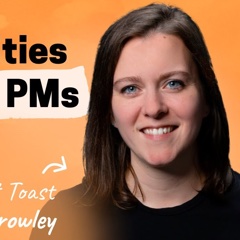
Maggie Crowley
VP of Product at Toast, former head of product at Charlie Health and senior director of product at Drift
Where to hear and read about Maggie Crowley1 episode or test

Maggie Crowley is VP of Product at Toast, after leading product at Charlie Health and Drift, and she took about five years to feel competent as a PM. The thing most worth learning from her is to pick one priority, ship it, follow up on the results and do whatever unglamorous work it takes, because strategy is only a small part of the job.
If you ever find yourself saying something like, that's not my job, that's probably a thing you should do.
Mastering product strategy and growing as a PM | Maggie Crowley (Toast, Drift, TripAdvisor)
Maggie Crowley: the story and the lessons
1Maggie Crowley's path and what five years taught her
Crowley has led product at startups, scale-ups and large companies. She now leads product at Toast. Before that she was VP and head of product at Charlie Health and senior director of product at Drift.
Earlier she was director of product at BevSpot and a PM at TripAdvisor. She holds an MBA from Harvard Business School and was an Olympic speed skater.
Crowley needed about five years to feel she knew what she was doing. Her TripAdvisor rotation put her on four teams in two years, and she left thinking 'I'm good'. Then she was the only PM at a startup, with no one to learn from, and doubted her decisions.
She chose Drift because its product thinkers were shipping with momentum.
She stayed almost four years at Drift to see her decisions play out. She saw two or three cycles of the same product and the results of her own calls, which let her move faster later.
She was surprised by how much she valued staying, partly because she rarely heard that view while planning her career. Her take: "you got to see the consequences of your decisions and that's rare."
Crowley says to take the first PM title you can get. Hiring managers screen on whether you have been a PM, then ask what you shipped. Candidates who can answer the second question are several steps ahead.
She hired an MBA graduate with no product experience who emailed her persistently until the time was right. They then spent four months working side by side at a WeWork to speed up her onboarding.
She keeps a small peer group that reviews her work. Crowley and two friends, Alexa and Daphne, met at Drift and still send each other work and ask for help simplifying it.
She says feedback gets scarcer as you grow more senior, so she recommends two or three peers in non-competing spaces, on Slack, WhatsApp or a group text.
2How Crowley writes a product strategy
Crowley writes her strategy doc for herself first. She started it after feedback that she needed to be more strategic, which she says often lands on women at the door of leadership. An engineer who kept pushing past surface answers on why they were doing something prompted it.
It is a loose Google doc of bullets under headers, with no template. She is always paranoid that others know more, and writes it so she won't put resources on a wrong bet.
She dumps the landscape first and builds down to a plan. The headers run: mission, landscape (business, products, market, competitors, SWOT, key risks), current state (what works, customer feedback, support tickets, tech debt), the top one or two opportunities, challenges, a solution and a plan.
For challenges she asks what has to be true about the world for the plan to work. The plan covers sequencing, team shape and cost. The result is a visible logic chain from company mission to her team's priority.
Sharing the doc turns disagreement into a point-by-point discussion. She shares it with everyone so people can show exactly where they disagree.
In her words: "it doesn't become like, I don't agree with you. It becomes, I don't agree with this point."
The doc can run 20 pages if a short summary sits on top. It can hold competitor screenshots and market notes. A Minto-style summary above the fold gives the conclusion and recommendation.
Engineering and design partners read deeply, while others skim the summary and give a quick yes or no. She says people read only a tiny section, but she knows she did the work and can run the conversation.
She holds the roadmap up against the strategy. A finished strategy almost never matches the roadmap, which fills with legacy commitments and late projects. She has seen 90% of resources committed to work that doesn't track the strategy.
A PM who can't scrap the roadmap can still use the comparison to question whether current work is the most important work.
Crowley skips the formal strategy doc for small features. If you work on a tiny slice of a product and have user feedback, she says to do what makes sense.
She saves the full doc for big, long bets: annual planning, a pivot, a new opportunity, or a product that is treading water.
3Crowley's rules for simple writing and one-pagers
Crowley reads drafts aloud and writes what she would say. She reads a draft, puts it down and asks what the author is trying to say. The spoken answer is usually clear and not what the page says, and her reply is always to just say that thing.
She says 99% of the time the spoken answer is the better draft. She learned the read-aloud habit from her dad in grade school.
She puts the conclusion first and cuts the first two paragraphs. She uses the Minto principle in every email and doc. New PMs think they need a buildup, and she says everyone will thank you for skipping it.
Her dad used to take away the first page of her school papers and tell her to just start there.
She caps priorities, bets and next steps at three. Bundling many ideas dilutes all of them, so she picks the one with the most impact. At any moment there are about 10 things worth doing, and doing all of them means success at none.
The hard part is saying no to the other nine.
Her one-pager opens with the problem, why it matters and why now. She calls this background section the most important part, because the rest gets easy if it is right. It centers the team on why the problem beats the other problems.
The doc becomes home base for decisions, with a dated list of what was decided or left out and links to research. The 'why now' question matters because, as she says, somebody is going to ask.
Crowley asks her engineering counterpart to shred the doc first. Before sharing widely, she sends the strategy or one-pager to her engineering partner and asks them to rip it apart.
Engineers and designers in a true triad commit their teams, so they engage deeply. Her rule: "as a PM you can't be precious about your work. You need people to poke holes in it."
4What Crowley says separates the best PMs
Crowley says the best PMs pick one priority and see it through. Prioritizing is not a single decision. It means keeping the project on top while others try to re-litigate it, for a week or a year.
She finds this hard in big companies, with 700 OKRs and 25,000 possible projects, and in startups, with constant fires.
She treats a priority as a bet and answers for it. She prefers 'making a bet' to 'ownership' because a bet admits it may not work. The PM builds confidence in the decision, then commits and is accountable to the team.
She says it is your job to pick the thing and take responsibility for it.
Crowley follows up on shipped work with calendar reminders. She sets reminders at two weeks, one month and six months after launch to check the metrics and share what happened.
Few PMs do this, so leaders notice, and it teaches why something worked or failed. It also means her progress doesn't depend on a manager noticing.
She carries the water and never says it's not her job. A PM is responsible for a business result, so she fills gaps in support, sales calls, customer implementation, QA, copy and project management. She says none of it is above you.
The PM is often the team's emotional center, so grabbing a task keeps morale up. The phrase 'carrying the water' came from a talk with David Cancel when she joined Drift.
Crowley puts strategy at about 5% of the PM job. Communication, analysis and user experience sense are basics. The PM who ships more gets more reps and creates more impact than one with a better strategy.
Her line: "It's one tiny slice. You do a strategy, but it's 5% of the work that you do."
Crowley hears off the record that most product work is improvised. After recordings, her podcast guests often said they had no idea what they were doing. Some said it was waterfall and the frameworks didn't matter.
Her summary of their view: "Nothing goes the way you want it to go." She notes that published accounts show the ideal version and hide the struggle.

Mastering product strategy and growing as a PM | Maggie Crowley (Toast, Drift, TripAdvisor)
The best PMs simplify, follow up on results and do the unglamorous work, and strategy is only a small slice of the job. The episode gives a step-by-step strategy doc and a one-pager template, plus career advice from someone who took five years to feel competent as a PM.
Crowley has led product at startups, scale-ups and large companies. She now leads product at Toast. Before that she was VP and head of product at Charlie Health and senior director of product at Drift.
Earlier she was director of product at BevSpot and a PM at TripAdvisor. She holds an MBA from Harvard Business School and was an Olympic speed skater.
Crowley needed about five years to feel she knew what she was doing. Her TripAdvisor rotation put her on four teams in two years, and she left thinking 'I'm good'. Then she was the only PM at a startup, with no one to learn from, and doubted her decisions.
She chose Drift because its product thinkers were shipping with momentum.
She stayed almost four years at Drift to see her decisions play out. She saw two or three cycles of the same product and the results of her own calls, which let her move faster later.
She was surprised by how much she valued staying, partly because she rarely heard that view while planning her career. Her take: "you got to see the consequences of your decisions and that's rare."
Crowley says to take the first PM title you can get. Hiring managers screen on whether you have been a PM, then ask what you shipped. Candidates who can answer the second question are several steps ahead.
She hired an MBA graduate with no product experience who emailed her persistently until the time was right. They then spent four months working side by side at a WeWork to speed up her onboarding.
She keeps a small peer group that reviews her work. Crowley and two friends, Alexa and Daphne, met at Drift and still send each other work and ask for help simplifying it.
She says feedback gets scarcer as you grow more senior, so she recommends two or three peers in non-competing spaces, on Slack, WhatsApp or a group text.
Crowley writes her strategy doc for herself first. She started it after feedback that she needed to be more strategic, which she says often lands on women at the door of leadership. An engineer who kept pushing past surface answers on why they were doing something prompted it.
It is a loose Google doc of bullets under headers, with no template. She is always paranoid that others know more, and writes it so she won't put resources on a wrong bet.
She dumps the landscape first and builds down to a plan. The headers run: mission, landscape (business, products, market, competitors, SWOT, key risks), current state (what works, customer feedback, support tickets, tech debt), the top one or two opportunities, challenges, a solution and a plan.
For challenges she asks what has to be true about the world for the plan to work. The plan covers sequencing, team shape and cost. The result is a visible logic chain from company mission to her team's priority.
Sharing the doc turns disagreement into a point-by-point discussion. She shares it with everyone so people can show exactly where they disagree.
In her words: "it doesn't become like, I don't agree with you. It becomes, I don't agree with this point."
The doc can run 20 pages if a short summary sits on top. It can hold competitor screenshots and market notes. A Minto-style summary above the fold gives the conclusion and recommendation.
Engineering and design partners read deeply, while others skim the summary and give a quick yes or no. She says people read only a tiny section, but she knows she did the work and can run the conversation.
She holds the roadmap up against the strategy. A finished strategy almost never matches the roadmap, which fills with legacy commitments and late projects. She has seen 90% of resources committed to work that doesn't track the strategy.
A PM who can't scrap the roadmap can still use the comparison to question whether current work is the most important work.
Crowley skips the formal strategy doc for small features. If you work on a tiny slice of a product and have user feedback, she says to do what makes sense.
She saves the full doc for big, long bets: annual planning, a pivot, a new opportunity, or a product that is treading water.
Crowley reads drafts aloud and writes what she would say. She reads a draft, puts it down and asks what the author is trying to say. The spoken answer is usually clear and not what the page says, and her reply is always to just say that thing.
She says 99% of the time the spoken answer is the better draft. She learned the read-aloud habit from her dad in grade school.
She puts the conclusion first and cuts the first two paragraphs. She uses the Minto principle in every email and doc. New PMs think they need a buildup, and she says everyone will thank you for skipping it.
Her dad used to take away the first page of her school papers and tell her to just start there.
She caps priorities, bets and next steps at three. Bundling many ideas dilutes all of them, so she picks the one with the most impact. At any moment there are about 10 things worth doing, and doing all of them means success at none.
The hard part is saying no to the other nine.
Her one-pager opens with the problem, why it matters and why now. She calls this background section the most important part, because the rest gets easy if it is right. It centers the team on why the problem beats the other problems.
The doc becomes home base for decisions, with a dated list of what was decided or left out and links to research. The 'why now' question matters because, as she says, somebody is going to ask.
Crowley asks her engineering counterpart to shred the doc first. Before sharing widely, she sends the strategy or one-pager to her engineering partner and asks them to rip it apart.
Engineers and designers in a true triad commit their teams, so they engage deeply. Her rule: "as a PM you can't be precious about your work. You need people to poke holes in it."
Crowley says the best PMs pick one priority and see it through. Prioritizing is not a single decision. It means keeping the project on top while others try to re-litigate it, for a week or a year.
She finds this hard in big companies, with 700 OKRs and 25,000 possible projects, and in startups, with constant fires.
She treats a priority as a bet and answers for it. She prefers 'making a bet' to 'ownership' because a bet admits it may not work. The PM builds confidence in the decision, then commits and is accountable to the team.
She says it is your job to pick the thing and take responsibility for it.
Crowley follows up on shipped work with calendar reminders. She sets reminders at two weeks, one month and six months after launch to check the metrics and share what happened.
Few PMs do this, so leaders notice, and it teaches why something worked or failed. It also means her progress doesn't depend on a manager noticing.
She carries the water and never says it's not her job. A PM is responsible for a business result, so she fills gaps in support, sales calls, customer implementation, QA, copy and project management. She says none of it is above you.
The PM is often the team's emotional center, so grabbing a task keeps morale up. The phrase 'carrying the water' came from a talk with David Cancel when she joined Drift.
Crowley puts strategy at about 5% of the PM job. Communication, analysis and user experience sense are basics. The PM who ships more gets more reps and creates more impact than one with a better strategy.
Her line: "It's one tiny slice. You do a strategy, but it's 5% of the work that you do."
Crowley hears off the record that most product work is improvised. After recordings, her podcast guests often said they had no idea what they were doing. Some said it was waterfall and the frameworks didn't matter.
Her summary of their view: "Nothing goes the way you want it to go." She notes that published accounts show the ideal version and hide the struggle.