
Madhavan Ramanujam
Author of Monetizing Innovation
Where to hear and read about Madhavan Ramanujam1 book · 2 episodes and tests
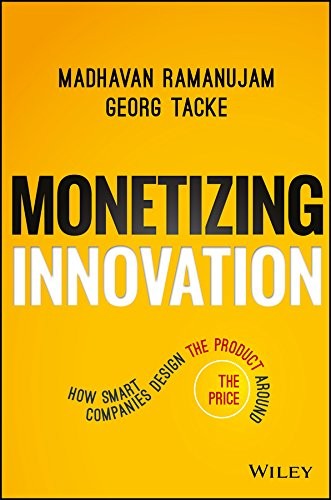 BookMonetizing Innovation

 Lenny's PodcastPricing your AI product: Lessons from 400+ companies and 50 unicorns | Madhavan Ramanujam
 Lenny's PodcastThe art and science of pricing | Madhavan Ramanujam (Monetizing Innovation, Simon-Kucher)
Madhavan Ramanujam is a pricing and monetization expert who spent about 15 years at Simon-Kucher advising companies like Uber, LinkedIn, Asana and DoorDash, wrote Monetizing Innovation and its sequel Scaling Innovation, and now invests in early-stage AI companies through his fund 49 Palms. The lesson most worth taking from him is to test willingness to pay before you build, then design the product, segments and pricing model around what customers will pay for.
Don't just hope; find out!
Monetizing Innovation: How Smart Companies Design the Product Around the Price
Madhavan Ramanujam: the story and the lessons
1How Madhavan Ramanujam came to pricing
A VC's question exposed that his revenue assumptions were invented. While pitching a startup idea out of Stanford, he showed a spreadsheet of labeled assumptions, and a VC asked how he really knew them. His honest answer was that he had made them up.
The same week, Simon-Kucher's managing partner called to recruit Stanford graduates. He joined to learn the science behind pricing, using his training in quantitative marketing to turn theoretical models into practical ones.
He spent 15 years in the Bay Area pricing tech companies. As a partner at Simon-Kucher, the largest pricing consultancy with about 2,000 people in 43 offices, he worked with 250+ companies including Uber, Asana, DoorDash and LinkedIn.
He later became managing partner. He counts dozens of unicorns among his clients across software, internet and marketplace businesses.
He left consulting to invest in early-stage AI founders. With co-GP Josh Bloom, who together have worked with over 500 companies and 50+ unicorns, he started 49 Palms. The fund helps AI founders with monetization in exchange for equity, with no service fee.
Fund one will hold about 20 to 25 companies. He made the move to share in founders' success rather than advise them late in their life. His motto: create value in everything you touch, and everything else will follow.
He judges his books by whether readers change what they do. He wanted Monetizing Innovation to be actionable on Monday morning, not marketing fluff, and readers message him almost daily about changes they made.
Six years after publication it was still in the top 10 of several Amazon categories. Each chapter of the sequel ends with CEO and leadership questions to check progress.
2Ramanujam's core thesis: design the product around the price
Most new products fail because price is decided last. A Simon-Kucher study of 1,615 companies found 72 percent of new products from the prior five years missed revenue and profit goals or failed outright.
Companies model costs line by line but guess at revenue. The usual order of design, build, market, then price should flip so market and price come first.
Founders only choose when to have the pricing conversation. He argues founders cannot avoid talking price with customers; the only thing they control is timing, and no moment is too early.
Product-market fit is not real without product-market-pricing fit. Liking a headset and liking it at $200 are different conversations.
Porsche priced the Cayenne before it existed; Dodge priced the Dart after. Porsche surveyed buyers before any concept car and was ready to drop the SUV if the price failed. Ten years after its 2003 launch the Cayenne sold about 100,000 a year and earned about half of Porsche's profit.
Porsche cut the six-speed manual racing transmission and kept large cup holders after customer testing. Fiat Chrysler attached a price to the Dart at the end, and it sold about 25,000 units in 2012, a quarter of forecasts.
He sorts failed launches into four types. Feature shocks cram in too much (Amazon's Fire Phone took a $170 million write-down), minivations are underpriced, hidden gems get shelved to protect the core, and undeads survive top-down approval.
Kodak invented digital photography in 1974 and shelved it to protect film. Segway cost $100 million to develop and sold about 30,000 by the end of 2007 against a promise of 50,000 in year one. He traces all four types to pricing arriving as an afterthought.
Pricing belongs in product, not finance. A decade earlier he placed pricing in finance as a counterweight to sales. He now says it should sit with product and report to the founder or product head.
Because teams must design the product around what customers need, value and pay for, he calls this a strongly held belief that probably won't change.
3How Ramanujam runs willingness-to-pay research
Never ask customers how much to charge. That answer is garbage, he says. Ask relative questions instead: if Salesforce is 100 for value, where are we, and where should our price sit?
An answer of 110 on price means customers accept a premium over the incumbent. His phrasing: people are meaningless in absolute terms but super smart relatively.
Acceptable, expensive and prohibitive prices reveal thresholds. After pitching value exactly as you would post-launch, ask for each of the three prices. At scale, crossing from $99 to $101 can make 20 to 30 percent call it expensive.
Rahul Vohra used this method to set Superhuman's $30 price. Make about a quarter to half of all questions why questions.
Read the spread of answers, never the average. Groups willing to pay $20 and $100 do not make a $60 market; that price overcharges one and undercharges the other.
A clear split can justify a separate version for each group.
Match the method to the company's stage. At idea stage, ask whether they would pay. Seed and Series A can use purchase probability scales and most-least rankings; late stage needs trade-off simulations.
On a 1 to 5 purchase scale, a 5 means only 30 to 50 percent real intent and a 4 means 10 to 20 percent. For B2C, 1,000 to 2,000 responses; for B2B, the 20 to 30 accounts that drive most revenue.
Willingness to pay should set the roadmap. An internet marketplace planned 25 buyer features; customers would pay $10 to $20 a month, but only for 10 of them, and those became the roadmap.
The team's favorite feature, showing Facebook friends who bought from a seller, had no segment willing to pay. A web hosting company cut from 27 features to eight, raised price, and lifted conversion and revenue over 25 percent.
About 20 percent of what you build drives 80 percent of willingness to pay. That 20 percent is often the easiest to build, so founders ship it nearly free and chase work that drives little payment.
He says MVP should mean most valuable product, not minimum viable product.
4Ramanujam on segments, bundles and tiers
Segment by needs and willingness to pay, not demographics. Prince Charles and Ozzy Osbourne share a demographic profile but want different things. Only about 10 percent of companies claiming a segmentation strategy have a meaningful one.
A paper maker surveyed about 200 customers and found four needs-based segments that mixed all sizes, including some who would pay for technical service the firm treated as a cost. His line: one size fits none.
Start with three or four segments and launch for the best one. Each extra segment adds complexity. The sales acid test asks whether reps can sort their own clients into the segments.
A European retail bank replaced 30 account offerings with three segment offers and grew personal banking profit 30 percent.
Sort features into leaders, fillers and killers. Leaders drive purchase, fillers add cheap value, killers lower willingness to pay for the whole bundle and should be sold as add-ons.
In a Happy Meal the burger leads, fries and Coke fill, and coffee is a killer. A feature is a killer when fewer than 20 percent value it and more than 20 percent don't value it at all.
Strip the entry tier when most buyers pick it. Target about 30 percent in good and 70 percent in better and best, with at least 10 percent in best.
An overloaded entry tier lets a firm land customers but not expand them. About 90 percent of companies claiming land and expand only land.
Mixed bundling often beats both separate and single bundles. In his pizzeria puzzle, stand-alone prices earn $3,300, a single bundle $4,200, and a $13 bundle with items at $9 earns $4,400.
Fewer than 10 percent of executives find the answer. Sometimes the best move is to unbundle, as Ryanair did with low fares plus fees.
5Why Ramanujam says how you charge beats how much
The pricing model comes before the price point. Michelin's new tire lasted 20 percent longer, which would have cut demand. In 2001 it began charging trucking fleets per kilometer, and by 2011 its EBIT was 25 percent above Bridgestone's.
Pick the model first, then the metric, then the structure. A bad monetization model can cost more than a bad price.
Charge on a metric that tracks customer value. Segment moved from charging per API to monthly tracked users. Optimizely rejected per-seat pricing and charged by visitors in experiments.
A lab software firm switched from a perpetual license to a fee per lab report and lifted revenue 20 percent.
Choose subscription or usage from the customer's situation. Subscription fits predictable bills and ongoing value with episodic use, like LifeLock. Usage fits low-commitment buying, fairness and costs that scale, if you can track the metric.
Hybrids like HubSpot's fixed fee plus overage also work.
A break-even question shows which model customers prefer. Offer mathematically equal options, such as a 3 percent fee versus 1.5 percent plus $1.50 on a $100 item, and ask which they prefer.
Done thousands of times, the indifferent option has never won.
Only three pricing strategies exist, and penetration is riskiest. Skimming (Apple), penetration (Amazon) and maximization (Microsoft). Pricing low for growth without a supporting model is a fallacy.
LivingSocial raised more than $900 million and lost more than $1 billion over four years. Lexus entered low and raised prices more than 40 percent five years later.
Settle price debates with your own elasticity curve. In one example, revenue peaked at $100 but profit at $110 on 10 percent less volume.
A $20 pricing error can easily cost 20 percent of total profit. Leaders can split 100 points across goals to expose that they want different prices.
6Ramanujam's behavioral pricing and value selling tactics
Pitch benefits, not features. SmugMug cut more than 100 feature statements to fewer than 10 benefits and lifted revenue and conversion by double digits with no product change.
Carbonite changed "20 gigabytes" to "unlimited storage" and conversion rose strongly. Being passionate about every detail is a warning sign.
A decoy tier moved one company's mix to the middle. A startup at $49, $79 and $149 had 60 to 70 percent on $49. It moved to $49, $99 and $199 with a slimmer base and a $299 anchor.
ARPU rose 36 percent and new-customer MRR 29 percent with no product changes. The CEO had copied the original tiers from business school without checking the mix.
Find psychological thresholds and stay just under them. An online subscription company had cliffs at $40, $70 and $100; more than 20 percent rejected $71 but accepted $69.99.
Thresholds differ by product, so they must be tested.
Frame prices in the smallest unit. Show annual plans as a monthly price and use per-day framing. Superhuman framed $30 a month as a dollar a day for four hours back each week.
Buyers weigh upfront cost more than total cost, which is why razor and printer models work.
Show products as a puzzle to lift attach rates. Financial services clients saw multi-product attach rise from about 20 percent to 40 to 50 percent.
He calls it the Panini effect, after sticker albums.
Simple pricing is pricing prospects can explain back. Ask early prospects to describe your pricing as if selling it for you; if they can't, it isn't simple.
7Ramanujam on protecting price and growing profitably
Durable companies run two engines: market share and wallet share. In Scaling Innovation he lays out nine strategies, four for startups and five for scaleups, across acquisition, monetization and retention.
His analogy: you would not fly an aircraft on one engine. Equal attention is not equal effort.
Each founder archetype has predictable blind spots. Disruptors neglect existing customers, money makers price so high they kill acquisition, and community builders ignore new customer types.
The cure is to be all three at once, which he calls a profitable growth architect.
Find the cause before cutting a price. A Latin American telecom required three nonprice fixes before any cut. Apple held the Apple Watch at $349 despite mixed reviews.
A discount becomes the new price about six months later. In downturns offer a de-featured version or better terms instead.
Downturns are the time to switch to usage pricing. A salon software company moved to per-haircut pricing during the pandemic, and the model recoups far more once haircuts return.
Reluctance to raise prices is internal and emotional. He suggests reviewing AI pricing about yearly and raising price points as costs rise, while keeping the model stable.
He cites Warren Buffett: needing a prayer session for a 10 percent increase means a terrible business.
Stop churn at acquisition. A save offer to a customer who has decided to leave buys about six months. Study who stays longest and acquire more like them.
8Ramanujam's playbook for pilots and B2B negotiation
A pilot exists only to build the business case. Co-create the ROI model with the customer's users in a 30-day pilot, agreeing on inputs so they won't fight the output.
"The entire goal of the POC is to create a business case. Period. Full stop."
Charge for pilots, but don't let the fee anchor the deal. A paid pilot screens out tire kickers, but a $10K pilot can be read as a $120K a year anchor unless you say otherwise.
LinkedIn sold its betas; Talent Solutions reached $1.3 billion by 2014.
Answer a price demand with value or a range. Say similar customers unlocked $10 million and pricing runs about 1 to 10x ROI; if pushed, give a range like $500K to $1 million, never one number.
Bring options, including a higher one. A founder expecting a $100K budget offered $100K plus 10 percent of incremental value or $500K fixed, and closed at $400K.
Good, better, best options move the talk from price to value.
Trade every concession and taper them. Ask for a get, such as a value audit every six months. Concede 15, then 5, then 2 percent, never 5, 10, 15.
The audit becomes the customer's own business case at renewal.
Create needs and build three-bucket ROI models. Ask how long a task takes today, then what it would mean instantly. Quantify KPI gains, cost savings and opportunity cost.
Opportunity cost, what a team does with 10 freed hours, is the bucket most often missed.
9How Ramanujam thinks about pricing AI products
AI companies must monetize from day one. Agentic AI taps labor budgets about 10x software budgets, and a product anchored at $20 a month struggles to climb.
AI also brings real costs early, and some fast-growing coding tools have underpriced.
Attribution and autonomy decide the pricing model. Low on both fits seats; attribution with a human in the loop, like Cursor, fits seats plus credits; autonomy without attribution fits usage.
High on both is the golden quadrant: outcome-based pricing.
Outcome pricing can capture 25 to 50 percent of value. Classic SaaS captured 10 to 20 percent. Intercom's Fin charges $0.99 per ticket resolved alone; Chargeflow takes up to 25 percent of chargebacks recovered.
About 5 percent of companies price this way; he expects 25 percent within three years.
Build proof and autonomy before switching to outcomes. Track customers' KPIs, build value dashboards, run value audits and build agentic workflows.
"If you try to rush into an outcome based pricing model but cannot prove attribution you will fail."
Pricing your AI product: Lessons from 400+ companies and 50 unicorns | Madhavan Ramanujam
Pricing and monetization expert Madhavan Ramanujam explains how to balance market share and wallet share, negotiate for full value, run POCs as business-case creation, and pick an AI pricing model with an attribution and autonomy 2x2. His work covers 250+ companies and 30 unicorns, and he argues AI winners can capture 25% to 50% of the value they create versus 10% to 20% for classic SaaS.
He spent 15 years in the Bay Area pricing tech companies. As a partner at Simon-Kucher, the largest pricing consultancy with about 2,000 people in 43 offices, he worked with 250+ companies including Uber, Asana, DoorDash and LinkedIn.
He later became managing partner. He counts dozens of unicorns among his clients across software, internet and marketplace businesses.
He left consulting to invest in early-stage AI founders. With co-GP Josh Bloom, who together have worked with over 500 companies and 50+ unicorns, he started 49 Palms. The fund helps AI founders with monetization in exchange for equity, with no service fee.
Fund one will hold about 20 to 25 companies. He made the move to share in founders' success rather than advise them late in their life. His motto: create value in everything you touch, and everything else will follow.
He judges his books by whether readers change what they do. He wanted Monetizing Innovation to be actionable on Monday morning, not marketing fluff, and readers message him almost daily about changes they made.
Six years after publication it was still in the top 10 of several Amazon categories. Each chapter of the sequel ends with CEO and leadership questions to check progress.
About 20 percent of what you build drives 80 percent of willingness to pay. That 20 percent is often the easiest to build, so founders ship it nearly free and chase work that drives little payment.
He says MVP should mean most valuable product, not minimum viable product.
Frame prices in the smallest unit. Show annual plans as a monthly price and use per-day framing. Superhuman framed $30 a month as a dollar a day for four hours back each week.
Buyers weigh upfront cost more than total cost, which is why razor and printer models work.
Simple pricing is pricing prospects can explain back. Ask early prospects to describe your pricing as if selling it for you; if they can't, it isn't simple.
Durable companies run two engines: market share and wallet share. In Scaling Innovation he lays out nine strategies, four for startups and five for scaleups, across acquisition, monetization and retention.
His analogy: you would not fly an aircraft on one engine. Equal attention is not equal effort.
Each founder archetype has predictable blind spots. Disruptors neglect existing customers, money makers price so high they kill acquisition, and community builders ignore new customer types.
The cure is to be all three at once, which he calls a profitable growth architect.
Reluctance to raise prices is internal and emotional. He suggests reviewing AI pricing about yearly and raising price points as costs rise, while keeping the model stable.
He cites Warren Buffett: needing a prayer session for a 10 percent increase means a terrible business.
Stop churn at acquisition. A save offer to a customer who has decided to leave buys about six months. Study who stays longest and acquire more like them.
A pilot exists only to build the business case. Co-create the ROI model with the customer's users in a 30-day pilot, agreeing on inputs so they won't fight the output.
"The entire goal of the POC is to create a business case. Period. Full stop."
Charge for pilots, but don't let the fee anchor the deal. A paid pilot screens out tire kickers, but a $10K pilot can be read as a $120K a year anchor unless you say otherwise.
LinkedIn sold its betas; Talent Solutions reached $1.3 billion by 2014.
Answer a price demand with value or a range. Say similar customers unlocked $10 million and pricing runs about 1 to 10x ROI; if pushed, give a range like $500K to $1 million, never one number.
Bring options, including a higher one. A founder expecting a $100K budget offered $100K plus 10 percent of incremental value or $500K fixed, and closed at $400K.
Good, better, best options move the talk from price to value.
Trade every concession and taper them. Ask for a get, such as a value audit every six months. Concede 15, then 5, then 2 percent, never 5, 10, 15.
The audit becomes the customer's own business case at renewal.
Create needs and build three-bucket ROI models. Ask how long a task takes today, then what it would mean instantly. Quantify KPI gains, cost savings and opportunity cost.
Opportunity cost, what a team does with 10 freed hours, is the bucket most often missed.
AI companies must monetize from day one. Agentic AI taps labor budgets about 10x software budgets, and a product anchored at $20 a month struggles to climb.
AI also brings real costs early, and some fast-growing coding tools have underpriced.
Attribution and autonomy decide the pricing model. Low on both fits seats; attribution with a human in the loop, like Cursor, fits seats plus credits; autonomy without attribution fits usage.
High on both is the golden quadrant: outcome-based pricing.
Outcome pricing can capture 25 to 50 percent of value. Classic SaaS captured 10 to 20 percent. Intercom's Fin charges $0.99 per ticket resolved alone; Chargeflow takes up to 25 percent of chargebacks recovered.
About 5 percent of companies price this way; he expects 25 percent within three years.
Build proof and autonomy before switching to outcomes. Track customers' KPIs, build value dashboards, run value audits and build agentic workflows.
"If you try to rush into an outcome based pricing model but cannot prove attribution you will fail."
The art and science of pricing | Madhavan Ramanujam (Monetizing Innovation, Simon-Kucher)
Pricing should be tested before the product is built: willingness to pay conversations, segmentation, pricing model choice, benefit-led messaging and behavioral pricing all shape what gets built and what it earns. Examples include Porsche's Cayenne, which became more than half of the company's profit, and a SaaS packaging reframe that lifted MRR and ARPU by 30 plus percent with no product changes.
A VC's question exposed that his revenue assumptions were invented. While pitching a startup idea out of Stanford, he showed a spreadsheet of labeled assumptions, and a VC asked how he really knew them. His honest answer was that he had made them up.
The same week, Simon-Kucher's managing partner called to recruit Stanford graduates. He joined to learn the science behind pricing, using his training in quantitative marketing to turn theoretical models into practical ones.
He spent 15 years in the Bay Area pricing tech companies. As a partner at Simon-Kucher, the largest pricing consultancy with about 2,000 people in 43 offices, he worked with 250+ companies including Uber, Asana, DoorDash and LinkedIn.
He later became managing partner. He counts dozens of unicorns among his clients across software, internet and marketplace businesses.
He judges his books by whether readers change what they do. He wanted Monetizing Innovation to be actionable on Monday morning, not marketing fluff, and readers message him almost daily about changes they made.
Six years after publication it was still in the top 10 of several Amazon categories. Each chapter of the sequel ends with CEO and leadership questions to check progress.
Most new products fail because price is decided last. A Simon-Kucher study of 1,615 companies found 72 percent of new products from the prior five years missed revenue and profit goals or failed outright.
Companies model costs line by line but guess at revenue. The usual order of design, build, market, then price should flip so market and price come first.
Founders only choose when to have the pricing conversation. He argues founders cannot avoid talking price with customers; the only thing they control is timing, and no moment is too early.
Product-market fit is not real without product-market-pricing fit. Liking a headset and liking it at $200 are different conversations.
Porsche priced the Cayenne before it existed; Dodge priced the Dart after. Porsche surveyed buyers before any concept car and was ready to drop the SUV if the price failed. Ten years after its 2003 launch the Cayenne sold about 100,000 a year and earned about half of Porsche's profit.
Porsche cut the six-speed manual racing transmission and kept large cup holders after customer testing. Fiat Chrysler attached a price to the Dart at the end, and it sold about 25,000 units in 2012, a quarter of forecasts.
He sorts failed launches into four types. Feature shocks cram in too much (Amazon's Fire Phone took a $170 million write-down), minivations are underpriced, hidden gems get shelved to protect the core, and undeads survive top-down approval.
Kodak invented digital photography in 1974 and shelved it to protect film. Segway cost $100 million to develop and sold about 30,000 by the end of 2007 against a promise of 50,000 in year one. He traces all four types to pricing arriving as an afterthought.
Pricing belongs in product, not finance. A decade earlier he placed pricing in finance as a counterweight to sales. He now says it should sit with product and report to the founder or product head.
Because teams must design the product around what customers need, value and pay for, he calls this a strongly held belief that probably won't change.
Never ask customers how much to charge. That answer is garbage, he says. Ask relative questions instead: if Salesforce is 100 for value, where are we, and where should our price sit?
An answer of 110 on price means customers accept a premium over the incumbent. His phrasing: people are meaningless in absolute terms but super smart relatively.
Acceptable, expensive and prohibitive prices reveal thresholds. After pitching value exactly as you would post-launch, ask for each of the three prices. At scale, crossing from $99 to $101 can make 20 to 30 percent call it expensive.
Rahul Vohra used this method to set Superhuman's $30 price. Make about a quarter to half of all questions why questions.
Match the method to the company's stage. At idea stage, ask whether they would pay. Seed and Series A can use purchase probability scales and most-least rankings; late stage needs trade-off simulations.
On a 1 to 5 purchase scale, a 5 means only 30 to 50 percent real intent and a 4 means 10 to 20 percent. For B2C, 1,000 to 2,000 responses; for B2B, the 20 to 30 accounts that drive most revenue.
Willingness to pay should set the roadmap. An internet marketplace planned 25 buyer features; customers would pay $10 to $20 a month, but only for 10 of them, and those became the roadmap.
The team's favorite feature, showing Facebook friends who bought from a seller, had no segment willing to pay. A web hosting company cut from 27 features to eight, raised price, and lifted conversion and revenue over 25 percent.
About 20 percent of what you build drives 80 percent of willingness to pay. That 20 percent is often the easiest to build, so founders ship it nearly free and chase work that drives little payment.
He says MVP should mean most valuable product, not minimum viable product.
Segment by needs and willingness to pay, not demographics. Prince Charles and Ozzy Osbourne share a demographic profile but want different things. Only about 10 percent of companies claiming a segmentation strategy have a meaningful one.
A paper maker surveyed about 200 customers and found four needs-based segments that mixed all sizes, including some who would pay for technical service the firm treated as a cost. His line: one size fits none.
Start with three or four segments and launch for the best one. Each extra segment adds complexity. The sales acid test asks whether reps can sort their own clients into the segments.
A European retail bank replaced 30 account offerings with three segment offers and grew personal banking profit 30 percent.
Sort features into leaders, fillers and killers. Leaders drive purchase, fillers add cheap value, killers lower willingness to pay for the whole bundle and should be sold as add-ons.
In a Happy Meal the burger leads, fries and Coke fill, and coffee is a killer. A feature is a killer when fewer than 20 percent value it and more than 20 percent don't value it at all.
Strip the entry tier when most buyers pick it. Target about 30 percent in good and 70 percent in better and best, with at least 10 percent in best.
An overloaded entry tier lets a firm land customers but not expand them. About 90 percent of companies claiming land and expand only land.
The pricing model comes before the price point. Michelin's new tire lasted 20 percent longer, which would have cut demand. In 2001 it began charging trucking fleets per kilometer, and by 2011 its EBIT was 25 percent above Bridgestone's.
Pick the model first, then the metric, then the structure. A bad monetization model can cost more than a bad price.
Charge on a metric that tracks customer value. Segment moved from charging per API to monthly tracked users. Optimizely rejected per-seat pricing and charged by visitors in experiments.
A lab software firm switched from a perpetual license to a fee per lab report and lifted revenue 20 percent.
Choose subscription or usage from the customer's situation. Subscription fits predictable bills and ongoing value with episodic use, like LifeLock. Usage fits low-commitment buying, fairness and costs that scale, if you can track the metric.
Hybrids like HubSpot's fixed fee plus overage also work.
A break-even question shows which model customers prefer. Offer mathematically equal options, such as a 3 percent fee versus 1.5 percent plus $1.50 on a $100 item, and ask which they prefer.
Done thousands of times, the indifferent option has never won.
Only three pricing strategies exist, and penetration is riskiest. Skimming (Apple), penetration (Amazon) and maximization (Microsoft). Pricing low for growth without a supporting model is a fallacy.
LivingSocial raised more than $900 million and lost more than $1 billion over four years. Lexus entered low and raised prices more than 40 percent five years later.
Pitch benefits, not features. SmugMug cut more than 100 feature statements to fewer than 10 benefits and lifted revenue and conversion by double digits with no product change.
Carbonite changed "20 gigabytes" to "unlimited storage" and conversion rose strongly. Being passionate about every detail is a warning sign.
A decoy tier moved one company's mix to the middle. A startup at $49, $79 and $149 had 60 to 70 percent on $49. It moved to $49, $99 and $199 with a slimmer base and a $299 anchor.
ARPU rose 36 percent and new-customer MRR 29 percent with no product changes. The CEO had copied the original tiers from business school without checking the mix.
Find psychological thresholds and stay just under them. An online subscription company had cliffs at $40, $70 and $100; more than 20 percent rejected $71 but accepted $69.99.
Thresholds differ by product, so they must be tested.
Frame prices in the smallest unit. Show annual plans as a monthly price and use per-day framing. Superhuman framed $30 a month as a dollar a day for four hours back each week.
Buyers weigh upfront cost more than total cost, which is why razor and printer models work.
Show products as a puzzle to lift attach rates. Financial services clients saw multi-product attach rise from about 20 percent to 40 to 50 percent.
He calls it the Panini effect, after sticker albums.
Find the cause before cutting a price. A Latin American telecom required three nonprice fixes before any cut. Apple held the Apple Watch at $349 despite mixed reviews.
A discount becomes the new price about six months later. In downturns offer a de-featured version or better terms instead.
Downturns are the time to switch to usage pricing. A salon software company moved to per-haircut pricing during the pandemic, and the model recoups far more once haircuts return.
Monetizing Innovation: How Smart Companies Design the Product Around the Price
New products miss their revenue and profit goals mostly because companies set the price last. They should learn what customers value and will pay before building, then design segments, features, bundles, the revenue model and the launch strategy around that price. The book gives nine concrete rules, plus cases from Porsche, LinkedIn, Uber, Optimizely and others, that move teams from hoping a product will sell to knowing it will.
Most new products fail because price is decided last. A Simon-Kucher study of 1,615 companies found 72 percent of new products from the prior five years missed revenue and profit goals or failed outright.
Companies model costs line by line but guess at revenue. The usual order of design, build, market, then price should flip so market and price come first.
Porsche priced the Cayenne before it existed; Dodge priced the Dart after. Porsche surveyed buyers before any concept car and was ready to drop the SUV if the price failed. Ten years after its 2003 launch the Cayenne sold about 100,000 a year and earned about half of Porsche's profit.
Porsche cut the six-speed manual racing transmission and kept large cup holders after customer testing. Fiat Chrysler attached a price to the Dart at the end, and it sold about 25,000 units in 2012, a quarter of forecasts.
He sorts failed launches into four types. Feature shocks cram in too much (Amazon's Fire Phone took a $170 million write-down), minivations are underpriced, hidden gems get shelved to protect the core, and undeads survive top-down approval.
Kodak invented digital photography in 1974 and shelved it to protect film. Segway cost $100 million to develop and sold about 30,000 by the end of 2007 against a promise of 50,000 in year one. He traces all four types to pricing arriving as an afterthought.
Acceptable, expensive and prohibitive prices reveal thresholds. After pitching value exactly as you would post-launch, ask for each of the three prices. At scale, crossing from $99 to $101 can make 20 to 30 percent call it expensive.
Rahul Vohra used this method to set Superhuman's $30 price. Make about a quarter to half of all questions why questions.
Read the spread of answers, never the average. Groups willing to pay $20 and $100 do not make a $60 market; that price overcharges one and undercharges the other.
A clear split can justify a separate version for each group.
Willingness to pay should set the roadmap. An internet marketplace planned 25 buyer features; customers would pay $10 to $20 a month, but only for 10 of them, and those became the roadmap.
The team's favorite feature, showing Facebook friends who bought from a seller, had no segment willing to pay. A web hosting company cut from 27 features to eight, raised price, and lifted conversion and revenue over 25 percent.
Segment by needs and willingness to pay, not demographics. Prince Charles and Ozzy Osbourne share a demographic profile but want different things. Only about 10 percent of companies claiming a segmentation strategy have a meaningful one.
A paper maker surveyed about 200 customers and found four needs-based segments that mixed all sizes, including some who would pay for technical service the firm treated as a cost. His line: one size fits none.
Start with three or four segments and launch for the best one. Each extra segment adds complexity. The sales acid test asks whether reps can sort their own clients into the segments.
A European retail bank replaced 30 account offerings with three segment offers and grew personal banking profit 30 percent.
Sort features into leaders, fillers and killers. Leaders drive purchase, fillers add cheap value, killers lower willingness to pay for the whole bundle and should be sold as add-ons.
In a Happy Meal the burger leads, fries and Coke fill, and coffee is a killer. A feature is a killer when fewer than 20 percent value it and more than 20 percent don't value it at all.
Strip the entry tier when most buyers pick it. Target about 30 percent in good and 70 percent in better and best, with at least 10 percent in best.
An overloaded entry tier lets a firm land customers but not expand them. About 90 percent of companies claiming land and expand only land.
Mixed bundling often beats both separate and single bundles. In his pizzeria puzzle, stand-alone prices earn $3,300, a single bundle $4,200, and a $13 bundle with items at $9 earns $4,400.
Fewer than 10 percent of executives find the answer. Sometimes the best move is to unbundle, as Ryanair did with low fares plus fees.
The pricing model comes before the price point. Michelin's new tire lasted 20 percent longer, which would have cut demand. In 2001 it began charging trucking fleets per kilometer, and by 2011 its EBIT was 25 percent above Bridgestone's.
Pick the model first, then the metric, then the structure. A bad monetization model can cost more than a bad price.
Charge on a metric that tracks customer value. Segment moved from charging per API to monthly tracked users. Optimizely rejected per-seat pricing and charged by visitors in experiments.
A lab software firm switched from a perpetual license to a fee per lab report and lifted revenue 20 percent.
Only three pricing strategies exist, and penetration is riskiest. Skimming (Apple), penetration (Amazon) and maximization (Microsoft). Pricing low for growth without a supporting model is a fallacy.
LivingSocial raised more than $900 million and lost more than $1 billion over four years. Lexus entered low and raised prices more than 40 percent five years later.
Settle price debates with your own elasticity curve. In one example, revenue peaked at $100 but profit at $110 on 10 percent less volume.
A $20 pricing error can easily cost 20 percent of total profit. Leaders can split 100 points across goals to expose that they want different prices.
Pitch benefits, not features. SmugMug cut more than 100 feature statements to fewer than 10 benefits and lifted revenue and conversion by double digits with no product change.
Carbonite changed "20 gigabytes" to "unlimited storage" and conversion rose strongly. Being passionate about every detail is a warning sign.
A decoy tier moved one company's mix to the middle. A startup at $49, $79 and $149 had 60 to 70 percent on $49. It moved to $49, $99 and $199 with a slimmer base and a $299 anchor.
ARPU rose 36 percent and new-customer MRR 29 percent with no product changes. The CEO had copied the original tiers from business school without checking the mix.
Find psychological thresholds and stay just under them. An online subscription company had cliffs at $40, $70 and $100; more than 20 percent rejected $71 but accepted $69.99.
Thresholds differ by product, so they must be tested.
Frame prices in the smallest unit. Show annual plans as a monthly price and use per-day framing. Superhuman framed $30 a month as a dollar a day for four hours back each week.
Buyers weigh upfront cost more than total cost, which is why razor and printer models work.
Find the cause before cutting a price. A Latin American telecom required three nonprice fixes before any cut. Apple held the Apple Watch at $349 despite mixed reviews.
A discount becomes the new price about six months later. In downturns offer a de-featured version or better terms instead.
Charge for pilots, but don't let the fee anchor the deal. A paid pilot screens out tire kickers, but a $10K pilot can be read as a $120K a year anchor unless you say otherwise.
LinkedIn sold its betas; Talent Solutions reached $1.3 billion by 2014.
Create needs and build three-bucket ROI models. Ask how long a task takes today, then what it would mean instantly. Quantify KPI gains, cost savings and opportunity cost.
Opportunity cost, what a team does with 10 freed hours, is the bucket most often missed.