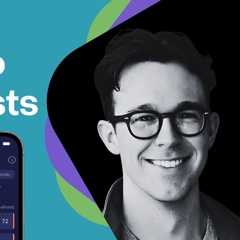
Luke Martin-Fuller
Co-founder, Visible
Where to hear and read about Luke Martin-Fuller1 episode or test

Luke Martin-Fuller is a co-founder of Visible, a wearable and app that helps people with chronic illness pace their energy, and a former big-law lawyer turned product manager. The most useful lesson from him is to earn trust and retention with the product first, which took Visible from $1M to $10M ARR in two years on one paid channel before any growth experiments.
Unless you've got something of value that is going to be retaining people and helping them, then there's no point investing in all of that experimentation.
$10M ARR without ever testing a paywall — Luke Martin-Fuller, Visible
Luke Martin-Fuller: the story and the lessons
1How Luke Martin-Fuller and Harry started Visible
Martin-Fuller went from big-law lawyer to fintech product manager before Visible. He worked as a lawyer, then became a product manager at a London fintech, where he met his future co-founder Harry.
Visible is now used by over 300,000 people to pace their energy.
A fitness tracker showed Harry the gap Visible fills. Harry caught mild COVID in 2020 and did not recover, so he bought a Whoop. Its data tracked his energy and brain fog, but it celebrated 10,000 steps and pushing harder made him worse.
He found pacing, staying inside your energy envelope, which NICE and the CDC recommend as the only management strategy. It is hard to do without data.
They tested demand with a mockup and an honest promise. A Fiverr designer made a 3D mockup of a wearable with the hero line 'pacing made simple'. About 5,000 people joined the waitlist in roughly a week for a product that did not exist.
Signups went to a Typeform. They said plainly there was little behind it, and Martin-Fuller notes a founder who sees the audience as gullible is unlikely to build something that speaks to it.
A free app for the Founding 100 showed what to build. The first 100 users came from the waitlist and stayed in a Facebook group and on frequent calls. They juggled three or four apps for symptoms, community and research, so Visible merged them into one experience.
The free app later reached about 50,000 users by word of mouth.
He raised only enough money to pay rent. Martin-Fuller asked for $50,000 so the founders could pay themselves for 12 months before he joined. An angel came first and a little more money followed quickly, enough for a small team while the product was free.
Revenue began over a year after launch, in October 2023, with a team of five.
Visible reached about $7M in revenue before a small, quiet Series A. It was cash flow positive at about $7M in revenue when it raised a small Series A, early in the year, from an investor who understood the mission. The money funded data science and the core product team.
The round was not announced because members do not care, and a press article could rank in search for people looking for a solution. On large rounds: "If you're raising that kind of money, you're expected to spend it."
2How Visible built trust before it built revenue
Visible refuses to call itself a cure. In a field of supplements, ear seeds and courses built on one big secret, Visible says it is not a treatment or a cure but helps you implement a management strategy.
Wary buyers now use AI tools to check whether a company is real and backed by science.
Martin-Fuller publishes research even though it moves no revenue number. Opt-in anonymized data sharing in the free app led to papers, including a Nature paper on using HRV and heart rate to predict future symptom events, and work with Mount Sinai and Imperial College London.
Skeptical buyers who dig in find the papers and conclude the company is legitimate. He says it is "not something that moves a revenue number at least immediately." It also cannot be cloned over a weekend.
Visible built consent, ethics and anonymization properly. Consent flows say who gets the data, for how long and why. An academic partner secures ethics committee sign-off, and a pipeline strips identifiers.
Martin-Fuller believes Visible holds the largest dataset ever for a group long underinvested in.
He let researchers pull the first study. Early on, the team asked researchers for advice before asking for anything. A researcher then requested the data for the first study.
"The earliest study that we did was actually more pull rather than push." He doubts cold outreach would work and stresses being part of the conversation.
Lived experience runs through the team and the cap table. Nearly half the team and the investors, from the first angel to the Series A lead, have lived experience of these illnesses.
Martin-Fuller advises founders against investors who only want the commercial opportunity, since backers must stay through thick and thin. Poor science also means no one can size the population bottoms-up for a pitch deck.
He built the product to retain people before investing in growth tests. Visible delayed lifecycle email, paywall tests, funnel experiments, new geographies, AdWords, TikTok and SEO until the product retained people. It grew from $1M to $10M subscription ARR in exactly two years.
Before charging, it sent 100 wearables free and iterated until they had value. Optimizing conversion cannot rescue a product that does not deliver.
3How Visible turned a wearable into a subscription business
Martin-Fuller tried existing devices before building hardware. Real-time heart rate alerts are impossible on 99% of devices, which sample every 5 to 10 minutes. Data aggregators force two apps open and delay syncing, which is hard with brain fog.
The first feature Visible knew it had to build was a notification when heart rate crosses a threshold.
He partnered with Polar instead of building sensors. Visible bought Polar sensors and used the open SDK to prove the concept, then bought the armband wholesale. About a year in, it asked for better battery life, easier charging and accelerometer data.
Polar has built heart rate monitors since 1977. Martin-Fuller says of that accuracy, "We could never compete with that."
Visible sells the band at cost and charges for the subscription. The band costs about $80 with no margin, and the plan is $20 a month or $14.99 on annual. Visible copies Tractive's model, not Oura's high upfront price or Whoop's bundled membership.
"We don't make any money on the hardware that we sell." He says there is scope to revisit pricing.
He warns that hardware bolts an e-commerce business onto an app. That means inventory planning, financing, fulfilment, boxes and refunds. Bluetooth, sync frequency, background operation and firmware updates are an order of magnitude harder than pulling from an API.
His advice is not to underestimate the complexity, though he does not regret the path.
Visible sells on the web because hardware cannot go through in-app purchase. Its own web payment flow gives it HSA and FSA payments, avoids the 30% app store fee and sends better attribution signals to ad platforms.
Web buyers take a median of 10 days to decide. Martin-Fuller says that research mindset is what Visible wants, not casual buyers.
The free app stands in for the free trial. A device cannot be trialed for free, so the free app lets buyers feel some value before buying a band. It gets minimal promotion yet drives a big chunk of acquisition.
PMF survey scores for the wearable membership are far higher than for the free app, so the paid product stays the clear upgrade.
4Visible's growth machine and Martin-Fuller's mistakes
One cash metric keeps Visible's paid growth efficient. Visible tracks marketing cash ROI, essentially ROAS, aiming to get a dollar back the day a dollar goes in. Roughly half of acquisition is paid, the rest word of mouth.
"Making sure that you put a dollar in, you get a dollar out that day will keep you a really efficient growth machine." The business stayed cash flow positive throughout.
Visible pays members flat cash for ad videos. A monthly digest invites members to a Slack group, where they send an audition tape and then get a weekly brief. Used videos earn a flat cash fee, not credits or discounts.
"That's cold hard cash." Members' real stories let viewers with the illness recognize themselves. It was built by hand until AI tools could send briefs automatically in December 2025.
Martin-Fuller tests videos cheaply and scales only the winners. Each video gets a very small Meta budget, and only one or two a week ever get scaled spend.
He thinks the team has missed a trick on virality: posting unbriefed videos as small organic TikToks, where perhaps one in a hundred goes viral, is untried.
He hired from the community, and two people run both creator programs. The social media manager, Gemma, lives with chronic illness and was first asked to make a video, then offered a job. She already knew which creators to approach.
Outside influencers are paid by reach or impressions. Much of the marketing team has the conditions or close family who do.
Visible's quiz turns away buyers who are a poor fit. The web quiz asks about experience and whether pacing fits, and it has not changed since the October 2023 launch.
"Our product isn't for everyone and it would be inconsistent with what we're trying to do in the world to just make people buy it." Screening trades some conversion for better reviews, retention and product signal.
His biggest win was rebuilding the fragile web funnel in-house. The no-code funnel was so flaky the team feared touching it, which blocked experiments. The rebuilt version has an internal dashboard for running variants, and a new hire is expected to use it.
Much remains untested: lifecycle email, paywall tests, SEO, AdWords and new geographies.
His biggest fail was an AI data feature users hated. The first version of a natural-language data feature was naive. Early access users said "we hate this", and Martin-Fuller went back to the drawing board.
Because it never reached everyone, negative sentiment did not spread. Brain fog makes people rely on familiar tools, so Visible rolls changes out to an early access group first and explains them with data.
He sees insurance coverage as the biggest growth unlock. It needs research, health economic evidence and talks with payers in various states. Martin-Fuller thinks it may take another few years.
The plan is a consumer app for hundreds of thousands of people, then evidence and regulation, then insurance reimbursement.

$10M ARR without ever testing a paywall — Luke Martin-Fuller, Visible
Visible, a wearable and app for pacing energy with chronic illness, shows how to grow with a product-first approach: it went from $1M to $10M in subscription ARR in exactly two years, with one paid channel, no lifecycle email and no paywall tests. The episode covers paying members for UGC ads, qualifying buyers with a web quiz, pricing hardware at cost, and building trust through published research.
Martin-Fuller went from big-law lawyer to fintech product manager before Visible. He worked as a lawyer, then became a product manager at a London fintech, where he met his future co-founder Harry.
Visible is now used by over 300,000 people to pace their energy.
A fitness tracker showed Harry the gap Visible fills. Harry caught mild COVID in 2020 and did not recover, so he bought a Whoop. Its data tracked his energy and brain fog, but it celebrated 10,000 steps and pushing harder made him worse.
He found pacing, staying inside your energy envelope, which NICE and the CDC recommend as the only management strategy. It is hard to do without data.
They tested demand with a mockup and an honest promise. A Fiverr designer made a 3D mockup of a wearable with the hero line 'pacing made simple'. About 5,000 people joined the waitlist in roughly a week for a product that did not exist.
Signups went to a Typeform. They said plainly there was little behind it, and Martin-Fuller notes a founder who sees the audience as gullible is unlikely to build something that speaks to it.
A free app for the Founding 100 showed what to build. The first 100 users came from the waitlist and stayed in a Facebook group and on frequent calls. They juggled three or four apps for symptoms, community and research, so Visible merged them into one experience.
The free app later reached about 50,000 users by word of mouth.
He raised only enough money to pay rent. Martin-Fuller asked for $50,000 so the founders could pay themselves for 12 months before he joined. An angel came first and a little more money followed quickly, enough for a small team while the product was free.
Revenue began over a year after launch, in October 2023, with a team of five.
Visible reached about $7M in revenue before a small, quiet Series A. It was cash flow positive at about $7M in revenue when it raised a small Series A, early in the year, from an investor who understood the mission. The money funded data science and the core product team.
The round was not announced because members do not care, and a press article could rank in search for people looking for a solution. On large rounds: "If you're raising that kind of money, you're expected to spend it."
Visible refuses to call itself a cure. In a field of supplements, ear seeds and courses built on one big secret, Visible says it is not a treatment or a cure but helps you implement a management strategy.
Wary buyers now use AI tools to check whether a company is real and backed by science.
Martin-Fuller publishes research even though it moves no revenue number. Opt-in anonymized data sharing in the free app led to papers, including a Nature paper on using HRV and heart rate to predict future symptom events, and work with Mount Sinai and Imperial College London.
Skeptical buyers who dig in find the papers and conclude the company is legitimate. He says it is "not something that moves a revenue number at least immediately." It also cannot be cloned over a weekend.
Visible built consent, ethics and anonymization properly. Consent flows say who gets the data, for how long and why. An academic partner secures ethics committee sign-off, and a pipeline strips identifiers.
Martin-Fuller believes Visible holds the largest dataset ever for a group long underinvested in.
He let researchers pull the first study. Early on, the team asked researchers for advice before asking for anything. A researcher then requested the data for the first study.
"The earliest study that we did was actually more pull rather than push." He doubts cold outreach would work and stresses being part of the conversation.
Lived experience runs through the team and the cap table. Nearly half the team and the investors, from the first angel to the Series A lead, have lived experience of these illnesses.
Martin-Fuller advises founders against investors who only want the commercial opportunity, since backers must stay through thick and thin. Poor science also means no one can size the population bottoms-up for a pitch deck.
He built the product to retain people before investing in growth tests. Visible delayed lifecycle email, paywall tests, funnel experiments, new geographies, AdWords, TikTok and SEO until the product retained people. It grew from $1M to $10M subscription ARR in exactly two years.
Before charging, it sent 100 wearables free and iterated until they had value. Optimizing conversion cannot rescue a product that does not deliver.
Martin-Fuller tried existing devices before building hardware. Real-time heart rate alerts are impossible on 99% of devices, which sample every 5 to 10 minutes. Data aggregators force two apps open and delay syncing, which is hard with brain fog.
The first feature Visible knew it had to build was a notification when heart rate crosses a threshold.
He partnered with Polar instead of building sensors. Visible bought Polar sensors and used the open SDK to prove the concept, then bought the armband wholesale. About a year in, it asked for better battery life, easier charging and accelerometer data.
Polar has built heart rate monitors since 1977. Martin-Fuller says of that accuracy, "We could never compete with that."
Visible sells the band at cost and charges for the subscription. The band costs about $80 with no margin, and the plan is $20 a month or $14.99 on annual. Visible copies Tractive's model, not Oura's high upfront price or Whoop's bundled membership.
"We don't make any money on the hardware that we sell." He says there is scope to revisit pricing.
He warns that hardware bolts an e-commerce business onto an app. That means inventory planning, financing, fulfilment, boxes and refunds. Bluetooth, sync frequency, background operation and firmware updates are an order of magnitude harder than pulling from an API.
His advice is not to underestimate the complexity, though he does not regret the path.
Visible sells on the web because hardware cannot go through in-app purchase. Its own web payment flow gives it HSA and FSA payments, avoids the 30% app store fee and sends better attribution signals to ad platforms.
Web buyers take a median of 10 days to decide. Martin-Fuller says that research mindset is what Visible wants, not casual buyers.
The free app stands in for the free trial. A device cannot be trialed for free, so the free app lets buyers feel some value before buying a band. It gets minimal promotion yet drives a big chunk of acquisition.
PMF survey scores for the wearable membership are far higher than for the free app, so the paid product stays the clear upgrade.
One cash metric keeps Visible's paid growth efficient. Visible tracks marketing cash ROI, essentially ROAS, aiming to get a dollar back the day a dollar goes in. Roughly half of acquisition is paid, the rest word of mouth.
"Making sure that you put a dollar in, you get a dollar out that day will keep you a really efficient growth machine." The business stayed cash flow positive throughout.
Visible pays members flat cash for ad videos. A monthly digest invites members to a Slack group, where they send an audition tape and then get a weekly brief. Used videos earn a flat cash fee, not credits or discounts.
"That's cold hard cash." Members' real stories let viewers with the illness recognize themselves. It was built by hand until AI tools could send briefs automatically in December 2025.
Martin-Fuller tests videos cheaply and scales only the winners. Each video gets a very small Meta budget, and only one or two a week ever get scaled spend.
He thinks the team has missed a trick on virality: posting unbriefed videos as small organic TikToks, where perhaps one in a hundred goes viral, is untried.
He hired from the community, and two people run both creator programs. The social media manager, Gemma, lives with chronic illness and was first asked to make a video, then offered a job. She already knew which creators to approach.
Outside influencers are paid by reach or impressions. Much of the marketing team has the conditions or close family who do.
Visible's quiz turns away buyers who are a poor fit. The web quiz asks about experience and whether pacing fits, and it has not changed since the October 2023 launch.
"Our product isn't for everyone and it would be inconsistent with what we're trying to do in the world to just make people buy it." Screening trades some conversion for better reviews, retention and product signal.
His biggest win was rebuilding the fragile web funnel in-house. The no-code funnel was so flaky the team feared touching it, which blocked experiments. The rebuilt version has an internal dashboard for running variants, and a new hire is expected to use it.
Much remains untested: lifecycle email, paywall tests, SEO, AdWords and new geographies.
His biggest fail was an AI data feature users hated. The first version of a natural-language data feature was naive. Early access users said "we hate this", and Martin-Fuller went back to the drawing board.
Because it never reached everyone, negative sentiment did not spread. Brain fog makes people rely on familiar tools, so Visible rolls changes out to an early access group first and explains them with data.
He sees insurance coverage as the biggest growth unlock. It needs research, health economic evidence and talks with payers in various states. Martin-Fuller thinks it may take another few years.
The plan is a consumer app for hundreds of thousands of people, then evidence and regulation, then insurance reimbursement.