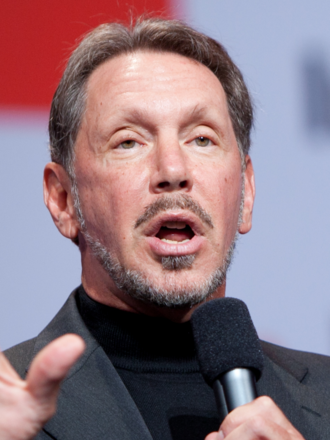
Larry Ellison
Founder of Oracle
Where to hear and read about Larry Ellison1 episode or test

Larry Ellison founded Oracle in 1977 to build the first commercial relational database, fought Microsoft and IBM for attention, and nearly lost the company in 1991 before rebuilding how it was run. The lesson most worth taking from him is that bold contrarian bets only last when every process behind them, not just the product, is engineered and kept simple.
The bigger the apparent risk the fewer people will try to go there.
How Larry Ellison Thinks
Larry Ellison: the story and the lessons
1Larry Ellison's path from drifter to founder
Programming freed Ellison from a world of rules he couldn't stand. He lacked discipline and had a short attention span, but freelance contract programming paid well for a few days of work a week.
He could work at night, wear jeans and ride his motorcycle to work. He says either you could do the job or you couldn't, and no one cared about a PhD from MIT.
He took the weekend jobs nobody wanted and spent weekdays outdoors. Programming let him hike, climb and kayak during the week.
Working near the top of a tech company, he found managers he describes as conformist, bureaucratic and "very reluctant to make decisions."
Ellison started Oracle at 34 to control his life, not build an empire. His goal was a company of about $10 million in revenue and 50 people, so he would not have to spend time with people he didn't enjoy.
He says he never wanted to run a company and was easily bored by running one.
A father's verdict kept him from quitting. His adoptive father told him he would never amount to anything.
"I couldn't give up because I couldn't prove my father right."
2How Ellison found and sold Oracle's first product
Ellison built a product rivals avoided because it was risky. In 1977, using IBM's published research papers as a blueprint, he built the first commercial relational database while everyone told him he was nuts.
Other relational projects were pure research with no focus on performance or reliability. He picked the riskiest approach only when it raised his chance of winning.
He chose software over consulting for leverage. Consulting was too much work, while a product could be built once and sold over and over.
He aimed at minicomputers to avoid the conservative IBM mainframe market, where competition was heavier.
The first release was called version two on purpose. No one would buy version one from five guys in California.
The CIA became the first customer, followed by Navy Intelligence, Air Force Intelligence and the NSA within about six months.
Ellison refused to sell equity and sold by sheer effort. Investor Don Lucas arranged a loan instead, and Ellison wrote manuals and stamped envelopes every night, getting home near midnight.
An analyst called relational databases "just a toy," a view Oracle fought for about 10 years. His second wife left during this period.
3How Ellison nearly destroyed Oracle in 1991
Salespeople booked multi-year deals as instant revenue. Revenue was recognized up front even for software not delivered or paid for, and Oracle had to restate earnings as its stock fell by over 80%.
Salespeople wrote their own contracts, gave huge discounts, sold to customers who could not pay, and once took a couple of jets from Israel Aircraft Industries in exchange for software.
US sales hunted big deals while Europe farmed customers. European staff built long-term relationships; US staff sold the largest possible deal and moved on.
It took until 1991 to see this was unsustainable and another decade to change the US sales culture.
Ellison calls his early management abdication, not delegation. For his first 15 years as CEO he cared only about technology and ignored sales, accounting and legal.
"I was doing only the things that interested me. It was the same problem I had in school." He was in his 40s, and says keeping legal and accounting as separate control functions would have avoided most of it.
The crisis hit his personal life at the same time. He faced a margin call on borrowed shares, his third marriage ended, and his closest friend Bob Miner wanted out.
He refused to run: "I had to save Oracle to save myself."
He raised cash without giving up control. He told an employee to raise about $200 million with as little equity as possible, and Nippon Steel lent $80 million on favorable terms for warrants on up to 25% of Oracle Japan, valued at $400 million.
He expected conventional financing to come on punitive terms that would weaken his position as dominant shareholder.
Almost everyone warned the new sales chief away. Of about 10 people he asked, all but one said Oracle was finished and Ellison could not be trusted.
The one dissenter called Ellison a lunatic with vision and said Oracle had more potential than any company in the valley. He was right.
4How Ellison rebuilt Oracle by engineering every process
Ellison realized engineering covers the whole company, not just products. After 1991 he concluded marketing, sales and service should all be carefully engineered.
Founders host David Senra's guest Jeff described him as a brilliant, compulsive personality who "learns brilliantly and compulsively." Ellison says he had blind spots and had to work on them.
He took the creativity out of the sales process. Salespeople's job became communicating and quantifying business benefits, not improvising on price.
"If you want to be creative, go write a novel. I want to engineer the sales process."
Autonomous country managers made Oracle compete with itself. A $10,000 per processor price became $20,000 at global sales, $15,000 in Geneva and $25,000 in Germany, and pricing took about 200 people.
He called himself "a weak king surrounded by a bunch of strong and fiercely independent dukes." Pricing now takes fewer than 10 people.
Oracle ran 70 HR databases and couldn't count its employees. Seventy systems cost more than one and still could not answer basic questions.
He summed it up as data everywhere and not a drop of information.
He cut bloat with four budget questions. Sales and spending, last year and this year; asking them exposed a $5 million energy center of excellence supporting $10 million in forecast sales.
A senior manager arrived with 200 slides and was offended when Ellison asked for the four answers first.
He fixed incentives that worked against Oracle. A partner bonus paid $120,000 on a deal where Oracle kept $600,000, versus $100,000 on a $1 million direct deal.
Quarter-end discounting, like offering a planned $2 million purchase for $1 million if bought now, taught customers to negotiate on the last day of the quarter, and breaking the habit took years.
Ellison found the real obstacle was people resisting process change. Making people write down why a process can't be simplified forces them to rethink it.
"Simplified modernized business processes are at least as important as good business software in delivering efficiencies to the enterprise."
5Why Ellison bets on a future others don't see
Ellison is comfortable only believing what almost no one else does. He cares about the next five years, has little interest in the recent past, and reads history voraciously.
His best friend of 25 years, Steve Jobs, told him to do something wonderful, not dwell on it, and figure out what's next.
He saw the internet would expand the database market. In the late 1990s analysts predicted the internet would hurt Oracle; he reasoned it would multiply transactions and users.
"The internet is not going to end the database market. It will drastically expand it."
He burned the boats and stopped all client server work. To the horror of colleagues and customers, he moved Oracle's whole engineering effort to internet architecture, forcing rivals to follow.
Staff wanted client server 2. He said they were mistaking the present for the future, the worst mistake a tech company can make, and that client server was dead and they would figure it out at the funeral.
Ellison picks a fight once certain, so he can't turn back. A public fight makes an about-face impossible and turns those around him into believers.
Recruiting believers matters more to him than selling software. "It is win or die."
He educates the market early so he leads the fashion. Oracle pushed the idea that the internet was about business, not only consumers, long before competitors.
He compares tech to women's clothing, where ideas go in and out of fashion.
6Ellison versus Gates: picking the biggest enemy
Ellison fought Microsoft and IBM so Oracle was judged their equal. He ignored smaller database firms and got the press talking about Oracle versus Microsoft, landing on the cover of Fortune as software's other billionaire.
Customers came to trust Oracle as a heavyweight that would survive. "If you're a fighter, the only way up is through the top fighters in your division."
An enemy gives a company focus and a yardstick. He says Oracle can't explain what it does without comparing itself to someone who does it differently.
He calls Microsoft's engineers skilled copyists, like artists copying great paintings in museums.
He respects Gates for putting what is right above who is right. After a 1993 call, Gates spent five hours rethinking a point and phoned back to concede it.
Ellison says Gates "would rather win the war than win the argument," and finds time with him intellectually interesting but emotionally exhausting.
The fight became a contest of personalities. Meant as a clash of computing architectures, he calls it "billionaire A versus billionaire B," with Oracle's technology along for the ride.
He prefers offense: "if you fight, maybe we'll survive."
7How Larry Ellison leads, hires and drives himself
Ellison hired Safra Catz to cover his weak follow-through. He moves on once a plan exists; Catz checked that his decisions were carried out, and later became CEO.
Before her, people hoped he would forget his decisions. "She's disciplined and thorough and I'm not." Catz says he can "think without walls."
He learned brilliance is not the same as doing the job. He hired a CFO, Walker, for his intellect and defended him until a colleague asked whether he could do his job.
Ellison realized the answer was no. "Brilliance is not enough."
Leaders must show confidence, not doubt. Of two Marine officers leading a charge, he says only the one who says "Follow me" with certainty gets followed.
The honest, doubtful officer should become a psychotherapist. "You cannot lead if you're filled with uncertainty."
He prefers group meetings to one-on-ones. Group settings mean everyone knows what is going on.
Ellison is a sprinter, not a grinder. He rests, sprints, rests, sprints, unlike the methodical Gates, swinging between indifference and complete obsession.
Critics say both that he dominates the business and that he is detached from it.
Fear of losing drives him more than money. He says he is more motivated by fear of failure than greed, and raised the bar whenever he got close to a goal.
"Silicon Valley is a killing field. Very few technology companies survive and we did." He will not accept defeat until carried dead from the field.
He judges people by actions, not motives. He is glad Jonas Salk made the polio vaccine, whatever his reasons, and allows vanity may be his own motive.
He once preferred being feared to being loved; he now says we all want to be loved, even him.
8Larry Ellison's rules on simplicity, cost and selling
Ellison calls complexity the cardinal sin of computing. He wants Oracle to do the work for the customer and cut the choices they face.
"If Detroit ran like Silicon Valley, nobody would sell cars. They would just sell parts," leaving customers to assemble a Honda engine, Ford transmission and BMW chassis.
Lock-in makes winning each customer worth a high price. A database customer stayed with its vendor about 10 years, so he gave up near-term profit to knock out Sybase while it was technically behind.
It is the same logic Jeff Bezos described in his shareholder letters, and Ellison used media attention to bring customers in.
A product's name can decide whether it sells. Network Computing Architecture got no traction; its successor, Internet Computing Architecture, took off.
He says the name was the only big difference between the two.
He guards company costs and pays his own indulgences. He pointed out his private plane came from his own pocket, and joked about shareholder abuse on meeting the Health South founder, later convicted of racketeering and money laundering.
The cost discipline echoes Sam Walton and Andrew Carnegie, who held that savings on costs are permanent.
In the end, product quality decides survival. Stock prices follow product quality, while in bubbles people watch the market more than their businesses.
"Writing checks is easy. Writing software is hard."

How Larry Ellison Thinks
Larry Ellison built Oracle by betting on what almost no one else believed, picking the biggest rival as an enemy, and then rebuilding his own weak management after nearly losing the company in 1991. The story is worth hearing because it shows a founder who owns his mistakes in public and engineers every process, not just the product.
Programming freed Ellison from a world of rules he couldn't stand. He lacked discipline and had a short attention span, but freelance contract programming paid well for a few days of work a week.
He could work at night, wear jeans and ride his motorcycle to work. He says either you could do the job or you couldn't, and no one cared about a PhD from MIT.
He took the weekend jobs nobody wanted and spent weekdays outdoors. Programming let him hike, climb and kayak during the week.
Working near the top of a tech company, he found managers he describes as conformist, bureaucratic and "very reluctant to make decisions."
Ellison started Oracle at 34 to control his life, not build an empire. His goal was a company of about $10 million in revenue and 50 people, so he would not have to spend time with people he didn't enjoy.
He says he never wanted to run a company and was easily bored by running one.
A father's verdict kept him from quitting. His adoptive father told him he would never amount to anything.
"I couldn't give up because I couldn't prove my father right."
Ellison built a product rivals avoided because it was risky. In 1977, using IBM's published research papers as a blueprint, he built the first commercial relational database while everyone told him he was nuts.
Other relational projects were pure research with no focus on performance or reliability. He picked the riskiest approach only when it raised his chance of winning.
He chose software over consulting for leverage. Consulting was too much work, while a product could be built once and sold over and over.
He aimed at minicomputers to avoid the conservative IBM mainframe market, where competition was heavier.
The first release was called version two on purpose. No one would buy version one from five guys in California.
The CIA became the first customer, followed by Navy Intelligence, Air Force Intelligence and the NSA within about six months.
Ellison refused to sell equity and sold by sheer effort. Investor Don Lucas arranged a loan instead, and Ellison wrote manuals and stamped envelopes every night, getting home near midnight.
An analyst called relational databases "just a toy," a view Oracle fought for about 10 years. His second wife left during this period.
Salespeople booked multi-year deals as instant revenue. Revenue was recognized up front even for software not delivered or paid for, and Oracle had to restate earnings as its stock fell by over 80%.
Salespeople wrote their own contracts, gave huge discounts, sold to customers who could not pay, and once took a couple of jets from Israel Aircraft Industries in exchange for software.
US sales hunted big deals while Europe farmed customers. European staff built long-term relationships; US staff sold the largest possible deal and moved on.
It took until 1991 to see this was unsustainable and another decade to change the US sales culture.
Ellison calls his early management abdication, not delegation. For his first 15 years as CEO he cared only about technology and ignored sales, accounting and legal.
"I was doing only the things that interested me. It was the same problem I had in school." He was in his 40s, and says keeping legal and accounting as separate control functions would have avoided most of it.
The crisis hit his personal life at the same time. He faced a margin call on borrowed shares, his third marriage ended, and his closest friend Bob Miner wanted out.
He refused to run: "I had to save Oracle to save myself."
He raised cash without giving up control. He told an employee to raise about $200 million with as little equity as possible, and Nippon Steel lent $80 million on favorable terms for warrants on up to 25% of Oracle Japan, valued at $400 million.
He expected conventional financing to come on punitive terms that would weaken his position as dominant shareholder.
Almost everyone warned the new sales chief away. Of about 10 people he asked, all but one said Oracle was finished and Ellison could not be trusted.
The one dissenter called Ellison a lunatic with vision and said Oracle had more potential than any company in the valley. He was right.
Ellison realized engineering covers the whole company, not just products. After 1991 he concluded marketing, sales and service should all be carefully engineered.
Founders host David Senra's guest Jeff described him as a brilliant, compulsive personality who "learns brilliantly and compulsively." Ellison says he had blind spots and had to work on them.
He took the creativity out of the sales process. Salespeople's job became communicating and quantifying business benefits, not improvising on price.
"If you want to be creative, go write a novel. I want to engineer the sales process."
Autonomous country managers made Oracle compete with itself. A $10,000 per processor price became $20,000 at global sales, $15,000 in Geneva and $25,000 in Germany, and pricing took about 200 people.
He called himself "a weak king surrounded by a bunch of strong and fiercely independent dukes." Pricing now takes fewer than 10 people.
Oracle ran 70 HR databases and couldn't count its employees. Seventy systems cost more than one and still could not answer basic questions.
He summed it up as data everywhere and not a drop of information.
He cut bloat with four budget questions. Sales and spending, last year and this year; asking them exposed a $5 million energy center of excellence supporting $10 million in forecast sales.
A senior manager arrived with 200 slides and was offended when Ellison asked for the four answers first.
He fixed incentives that worked against Oracle. A partner bonus paid $120,000 on a deal where Oracle kept $600,000, versus $100,000 on a $1 million direct deal.
Quarter-end discounting, like offering a planned $2 million purchase for $1 million if bought now, taught customers to negotiate on the last day of the quarter, and breaking the habit took years.
Ellison found the real obstacle was people resisting process change. Making people write down why a process can't be simplified forces them to rethink it.
"Simplified modernized business processes are at least as important as good business software in delivering efficiencies to the enterprise."
Ellison is comfortable only believing what almost no one else does. He cares about the next five years, has little interest in the recent past, and reads history voraciously.
His best friend of 25 years, Steve Jobs, told him to do something wonderful, not dwell on it, and figure out what's next.
He saw the internet would expand the database market. In the late 1990s analysts predicted the internet would hurt Oracle; he reasoned it would multiply transactions and users.
"The internet is not going to end the database market. It will drastically expand it."
He burned the boats and stopped all client server work. To the horror of colleagues and customers, he moved Oracle's whole engineering effort to internet architecture, forcing rivals to follow.
Staff wanted client server 2. He said they were mistaking the present for the future, the worst mistake a tech company can make, and that client server was dead and they would figure it out at the funeral.
Ellison picks a fight once certain, so he can't turn back. A public fight makes an about-face impossible and turns those around him into believers.
Recruiting believers matters more to him than selling software. "It is win or die."
He educates the market early so he leads the fashion. Oracle pushed the idea that the internet was about business, not only consumers, long before competitors.
He compares tech to women's clothing, where ideas go in and out of fashion.
Ellison fought Microsoft and IBM so Oracle was judged their equal. He ignored smaller database firms and got the press talking about Oracle versus Microsoft, landing on the cover of Fortune as software's other billionaire.
Customers came to trust Oracle as a heavyweight that would survive. "If you're a fighter, the only way up is through the top fighters in your division."
An enemy gives a company focus and a yardstick. He says Oracle can't explain what it does without comparing itself to someone who does it differently.
He calls Microsoft's engineers skilled copyists, like artists copying great paintings in museums.
He respects Gates for putting what is right above who is right. After a 1993 call, Gates spent five hours rethinking a point and phoned back to concede it.
Ellison says Gates "would rather win the war than win the argument," and finds time with him intellectually interesting but emotionally exhausting.
The fight became a contest of personalities. Meant as a clash of computing architectures, he calls it "billionaire A versus billionaire B," with Oracle's technology along for the ride.
He prefers offense: "if you fight, maybe we'll survive."
Ellison hired Safra Catz to cover his weak follow-through. He moves on once a plan exists; Catz checked that his decisions were carried out, and later became CEO.
Before her, people hoped he would forget his decisions. "She's disciplined and thorough and I'm not." Catz says he can "think without walls."
He learned brilliance is not the same as doing the job. He hired a CFO, Walker, for his intellect and defended him until a colleague asked whether he could do his job.
Ellison realized the answer was no. "Brilliance is not enough."
Leaders must show confidence, not doubt. Of two Marine officers leading a charge, he says only the one who says "Follow me" with certainty gets followed.
The honest, doubtful officer should become a psychotherapist. "You cannot lead if you're filled with uncertainty."
He prefers group meetings to one-on-ones. Group settings mean everyone knows what is going on.
Ellison is a sprinter, not a grinder. He rests, sprints, rests, sprints, unlike the methodical Gates, swinging between indifference and complete obsession.
Critics say both that he dominates the business and that he is detached from it.
Fear of losing drives him more than money. He says he is more motivated by fear of failure than greed, and raised the bar whenever he got close to a goal.
"Silicon Valley is a killing field. Very few technology companies survive and we did." He will not accept defeat until carried dead from the field.
He judges people by actions, not motives. He is glad Jonas Salk made the polio vaccine, whatever his reasons, and allows vanity may be his own motive.
He once preferred being feared to being loved; he now says we all want to be loved, even him.
Ellison calls complexity the cardinal sin of computing. He wants Oracle to do the work for the customer and cut the choices they face.
"If Detroit ran like Silicon Valley, nobody would sell cars. They would just sell parts," leaving customers to assemble a Honda engine, Ford transmission and BMW chassis.
Lock-in makes winning each customer worth a high price. A database customer stayed with its vendor about 10 years, so he gave up near-term profit to knock out Sybase while it was technically behind.
It is the same logic Jeff Bezos described in his shareholder letters, and Ellison used media attention to bring customers in.
A product's name can decide whether it sells. Network Computing Architecture got no traction; its successor, Internet Computing Architecture, took off.
He says the name was the only big difference between the two.
He guards company costs and pays his own indulgences. He pointed out his private plane came from his own pocket, and joked about shareholder abuse on meeting the Health South founder, later convicted of racketeering and money laundering.
The cost discipline echoes Sam Walton and Andrew Carnegie, who held that savings on costs are permanent.
In the end, product quality decides survival. Stock prices follow product quality, while in bubbles people watch the market more than their businesses.
"Writing checks is easy. Writing software is hard."