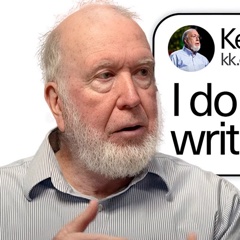
Kevin Kelly
Founding executive editor of Wired and author of The Inevitable and Excellent Advice for Living
Where to hear and read about Kevin Kelly1 episode or test

Kevin Kelly is the founding executive editor of Wired and author of The Inevitable and Excellent Advice for Living, a self-described reluctant writer and born editor. The thing most worth learning from him is to write to find out what you think, test every sentence for honesty, and aim to be the only one doing your work, not the best.
Don't aim to be the best, be the only.
WIRED Founding Editor Answers My Writing Questions — Kevin Kelly
Kevin Kelly: the story and the lessons
1How Kevin Kelly became a writer and editor
Kelly never set out to write; he wanted to be a photographer. His photo captions kept getting longer. Writing first shared what he had learned, then became how he figured out what he thinks.
He states his mission as increasing options and opportunities so everyone can express their genius. Feedback from sharing shows him what people respond to and whether they get it.
Kelly calls himself a reluctant writer and a born editor. He hates drafting and calls his first drafts abysmal, getting grumpy and procrastinating. Once words are on the page he comes alive: "I love having written."
He is a slow writer and does not type fast. Even so, he wrote a blog every day for 20 years.
Stewart Brand was Kelly's model for living at the frontier. In 1972 Brand wrote a Rolling Stone piece on long-haired hackers playing games on machines in a Stanford basement, then decided to hang out at that frontier.
Kelly also copies Brand's habit of never explaining the Whole Earth Catalog the same way twice. Kelly reuses his basic ideas but tries to reinterpret them each time.
Kelly hangs around scenes he does not yet understand. His 1994 book Out of Control had a chapter on encrypted digital money, before blockchain. At Wired he assigned Steven Levy to follow it, and Levy wrote a whole book.
He wrote Out of Control in the late 80s and early 90s. He says an editorial nose for what is new but important starts each piece: new language, and other people freaking out.
2Kevin Kelly's writing process
Kelly writes to find out what he thinks, not to report it. He writes one sentence, sees he has no idea what he means, goes back for more interviews, then writes the next one.
He treats his yearly Wired feature as being paid to work out his view. "I write to find out what I think about it because I'm not the kind of person who has an idea and then I'm going to sit down and write it out."
Kelly tests every sentence with two questions. In a second evaluating pass he asks: do I really believe this, and would this phrase have occurred somewhere else before?
He keeps his inner editor out of the first Genesis pass. A sentence that passes both tests feels like relief and release, which he reads as a sign it is honest.
Kelly drafts in short bursts and edits in long blocks. He drafts for about an hour and a half to two hours, until he is bored or has said all he knows. Editing needs a big block because he must load the whole piece into his head.
He rereads and edits each day's pages the next morning, and late in a project prints out and uses a red pen. If drafting stalls, he either needs more research or the piece is too muddled.
Kelly spends most editing talk on structure, not phrasing. About 95 percent of his conversations with Wired writers were about structure. Readers notice it only when it is missing, as a jump, a logical hole or confusion.
Complicated pieces need an outside reader. With the right structure, he says, it is not really about phrasing. He cites John McPhee as someone who talks about structure constantly.
Kelly manages his time because the work of a book is infinite. He set a goal of writing the best book he can in a year, and sets his own deadline because he must have one. He abandons the book when it arrives.
He took the idea from The Writer's Time, which Stewart Brand pointed him to. "You can't manage the work, you can only manage your time."
Kelly writes a lot because he sees no other recipe. He wants more words that land, not more words, but says the only recipe he has seen for great writing is writing a lot.
He keeps about a hundred finished pieces unpublished in Notion. He has also switched to a daily piece of art and wants a weekly video, to learn new tools.
Kelly photographs and draws in order to see. You cannot draw something real without looking closely at it. Photography also gave him a reason to travel and spend whole days looking.
He ties this to writing, where seeing clearly comes first. He quotes David McCullough, who says learning to paint taught him to write.
3How Kelly edited the Whole Earth Catalog and Wired
Kelly aimed to provoke about a fifth of readers each issue. On the Whole Earth Catalog he felt an issue made its mark when roughly one fifth of readers were disturbed enough to react.
He rotated who got provoked so it was never the same group. If nobody was disturbed, the issue had not gone far enough to advance the conversation.
Wired was built to please its own makers. The founders were the audience, making a magazine they wanted to read that did not exist yet. Nobody was around to ask permission from.
Louis Rossetto wanted Marshall McLuhan on the masthead, and Kelly named him patron saint, partly as a joke, without having read him.
Kelly told Wired writers to amaze him and write up. Tech writers were trained to aim low, at something like an 11th grader. Kelly told his writers that he was bored by most of what he read.
If you mention DNA, you do not need to explain it. "Tell me something that I have no idea about in a way that I'm going to find surprising."
Kelly proposed starting from the cover and writing the article back. Headlines and covers were the hardest part of Wired, and the team fought over them. They imagined the greatest covers, then asked whether each was possible and had evidence behind it.
That produced story ideas, then assignments.
Kelly hired for enthusiasm and ideas, then trained the skills. He says enthusiasm is worth 25 IQ points. There were no web developers yet at Wired, so skills had to be taught.
Wired created the click-through banner ad. He hired writers on their ideas, not their prose, since clear writing comes from clear thinking.
4Where Kevin Kelly's ideas come from and how he shares them
Kelly aims to be the only one, not the best. Breakthroughs happen where there is no name for what you do. If you struggle to explain your work to your mother, you are in the right spot.
He compares it to podcasting ten years ago, "kind of like radio, but not quite radio." A deadline stops you being perfect, so you have to be different. Finding the spot takes most people much of their lives.
Kelly writes the ideas nobody would buy. When an idea kept coming back and found no takers after two or three tries, he wrote it himself. Ideas he could not sell for two years became his best pieces.
He talks up his ideas hoping someone steals them. "I only want to write the things that only I can do." He has not written the 1000 True Fans book because somebody else could.
Kelly talks an idea out for years before writing it. New Rules for the New Economy was written very fast after years of giving it as a talk. He says he would rewrite it now that he knows what it is about.
1000 True Fans followed the same path: he told it to people for years, and writing it out produced more ideas. He wrote it before Kickstarter or Patreon, and says Substack is largely built on it.
Kelly turned personal mantras into Excellent Advice for Living. He wrote short mantras to change his own behavior. On his 68th birthday he wrote 68 pieces of advice as a gift to his kids, and the list grew into the book.
One is to put a lost thing back where he first looked for it, not where he found it. Another filter for invitations: would I do this tomorrow morning?
Kelly credits scenius, not lone genius, for great work. Brian Eno's scenius is the collective genius of a scene. Kelly's examples are Xerox PARC, Lockheed's Skunk Works and Camp 4 in Yosemite.
A scenius has a porous membrane, unlike a company. He sees YouTube as the largest, least visible one, and wishes he had written more on how to build one. He also calls simultaneous invention the norm, citing Bell and Elisha Gray.
Kelly wants ideas returned to the commons quickly. A tiny step still deserves a temporary monopoly to encourage the work, but he calls 99-plus-year copyright crazy.
He thinks about 20 years seems reasonable, and patents could be shorter.
Kelly is moving from books to YouTube. His kids and their friends watch YouTube instead of reading books. Across newsletters, podcasts, a 20-year daily blog and social media, YouTube is the only place his audience grows.
He says he will not write any more book-native books.
5How Kevin Kelly markets his books
Kelly treats a finished book as only half done. When the last galley is signed off he is 50 percent done, and the other 50 percent is marketing. He expects to spend more total hours marketing than writing.
He began with the common aversion to selling, then saw that a book cover is a kind of marketing. He cites Dan Pink's To Sell Is Human and feels a duty to share his work.
Kelly says authors must bring their own audience. Publishers sold to bookstores, and people no longer buy books there. They now ask what audience an author brings and cannot reach readers themselves.
He calls this the opposite of 1000 True Fans, and does all the marketing for his books.
Kelly trades his time for readers with a concrete offer. For What Technology Wants he offered an hour talk to any group that bought 25 books. He gave talks full time for a month, to hosts including a high school, a church, an architect's office and Google.
For the next book he held group calls for ten people once nine had bought a book. Many groups had read the book before he arrived.
Kelly says podcasts sell books better than radio or TV. He will join any podcast with more than three episodes, booked on Calendly. For a launch he does six to eight podcasts a day for about three months.
Podcast audiences are intimate and give time to go deep into the book. Radio and TV give two minutes and 15 seconds, and that audience won't buy books.
6Kevin Kelly on greatness, time and a life of play
Kelly decided greatness is overrated and chose to be a balanced gadfly. He says every great person he knows is extremely great in some dimensions and weak in another. His own many small interests do not cohere into that extremity.
He says he is too calm to be great and expects no one to remember his name in two generations. Of the price families pay, his verdict: "that's not what I want."
Kelly defines wealth as owning your own time. He says the rich have money and the wealthy have control of their time.
He tries not to treat his life as a career, does not plan to retire, and sees work and play as the same thing.
Kelly urges doing something weird and unprofitable in your 20s. That time becomes a touchstone you return to later. He believes in sabbaticals, Sabbaths and goofing off with no agenda.
His best projects had no economic reason. He painted and posted a piece every day for a year, and his 50-year photography book of Asia's disappearing cultures had no demand.
Kelly says giving away a lot is how you get a lot. He cannot explain why, but says you can count on it, and that most major religions rest on it.
He feels a moral obligation to widen the chance for everyone to express their genius, so that a Shakespeare alive today can be heard.
Kelly reads widely and reads what his favorite authors read. He says remarkable people read more books than he does. He suggests reading the authors your favorite authors read.
A friend reads the bestsellers of past years, almost all forgotten now, so aiming at the bestseller list is a poor target. His house had no TVs and books everywhere.
Kelly treats modest fame as useful and heavy fame as a burden. He sits among very famous people so does not count himself famous. He compares real fame to having a billion dollars, which takes over your life.
In China he has more fame and sometimes needs bodyguards at big festivals. He values attention when it lets him meet people he would not otherwise meet.

WIRED Founding Editor Answers My Writing Questions — Kevin Kelly
Kevin Kelly, a self-described reluctant writer and born editor, explains that he writes to find out what he thinks, and that structure and honest sentence-level questioning matter more than phrasing. The habit worth hearing is his two-question test on every sentence, plus his deadline-driven, edit-heavy process.
Kelly never set out to write; he wanted to be a photographer. His photo captions kept getting longer. Writing first shared what he had learned, then became how he figured out what he thinks.
He states his mission as increasing options and opportunities so everyone can express their genius. Feedback from sharing shows him what people respond to and whether they get it.
Kelly calls himself a reluctant writer and a born editor. He hates drafting and calls his first drafts abysmal, getting grumpy and procrastinating. Once words are on the page he comes alive: "I love having written."
He is a slow writer and does not type fast. Even so, he wrote a blog every day for 20 years.
Stewart Brand was Kelly's model for living at the frontier. In 1972 Brand wrote a Rolling Stone piece on long-haired hackers playing games on machines in a Stanford basement, then decided to hang out at that frontier.
Kelly also copies Brand's habit of never explaining the Whole Earth Catalog the same way twice. Kelly reuses his basic ideas but tries to reinterpret them each time.
Kelly hangs around scenes he does not yet understand. His 1994 book Out of Control had a chapter on encrypted digital money, before blockchain. At Wired he assigned Steven Levy to follow it, and Levy wrote a whole book.
He wrote Out of Control in the late 80s and early 90s. He says an editorial nose for what is new but important starts each piece: new language, and other people freaking out.
Kelly writes to find out what he thinks, not to report it. He writes one sentence, sees he has no idea what he means, goes back for more interviews, then writes the next one.
He treats his yearly Wired feature as being paid to work out his view. "I write to find out what I think about it because I'm not the kind of person who has an idea and then I'm going to sit down and write it out."
Kelly tests every sentence with two questions. In a second evaluating pass he asks: do I really believe this, and would this phrase have occurred somewhere else before?
He keeps his inner editor out of the first Genesis pass. A sentence that passes both tests feels like relief and release, which he reads as a sign it is honest.
Kelly drafts in short bursts and edits in long blocks. He drafts for about an hour and a half to two hours, until he is bored or has said all he knows. Editing needs a big block because he must load the whole piece into his head.
He rereads and edits each day's pages the next morning, and late in a project prints out and uses a red pen. If drafting stalls, he either needs more research or the piece is too muddled.
Kelly spends most editing talk on structure, not phrasing. About 95 percent of his conversations with Wired writers were about structure. Readers notice it only when it is missing, as a jump, a logical hole or confusion.
Complicated pieces need an outside reader. With the right structure, he says, it is not really about phrasing. He cites John McPhee as someone who talks about structure constantly.
Kelly manages his time because the work of a book is infinite. He set a goal of writing the best book he can in a year, and sets his own deadline because he must have one. He abandons the book when it arrives.
He took the idea from The Writer's Time, which Stewart Brand pointed him to. "You can't manage the work, you can only manage your time."
Kelly writes a lot because he sees no other recipe. He wants more words that land, not more words, but says the only recipe he has seen for great writing is writing a lot.
He keeps about a hundred finished pieces unpublished in Notion. He has also switched to a daily piece of art and wants a weekly video, to learn new tools.
Kelly photographs and draws in order to see. You cannot draw something real without looking closely at it. Photography also gave him a reason to travel and spend whole days looking.
He ties this to writing, where seeing clearly comes first. He quotes David McCullough, who says learning to paint taught him to write.
Kelly aimed to provoke about a fifth of readers each issue. On the Whole Earth Catalog he felt an issue made its mark when roughly one fifth of readers were disturbed enough to react.
He rotated who got provoked so it was never the same group. If nobody was disturbed, the issue had not gone far enough to advance the conversation.
Wired was built to please its own makers. The founders were the audience, making a magazine they wanted to read that did not exist yet. Nobody was around to ask permission from.
Louis Rossetto wanted Marshall McLuhan on the masthead, and Kelly named him patron saint, partly as a joke, without having read him.
Kelly told Wired writers to amaze him and write up. Tech writers were trained to aim low, at something like an 11th grader. Kelly told his writers that he was bored by most of what he read.
If you mention DNA, you do not need to explain it. "Tell me something that I have no idea about in a way that I'm going to find surprising."
Kelly proposed starting from the cover and writing the article back. Headlines and covers were the hardest part of Wired, and the team fought over them. They imagined the greatest covers, then asked whether each was possible and had evidence behind it.
That produced story ideas, then assignments.
Kelly hired for enthusiasm and ideas, then trained the skills. He says enthusiasm is worth 25 IQ points. There were no web developers yet at Wired, so skills had to be taught.
Wired created the click-through banner ad. He hired writers on their ideas, not their prose, since clear writing comes from clear thinking.
Kelly aims to be the only one, not the best. Breakthroughs happen where there is no name for what you do. If you struggle to explain your work to your mother, you are in the right spot.
He compares it to podcasting ten years ago, "kind of like radio, but not quite radio." A deadline stops you being perfect, so you have to be different. Finding the spot takes most people much of their lives.
Kelly writes the ideas nobody would buy. When an idea kept coming back and found no takers after two or three tries, he wrote it himself. Ideas he could not sell for two years became his best pieces.
He talks up his ideas hoping someone steals them. "I only want to write the things that only I can do." He has not written the 1000 True Fans book because somebody else could.
Kelly talks an idea out for years before writing it. New Rules for the New Economy was written very fast after years of giving it as a talk. He says he would rewrite it now that he knows what it is about.
1000 True Fans followed the same path: he told it to people for years, and writing it out produced more ideas. He wrote it before Kickstarter or Patreon, and says Substack is largely built on it.
Kelly turned personal mantras into Excellent Advice for Living. He wrote short mantras to change his own behavior. On his 68th birthday he wrote 68 pieces of advice as a gift to his kids, and the list grew into the book.
One is to put a lost thing back where he first looked for it, not where he found it. Another filter for invitations: would I do this tomorrow morning?
Kelly credits scenius, not lone genius, for great work. Brian Eno's scenius is the collective genius of a scene. Kelly's examples are Xerox PARC, Lockheed's Skunk Works and Camp 4 in Yosemite.
A scenius has a porous membrane, unlike a company. He sees YouTube as the largest, least visible one, and wishes he had written more on how to build one. He also calls simultaneous invention the norm, citing Bell and Elisha Gray.
Kelly wants ideas returned to the commons quickly. A tiny step still deserves a temporary monopoly to encourage the work, but he calls 99-plus-year copyright crazy.
He thinks about 20 years seems reasonable, and patents could be shorter.
Kelly is moving from books to YouTube. His kids and their friends watch YouTube instead of reading books. Across newsletters, podcasts, a 20-year daily blog and social media, YouTube is the only place his audience grows.
He says he will not write any more book-native books.
Kelly treats a finished book as only half done. When the last galley is signed off he is 50 percent done, and the other 50 percent is marketing. He expects to spend more total hours marketing than writing.
He began with the common aversion to selling, then saw that a book cover is a kind of marketing. He cites Dan Pink's To Sell Is Human and feels a duty to share his work.
Kelly says authors must bring their own audience. Publishers sold to bookstores, and people no longer buy books there. They now ask what audience an author brings and cannot reach readers themselves.
He calls this the opposite of 1000 True Fans, and does all the marketing for his books.
Kelly trades his time for readers with a concrete offer. For What Technology Wants he offered an hour talk to any group that bought 25 books. He gave talks full time for a month, to hosts including a high school, a church, an architect's office and Google.
For the next book he held group calls for ten people once nine had bought a book. Many groups had read the book before he arrived.
Kelly says podcasts sell books better than radio or TV. He will join any podcast with more than three episodes, booked on Calendly. For a launch he does six to eight podcasts a day for about three months.
Podcast audiences are intimate and give time to go deep into the book. Radio and TV give two minutes and 15 seconds, and that audience won't buy books.
Kelly decided greatness is overrated and chose to be a balanced gadfly. He says every great person he knows is extremely great in some dimensions and weak in another. His own many small interests do not cohere into that extremity.
He says he is too calm to be great and expects no one to remember his name in two generations. Of the price families pay, his verdict: "that's not what I want."
Kelly defines wealth as owning your own time. He says the rich have money and the wealthy have control of their time.
He tries not to treat his life as a career, does not plan to retire, and sees work and play as the same thing.
Kelly urges doing something weird and unprofitable in your 20s. That time becomes a touchstone you return to later. He believes in sabbaticals, Sabbaths and goofing off with no agenda.
His best projects had no economic reason. He painted and posted a piece every day for a year, and his 50-year photography book of Asia's disappearing cultures had no demand.
Kelly says giving away a lot is how you get a lot. He cannot explain why, but says you can count on it, and that most major religions rest on it.
He feels a moral obligation to widen the chance for everyone to express their genius, so that a Shakespeare alive today can be heard.
Kelly reads widely and reads what his favorite authors read. He says remarkable people read more books than he does. He suggests reading the authors your favorite authors read.
A friend reads the bestsellers of past years, almost all forgotten now, so aiming at the bestseller list is a poor target. His house had no TVs and books everywhere.
Kelly treats modest fame as useful and heavy fame as a burden. He sits among very famous people so does not count himself famous. He compares real fame to having a billion dollars, which takes over your life.
In China he has more fame and sometimes needs bodyguards at big festivals. He values attention when it lets him meet people he would not otherwise meet.