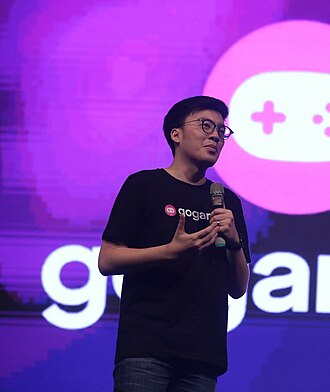
Kevin Aluwi
Co-founder and former CEO of Gojek
Where to hear and read about Kevin Aluwi1 episode or test

Kevin Aluwi is the co-founder and former CEO of Gojek, the Indonesian company that grew from a motorcycle taxi service into Southeast Asia's biggest startup. The lesson most worth taking is that a far smaller company can beat richer rivals through brand and a willingness to do hard, unglamorous work that customers value.
I don't believe that any moats are durable over time. Eventually, with enough time, all moats can be crossed.
Taxi mafias, cash vaults & 100% MoM growth: The story of SEA’s biggest startup | Kevin Aluwi (Gojek)
Kevin Aluwi: the story and the lessons
1Kevin Aluwi's path from failed banker to Gojek CEO
A stalled finance career pushed Aluwi back to Indonesia in 2011. He graduated in 2009, after the 2008 crash, and his bosses at a boutique investment bank thought he underperformed, so he left. He moved back in 2011 to join Indonesian tech early.
Talent, funding and product market fit were thin, and people saw the internet as a place for chat and social media. Few believed valuable products could be built locally.
Gojek began by solving a problem unique to Indonesia. Millions of motorcycle taxi drivers work in Indonesia's urban centers. The first product let users ask a rider for a trip, a package delivery or a purchase brought to them.
It later added car drivers, grocery delivery, payments and financial services. At its peak the app held nearly 30 services, and Aluwi says nobody at the company could name every one.
Gojek more than doubled every month for 16 to 18 months. After the 2015 app launch it grew over 100 percent month on month, which Sequoia called the craziest growth story they had heard.
Aluwi credits a young population and obviously broken everyday services, not brilliance. His lesson is to expect very fast adoption in developing markets once product market fit exists.
Gojek reached the scale of the largest US companies. It reports 2.7 million drivers, 15 million merchants and 3 billion orders last year. It went public after merging with Indonesia's top e-commerce platform, in Indonesia's largest IPO ever, raising over $1 billion at a valuation of about $27 to 28 billion.
Aluwi places its volume near Uber's and above Lyft's, with more drivers in the region than in all of America. He wishes the story did not open with size, because Gojek started as a scrappy underdog.
After leaving the CEO role, Aluwi has no fixed plan. He angel invests, advises founders and looks for his next obsession. Starting another company is his default, but he is taking things easy first.
He calls building Gojek one of the most important experiences of his life and says it made him a better person.
2How Gojek beat rivals with 100 times more capital
Gojek started far weaker than its regional competitor and could not outspend it. In its first six months Gojek had raised about $2 million, while the competitor had raised $250 million. Rivals could outspend it on discounts and driver incentives.
Aluwi argues the two most important things in a consumer business are product and brand, in that order. Great brands create identity-level loyalty that discounts and extra features cannot easily sway.
Gojek put its logo on jackets and helmets to show what the service does. People stuck in traffic saw Gojek riders whizzing past with passengers or packages. That tied the brand to the value of the service, not just recall.
Aluwi calls billboards and CPM or CPC campaigns the lazy alternative. Rivals entering motorcycle ride hailing from a car-first view did not brand their drivers.
Gojek made brand consistent across copy, ads and app design. Its personality is a helper that makes life easier, and the copy is informal with loose grammar to relate to people. Gojek was the first company of scale in its market to run ads that make fun of itself and of Indonesian culture.
The tone said "we get you", so Gojek felt part of the culture. Aluwi's point is that branding is the impression a user has everywhere, not a logo or an ad.
Gojek built features around local habits that rivals blocked. In Asia people often send food as a gift to loved ones or romantic interests. Gojek let users set a delivery point far from their own location, which competitors disallowed over fraud worries.
It then played with the habit in marketing as Go-Food dating. Aluwi's summary of the approach: "we leaned into it".
Gojek built for the Indonesian motorcycle driver instead of cloning Uber. A person on a motorcycle can do many jobs, which led to a super app before super apps were common.
Aluwi's advice to founders is "don't just copy".
3Why Aluwi treats doing hard things as the moat
Aluwi does not believe any moat is durable. He finds capabilities, features and distribution partners can all be crossed given enough time. The overlooked advantage is doing hard things that create value for customers.
Because they are hard, competitors struggle to copy them. Gojek leaned into hard work where many startups pick the simplest thing.
Gojek hired private security to protect drivers from taxi mafias. Motorcycle taxi mafias controlled areas by violence and attacked drivers with thrown bricks, knives and machetes. Gojek ran a sizable private security operation for a fairly long time.
Drivers were contractors, so Gojek could have stayed out of it. Most help was a phone call and a patrol arriving in five to ten minutes. Driver loyalty held even when competitors paid more.
Gojek paid tens of thousands of drivers in cash from vaults. With digital payments barely existing, drivers showed ID and balance at a booth and collected cash from a vault, and lines formed. Gojek later integrated with a bank and an ATM network.
Aluwi says early on you must be more operations heavy than tech heavy, because elegant technical solutions take a long time.
Gojek copied the best features of fraudulent driver apps. Fake apps stole driver details and drew drivers with features like auto-accepting orders. Gojek built the top two or three of those features into its own app.
Engineering and security talent was extremely scarce in Southeast Asia, so this was a decision of necessity, not principle. It significantly reduced users on the fake apps.
Aluwi opened a Bangalore engineering center in 2015 to build remote capacity. Outside a tech hub, local talent and funding were underdeveloped, so Gojek reached a deeper talent pool in India well before remote work was common.
His advice is to get good at remote work early and lean on operations to do what doesn't scale.
4Why Aluwi thinks super apps are overrated
Aluwi says the super app pitch looks better on a deck than in practice. Consultants promise lower acquisition cost, higher attach rates, better retention and easy cross-selling. He says many of those benefits do not pan out.
Each new service must be re-advertised and explained, which adds cost. Unrelated services also force a giant menu or grid that limits design.
Gojek's unifying idea was the driver. Moving from rides to packages, food and groceries needed no explaining. Massage broke down because customers asked if the driver would come in and give the massage, and Gojek shut it down a few years after launch.
His rule: "there kind of needs to be a unifying concept across all of your services within the app".
Most customers never noticed mobile top-up on the home page. Only 30 to 40 percent knew they could top up their phone in the app, though over 95 percent needed it. The button was one of only six on the home page.
Aluwi calls presenting many unrelated services an unsolved problem.
5How Aluwi learns, decides and hires
Aluwi did jobs badly himself to learn what good looks like. Where experienced talent was scarce he wrote push copy, ran Facebook and Google ads and drove the app. Seeing how bad he was showed him what good looked like, so he could hire someone far better.
He says this applies most to founders and less to executives.
Driving the first car rides gave Aluwi empathy for drivers. One passenger had him load a giant bag and detour to a laundry for very little pay.
That trip led him to back waiting fees and multiple-stop fares, so extra work got paid.
Aluwi makes whoever is accountable for a result the decider. He says communal product teams where ideas come from everywhere are well intentioned but slow when nobody clearly decides. Everyone can still contribute ideas.
Gojek named a decider for each product development process, and execution improved significantly after the switch.
Aluwi hires people who can pitch an obscure obsession. His interview question asks about a subject or activity a candidate has been obsessed with for a long time. The more obscure and passionate, the better.
It shows they can think in a structured, detailed way and sell an idea so that he becomes interested.

Taxi mafias, cash vaults & 100% MoM growth: The story of SEA’s biggest startup | Kevin Aluwi (Gojek)
Kevin Aluwi explains how Gojek beat far better funded rivals in Indonesia through brand, operational scrappiness and a willingness to do hard things, and why super apps are overrated. Gojek grew over 100% month on month for 16 to 18 months and became Indonesia's largest IPO at a valuation of about $27 to 28 billion.
A stalled finance career pushed Aluwi back to Indonesia in 2011. He graduated in 2009, after the 2008 crash, and his bosses at a boutique investment bank thought he underperformed, so he left. He moved back in 2011 to join Indonesian tech early.
Talent, funding and product market fit were thin, and people saw the internet as a place for chat and social media. Few believed valuable products could be built locally.
Gojek began by solving a problem unique to Indonesia. Millions of motorcycle taxi drivers work in Indonesia's urban centers. The first product let users ask a rider for a trip, a package delivery or a purchase brought to them.
It later added car drivers, grocery delivery, payments and financial services. At its peak the app held nearly 30 services, and Aluwi says nobody at the company could name every one.
Gojek more than doubled every month for 16 to 18 months. After the 2015 app launch it grew over 100 percent month on month, which Sequoia called the craziest growth story they had heard.
Aluwi credits a young population and obviously broken everyday services, not brilliance. His lesson is to expect very fast adoption in developing markets once product market fit exists.
Gojek reached the scale of the largest US companies. It reports 2.7 million drivers, 15 million merchants and 3 billion orders last year. It went public after merging with Indonesia's top e-commerce platform, in Indonesia's largest IPO ever, raising over $1 billion at a valuation of about $27 to 28 billion.
Aluwi places its volume near Uber's and above Lyft's, with more drivers in the region than in all of America. He wishes the story did not open with size, because Gojek started as a scrappy underdog.
After leaving the CEO role, Aluwi has no fixed plan. He angel invests, advises founders and looks for his next obsession. Starting another company is his default, but he is taking things easy first.
He calls building Gojek one of the most important experiences of his life and says it made him a better person.
Gojek started far weaker than its regional competitor and could not outspend it. In its first six months Gojek had raised about $2 million, while the competitor had raised $250 million. Rivals could outspend it on discounts and driver incentives.
Aluwi argues the two most important things in a consumer business are product and brand, in that order. Great brands create identity-level loyalty that discounts and extra features cannot easily sway.
Gojek put its logo on jackets and helmets to show what the service does. People stuck in traffic saw Gojek riders whizzing past with passengers or packages. That tied the brand to the value of the service, not just recall.
Aluwi calls billboards and CPM or CPC campaigns the lazy alternative. Rivals entering motorcycle ride hailing from a car-first view did not brand their drivers.
Gojek made brand consistent across copy, ads and app design. Its personality is a helper that makes life easier, and the copy is informal with loose grammar to relate to people. Gojek was the first company of scale in its market to run ads that make fun of itself and of Indonesian culture.
The tone said "we get you", so Gojek felt part of the culture. Aluwi's point is that branding is the impression a user has everywhere, not a logo or an ad.
Gojek built features around local habits that rivals blocked. In Asia people often send food as a gift to loved ones or romantic interests. Gojek let users set a delivery point far from their own location, which competitors disallowed over fraud worries.
It then played with the habit in marketing as Go-Food dating. Aluwi's summary of the approach: "we leaned into it".
Gojek built for the Indonesian motorcycle driver instead of cloning Uber. A person on a motorcycle can do many jobs, which led to a super app before super apps were common.
Aluwi's advice to founders is "don't just copy".
Aluwi does not believe any moat is durable. He finds capabilities, features and distribution partners can all be crossed given enough time. The overlooked advantage is doing hard things that create value for customers.
Because they are hard, competitors struggle to copy them. Gojek leaned into hard work where many startups pick the simplest thing.
Gojek hired private security to protect drivers from taxi mafias. Motorcycle taxi mafias controlled areas by violence and attacked drivers with thrown bricks, knives and machetes. Gojek ran a sizable private security operation for a fairly long time.
Drivers were contractors, so Gojek could have stayed out of it. Most help was a phone call and a patrol arriving in five to ten minutes. Driver loyalty held even when competitors paid more.
Gojek paid tens of thousands of drivers in cash from vaults. With digital payments barely existing, drivers showed ID and balance at a booth and collected cash from a vault, and lines formed. Gojek later integrated with a bank and an ATM network.
Aluwi says early on you must be more operations heavy than tech heavy, because elegant technical solutions take a long time.
Gojek copied the best features of fraudulent driver apps. Fake apps stole driver details and drew drivers with features like auto-accepting orders. Gojek built the top two or three of those features into its own app.
Engineering and security talent was extremely scarce in Southeast Asia, so this was a decision of necessity, not principle. It significantly reduced users on the fake apps.
Aluwi opened a Bangalore engineering center in 2015 to build remote capacity. Outside a tech hub, local talent and funding were underdeveloped, so Gojek reached a deeper talent pool in India well before remote work was common.
His advice is to get good at remote work early and lean on operations to do what doesn't scale.
Aluwi says the super app pitch looks better on a deck than in practice. Consultants promise lower acquisition cost, higher attach rates, better retention and easy cross-selling. He says many of those benefits do not pan out.
Each new service must be re-advertised and explained, which adds cost. Unrelated services also force a giant menu or grid that limits design.
Gojek's unifying idea was the driver. Moving from rides to packages, food and groceries needed no explaining. Massage broke down because customers asked if the driver would come in and give the massage, and Gojek shut it down a few years after launch.
His rule: "there kind of needs to be a unifying concept across all of your services within the app".
Most customers never noticed mobile top-up on the home page. Only 30 to 40 percent knew they could top up their phone in the app, though over 95 percent needed it. The button was one of only six on the home page.
Aluwi calls presenting many unrelated services an unsolved problem.
Aluwi did jobs badly himself to learn what good looks like. Where experienced talent was scarce he wrote push copy, ran Facebook and Google ads and drove the app. Seeing how bad he was showed him what good looked like, so he could hire someone far better.
He says this applies most to founders and less to executives.
Driving the first car rides gave Aluwi empathy for drivers. One passenger had him load a giant bag and detour to a laundry for very little pay.
That trip led him to back waiting fees and multiple-stop fares, so extra work got paid.
Aluwi makes whoever is accountable for a result the decider. He says communal product teams where ideas come from everywhere are well intentioned but slow when nobody clearly decides. Everyone can still contribute ideas.
Gojek named a decider for each product development process, and execution improved significantly after the switch.
Aluwi hires people who can pitch an obscure obsession. His interview question asks about a subject or activity a candidate has been obsessed with for a long time. The more obscure and passionate, the better.
It shows they can think in a structured, detailed way and sell an idea so that he becomes interested.