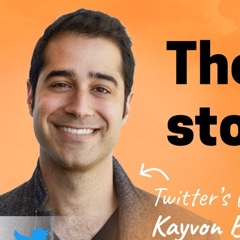
Kayvon Beykpour
Former Head of Product and GM of Consumer at Twitter; founder of Periscope
Where to hear and read about Kayvon Beykpour1 episode or test

Kayvon Beykpour founded Periscope, sold it to Twitter in 2015, and rose to head of product and then GM of consumer. The lesson most worth taking from him is to treat the things your organization thinks it can't change as a roadmap, and hand the risky bets to obsessed people with one unified team behind each.
The sacred cows are their own roadmap. It's like a built-in free roadmap.
Twitter’s ex-Head of Product on Elon, consumer products, culture, more | Kayvon Beykpour
Kayvon Beykpour: the story and the lessons
1Kayvon Beykpour's path from Periscope founder to Twitter's consumer chief
Beykpour learned corporate patience at 19, when Blackboard bought his startup. Blackboard acquired his college startup, and he spent four years there as a senior executive in a slow public company.
That experience later helped him with Twitter's consensus-heavy culture, where a less patient person would have given up.
Twitter bought Periscope in 2015 and kept him leading it. He became the longest-tenured head of product at Twitter, then GM of the consumer business. Periscope was the largest live-streaming platform of its time.
It inspired Instagram Live, TikTok Live and Facebook Live.
Periscope began as a photo app called Bounty. A pin on a place got a photo reply. Scott Belsky prototyped the live idea by taking Kayvon on a FaceTime walk around the TED conference.
Belsky was one of the first investors to say yes without knowing the founders. Kayvon also credits Star Trek's beaming as the inspiration, since live streaming is the closest software approximation.
His first boss taught him a work ethic: when nothing to do, sweep. At 14 he maintained fire extinguishers in San Francisco buildings with his boss Fred.
The lesson he took is that there is always something to do to move the ball forward.
2What Beykpour learned building and losing Periscope
Beykpour onboarded every beta user himself with a live private broadcast. The beta grew to about 500 people before the March 2015 launch. He walked around the office broadcasting privately while each user chatted, tapped hearts and asked him to go places.
Private broadcasting was built for exactly this demo. Kobe Bryant, invited by Chris Sacca, typed a trolling comment and then said he was joking. The exchange showed the bidirectional feel of the product.
Growth surges in new markets hid Periscope's weak retention. The app blew up in the US, then France, Turkey and the Middle East, one market every month or two. The team never prioritized retention, and some shipped changes made it worse.
"We did not address the core problem that retention wasn't good." The Twitter deal was meant to add durability, but integration took far too long.
He doubts a live-only consumer video app can last. Periscope users had no reason to open the app when they weren't broadcasting. Instagram and TikTok are asynchronous products with live added on top.
Vertical live products like Twitch (gaming) and Whatnot (selling) have properties that make them durable on their own.
Facebook beat Periscope by putting the whole company behind live video. Legend has it Mark Zuckerberg told 300 people to stop and build live. Facebook copied working features and paid prolific Periscopers, including Kevin Hart, to stream exclusively.
Beykpour calls the execution brilliant despite his frustration as a competitor.
Periscope's real use was conversation, not teleportation. The team dreamed of seeing through someone else's eyes. Most users were bored or lonely and just wanted to talk with other people.
That insight carried into a post-Periscope project codenamed Hydra, for the many heads in a conversation.
3How Beykpour changed Twitter's product culture
His first year as head of product was mostly politics. With a functional org, every plan needed buy-in from each peer function. The work was consensus-building, not execution.
After the first year, early wins built excitement for bigger swings and it felt like swimming in the same direction. He says the team was still not fast or bold enough.
Refining the core restored growth but made Twitter afraid of bold bets. For two years the strategy was to refine the core, and the ranked timeline returned Twitter to daily user growth. Users still said the product hadn't changed in eight years.
His fix was a portfolio of safe core improvements plus speculative bets. He says he did not nail the balance.
Beykpour treated every sacred cow as a free roadmap. The sacred cows were the ranked feed, the 140-character limit, and users having no control over replies. Working through them led to hide replies, a ranked timeline and eventually Community Notes and Spaces.
An engineer was told hide replies was bad for their career and would never launch. Beykpour's framing was "Tweet what you want, but don't at mention." He called it an innocuous test, and discouraging a hypothesis was the real problem.
He told the vision repeatedly and sorted people onto or off the wagon. The story of the bets and reasons had to be repeated inside the company and to users and advertisers. Some people were inspired and others stayed pessimistic.
Twitter lacked the structure and fortitude to move skeptics out, which slowed change. Talented people do not wait, and leave if stuck in organizational problems.
Instrumenting onboarding exposed a broken SMS verification flow. The telco integration was not sending codes, so large shares of sign-ups in the UAE and other countries could not use Twitter at all.
At hundreds of millions of users, fixing basic building blocks gives reliable growth.
4How Beykpour ran risky bets with acquired founders
He gave acquired founders their own silo for the riskiest bets. Keith Coleman ran Birdwatch (now Community Notes), Esther Crawford ran Super Follows and tipping, and Mo Oladam ran Fleets. Founders bring urgency and can still work inside a large organization.
"We gave Keith a little silo to go build this vision, and then it was our job to make sure that bet didn't get suffocated." Most people thought crowdsourced moderation was a terrible idea.
Community Notes and Fleets were judged without OKRs. They were structured like seed-stage startups. Other projects stayed in the core because separating them would do more harm than good.
He says skipping OKR judgment has pros and cons.
He staffed risky projects only with people who believed in them. Staffing was done by different people with only the CEO above them, so nobody owned the match, and some teams disagreed on whether the project was worth trying.
He calls obsession the cheap cheat code, and says every project must be willed into existence. It must come with a willingness to see whether the thing is working.
He bets on people before they look qualified. He was a beneficiary himself: Periscope was acquired and he was later given the product team. Such people can use the system and know when to break it.
The strategy is expensive if you must buy companies, but he never regretted it.
5Where Beykpour says frameworks and metrics go wrong
Beykpour sees Jobs-to-be-Done as a lens, not a governing principle. Twitter followed the process for its own sake and lost the forest for the trees. Its useful core is seeing needs and true alternatives through the customer's eyes.
He found it exhausting, and defending it was hard because he did not believe in it. The flaw is rigid use, not the idea itself.
He refused to let daily-user metrics excuse experiences users hate. The Swish toggle flipped users back to the ranked feed after about 24 hours because that was better for daily active users. Users hated it.
His answer is "good old-fashioned judgment and product taste."
He watches for two signs a framework has gone too far. First, it yields decisions you subjectively consider bad as a user. Second, it disincentivizes bets you want to make.
A Spaces banner at the top of the app pushed tweets and ads down and hurt daily users and revenue short term. He still believes in that bet. The test assumes the judge has good taste, which is itself subjective.
6Why Twitter lost on video and how Beykpour fixed it with Spaces
Twitter kept spotting shifts early and then botching the follow-through. It bought Vine and Periscope and tried to buy Instagram before Facebook did. He blames himself as much as anyone.
That pattern motivated him to avoid the same mistake as head of product.
Twitter competed with its own video bets using separate teams and stacks. Vine ran as a separate organization with its own New York office. Native video was built on a different stack, and premium NFL live video got its own team, UX and architecture.
Persistence and table pounding forced a fix. Today ESPN at Wimbledon and an iPhone user share the same stack. His conclusion: unified leadership under one opinionated person.
He made Spaces the company's top priority after Vine and Periscope. Spaces went from a six-person project that few cared about to the number one priority above any other project.
Clubhouse put the right experience into focus, and Twitter built its own version on Twitter's mechanics. He says Spaces is among the projects he is proudest of.
Beykpour will borrow ideas in good taste and add a spin. He sees nothing wrong with being shamelessly inspired by others if it is right for the customer.
"It's possible to take ideas in good taste and take ideas in poor taste." He judged some who copied Periscope as poor taste, though it worked.
7How Beykpour was fired and what he told Elon Musk
A functional org with a hands-off CEO left him unable to drive change. Heads of consumer, revenue, engineering, design and research disagreed and Jack did not break ties, so Kayvon led only product management.
"It's very difficult to change culture with one hand tied behind your back." Parag, newly CEO, switched to a GM structure and made Kayvon GM of consumer.
He was fired on paternity leave, the day after his daughter came home. Parag said he was taking the team in a different direction. Within three weeks of the leave, Elon joined the board, left it and made an offer.
That night Twitter signed the term sheet with Elon. Kayvon says the silver lining was a year with his new daughter.
On day two of Elon's control he briefed him on people and projects. Scott Belsky's recommendation led to a FaceTime call and a two-hour meeting at Twitter HQ. Kayvon pushed Birdwatch as the future of moderation and backed Spaces, Communities and the Creator Program.
He hoped they would get more oxygen under a new leader. He chose not to join Elon, deciding it was someone else's turn.
8Beykpour's habits for taste and hiring
He builds product taste by being a voracious user of other products. He tries things even when they seem dumb, noting what is superficial, ugly but useful, or beautiful and useful.
"The best cheat codes for getting better at building products is just being a voracious user of products." Being a heavy user of your own product also shows you what to fix.
He asks candidates about a failure and a success. He wants a project they cared about that failed, why, and what they learned, plus one that succeeded.
It reveals self-reflection and appetite for risk. "You just get to know someone really well."
He is building a new consumer startup with a small team. He started it with a couple of co-founders late last year and is not ready to say more.
He enjoys a small team after the opposite extreme of a very large company.

Twitter’s ex-Head of Product on Elon, consumer products, culture, more | Kayvon Beykpour
Kayvon Beykpour explains how he moved Twitter's product org from a stagnant, risk-averse culture to one that shipped Spaces, Communities, Community Notes and Fleets, mostly by acquiring founders and giving them silos. He also covers why Periscope failed and where frameworks like Jobs-to-be-Done and OKRs go wrong.
Beykpour learned corporate patience at 19, when Blackboard bought his startup. Blackboard acquired his college startup, and he spent four years there as a senior executive in a slow public company.
That experience later helped him with Twitter's consensus-heavy culture, where a less patient person would have given up.
Twitter bought Periscope in 2015 and kept him leading it. He became the longest-tenured head of product at Twitter, then GM of the consumer business. Periscope was the largest live-streaming platform of its time.
It inspired Instagram Live, TikTok Live and Facebook Live.
Periscope began as a photo app called Bounty. A pin on a place got a photo reply. Scott Belsky prototyped the live idea by taking Kayvon on a FaceTime walk around the TED conference.
Belsky was one of the first investors to say yes without knowing the founders. Kayvon also credits Star Trek's beaming as the inspiration, since live streaming is the closest software approximation.
His first boss taught him a work ethic: when nothing to do, sweep. At 14 he maintained fire extinguishers in San Francisco buildings with his boss Fred.
The lesson he took is that there is always something to do to move the ball forward.
Beykpour onboarded every beta user himself with a live private broadcast. The beta grew to about 500 people before the March 2015 launch. He walked around the office broadcasting privately while each user chatted, tapped hearts and asked him to go places.
Private broadcasting was built for exactly this demo. Kobe Bryant, invited by Chris Sacca, typed a trolling comment and then said he was joking. The exchange showed the bidirectional feel of the product.
Growth surges in new markets hid Periscope's weak retention. The app blew up in the US, then France, Turkey and the Middle East, one market every month or two. The team never prioritized retention, and some shipped changes made it worse.
"We did not address the core problem that retention wasn't good." The Twitter deal was meant to add durability, but integration took far too long.
He doubts a live-only consumer video app can last. Periscope users had no reason to open the app when they weren't broadcasting. Instagram and TikTok are asynchronous products with live added on top.
Vertical live products like Twitch (gaming) and Whatnot (selling) have properties that make them durable on their own.
Facebook beat Periscope by putting the whole company behind live video. Legend has it Mark Zuckerberg told 300 people to stop and build live. Facebook copied working features and paid prolific Periscopers, including Kevin Hart, to stream exclusively.
Beykpour calls the execution brilliant despite his frustration as a competitor.
Periscope's real use was conversation, not teleportation. The team dreamed of seeing through someone else's eyes. Most users were bored or lonely and just wanted to talk with other people.
That insight carried into a post-Periscope project codenamed Hydra, for the many heads in a conversation.
His first year as head of product was mostly politics. With a functional org, every plan needed buy-in from each peer function. The work was consensus-building, not execution.
After the first year, early wins built excitement for bigger swings and it felt like swimming in the same direction. He says the team was still not fast or bold enough.
Refining the core restored growth but made Twitter afraid of bold bets. For two years the strategy was to refine the core, and the ranked timeline returned Twitter to daily user growth. Users still said the product hadn't changed in eight years.
His fix was a portfolio of safe core improvements plus speculative bets. He says he did not nail the balance.
Beykpour treated every sacred cow as a free roadmap. The sacred cows were the ranked feed, the 140-character limit, and users having no control over replies. Working through them led to hide replies, a ranked timeline and eventually Community Notes and Spaces.
An engineer was told hide replies was bad for their career and would never launch. Beykpour's framing was "Tweet what you want, but don't at mention." He called it an innocuous test, and discouraging a hypothesis was the real problem.
He told the vision repeatedly and sorted people onto or off the wagon. The story of the bets and reasons had to be repeated inside the company and to users and advertisers. Some people were inspired and others stayed pessimistic.
Twitter lacked the structure and fortitude to move skeptics out, which slowed change. Talented people do not wait, and leave if stuck in organizational problems.
Instrumenting onboarding exposed a broken SMS verification flow. The telco integration was not sending codes, so large shares of sign-ups in the UAE and other countries could not use Twitter at all.
At hundreds of millions of users, fixing basic building blocks gives reliable growth.
He gave acquired founders their own silo for the riskiest bets. Keith Coleman ran Birdwatch (now Community Notes), Esther Crawford ran Super Follows and tipping, and Mo Oladam ran Fleets. Founders bring urgency and can still work inside a large organization.
"We gave Keith a little silo to go build this vision, and then it was our job to make sure that bet didn't get suffocated." Most people thought crowdsourced moderation was a terrible idea.
Community Notes and Fleets were judged without OKRs. They were structured like seed-stage startups. Other projects stayed in the core because separating them would do more harm than good.
He says skipping OKR judgment has pros and cons.
He staffed risky projects only with people who believed in them. Staffing was done by different people with only the CEO above them, so nobody owned the match, and some teams disagreed on whether the project was worth trying.
He calls obsession the cheap cheat code, and says every project must be willed into existence. It must come with a willingness to see whether the thing is working.
He bets on people before they look qualified. He was a beneficiary himself: Periscope was acquired and he was later given the product team. Such people can use the system and know when to break it.
The strategy is expensive if you must buy companies, but he never regretted it.
Beykpour sees Jobs-to-be-Done as a lens, not a governing principle. Twitter followed the process for its own sake and lost the forest for the trees. Its useful core is seeing needs and true alternatives through the customer's eyes.
He found it exhausting, and defending it was hard because he did not believe in it. The flaw is rigid use, not the idea itself.
He refused to let daily-user metrics excuse experiences users hate. The Swish toggle flipped users back to the ranked feed after about 24 hours because that was better for daily active users. Users hated it.
His answer is "good old-fashioned judgment and product taste."
He watches for two signs a framework has gone too far. First, it yields decisions you subjectively consider bad as a user. Second, it disincentivizes bets you want to make.
A Spaces banner at the top of the app pushed tweets and ads down and hurt daily users and revenue short term. He still believes in that bet. The test assumes the judge has good taste, which is itself subjective.
Twitter kept spotting shifts early and then botching the follow-through. It bought Vine and Periscope and tried to buy Instagram before Facebook did. He blames himself as much as anyone.
That pattern motivated him to avoid the same mistake as head of product.
Twitter competed with its own video bets using separate teams and stacks. Vine ran as a separate organization with its own New York office. Native video was built on a different stack, and premium NFL live video got its own team, UX and architecture.
Persistence and table pounding forced a fix. Today ESPN at Wimbledon and an iPhone user share the same stack. His conclusion: unified leadership under one opinionated person.
He made Spaces the company's top priority after Vine and Periscope. Spaces went from a six-person project that few cared about to the number one priority above any other project.
Clubhouse put the right experience into focus, and Twitter built its own version on Twitter's mechanics. He says Spaces is among the projects he is proudest of.
Beykpour will borrow ideas in good taste and add a spin. He sees nothing wrong with being shamelessly inspired by others if it is right for the customer.
"It's possible to take ideas in good taste and take ideas in poor taste." He judged some who copied Periscope as poor taste, though it worked.
A functional org with a hands-off CEO left him unable to drive change. Heads of consumer, revenue, engineering, design and research disagreed and Jack did not break ties, so Kayvon led only product management.
"It's very difficult to change culture with one hand tied behind your back." Parag, newly CEO, switched to a GM structure and made Kayvon GM of consumer.
He was fired on paternity leave, the day after his daughter came home. Parag said he was taking the team in a different direction. Within three weeks of the leave, Elon joined the board, left it and made an offer.
That night Twitter signed the term sheet with Elon. Kayvon says the silver lining was a year with his new daughter.
On day two of Elon's control he briefed him on people and projects. Scott Belsky's recommendation led to a FaceTime call and a two-hour meeting at Twitter HQ. Kayvon pushed Birdwatch as the future of moderation and backed Spaces, Communities and the Creator Program.
He hoped they would get more oxygen under a new leader. He chose not to join Elon, deciding it was someone else's turn.
He builds product taste by being a voracious user of other products. He tries things even when they seem dumb, noting what is superficial, ugly but useful, or beautiful and useful.
"The best cheat codes for getting better at building products is just being a voracious user of products." Being a heavy user of your own product also shows you what to fix.
He asks candidates about a failure and a success. He wants a project they cared about that failed, why, and what they learned, plus one that succeeded.
It reveals self-reflection and appetite for risk. "You just get to know someone really well."
He is building a new consumer startup with a small team. He started it with a couple of co-founders late last year and is not ready to say more.
He enjoys a small team after the opposite extreme of a very large company.