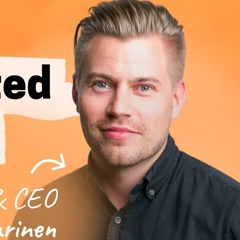
Karri Saarinen
Co-founder and CEO of Linear; previously founding designer at Coinbase and principal designer at Airbnb
Where to hear and read about Karri Saarinen1 episode or test

Karri Saarinen is co-founder and CEO of Linear, an issue tracker he built after design roles at Coinbase and Airbnb. The most useful thing to learn from him is how a small, high-caliber team that knows its customers can build with taste and focus, without metrics, A/B tests or a PM layer.
I think we are in the retention business and the trust business, so we need to continuously deliver good quality product and maintain that trust.
Inside Linear: Building with taste, craft, and focus | Karri Saarinen (co-founder, designer, CEO)
Karri Saarinen: the story and the lessons
1How Karri Saarinen launched Linear
Saarinen started Linear after design leadership at Coinbase and Airbnb. He was founding designer at Coinbase and principal designer at Airbnb, and had co-founded two startups before Linear. Linear launched in 2019 as a project and issue tracker for software teams.
The three founders had each worked at companies of different stages and found existing tools clunky and shaped by legacy thinking. Customers now include Block, Vercel, Ramp, Retool and Mercury.
The first version took a few months and the team used it within weeks. Work began in April 2019 and the team was using the product by May. By June and July there were 100 to 200 users at about 10 companies.
Speed came from a self-built setup where data lives in the client and syncs to the backend.
Each founder announced Linear in their own voice, to people like them. Saarinen had about 10,000 followers from talks and blog posts at Airbnb and Coinbase. The founders each wrote their own reasons on Twitter, and the waitlist reached about 4,000 within a month.
He says startups often imitate fancy corporate announcements, while Linear wrote more directly: what it would do and why. A small angel round added accountability and helped spread the news.
He picked beta users with a waitlist survey and read it himself. The survey asked which tools people used, why they wanted Linear and company size. Smaller companies on supported tools came first, and Saarinen sent invites from his personal email.
This kept the early product focused on a segment it could actually serve.
Saarinen invited about 10 people a week and fixed problems between batches. The private beta lasted almost a year. Public launch came with several hundred companies already using the product.
A big group would hit the same bug and send the same report, so small cohorts made feedback useful. "Let's invite these people and then they say, hey, this is a problem. Then we go fix that."
A pay-what-you-want slider tested payments before Linear set a price. During the beta, customers could pick a per-seat price up to about $20. Some chose $1 and some went to the top.
It did not yield enough data to set pricing, but it tested the payment flow and gave confidence that a price under $20 would find a market. At launch almost every beta company subscribed.
2How Saarinen builds craft with small project teams
Saarinen treats design as the entry bar, never the sole advantage. In a crowded category even a new entrant must be pretty good to count, and buyers who don't know which feature they need pick what looks highest quality.
He notes Google and YouTube launched with basic pages that would go unnoticed today. "Design is never going to be the reason why a company is successful." Good design and brand add leverage early, when nobody knows you.
Linear runs on one PM and project teams of engineers and designers. Head of product Nan Yu sets direction and does not run every meeting or spec. Each project has a lead, an engineer or designer, assigned per project rather than by title.
Linear has about 50 people. Teams form around a project and disperse when it ends, and Saarinen says the PM is not the one staring at where a button goes.
Owning a feature led an engineer to build what nobody asked for. Engineer Andreas built dynamic safe zones for sub-menus so users can move diagonally without missing by a few pixels.
"These things happen when you give people more of the ownership of the project and also the space to do that."
Craft only survives if every founder and employee values it. Co-founders Jori and Tuomas are engineers who sweat details even more than Saarinen. Early on he drew the broad strokes of the UI and they added things like animations.
He advised a founder whose co-founders came from Airbnb, Facebook and Amazon to align on quality, because one company cannot run several cultures.
Saarinen ships rough features to the team first and polishes last. A feature goes into production in the first week or so, visible only to the team, then to one to ten opt-in customers. Full polish comes only before general release.
For hard-to-imagine features, like the roadmap, he works with a large customer such as Vercel. A delay for polish usually costs days, not a rebuild.
He tests every state himself before anything goes to everyone. Comment threading looked fine in demos, but varied message lengths showed janky animations and wrong scrolling, so the release was pulled back.
There are no formal review stages, only regular check-ins and a final quality review. "I might just go in and try it out and try the different states and click it around."
He builds the brand through actions, not a logo and colors. A brand forms from what you do and say, how you treat customers and how you build the site and product. Copying another company's look does not make one.
At Airbnb, Brian Chesky treated the brand as part of everything, so people now go straight to airbnb.com. "The brand doesn't happen overnight."
3How Linear decides without metrics or A/B tests
Linear replaces feature goals with deep customer understanding. It sets no goals for individual features and runs no A/B tests, only company-level metrics such as weekly active users. Stats are pulled only to answer a specific question.
The whole team reads shared customer Slack channels and joins calls, and founders hold weekly customer calls. Linear has been profitable for the last two years this way.
Saarinen accepts some wrong calls rather than let data decide. He says teams over-rely on data from fear of choosing wrong. Success at Linear means customers agree the problem is solved, not that a number moved.
He calls the approach a little science with a lot of magic. "The data didn't make that choice for us."
He builds opinionated software for someone, not flexible software for everyone. Flexible tools let each team invent its own workflow and spend time on the tool instead of the work. Linear gives one best-guess workflow with good defaults.
"Design something for someone. It is very hard to design everything for everyone because you just end up with a very generalized solution."
Cycles commit a team to a short list for one or two weeks. They are optional, run on an automatic schedule and ignore the near-infinite backlog.
If priorities change, the original plan explains why other work slipped. Saarinen avoids the word sprint because "we are not really sprinting anywhere."
He sees product-market fit as a spectrum won one segment at a time. The first two years aimed to make Linear the default tool for early-stage startups. The last two years aim to strengthen fit with companies of hundreds or 1,000 people.
He says a Fortune 500 company would not be well served today. Zoom's founder Eric told him early Zoom kept chasing more of the customers it served well, such as universities. Linear watches for pull, from crypto companies earlier and AI companies now.
He cuts side quests and asks whether something matters now. Saarinen uses the YC advice he took in 2012: talk to customers, build the product and exercise. Linear delayed SOC 2 and told customers it was not available yet, and most were fine.
He turned down this podcast earlier because the timing was better later. A company T-shirt counts as a side quest unless it helps customers or the product.
4How Saarinen hires and leads
Linear hires slowly and keeps the team small. It hired no one in its first year, then a couple of people, then a few more, and never more than doubled in a year. It is at about 50 people.
Saarinen says fast hiring at high-growth companies brought chaos and mess, and Linear may hire even slower. The company has more cash in the bank than it raised.
He hires people who can take more scope than their title. Engineers need product thinking, marketers should be good storytellers with taste and operations hires should understand HR.
Overlap means people rarely say "not my job." Scope is given at the start through few levels, not earned by climbing them. "They can take more scope than their skill set would assume."
He tests product sense by probing the reasons behind past decisions. He asks why a decision was made, whether the candidate agreed and what they would do differently. He also asks what they are most proud of and why.
A strong answer ties reasons to users or context. "I didn't like it" or "I just built it" is weak. Without PMs, he says you cannot interview engineers only for engineering.
The last hiring step is a paid trial on a vague real problem. The candidate works as a mini contractor, gets a vague brief and a code base, scopes it, builds a version and presents it. They also join meetings and talk one on one with the team.
Trials can run on weekends or holidays. Only a few candidates have ever declined, and it protects candidates from a risky choice because interviews alone hide how a startup operates.
Moving from IC to CEO meant handling many different problems at once. A designer focuses on design, while a CEO faces compensation, marketing plans and offsites in the same week.
He hires leaders to own areas and says he hasn't fully figured it out, but enjoys slowly learning finance and legal.

Inside Linear: Building with taste, craft, and focus | Karri Saarinen (co-founder, designer, CEO)
Linear builds an issue tracker with a high bar for craft, no A/B tests, no metric goals and only one PM, relying on customer closeness, taste and a small high-caliber team. It has been profitable for two years and has a net negative lifetime burn, with a hand-picked waitlist, a year-long private beta and a paid work trial hiring process behind it.
Saarinen started Linear after design leadership at Coinbase and Airbnb. He was founding designer at Coinbase and principal designer at Airbnb, and had co-founded two startups before Linear. Linear launched in 2019 as a project and issue tracker for software teams.
The three founders had each worked at companies of different stages and found existing tools clunky and shaped by legacy thinking. Customers now include Block, Vercel, Ramp, Retool and Mercury.
The first version took a few months and the team used it within weeks. Work began in April 2019 and the team was using the product by May. By June and July there were 100 to 200 users at about 10 companies.
Speed came from a self-built setup where data lives in the client and syncs to the backend.
Each founder announced Linear in their own voice, to people like them. Saarinen had about 10,000 followers from talks and blog posts at Airbnb and Coinbase. The founders each wrote their own reasons on Twitter, and the waitlist reached about 4,000 within a month.
He says startups often imitate fancy corporate announcements, while Linear wrote more directly: what it would do and why. A small angel round added accountability and helped spread the news.
He picked beta users with a waitlist survey and read it himself. The survey asked which tools people used, why they wanted Linear and company size. Smaller companies on supported tools came first, and Saarinen sent invites from his personal email.
This kept the early product focused on a segment it could actually serve.
Saarinen invited about 10 people a week and fixed problems between batches. The private beta lasted almost a year. Public launch came with several hundred companies already using the product.
A big group would hit the same bug and send the same report, so small cohorts made feedback useful. "Let's invite these people and then they say, hey, this is a problem. Then we go fix that."
A pay-what-you-want slider tested payments before Linear set a price. During the beta, customers could pick a per-seat price up to about $20. Some chose $1 and some went to the top.
It did not yield enough data to set pricing, but it tested the payment flow and gave confidence that a price under $20 would find a market. At launch almost every beta company subscribed.
Saarinen treats design as the entry bar, never the sole advantage. In a crowded category even a new entrant must be pretty good to count, and buyers who don't know which feature they need pick what looks highest quality.
He notes Google and YouTube launched with basic pages that would go unnoticed today. "Design is never going to be the reason why a company is successful." Good design and brand add leverage early, when nobody knows you.
Linear runs on one PM and project teams of engineers and designers. Head of product Nan Yu sets direction and does not run every meeting or spec. Each project has a lead, an engineer or designer, assigned per project rather than by title.
Linear has about 50 people. Teams form around a project and disperse when it ends, and Saarinen says the PM is not the one staring at where a button goes.
Owning a feature led an engineer to build what nobody asked for. Engineer Andreas built dynamic safe zones for sub-menus so users can move diagonally without missing by a few pixels.
"These things happen when you give people more of the ownership of the project and also the space to do that."
Craft only survives if every founder and employee values it. Co-founders Jori and Tuomas are engineers who sweat details even more than Saarinen. Early on he drew the broad strokes of the UI and they added things like animations.
He advised a founder whose co-founders came from Airbnb, Facebook and Amazon to align on quality, because one company cannot run several cultures.
Saarinen ships rough features to the team first and polishes last. A feature goes into production in the first week or so, visible only to the team, then to one to ten opt-in customers. Full polish comes only before general release.
For hard-to-imagine features, like the roadmap, he works with a large customer such as Vercel. A delay for polish usually costs days, not a rebuild.
He tests every state himself before anything goes to everyone. Comment threading looked fine in demos, but varied message lengths showed janky animations and wrong scrolling, so the release was pulled back.
There are no formal review stages, only regular check-ins and a final quality review. "I might just go in and try it out and try the different states and click it around."
He builds the brand through actions, not a logo and colors. A brand forms from what you do and say, how you treat customers and how you build the site and product. Copying another company's look does not make one.
At Airbnb, Brian Chesky treated the brand as part of everything, so people now go straight to airbnb.com. "The brand doesn't happen overnight."
Linear replaces feature goals with deep customer understanding. It sets no goals for individual features and runs no A/B tests, only company-level metrics such as weekly active users. Stats are pulled only to answer a specific question.
The whole team reads shared customer Slack channels and joins calls, and founders hold weekly customer calls. Linear has been profitable for the last two years this way.
Saarinen accepts some wrong calls rather than let data decide. He says teams over-rely on data from fear of choosing wrong. Success at Linear means customers agree the problem is solved, not that a number moved.
He calls the approach a little science with a lot of magic. "The data didn't make that choice for us."
He builds opinionated software for someone, not flexible software for everyone. Flexible tools let each team invent its own workflow and spend time on the tool instead of the work. Linear gives one best-guess workflow with good defaults.
"Design something for someone. It is very hard to design everything for everyone because you just end up with a very generalized solution."
Cycles commit a team to a short list for one or two weeks. They are optional, run on an automatic schedule and ignore the near-infinite backlog.
If priorities change, the original plan explains why other work slipped. Saarinen avoids the word sprint because "we are not really sprinting anywhere."
He sees product-market fit as a spectrum won one segment at a time. The first two years aimed to make Linear the default tool for early-stage startups. The last two years aim to strengthen fit with companies of hundreds or 1,000 people.
He says a Fortune 500 company would not be well served today. Zoom's founder Eric told him early Zoom kept chasing more of the customers it served well, such as universities. Linear watches for pull, from crypto companies earlier and AI companies now.
He cuts side quests and asks whether something matters now. Saarinen uses the YC advice he took in 2012: talk to customers, build the product and exercise. Linear delayed SOC 2 and told customers it was not available yet, and most were fine.
He turned down this podcast earlier because the timing was better later. A company T-shirt counts as a side quest unless it helps customers or the product.
Linear hires slowly and keeps the team small. It hired no one in its first year, then a couple of people, then a few more, and never more than doubled in a year. It is at about 50 people.
Saarinen says fast hiring at high-growth companies brought chaos and mess, and Linear may hire even slower. The company has more cash in the bank than it raised.
He hires people who can take more scope than their title. Engineers need product thinking, marketers should be good storytellers with taste and operations hires should understand HR.
Overlap means people rarely say "not my job." Scope is given at the start through few levels, not earned by climbing them. "They can take more scope than their skill set would assume."
He tests product sense by probing the reasons behind past decisions. He asks why a decision was made, whether the candidate agreed and what they would do differently. He also asks what they are most proud of and why.
A strong answer ties reasons to users or context. "I didn't like it" or "I just built it" is weak. Without PMs, he says you cannot interview engineers only for engineering.
The last hiring step is a paid trial on a vague real problem. The candidate works as a mini contractor, gets a vague brief and a code base, scopes it, builds a version and presents it. They also join meetings and talk one on one with the team.
Trials can run on weekends or holidays. Only a few candidates have ever declined, and it protects candidates from a risky choice because interviews alone hide how a startup operates.
Moving from IC to CEO meant handling many different problems at once. A designer focuses on design, while a CEO faces compensation, marketing plans and offsites in the same week.
He hires leaders to own areas and says he hasn't fully figured it out, but enjoys slowly learning finance and legal.

 Linear