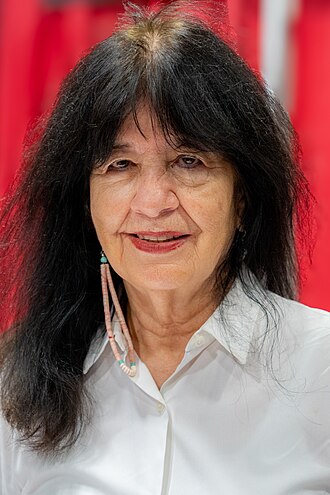
Joy Harjo
Where to hear and read about Joy Harjo1 episode or test

Joy Harjo is a poet who has written for decades by listening, treating the poem as something translated from the sound and rhythm of the world. The most useful thing to learn from her is to trust your own voice and sound, and to defend them against fashion and against editors who want plain grammar.
I don't want my voice or my theme or something just to be caught in a particular fashion of the times
Learn To Write Poetry (in 47 Minutes) — Ada Limón & Joy Harjo
Joy Harjo: the story and the lessons
1How Joy Harjo listens before she writes
Harjo sees the poet as a translator of the earth's song. She says the earth has a song and the poet translates it instead of imposing on it. She uses craft to turn what she hears into a poem.
When a line simply comes through, she says thank you. She says the aim is to listen and not impose herself, and that listening is interactive: once you listen, you hear plants, rocks and "the beneath the beneath".
Harjo cannot write poetry or prose with music playing. Songwriting is the exception for her. Novelist Leslie Silko plays loud music as a wall of sound behind her writing, but Harjo can't work that way.
The contrast shows that writers should test which setup lets them hear their own rhythm.
Harjo has sought time alone since she was a small child. She spent time alone even as a small child, for sanity.
Ada Limón ties this kind of solitude to being attuned to the music of the world.
2Harjo on voice, fashion and sound sense
Harjo never cultivated her voice and trusts it is already there. She hears the same voice in the saxophone, in speech and in song. When students ask how to find their voice, she says it is already there.
She tells them to investigate why they think as they do, where their minds travel and where they obsess, with curiosity. Her line: "Maybe my voice cultivated me."
Harjo refused to bend her voice to the fashion of the day. She knows her voice doesn't fit the youth-focused, theory-driven poetry of the moment. She tried to fit and it didn't work.
She wrote the way she wrote, even when that made her harder to understand.
Harjo told an editor her odd word order was sound sense. In her poem "Shape Shifter", a magazine editor questioned the placement of two words around the image of a deer. She answered, "No, this is sound sense."
The grammatical order would have flattened the sentence. The reordered words matched the deer's perception, and the editors accepted it.
Harjo names the poets she learned from. After finishing "Shape Shifter" she realized how much she owed Galway Kinnell, especially his "The Bear" and "The Book of Nightmares".
She traced the shape-shifting and tracking in her poem back to his work.
3Harjo on time, culture and attention
Harjo writes for a time far longer than the clock. She tells young Native writers that colonization is brief next to the time their people have been here, and "we will be here after."
She can hold that long view only for moments before it goes away. Limón admires that her work comes from before clock time.
Harjo links poetry to song, dance and place. She lived in Hawaii for over 11 years, where hula is dancing poetry tied to land and stars.
She says poems carry a culture's sense of itself, in its arts, symbols and story structures.
Harjo stepped back from her phone when her dreams sped up. Her long, poem-like dreams had turned into fast flips like Reels and TikToks. She took that as a sign that fast media was interfering with lengthy thought.
She says interruption from the phone and internet breaks up the resonance she needs.
Harjo calls abbreviated texts and emails clock time writing. She and Limón note that texts and emails are often unpunctuated and written only to get a literal message across.
That keeps language a blunt tool. Harjo says poetry is essentially metaphor, which lets us hold contradiction in one place.
4How Harjo reads and hears poems
Harjo tells students to listen to a poem like a song. She says teachers should have students listen to a poem the way they listen to a song, then listen again.
Her example is "Hotel California": who knows what it means, and who cares.
Harjo shows that hearing a poem aloud changes how people receive it. A doctor who never understood poetry said he got it after hearing Harjo and Limón read.
She also recalls the dub poet Linton Kwesi Johnson in Amsterdam in the late 1970s, who read without his band while the whole room danced to his cadence.

Learn To Write Poetry (in 47 Minutes) — Ada Limón & Joy Harjo
Two poets argue that writing begins with receiving, listening to sound, rhythm and silence before you try to say anything. The most useful habits are writing without music, treating line breaks and sound as instructions to the reader, and defending sound against editors who want grammar.
Harjo sees the poet as a translator of the earth's song. She says the earth has a song and the poet translates it instead of imposing on it. She uses craft to turn what she hears into a poem.
When a line simply comes through, she says thank you. She says the aim is to listen and not impose herself, and that listening is interactive: once you listen, you hear plants, rocks and "the beneath the beneath".
Harjo cannot write poetry or prose with music playing. Songwriting is the exception for her. Novelist Leslie Silko plays loud music as a wall of sound behind her writing, but Harjo can't work that way.
The contrast shows that writers should test which setup lets them hear their own rhythm.
Harjo has sought time alone since she was a small child. She spent time alone even as a small child, for sanity.
Ada Limón ties this kind of solitude to being attuned to the music of the world.
Harjo never cultivated her voice and trusts it is already there. She hears the same voice in the saxophone, in speech and in song. When students ask how to find their voice, she says it is already there.
She tells them to investigate why they think as they do, where their minds travel and where they obsess, with curiosity. Her line: "Maybe my voice cultivated me."
Harjo refused to bend her voice to the fashion of the day. She knows her voice doesn't fit the youth-focused, theory-driven poetry of the moment. She tried to fit and it didn't work.
She wrote the way she wrote, even when that made her harder to understand.
Harjo told an editor her odd word order was sound sense. In her poem "Shape Shifter", a magazine editor questioned the placement of two words around the image of a deer. She answered, "No, this is sound sense."
The grammatical order would have flattened the sentence. The reordered words matched the deer's perception, and the editors accepted it.
Harjo names the poets she learned from. After finishing "Shape Shifter" she realized how much she owed Galway Kinnell, especially his "The Bear" and "The Book of Nightmares".
She traced the shape-shifting and tracking in her poem back to his work.
Harjo writes for a time far longer than the clock. She tells young Native writers that colonization is brief next to the time their people have been here, and "we will be here after."
She can hold that long view only for moments before it goes away. Limón admires that her work comes from before clock time.
Harjo links poetry to song, dance and place. She lived in Hawaii for over 11 years, where hula is dancing poetry tied to land and stars.
She says poems carry a culture's sense of itself, in its arts, symbols and story structures.
Harjo stepped back from her phone when her dreams sped up. Her long, poem-like dreams had turned into fast flips like Reels and TikToks. She took that as a sign that fast media was interfering with lengthy thought.
She says interruption from the phone and internet breaks up the resonance she needs.
Harjo calls abbreviated texts and emails clock time writing. She and Limón note that texts and emails are often unpunctuated and written only to get a literal message across.
That keeps language a blunt tool. Harjo says poetry is essentially metaphor, which lets us hold contradiction in one place.
Harjo tells students to listen to a poem like a song. She says teachers should have students listen to a poem the way they listen to a song, then listen again.
Her example is "Hotel California": who knows what it means, and who cares.
Harjo shows that hearing a poem aloud changes how people receive it. A doctor who never understood poetry said he got it after hearing Harjo and Limón read.
She also recalls the dub poet Linton Kwesi Johnson in Amsterdam in the late 1970s, who read without his band while the whole room danced to his cadence.