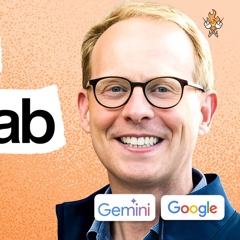
Josh Woodward
VP of Google Labs, the Gemini app and AI Studio, Google
Where to hear and read about Josh Woodward1 episode or test

Josh Woodward is VP of Google Labs, the Gemini app and AI Studio, and runs Google's longest-running labs team, behind NotebookLM, Flow and Project Genie. The thing most worth learning from him is to protect a small team that tracks what AI has just made possible, tests it on real people fast, and lets the team call the kill.
You've got to try to create a space where weird things can grow.
Why every company now needs to think and operate like a lab team | Josh Woodward (VP Google Labs)
Josh Woodward: the story and the lessons
1What Josh Woodward runs at Google
Woodward runs Google's longest-running labs team and the Gemini app. He is VP of Google Labs, the Gemini app and AI Studio. Labs is behind NotebookLM, Flow and Project Genie.
Notebook, Flow, AI Studio and Google Beam each began with a small, obsessed group over the last four or five years.
One mantra covers a billion-user app and 10,000-user experiments. Gemini has over a billion users, while Labs celebrates 10,000 users that other dashboards would not count. Both teams work by the order users first, Google second, product third.
Teams do not build for their own benefit. They ask whether someone on the other end loves the product.
Labs went all in on AI after exploring other areas. Labs tried other areas four or 5 years ago, then focused only on AI, including some hardware.
Google Beam is a magic mirror that makes a 3D version of the person you are talking to, like a hologram.
Woodward wants assistants with one prompt box and no modes. Google is building a Gemini that is personal, proactive and powerful. Users tell it what they want and it acts.
Gemini and Gemini Spark can already connect Gmail, Calendar and Docs. He says: "forget the modes and toggles. Just like one prompt box."
Woodward calls benchmarks overhyped and a team's principles underhyped. Most people will never care about an Elo rating, and he says the industry over-rotates to speeds and feeds.
He argues products encode a team's principles, and he wants more talk about what future people want to build.
2How Woodward finds ideas and tests for product-market fit
Woodward keeps a list of what is almost possible. Labs tracks experiences AI cannot quite do yet, plus 82 predictions about the future. When a capability crosses over, like a phase shift from solid to gas, a small team starts on it.
He saw one such crossing two days before the interview and a project began within 48 hours. The tech must also match a real user problem, ideally one people would pay to solve.
Woodward does not schedule idea generation. Ideas rarely come from design sprints. They come from small groups hacking over weekends, breaks and in hallways, so Labs creates space for side projects and watches for the one that stands out.
His line: "You can't microwave good ideas." The people with interesting side projects matter as much as the idea.
Woodward judges early prototypes by whether people's eyes light up. He takes prototypes outside the building and asks people what they think. Eyes lighting up and leaning in means a real pain point, and early on this beats DAU or D7 retention.
The notes flag this test as unvalidated, with no case shown where it misled a team. He also admits that early fit is more art than science.
Real hits start with a surprise, and many attempts fail. The first NotebookLM podcast came from two teammates at 6:30 p.m. on a Tuesday. The AI hosts made dry British Parliament debates interesting, which told the team to build on it.
Whisk, which blended images and animated them, led to Flow. Some products the team gets excited about just are not good, so it is partly a numbers game.
Woodward's teams fall in love with the problem, not the solution. He expects three, four or five pivots before an idea works or dies. A team attached to the problem can change the solution and carry on.
When fit arrives it is obvious and the team swarms it. Nano Banana on Gemini, NotebookLM podcasts, Flow and Stitch each had that moment.
Woodward expects to be wrong nine times out of ten. Labs picks futures such as software, creativity, work and entertainment, and lists the tech thresholds each needs, like model latency, languages and modalities.
He says maybe 9.9 out of 10 predictions miss, but a team still needs a point of view. Immersive entertainment is the area he watches most closely.
3How Woodward decides when to kill an idea and what went wrong before
Woodward trusts the team's read that an idea is dead. The team usually knows before the leader does. Warning signs are fading passion and having tried everything they can think of.
The leader's job is to make it safe to ask uncomfortable questions. "The team usually knows before the leader knows."
Woodward publicly thanked a PM who recommended against launching. Early data on a Gemini feature came back flat after the team looked users in the eyes. The PM advised against launch and Woodward replied to all with thanks.
A team that can call out both good and bad can pivot without blame.
Woodward once grew a project to 30 engineers with no product-market fit. The project had a very inspiring vision and zero fit, and it ended badly. He now calls fast headcount growth a vanity metric.
Doubling headcount in a quarter says nothing about fit. He also warns against tidy org charts and says sometimes a team has to live in the mess and see what emerges.
Woodward plans in rolling six-month windows with 100-day pushes. The roadmap is six months, set by how often every lab ships a new pre-training model. The best teams reach a meaningful milestone in 50 to 100 days.
He keeps a multi-year vision but no two-year roadmap. Leaders unblock teams, let people cook, and use events like I/O or a model release as target dates.
Woodward names sprint and rest periods so people can last years. Labs runs 20 or 30 experiments at once, each team with its own milestones. When a big model is coming, the five products that showcase it are declared explosive.
After Google I/O in June, teams hack and rediscover what is new. That looks unproductive but seeds the next season, and the aim is to work together for many years.
4How Woodward builds and protects a lab
Woodward says a lab needs independence and a defined job. A lab should not sit under an existing business unit, and in some companies it should report to the CEO. It must choose whether to graduate ideas into products or invent new product lines.
Google Labs began as a graduation lab and widened as AI blurred categories. His claim that corporate labs fizzle in three to four years is his reading, with no data or named examples.
Woodward says a lab fails if it cannot bridge to the core company. Every company needs frontier people, those with eight $200 a month subscriptions who know the latest viral thing within 24 hours, plus a place to build.
The third need is a bridge so the company does not dismiss the lab as an R&D group making toys. Someone must argue a toy today will be essential in 5 years.
Woodward staffs new projects with two to three people. Labs project teams went from about five to seven people to about two to three, maybe four, as AI cut the cost of building.
He likens them to musicians who play different songs with different partners, where the songs are the products. Building trust matters more as teams shift more often.
Woodward hires people who show what they just built. "Let me show you this thing I just built" earns instant credibility. He also asks about unknown, unstructured dark caves and boosts candidates who are energized by them.
New hires get a Labs in a nutshell doc in week one, and many have seen it during screening.
Woodward screens for unlearning rate, explosive endurance and trust. Unlearning rate is how fast someone learns something and then walks away from it. Explosive endurance, a phrase from a book about Roger Federer, is going hard over a long time.
He says unlearning rate matters more than learning rate. Strong people also collaborate well with both agents and people.
Woodward treats PM as a major and building as a minor. He calls everybody a builder overhyped. Specialty stays the core of a person's value, though strong builders come from strategy, ops, BD and marketing too.
His advice to new PMs and APMs is to prototype in service of becoming an exceptional PM: "don't lose that major."
Woodward uses Labs to pilot new ways of working. Labs was among the first to argue roles are blurring and piloted a builder job ladder before a Google-wide rollout.
He calls it creating good trouble and suggests CEOs use a lab to challenge how the company works.
Woodward sets different goals for zero-to-one and scaled products. Zero-to-one is judged by eyeballs. Ten-to-a-hundred is a scaling game of waterfalls and CPAs.
Large products like Notebook, Flow and AI Studio risk crowding out zero-to-one work, so the stage names give the team a shared language.

Why every company now needs to think and operate like a lab team | Josh Woodward (VP Google Labs)
Every company needs a lab-style team that tracks what AI has just made possible, tests ideas fast and knows when to kill them. Woodward runs Google's longest-running labs team, behind NotebookLM, Flow and Project Genie, and shares how it finds ideas, spots product-market fit, sets team size and keeps a lab from fizzling.
Woodward runs Google's longest-running labs team and the Gemini app. He is VP of Google Labs, the Gemini app and AI Studio. Labs is behind NotebookLM, Flow and Project Genie.
Notebook, Flow, AI Studio and Google Beam each began with a small, obsessed group over the last four or five years.
One mantra covers a billion-user app and 10,000-user experiments. Gemini has over a billion users, while Labs celebrates 10,000 users that other dashboards would not count. Both teams work by the order users first, Google second, product third.
Teams do not build for their own benefit. They ask whether someone on the other end loves the product.
Labs went all in on AI after exploring other areas. Labs tried other areas four or 5 years ago, then focused only on AI, including some hardware.
Google Beam is a magic mirror that makes a 3D version of the person you are talking to, like a hologram.
Woodward wants assistants with one prompt box and no modes. Google is building a Gemini that is personal, proactive and powerful. Users tell it what they want and it acts.
Gemini and Gemini Spark can already connect Gmail, Calendar and Docs. He says: "forget the modes and toggles. Just like one prompt box."
Woodward calls benchmarks overhyped and a team's principles underhyped. Most people will never care about an Elo rating, and he says the industry over-rotates to speeds and feeds.
He argues products encode a team's principles, and he wants more talk about what future people want to build.
Woodward keeps a list of what is almost possible. Labs tracks experiences AI cannot quite do yet, plus 82 predictions about the future. When a capability crosses over, like a phase shift from solid to gas, a small team starts on it.
He saw one such crossing two days before the interview and a project began within 48 hours. The tech must also match a real user problem, ideally one people would pay to solve.
Woodward does not schedule idea generation. Ideas rarely come from design sprints. They come from small groups hacking over weekends, breaks and in hallways, so Labs creates space for side projects and watches for the one that stands out.
His line: "You can't microwave good ideas." The people with interesting side projects matter as much as the idea.
Woodward judges early prototypes by whether people's eyes light up. He takes prototypes outside the building and asks people what they think. Eyes lighting up and leaning in means a real pain point, and early on this beats DAU or D7 retention.
The notes flag this test as unvalidated, with no case shown where it misled a team. He also admits that early fit is more art than science.
Real hits start with a surprise, and many attempts fail. The first NotebookLM podcast came from two teammates at 6:30 p.m. on a Tuesday. The AI hosts made dry British Parliament debates interesting, which told the team to build on it.
Whisk, which blended images and animated them, led to Flow. Some products the team gets excited about just are not good, so it is partly a numbers game.
Woodward's teams fall in love with the problem, not the solution. He expects three, four or five pivots before an idea works or dies. A team attached to the problem can change the solution and carry on.
When fit arrives it is obvious and the team swarms it. Nano Banana on Gemini, NotebookLM podcasts, Flow and Stitch each had that moment.
Woodward expects to be wrong nine times out of ten. Labs picks futures such as software, creativity, work and entertainment, and lists the tech thresholds each needs, like model latency, languages and modalities.
He says maybe 9.9 out of 10 predictions miss, but a team still needs a point of view. Immersive entertainment is the area he watches most closely.
Woodward trusts the team's read that an idea is dead. The team usually knows before the leader does. Warning signs are fading passion and having tried everything they can think of.
The leader's job is to make it safe to ask uncomfortable questions. "The team usually knows before the leader knows."
Woodward publicly thanked a PM who recommended against launching. Early data on a Gemini feature came back flat after the team looked users in the eyes. The PM advised against launch and Woodward replied to all with thanks.
A team that can call out both good and bad can pivot without blame.
Woodward once grew a project to 30 engineers with no product-market fit. The project had a very inspiring vision and zero fit, and it ended badly. He now calls fast headcount growth a vanity metric.
Doubling headcount in a quarter says nothing about fit. He also warns against tidy org charts and says sometimes a team has to live in the mess and see what emerges.
Woodward plans in rolling six-month windows with 100-day pushes. The roadmap is six months, set by how often every lab ships a new pre-training model. The best teams reach a meaningful milestone in 50 to 100 days.
He keeps a multi-year vision but no two-year roadmap. Leaders unblock teams, let people cook, and use events like I/O or a model release as target dates.
Woodward names sprint and rest periods so people can last years. Labs runs 20 or 30 experiments at once, each team with its own milestones. When a big model is coming, the five products that showcase it are declared explosive.
After Google I/O in June, teams hack and rediscover what is new. That looks unproductive but seeds the next season, and the aim is to work together for many years.
Woodward says a lab needs independence and a defined job. A lab should not sit under an existing business unit, and in some companies it should report to the CEO. It must choose whether to graduate ideas into products or invent new product lines.
Google Labs began as a graduation lab and widened as AI blurred categories. His claim that corporate labs fizzle in three to four years is his reading, with no data or named examples.
Woodward says a lab fails if it cannot bridge to the core company. Every company needs frontier people, those with eight $200 a month subscriptions who know the latest viral thing within 24 hours, plus a place to build.
The third need is a bridge so the company does not dismiss the lab as an R&D group making toys. Someone must argue a toy today will be essential in 5 years.
Woodward staffs new projects with two to three people. Labs project teams went from about five to seven people to about two to three, maybe four, as AI cut the cost of building.
He likens them to musicians who play different songs with different partners, where the songs are the products. Building trust matters more as teams shift more often.
Woodward hires people who show what they just built. "Let me show you this thing I just built" earns instant credibility. He also asks about unknown, unstructured dark caves and boosts candidates who are energized by them.
New hires get a Labs in a nutshell doc in week one, and many have seen it during screening.
Woodward screens for unlearning rate, explosive endurance and trust. Unlearning rate is how fast someone learns something and then walks away from it. Explosive endurance, a phrase from a book about Roger Federer, is going hard over a long time.
He says unlearning rate matters more than learning rate. Strong people also collaborate well with both agents and people.
Woodward treats PM as a major and building as a minor. He calls everybody a builder overhyped. Specialty stays the core of a person's value, though strong builders come from strategy, ops, BD and marketing too.
His advice to new PMs and APMs is to prototype in service of becoming an exceptional PM: "don't lose that major."
Woodward uses Labs to pilot new ways of working. Labs was among the first to argue roles are blurring and piloted a builder job ladder before a Google-wide rollout.
He calls it creating good trouble and suggests CEOs use a lab to challenge how the company works.
Woodward sets different goals for zero-to-one and scaled products. Zero-to-one is judged by eyeballs. Ten-to-a-hundred is a scaling game of waterfalls and CPAs.
Large products like Notebook, Flow and AI Studio risk crowding out zero-to-one work, so the stage names give the team a shared language.