Jordan Bryant
Founder and CEO of Chamber DS, an app incubator
Where to hear and read about Jordan Bryant1 episode or test

Jordan Bryant is founder and CEO of Chamber DS, an app incubator that owns the TimeClock app. The thing most worth learning from him is to find the one leaking funnel step, learn from users why it leaks, and fix it cheaply before rebuilding anything.
The secret sauce was tapping into our knowing who we're talking to and then tapping into that insight.
How to Optimize Growth Funnel (Case Study 2X Revenue Growth)
Jordan Bryant: the story and the lessons
1Jordan Bryant and the TimeClock growth case
Bryant runs Chamber DS, an incubator that owns the TimeClock app. TimeClock lets employees clock in and out to track their time. Users download it, create an account and get 30 days free, then paying customers are charged $10 per month.
Bryant uses the app as a case study in doubling revenue by fixing one funnel step.
TimeClock's funnel looked healthy at first but the business barely made money. About 90 downloads a month produced 21 accounts (23%) and 14 customers (67%). Fixed technology costs ate the revenue, so profit stayed thin.
Small volume hid the leak. Good conversion rates did not mean a good business until enough users entered the funnel.
The fix lifted fully onboarded users 81% and put a $100K company on track to double. A one-week email series with 15-second GIF tutorials moved margin toward 45%. That pointed to a company going from $100K to $200K this year.
Onboarding went from 5% to 8%, still a low rate. Bryant treated it as a start that funded further work.
2How Bryant finds the weak step in a funnel
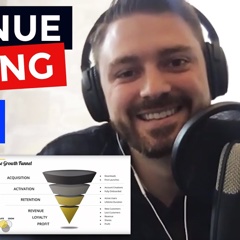
Bryant tracks six funnel stages all the way down to profit. The stages are acquisition, activation, retention, revenue, loyalty and profit. He uses concrete events such as downloads, first launches, accounts created, fully onboarded users and active users.
He also tracks time from user to customer, how long they stay, and revenue and profit per user. As he puts it, "we need to track that all the way down to profitability".
Bryant adds traffic to a healthy funnel to expose hidden leaks. With App Masters, TimeClock grew over 1,000%, producing 901 new accounts and free trials. Only 16 became paying customers, about 2%.
With no known holes, the plan was simply to "throw some water in that thing". The added volume pinpointed the problem.
Bryant looked at what happens after signup to locate the drop. Only 42 of the 901 accounts finished onboarding, and 16 of those 42 paid. So paying was not the problem. Getting users onboarded was.
Onboarding meant three actions: add an employee, add a device, clock the employee in. Users did not understand how to complete them.
3Why Bryant interviews users before fixing anything
Bryant pairs surveys with interviews of both droppers and buyers. Surveys first show who actually uses the app. Interviews then cover users before they convert and customers who already did.
Before-conversion interviews ask what users expect and do along the way. Customer interviews ask what they thought and did to get fully onboarded. This closes the gap between those who finish and those who drop.
Bryant learned the real buyer was a non-technical construction office manager. Users were office managers at construction firms with 20 to 30 employees. They download the app, hand it to staff and decide the purchase.
TimeClock was their first step in digitizing the company, a leap of faith that needed guidance at every step. They wanted "two to three really simple steps to get fully on-boarded".
Bryant simplified onboarding to one focused step at a time. The work covered simpler terminology, simpler steps and less on screen, so users concentrate on the one step in front of them.
4Bryant's cheap fix and how he reinvests the gain
Bryant starts with the easiest fix that needs no engineering. The email series targeted only the first three setup steps and took about a week to build. Its job was to validate that this was the right hole to plug.
Results showed within a month, and top-of-funnel conversion held steady.
Bryant says the user insight, not the email tactic, made it work. Users told the team which three steps to teach, when to send them and how to explain them.
He warns against concluding "we just implemented an email series and boom there is a successful app". Copying the emails without the research will not repeat the result.
Bryant uses the small win to fund the next round of tests. The new cash flow gives room to reinvest in in-app improvements aimed at the same metric.
With the funnel mapped and the weak metric known, his approach is "now we just pound that metric until we get it to where we want to be".

How to Optimize Growth Funnel (Case Study 2X Revenue Growth)
Shows how to find and fix the weakest step in an app's growth funnel by adding traffic, locating the leak, interviewing users and fixing it cheaply. For the TimeClock app, a one-week onboarding email series lifted fully onboarded users by 81% and put a $100K company on track to double.
Bryant runs Chamber DS, an incubator that owns the TimeClock app. TimeClock lets employees clock in and out to track their time. Users download it, create an account and get 30 days free, then paying customers are charged $10 per month.
Bryant uses the app as a case study in doubling revenue by fixing one funnel step.
TimeClock's funnel looked healthy at first but the business barely made money. About 90 downloads a month produced 21 accounts (23%) and 14 customers (67%). Fixed technology costs ate the revenue, so profit stayed thin.
Small volume hid the leak. Good conversion rates did not mean a good business until enough users entered the funnel.
The fix lifted fully onboarded users 81% and put a $100K company on track to double. A one-week email series with 15-second GIF tutorials moved margin toward 45%. That pointed to a company going from $100K to $200K this year.
Onboarding went from 5% to 8%, still a low rate. Bryant treated it as a start that funded further work.
Bryant tracks six funnel stages all the way down to profit. The stages are acquisition, activation, retention, revenue, loyalty and profit. He uses concrete events such as downloads, first launches, accounts created, fully onboarded users and active users.
He also tracks time from user to customer, how long they stay, and revenue and profit per user. As he puts it, "we need to track that all the way down to profitability".
Bryant adds traffic to a healthy funnel to expose hidden leaks. With App Masters, TimeClock grew over 1,000%, producing 901 new accounts and free trials. Only 16 became paying customers, about 2%.
With no known holes, the plan was simply to "throw some water in that thing". The added volume pinpointed the problem.
Bryant looked at what happens after signup to locate the drop. Only 42 of the 901 accounts finished onboarding, and 16 of those 42 paid. So paying was not the problem. Getting users onboarded was.
Onboarding meant three actions: add an employee, add a device, clock the employee in. Users did not understand how to complete them.
Bryant pairs surveys with interviews of both droppers and buyers. Surveys first show who actually uses the app. Interviews then cover users before they convert and customers who already did.
Before-conversion interviews ask what users expect and do along the way. Customer interviews ask what they thought and did to get fully onboarded. This closes the gap between those who finish and those who drop.
Bryant learned the real buyer was a non-technical construction office manager. Users were office managers at construction firms with 20 to 30 employees. They download the app, hand it to staff and decide the purchase.
TimeClock was their first step in digitizing the company, a leap of faith that needed guidance at every step. They wanted "two to three really simple steps to get fully on-boarded".
Bryant simplified onboarding to one focused step at a time. The work covered simpler terminology, simpler steps and less on screen, so users concentrate on the one step in front of them.
Bryant starts with the easiest fix that needs no engineering. The email series targeted only the first three setup steps and took about a week to build. Its job was to validate that this was the right hole to plug.
Results showed within a month, and top-of-funnel conversion held steady.
Bryant says the user insight, not the email tactic, made it work. Users told the team which three steps to teach, when to send them and how to explain them.
He warns against concluding "we just implemented an email series and boom there is a successful app". Copying the emails without the research will not repeat the result.
Bryant uses the small win to fund the next round of tests. The new cash flow gives room to reinvest in in-app improvements aimed at the same metric.
With the funnel mapped and the weak metric known, his approach is "now we just pound that metric until we get it to where we want to be".