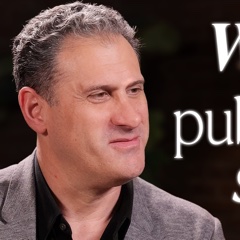
Jon Yaged
CEO of Macmillan, one of the top five US publishing houses
Where to hear and read about Jon Yaged1 episode or test

Jon Yaged is CEO of Macmillan, one of the top five US publishing houses, who came up through law, music, film and children's books. The most useful thing to learn from him is his marketing method: name the reader community, find its connectors, and let the book itself show you the hooks.
you have to identify the community you're trying to reach.
The Best Ways to Publish a Book (Macmillan CEO Interview)
Jon Yaged: the story and the lessons
1Jon Yaged's path from talent lawyer to Macmillan CEO
Yaged came to publishing from law, music and film. He started as a lawyer representing talent and worked in music and film before publishing. He describes a guitarist's background and a jazz-musician grandfather.
His grandfather said a drummer who looks at his watch needs another job, and that perfection in music meant getting the vibe right, not every note.
He built his career publishing children's books at Disney and Macmillan. At Disney he published Maurice Sendak, including Brundibar with Tony Kushner. Sick Day for Amos McGee won the Caldecott two weeks after he started at Macmillan.
He is the third Macmillan CEO in a row who once published children's books.
He launched Swoon Reads after seeing readers want what Macmillan did not publish. Running Macmillan's children's division, he saw readers asking for things the house was not publishing, and that led to Swoon Reads.
It ran a few years and had some great successes, though it did not work out exactly as hoped.
2How Yaged runs Macmillan
Yaged sees his biggest job as protecting an atmosphere where creativity thrives. His first answer to the owners when he started over 15 years ago was to create that environment. He wants a place where people are not afraid to make the wrong call.
The Village Vanguard remains his model, because listeners can linger and the music is interactive. At Disney he watched Pixar run 100% about what would end up on the screen.
Private ownership lets Macmillan think long term. The owners are Stefan von Holtzbrinck and his niece Christiane Schuler, who share a passion for the work. Yaged calls not being public a gift because creativity does not run quarter by quarter.
Success at Macmillan means money, prizes, bestsellers and books that matter. Fifteen and a half years ago, Yaged asked his future boss John Sargent how success is measured at a big private company. The answer was to make some money, win awards, hit bestseller lists and publish books that make a difference.
The line was "we never manage to the last nickel." The owners do not try to squeeze every drop of juice out of the orange.
Seven imprints compete for the same book with different visions. Seven divisions publish new books and an eighth does audio. Each pitches its own vision, so one book can look like two different books.
Advances of half a million or more need Yaged's approval. When an imprint bids low, he tells it that it will not win at that number, without naming rivals.
Yaged treats joy and authenticity as a way of winning. He says a joyful workplace makes authors, agents, retailers and printers go out of their way for Macmillan. His best compliment is being called authentic.
He saw a sincere Wicked usher's story lose its warmth when the man glanced at his script. Imperfect and from the heart beats perfect and read from a page.
His day is mostly firefighting around a short list of yearly goals. He calls the job more reactive than he would like, but he would not give up being a sounding board. Yearly goals include updating dated tech infrastructure and growing business books, where Macmillan under-indexes.
Tor built the Bramble imprint a couple of years ago to ride the romance wave. He spots trends by listening to editors.
3Yaged's method for marketing a book
Every campaign starts by naming the community and finding its connectors. Yaged identifies the community a book is for, finds the evangelists inside it, then equips them to spread the word. Tactics change with every book and genre, but this starting question does not.
St. Martin's Press and Tor already work this way, and the whole company is adopting it.
He says to read the book itself to find its hooks. The text shows the hooks and angles that will interest the community. Writers can mine their own draft for the lines they would use to explain it to a stranger.
Yaged believes word of mouth still sells books. A friend's recommendation moves you faster than an ad on a bus. The trusted source has moved from scholarly reviewers to bloggers and booksellers to Instagram and now TikTok, but the mechanism is the same.
Publicity works because it borrows that trust.
Marketing spend is judged by return, and failing channels get dropped. If an ad campaign or channel is not delivering, Macmillan pulls off it and spends elsewhere. Each publisher gets a marketing budget based on projected revenue.
He says time matters more than money, since a lost day cannot be bought back.
He wishes he could see what readers actually do. Yaged would like to see when readers put a book down or binge it. Marketing is indirect, because a bookseller makes the sale and an ad cannot be tied to a purchase.
Early reader groups approximate it: a reader who finishes 30% in the first day signals a hit.
Old books need new moments and better discovery, not fresh publicity. A ten-year-old book will not land on a morning show, so Macmillan creates moments with anniversary editions and tweaks metadata so a title surfaces in topic searches. The tenth anniversary of Kristin Hannah's The Nightingale worked well.
A movie or TV adaptation is a separate publicity moment.
Authors must write a great book and build their own reach. Asked whether to burn the boats on the novel or build an email list and Instagram, Yaged said to do both. Authors now have to help promote their books more than ever.
He says the best way to sell a book has not changed in hundreds of years: write a damn good book.
4How Yaged explains the economics of publishing
Publishers run on thin margins because retailers and authors take most of each sale. On a $30 book, more than $15 goes to the retailer, so the publisher gets under 50 cents of each cover-price dollar. Authors earn 10 to 15% of cover price on a hardback, or $3 to $4.50 a copy, on top of the advance.
Author pay is the single biggest cost, ahead of printing. Publishing pays creators a bigger share than any other traditional media.
The backlist is what makes Macmillan money. About half of Macmillan's business is books over a year old, which need less marketing and cheaper paperback printing. Buying a backlist is almost like buying an annuity, which drives consolidation.
Catalogs rarely come up for sale, because US publishing deals hold rights for the full copyright term.
Advances are set by working backward from a comparable book. Editors and sales teams ask which book the new one will behave like, check that book's sales, and work out what they can pay. BookScan covers about 85% of the industry, print only.
Agents also quote comp numbers to push advances up, so a writer who knows their comps speaks the buyer's language.
Yaged rejects the venture capital model for a publisher's list. Macmillan does not overpay across its list hoping one in ten works. A publisher pays similar amounts for all its books, so a hit cannot make up a 90% loss rate.
Venture investors can do it because one win can dwarf every loss.
Picture books earn thinner margins but live longer. A 32-page picture book costs as much to print as a 400-page novel but sells for $18.99 to $19.99, not $30. Publishers hope volume over time makes the dollars work.
Author and illustrator almost always split the money 50/50.
5Why Yaged trusts editors over algorithms
He uses data for what he controls and gut for the outlier. Yaged wants all the information so he can make a gut decision. He will test ads and tune metadata, but he has not seen an algorithm that can identify the outlier.
Almost every New York publisher but one rejected Harry Potter. Macmillan publishes roughly one in 20 to 30 submissions.
An editor's track record earns the benefit of the doubt. When someone asks why an editor bought a book, he points to the other 100 she bought that were huge. They do not get carte blanche, only the benefit of the doubt when asking for money.
Predictions fail in both directions: slam dunks flop and nice books become huge.
He says good editors build their instinct by reading widely. Editors who spot the next thing read a lot, including about the competition, and stay out in the world. He worries this is harder in a crowded market.
Yaged says the courage to look different starts the next trend. Publishers copy what works, so covers start to look alike. A Disney designer put an oversized face with a reflection in its glasses on a cover, and it became standard for a while.
Retailers add pressure: an account might take 10,000 copies instead of 3,000 if the cover looks like another hit. A book that works brings the retailer back for the other seven thousand.
He thinks New York's bubble hides trends happening elsewhere. Clustering in New York brings energy, but Yaged believes self-publishing grew so big because traditional publishers missed trends outside it. He still monitors self-publishing to see what comes next.
6What Yaged says about AI in publishing
Yaged sees AI as a tool for chores, not a replacement for editors. AI can draft tip sheets, the one-page book summaries junior staff hate writing, and refresh keywords on old titles. Demand forecasting let Macmillan print about 1 million fewer copies in a year.
He expects people to lose jobs to someone who understands AI, not to AI, like typewriters giving way to word processors.
He believes the outlier hit stays human. Chatbots predict the next word, but the beauty of a book sits in the outliers. He recalls a Star Trek scene where Data cannot grasp a watched pot never boils, because he knows it boils in 1 minute 33 seconds.
He allows that further advances could change the picture.
He warns that AI-written text cannot be owned. US copyright law does not protect work created by AI, so a publisher cannot own it and anyone could publish a version. The test he recalls is roughly whether a work is substantially created by a human.
He says it is not a bright line and he cannot give the exact wording. Macmillan contracts already have authors vouch that the work is their own.
He backs AI as a research assistant and thought partner. An author can load books they have permission to use and ask where a theme appears, which beats rereading. In fiction it can give feedback on character development.
He calls the research use Google on steroids.
Human narration matters most for memoir, and AI suits doors that were shut. Matthew Perry's audiobook sounds like him telling a story on the couch, and Sarah Wynn-Williams's Careless People won awards in her own voice despite her not being an actor. Macmillan cloned a narrator's aged voice to redo one section of a backlist title, and disclosed it.
Many books never get an audiobook because they are expensive. A cheap, good AI version could reach those listeners, and a hit could be re-recorded with a human.
7What Yaged knows about children's books
Yaged says great children's creators never talk down to kids. They know how smart, insightful and empathetic children are, and they write to that. He treats this as a rule for any audience.
He sees a picture book as three layers of storytelling. There are the words, the images and the space between them. Illustrators obsess over the page turn, where the right-hand image arrives before the story continues on the left.
Sick Day for Amos McGee, written by Philip Stead for his wife Erin to illustrate, was her first book and won the Caldecott.
Print still wins in children's books. Kids ebooks sell, but far less than physical books, and Yaged expected more change by now. Parents want to share the classics, and a screen ruins the intimacy of a toddler flipping through a book.
New kids are born every year, which keeps the list evergreen.
He calls falling childhood reading an existential threat to publishing and society. Boys and girls both say they like reading less, and it is far worse for boys. Research links not reading at grade level by third or fourth grade to worse outcomes in life.
Reading is the best way to build analytical skills and reasoning.
8Yaged's advice to writers
Get an agent, because Macmillan takes almost nothing unsolicited. About 99% of its books come from agents or from an editor's own idea pitched to an agent for a chosen author. Macmillan publishes about 1,200 books a year, roughly 5% of the industry.
Getting an agent is itself hard, so budget time for it.
Treat the editor as a partner and invite the unvarnished truth. Healthy pushback is honest back and forth on specifics such as the jacket and the edit. One major Macmillan author trusts her editor to give the unvarnished truth on her next book.
Some authors do not want that, so say up front what you expect.
Self-publishing works for ebooks and poorly for print. Ebooks and maybe audio can be done alone, but getting print books into stores is not easy. A very successful self-published author had well over 95% ebook sales, against about 30% for a bestselling Macmillan novel.
A publisher sells money and expertise: an advance that lets authors finish the book, plus printing, marketing, distribution and editing. Some authors start alone, then partner with Macmillan after success.
Write memoir as if telling a friend a story. Yaged says Matthew Perry's book read like him talking on the couch, and that voice carried into the audiobook.
Immerse yourself in the trade press and writers' groups. He suggests reading Publishers Lunch and Publishers Weekly and joining groups such as SCBWI, the AAP or the Children's Book Council.
He says there is no one-stop shop for understanding publishing.

The Best Ways to Publish a Book (Macmillan CEO Interview)
A publishing CEO explains how books actually get bought, edited, marketed and sold, and what that means for a writer deciding how to work and how to reach readers. The most useful idea is his marketing method: name the community, find its connectors, and let the book itself show you the hooks.
Yaged came to publishing from law, music and film. He started as a lawyer representing talent and worked in music and film before publishing. He describes a guitarist's background and a jazz-musician grandfather.
His grandfather said a drummer who looks at his watch needs another job, and that perfection in music meant getting the vibe right, not every note.
He built his career publishing children's books at Disney and Macmillan. At Disney he published Maurice Sendak, including Brundibar with Tony Kushner. Sick Day for Amos McGee won the Caldecott two weeks after he started at Macmillan.
He is the third Macmillan CEO in a row who once published children's books.
He launched Swoon Reads after seeing readers want what Macmillan did not publish. Running Macmillan's children's division, he saw readers asking for things the house was not publishing, and that led to Swoon Reads.
It ran a few years and had some great successes, though it did not work out exactly as hoped.
Yaged sees his biggest job as protecting an atmosphere where creativity thrives. His first answer to the owners when he started over 15 years ago was to create that environment. He wants a place where people are not afraid to make the wrong call.
The Village Vanguard remains his model, because listeners can linger and the music is interactive. At Disney he watched Pixar run 100% about what would end up on the screen.
Private ownership lets Macmillan think long term. The owners are Stefan von Holtzbrinck and his niece Christiane Schuler, who share a passion for the work. Yaged calls not being public a gift because creativity does not run quarter by quarter.
Success at Macmillan means money, prizes, bestsellers and books that matter. Fifteen and a half years ago, Yaged asked his future boss John Sargent how success is measured at a big private company. The answer was to make some money, win awards, hit bestseller lists and publish books that make a difference.
The line was "we never manage to the last nickel." The owners do not try to squeeze every drop of juice out of the orange.
Seven imprints compete for the same book with different visions. Seven divisions publish new books and an eighth does audio. Each pitches its own vision, so one book can look like two different books.
Advances of half a million or more need Yaged's approval. When an imprint bids low, he tells it that it will not win at that number, without naming rivals.
Yaged treats joy and authenticity as a way of winning. He says a joyful workplace makes authors, agents, retailers and printers go out of their way for Macmillan. His best compliment is being called authentic.
He saw a sincere Wicked usher's story lose its warmth when the man glanced at his script. Imperfect and from the heart beats perfect and read from a page.
His day is mostly firefighting around a short list of yearly goals. He calls the job more reactive than he would like, but he would not give up being a sounding board. Yearly goals include updating dated tech infrastructure and growing business books, where Macmillan under-indexes.
Tor built the Bramble imprint a couple of years ago to ride the romance wave. He spots trends by listening to editors.
Every campaign starts by naming the community and finding its connectors. Yaged identifies the community a book is for, finds the evangelists inside it, then equips them to spread the word. Tactics change with every book and genre, but this starting question does not.
St. Martin's Press and Tor already work this way, and the whole company is adopting it.
He says to read the book itself to find its hooks. The text shows the hooks and angles that will interest the community. Writers can mine their own draft for the lines they would use to explain it to a stranger.
Yaged believes word of mouth still sells books. A friend's recommendation moves you faster than an ad on a bus. The trusted source has moved from scholarly reviewers to bloggers and booksellers to Instagram and now TikTok, but the mechanism is the same.
Publicity works because it borrows that trust.
Marketing spend is judged by return, and failing channels get dropped. If an ad campaign or channel is not delivering, Macmillan pulls off it and spends elsewhere. Each publisher gets a marketing budget based on projected revenue.
He says time matters more than money, since a lost day cannot be bought back.
He wishes he could see what readers actually do. Yaged would like to see when readers put a book down or binge it. Marketing is indirect, because a bookseller makes the sale and an ad cannot be tied to a purchase.
Early reader groups approximate it: a reader who finishes 30% in the first day signals a hit.
Old books need new moments and better discovery, not fresh publicity. A ten-year-old book will not land on a morning show, so Macmillan creates moments with anniversary editions and tweaks metadata so a title surfaces in topic searches. The tenth anniversary of Kristin Hannah's The Nightingale worked well.
A movie or TV adaptation is a separate publicity moment.
Authors must write a great book and build their own reach. Asked whether to burn the boats on the novel or build an email list and Instagram, Yaged said to do both. Authors now have to help promote their books more than ever.
He says the best way to sell a book has not changed in hundreds of years: write a damn good book.
Publishers run on thin margins because retailers and authors take most of each sale. On a $30 book, more than $15 goes to the retailer, so the publisher gets under 50 cents of each cover-price dollar. Authors earn 10 to 15% of cover price on a hardback, or $3 to $4.50 a copy, on top of the advance.
Author pay is the single biggest cost, ahead of printing. Publishing pays creators a bigger share than any other traditional media.
The backlist is what makes Macmillan money. About half of Macmillan's business is books over a year old, which need less marketing and cheaper paperback printing. Buying a backlist is almost like buying an annuity, which drives consolidation.
Catalogs rarely come up for sale, because US publishing deals hold rights for the full copyright term.
Advances are set by working backward from a comparable book. Editors and sales teams ask which book the new one will behave like, check that book's sales, and work out what they can pay. BookScan covers about 85% of the industry, print only.
Agents also quote comp numbers to push advances up, so a writer who knows their comps speaks the buyer's language.
Yaged rejects the venture capital model for a publisher's list. Macmillan does not overpay across its list hoping one in ten works. A publisher pays similar amounts for all its books, so a hit cannot make up a 90% loss rate.
Venture investors can do it because one win can dwarf every loss.
Picture books earn thinner margins but live longer. A 32-page picture book costs as much to print as a 400-page novel but sells for $18.99 to $19.99, not $30. Publishers hope volume over time makes the dollars work.
Author and illustrator almost always split the money 50/50.
He uses data for what he controls and gut for the outlier. Yaged wants all the information so he can make a gut decision. He will test ads and tune metadata, but he has not seen an algorithm that can identify the outlier.
Almost every New York publisher but one rejected Harry Potter. Macmillan publishes roughly one in 20 to 30 submissions.
An editor's track record earns the benefit of the doubt. When someone asks why an editor bought a book, he points to the other 100 she bought that were huge. They do not get carte blanche, only the benefit of the doubt when asking for money.
Predictions fail in both directions: slam dunks flop and nice books become huge.
He says good editors build their instinct by reading widely. Editors who spot the next thing read a lot, including about the competition, and stay out in the world. He worries this is harder in a crowded market.
Yaged says the courage to look different starts the next trend. Publishers copy what works, so covers start to look alike. A Disney designer put an oversized face with a reflection in its glasses on a cover, and it became standard for a while.
Retailers add pressure: an account might take 10,000 copies instead of 3,000 if the cover looks like another hit. A book that works brings the retailer back for the other seven thousand.
He thinks New York's bubble hides trends happening elsewhere. Clustering in New York brings energy, but Yaged believes self-publishing grew so big because traditional publishers missed trends outside it. He still monitors self-publishing to see what comes next.
Yaged sees AI as a tool for chores, not a replacement for editors. AI can draft tip sheets, the one-page book summaries junior staff hate writing, and refresh keywords on old titles. Demand forecasting let Macmillan print about 1 million fewer copies in a year.
He expects people to lose jobs to someone who understands AI, not to AI, like typewriters giving way to word processors.
He believes the outlier hit stays human. Chatbots predict the next word, but the beauty of a book sits in the outliers. He recalls a Star Trek scene where Data cannot grasp a watched pot never boils, because he knows it boils in 1 minute 33 seconds.
He allows that further advances could change the picture.
He warns that AI-written text cannot be owned. US copyright law does not protect work created by AI, so a publisher cannot own it and anyone could publish a version. The test he recalls is roughly whether a work is substantially created by a human.
He says it is not a bright line and he cannot give the exact wording. Macmillan contracts already have authors vouch that the work is their own.
He backs AI as a research assistant and thought partner. An author can load books they have permission to use and ask where a theme appears, which beats rereading. In fiction it can give feedback on character development.
He calls the research use Google on steroids.
Human narration matters most for memoir, and AI suits doors that were shut. Matthew Perry's audiobook sounds like him telling a story on the couch, and Sarah Wynn-Williams's Careless People won awards in her own voice despite her not being an actor. Macmillan cloned a narrator's aged voice to redo one section of a backlist title, and disclosed it.
Many books never get an audiobook because they are expensive. A cheap, good AI version could reach those listeners, and a hit could be re-recorded with a human.
Yaged says great children's creators never talk down to kids. They know how smart, insightful and empathetic children are, and they write to that. He treats this as a rule for any audience.
He sees a picture book as three layers of storytelling. There are the words, the images and the space between them. Illustrators obsess over the page turn, where the right-hand image arrives before the story continues on the left.
Sick Day for Amos McGee, written by Philip Stead for his wife Erin to illustrate, was her first book and won the Caldecott.
Print still wins in children's books. Kids ebooks sell, but far less than physical books, and Yaged expected more change by now. Parents want to share the classics, and a screen ruins the intimacy of a toddler flipping through a book.
New kids are born every year, which keeps the list evergreen.
He calls falling childhood reading an existential threat to publishing and society. Boys and girls both say they like reading less, and it is far worse for boys. Research links not reading at grade level by third or fourth grade to worse outcomes in life.
Reading is the best way to build analytical skills and reasoning.
Get an agent, because Macmillan takes almost nothing unsolicited. About 99% of its books come from agents or from an editor's own idea pitched to an agent for a chosen author. Macmillan publishes about 1,200 books a year, roughly 5% of the industry.
Getting an agent is itself hard, so budget time for it.
Treat the editor as a partner and invite the unvarnished truth. Healthy pushback is honest back and forth on specifics such as the jacket and the edit. One major Macmillan author trusts her editor to give the unvarnished truth on her next book.
Some authors do not want that, so say up front what you expect.
Self-publishing works for ebooks and poorly for print. Ebooks and maybe audio can be done alone, but getting print books into stores is not easy. A very successful self-published author had well over 95% ebook sales, against about 30% for a bestselling Macmillan novel.
A publisher sells money and expertise: an advance that lets authors finish the book, plus printing, marketing, distribution and editing. Some authors start alone, then partner with Macmillan after success.
Write memoir as if telling a friend a story. Yaged says Matthew Perry's book read like him talking on the couch, and that voice carried into the audiobook.
Immerse yourself in the trade press and writers' groups. He suggests reading Publishers Lunch and Publishers Weekly and joining groups such as SCBWI, the AAP or the Children's Book Council.
He says there is no one-stop shop for understanding publishing.