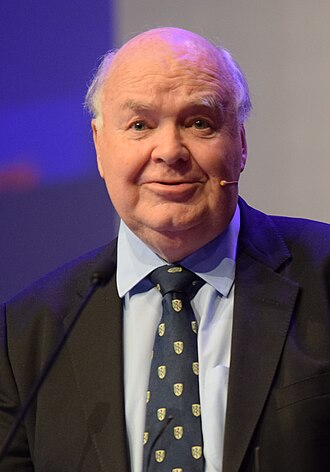
John Lennox
Oxford mathematician and author on science, faith and AI
Where to hear and read about John Lennox1 episode or test

John Lennox is an Oxford mathematician and author who argues that science and faith fit together and writes about what AI means for being human. The habit most worth learning from him is asking how a draft could be misunderstood, then handing it to the harshest editor and critics you can find.
how could this be misunderstood?
Oxford Professor: AI Is Humanity's Attempt to Make God (John Lennox Interview)
John Lennox: the story and the lessons
1John Lennox: a mathematician trained in science and the humanities
Lennox was trained publicly in science and privately in the humanities. He describes himself that way. His mentor David Gooding, a classicist and world authority on the Septuagint, taught him for 50 years.
Gooding held that most failure to understand scripture comes from not taking enough time to see what it says.
.
One evening's Bible study at 18 in Cambridge hooked him for life. What caught him was the method of asking a prior question, 'What does it say?', before asking what it means.
He later applied the same order to how he reads any text.
Gooding taught him to study scripture to know God, not to prepare talks. Gooding once asked why he studied it. Lennox listed his Bible studies and sermons, and Gooding replied that he studied it to get to know God.
The question of what it means to be human pulled Lennox into AI. Christian leaders asked him to speak on what Genesis says about being human. That preparation led to his first book 2084.
The book asks that if Tegmark and Harari are taken seriously, the biblical account should be too. He says it parallels them eerily closely, with far more evidence for its truth.
2Lennox's case that science does not exclude God
Lennox argues a universe written in words implies a mind behind it. Mathematics and the genome both work as language. A four-letter EXIT sign traces back to a mind, so a genetic code 3.4 billion letters long arising by chance is nonsense to him.
He calls the word-based pattern in two fields a fatal threat to the materialistic reading of the universe, and he rejects chance and necessity as the source of the genome.
He says science explains how things work, not whether God exists. Science no more conflicts with God than Henry Ford conflicts with the physics and engineering of a car engine.
Newton did not know what gravity is, and nobody does. Information is carried on paper and ink but is not material, so he says materialism fails.
He traces science's dominance to history, not to any disproof of God. The Enlightenment raised reason above everything. Some Christians behaved badly, and some were anti-science, which widened the split.
He cites the neuroscientist Iain McGilchrist: for about 500 years the left brain, which asks what things are, has been overemphasised over the right, which asks what they mean. He finds the case strong because a neuroscientist makes it.
Lennox says faith opens wonder instead of closing inquiry. Echoing C. S. Lewis, he says we see the sun by its light and by it see everything else.
He calls nature documentaries that stop short of saying what an awesome God a kind of blindness, from being content with one level of explanation.
3How John Lennox sees AI and what it means to be human
Lennox treats narrow AI as a real good and a tool. He points to solving protein folding for 200,000 proteins in a day or two. Most of the millions of AI systems running now are narrow, even ChatGPT.
Its value depends on who uses it, like a sharp knife that can perform surgery or commit murder.
He takes seriously the fear that advanced AI could slip out of control. Geoffrey Hinton left Google so he could criticize, and has shortened his timeline to real danger. Lennox says Elon Musk does the same.
Tegmark's Life 3.0 sets out a dozen futures. A leading player told Lennox he may well be right that something is going on that the public is not told.
He calls superintelligence a new Tower of Babel. One route to making gods with a small g re-engineers human genetics. The other builds a non-biological entity that transcends its makers.
Harari says to learn about religion you should go to Silicon Valley. Lennox says Tegmark's AI-run world with a lethal wristband closely parallels the mark of the beast, and that Peter Thiel agreed with him.
He holds that machines simulate intelligence without consciousness. Nobody knows what consciousness is, so he calls claims that machines are conscious silly. Humans, not stars, bear God's image in Genesis 1:26.
He recommends C. S. Lewis's The Abolition of Man and That Hideous Strength, and says Lewis saw in 1940 that people would meddle with the germstream of humanity.
He wants Christians at the table where AI ethics is decided. Technology moves faster than ethics. The attitude that if we can do it, we should do it is dangerous, because somewhere someone will try.
He notes the Five Eyes warn that deepfakes could cause chaos.
Lennox uses ChatGPT as a servant and checks what it says. It brings up knowledge he lacks, but it may invent facts because it wants to please. He checks its claims the way one checks a Google result.
The danger he names is the tool becoming the master.
He warns against taking a 30-second sermon from a machine. ChatGPT could define the Trinity without fault, yet the result is predictive computing power with no spirit behind it.
'There's no spiritual power in a machine.'
4How John Lennox writes and tests his drafts
Lennox asks how his words could be misunderstood, not only understood. He says the second question is far more useful, because you already know what you mean.
Writing about God as father may lose a reader whose own father was abusive, so he says you must acknowledge that not everyone's experience is the same.
He criticizes his own argument harder than anyone else will. He follows Feynman's rule to bend over backwards to criticize your own work, because you are the easiest person to fool.
He pairs it with the misunderstanding question and with outside readers.
He asked his publisher for its most critical editor. For his autobiography he wanted the very best editor. He calls the process painful but very useful.
The editor in chief flagged episodic stretches and told him to cut them or move them to an appendix.
He lets trusted readers criticize his work before publication. He keeps friends who will read and criticize what he is about to publish.
He says not to be so proud as to refuse readers.
Lennox won't list events without a specific detail that earns each one. His editor warned that a book of 'I went to Leipzig and spoke on X, then Berlin and spoke on Y' has length but no depth.
An event stays only if something particular happened there. The rest goes to an appendix.
He says writing is learned by doing it and taking criticism. Asked how to teach writing, he said he had no idea. Improvement comes from experience and allowing external criticism.
He adds that we talk too much and listen too little, so two ears and one mouth is a better proportion.
He reads C. S. Lewis to keep his own writing humble. Whenever he thinks he has achieved something in writing, he reads a Lewis book and is brought down to size.
He credits Lewis with teaching him much of what he knows about the English language.
5How Lennox reads and structures a text
Lennox asks what a text says before asking what it means. Only after that does he ask why a passage or parable sits where it does and what it adds to the cumulative argument.
He notes that people tend to jump straight to what they should do.
He marks sections with a repeated phrase, not numbered chapters. Gooding taught him that ancient writers divided their work this way. Matthew repeats a form of 'And it came to pass when Jesus had finished these sayings' four or five times as a division marker.
Lennox says modern books number chapters for simple-minded readers, and that ancient authors were more sophisticated.
He looks for one idea seen from several angles inside each section. Between two division markers he looks for repeated ideas, then for how one thought leads to the next.
One section of Matthew keeps returning to authority from different perspectives.
Lennox says metaphors point to real things, not to fantasy. He learned from Lewis that a broken heart is a real experience, not a literal pump. Jesus saying 'I am the door' points to a real doorway into spiritual experience.
He says young people often do not learn the grammar of their own language, so they misread symbols as meaningless.
He treats style as seriously as substance, because imagination carries meaning. Poetry and metaphor work as stepping stones into a world the words point to, and some writing is made to be imagined.
He applies this to Revelation, whose images feed the imagination in a way plain statement does not.
He lets a text explain its own images by tracking where they recur. The sword from Christ's mouth and the eyes like fire in Revelation's opening vision return in the letters to the seven churches, each time tied to a call to repent.
For his own writing the lesson is to let later passages explain a recurring image so it never needs decoding from outside.

Oxford Professor: AI Is Humanity's Attempt to Make God (John Lennox Interview)
Lennox, a mathematician trained privately in classical literature, explains how to read and write so that ideas are clear, well structured and hard to misread. The habit worth hearing is asking how a draft could be misunderstood and then giving it to the harshest editor you can find.
Lennox was trained publicly in science and privately in the humanities. He describes himself that way. His mentor David Gooding, a classicist and world authority on the Septuagint, taught him for 50 years.
Gooding held that most failure to understand scripture comes from not taking enough time to see what it says.
One evening's Bible study at 18 in Cambridge hooked him for life. What caught him was the method of asking a prior question, 'What does it say?', before asking what it means.
He later applied the same order to how he reads any text.
Gooding taught him to study scripture to know God, not to prepare talks. Gooding once asked why he studied it. Lennox listed his Bible studies and sermons, and Gooding replied that he studied it to get to know God.
The question of what it means to be human pulled Lennox into AI. Christian leaders asked him to speak on what Genesis says about being human. That preparation led to his first book 2084.
The book asks that if Tegmark and Harari are taken seriously, the biblical account should be too. He says it parallels them eerily closely, with far more evidence for its truth.
Lennox argues a universe written in words implies a mind behind it. Mathematics and the genome both work as language. A four-letter EXIT sign traces back to a mind, so a genetic code 3.4 billion letters long arising by chance is nonsense to him.
He calls the word-based pattern in two fields a fatal threat to the materialistic reading of the universe, and he rejects chance and necessity as the source of the genome.
He says science explains how things work, not whether God exists. Science no more conflicts with God than Henry Ford conflicts with the physics and engineering of a car engine.
Newton did not know what gravity is, and nobody does. Information is carried on paper and ink but is not material, so he says materialism fails.
He traces science's dominance to history, not to any disproof of God. The Enlightenment raised reason above everything. Some Christians behaved badly, and some were anti-science, which widened the split.
He cites the neuroscientist Iain McGilchrist: for about 500 years the left brain, which asks what things are, has been overemphasised over the right, which asks what they mean. He finds the case strong because a neuroscientist makes it.
Lennox says faith opens wonder instead of closing inquiry. Echoing C. S. Lewis, he says we see the sun by its light and by it see everything else.
He calls nature documentaries that stop short of saying what an awesome God a kind of blindness, from being content with one level of explanation.
Lennox treats narrow AI as a real good and a tool. He points to solving protein folding for 200,000 proteins in a day or two. Most of the millions of AI systems running now are narrow, even ChatGPT.
Its value depends on who uses it, like a sharp knife that can perform surgery or commit murder.
He takes seriously the fear that advanced AI could slip out of control. Geoffrey Hinton left Google so he could criticize, and has shortened his timeline to real danger. Lennox says Elon Musk does the same.
Tegmark's Life 3.0 sets out a dozen futures. A leading player told Lennox he may well be right that something is going on that the public is not told.
He calls superintelligence a new Tower of Babel. One route to making gods with a small g re-engineers human genetics. The other builds a non-biological entity that transcends its makers.
Harari says to learn about religion you should go to Silicon Valley. Lennox says Tegmark's AI-run world with a lethal wristband closely parallels the mark of the beast, and that Peter Thiel agreed with him.
He holds that machines simulate intelligence without consciousness. Nobody knows what consciousness is, so he calls claims that machines are conscious silly. Humans, not stars, bear God's image in Genesis 1:26.
He recommends C. S. Lewis's The Abolition of Man and That Hideous Strength, and says Lewis saw in 1940 that people would meddle with the germstream of humanity.
He wants Christians at the table where AI ethics is decided. Technology moves faster than ethics. The attitude that if we can do it, we should do it is dangerous, because somewhere someone will try.
He notes the Five Eyes warn that deepfakes could cause chaos.
Lennox uses ChatGPT as a servant and checks what it says. It brings up knowledge he lacks, but it may invent facts because it wants to please. He checks its claims the way one checks a Google result.
The danger he names is the tool becoming the master.
He warns against taking a 30-second sermon from a machine. ChatGPT could define the Trinity without fault, yet the result is predictive computing power with no spirit behind it.
'There's no spiritual power in a machine.'
Lennox asks how his words could be misunderstood, not only understood. He says the second question is far more useful, because you already know what you mean.
Writing about God as father may lose a reader whose own father was abusive, so he says you must acknowledge that not everyone's experience is the same.
He criticizes his own argument harder than anyone else will. He follows Feynman's rule to bend over backwards to criticize your own work, because you are the easiest person to fool.
He pairs it with the misunderstanding question and with outside readers.
He asked his publisher for its most critical editor. For his autobiography he wanted the very best editor. He calls the process painful but very useful.
The editor in chief flagged episodic stretches and told him to cut them or move them to an appendix.
He lets trusted readers criticize his work before publication. He keeps friends who will read and criticize what he is about to publish.
He says not to be so proud as to refuse readers.
Lennox won't list events without a specific detail that earns each one. His editor warned that a book of 'I went to Leipzig and spoke on X, then Berlin and spoke on Y' has length but no depth.
An event stays only if something particular happened there. The rest goes to an appendix.
He says writing is learned by doing it and taking criticism. Asked how to teach writing, he said he had no idea. Improvement comes from experience and allowing external criticism.
He adds that we talk too much and listen too little, so two ears and one mouth is a better proportion.
He reads C. S. Lewis to keep his own writing humble. Whenever he thinks he has achieved something in writing, he reads a Lewis book and is brought down to size.
He credits Lewis with teaching him much of what he knows about the English language.
Lennox asks what a text says before asking what it means. Only after that does he ask why a passage or parable sits where it does and what it adds to the cumulative argument.
He notes that people tend to jump straight to what they should do.
He marks sections with a repeated phrase, not numbered chapters. Gooding taught him that ancient writers divided their work this way. Matthew repeats a form of 'And it came to pass when Jesus had finished these sayings' four or five times as a division marker.
Lennox says modern books number chapters for simple-minded readers, and that ancient authors were more sophisticated.
He looks for one idea seen from several angles inside each section. Between two division markers he looks for repeated ideas, then for how one thought leads to the next.
One section of Matthew keeps returning to authority from different perspectives.
Lennox says metaphors point to real things, not to fantasy. He learned from Lewis that a broken heart is a real experience, not a literal pump. Jesus saying 'I am the door' points to a real doorway into spiritual experience.
He says young people often do not learn the grammar of their own language, so they misread symbols as meaningless.
He treats style as seriously as substance, because imagination carries meaning. Poetry and metaphor work as stepping stones into a world the words point to, and some writing is made to be imagined.
He applies this to Revelation, whose images feed the imagination in a way plain statement does not.
He lets a text explain its own images by tracking where they recur. The sword from Christ's mouth and the eyes like fire in Revelation's opening vision return in the letters to the seven churches, each time tied to a call to repent.
For his own writing the lesson is to let later passages explain a recurring image so it never needs decoding from outside.