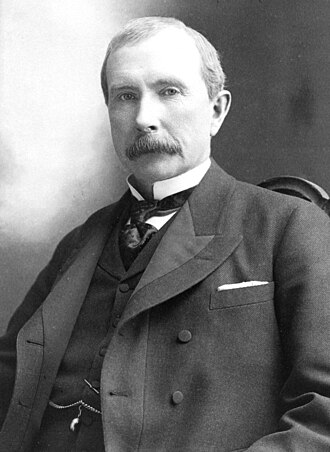
John D. Rockefeller
Founder of Standard Oil
Where to hear and read about John D. Rockefeller1 book · 3 episodes and tests
 Book · notes comingTitan
 FoundersHow Rockefeller Worked

 AcquiredStandard Oil Part II (Extended Cut)
 AcquiredStandard Oil Part I
John D. Rockefeller was a Cleveland bookkeeper who built Standard Oil into the first great American corporation, controlling 90% of US oil by 1877, and later turned his fortune into the first organized philanthropy. The lesson most worth taking from him is how he picked the one cost that mattered, borrowed to win on scale, and stacked each advantage on the last until rivals preferred joining him to fighting him.
You cannot have a winning cooperation except by willing partners.
How Rockefeller Worked
John D. Rockefeller: the story and the lessons
1John D. Rockefeller's start: a con man father, a Baptist mother and a bookkeeping job
Rockefeller grew up between a swindler father and a devout Baptist mother. His father, William "Devil Bill" Rockefeller, sold fake medicines, kept a second household and flashed a hundred dollar bill on his roll. John was born July 8, 1839, and his mother's family taught him that money serves a higher purpose.
He came to hate shows of wealth, lived in the smallest house on the nicest street in Cleveland and never boarded a friend's yacht. He believed it was his duty "to make money and still more money and to use the money I make for the good of my fellow man."
At 16 he became head of his family and learned bookkeeping. After his father married a second wife, Bill stopped paying for school, and John paid $40 for a three month bookkeeping course.
His father's advice stuck: "Never mind the crowd. Keep away from it. Tend to your own business."
He got his first job by canvassing Cleveland's strongest firms for six weeks. With no contacts or introductions, he used a directory with credit ratings to target the best firms, went door to door six days a week, then started the rounds again. Hewitt and Tuttle hired him on September 26, 1855.
He celebrated that "Job Day" every year for the rest of his life, more than his birthday.
He acted like an owner before he owned anything. He checked every line of every bill himself and read the firm's old ledgers until he knew more about the business than its founders. He got a 50% raise almost at once.
Dealing with freight agents and boat captains, he learned that posted shipping rates were negotiable and favored shippers got rebates, a lesson he later used in oil.
By 19 he was a partner, and the Civil War made the firm rich. In 1858 he formed Clark and Rockefeller with Maurice Clark, putting in half of $4,000. In 1862 the firm made a $17,000 trading profit, about four times everything it had earned before.
He hired a substitute to fight, though he was a strict abolitionist. Fronting money to farmers taught him to borrow, and when a bank refused him, "that simply meant that I must look elsewhere until I got what I wanted."
2How Rockefeller entered oil and broke free of cautious partners
He bet on refining in cities, not on drilling for oil. Wary of boom and bust speculation, he backed chemist Samuel Andrews in 1863 with $4,000 and built the Excelsior Works in Cleveland's Flats, beside the river and new rail lines.
Refining was the steady middle of the chain. A refinery cost about $1,000 to start, so nothing protected anyone except how well it was run.
He won on cost discipline while rivals treated oil as a gold rush. He tuned layout and process constantly, hired his own plumbers and blacksmiths, bought a forest for barrels and burned waste gasoline to fuel the plants. Over his career he cut the unit cost of refined oil almost in half.
Oil swung from $12 a barrel to 12 cents, and rivals took easy margins they knew could vanish.
He bought out Clark at an auction he had already financed. Clark feared the debt growth required. In 1865 Rockefeller baited the Clarks into threatening dissolution, advertised an auction, and with bank money lined up bought Clark's half of the oil business for $72,500.
He called it "the day that determined my career." He said Clark "was scared to death because we owed money to the banks," and he never again partnered with people of modest goals.
He named his second refinery Standard to promise reliable quality. Badly refined kerosene caused house fires and the industry had no standards. The Standard Works opened in December 1865.
By 1866 two thirds of Standard's kerosene went overseas, mostly to Europe.
He acted at once on shifts that rivals only noticed. When exports jumped to about 70% of refined output in 1866, only he reacted, sending his brother William to open a New York office as his own exporter.
He also sent John Andrews to Oil City with one job: report the crude price daily.
3How Rockefeller won on transportation and stacked one advantage on another
He picked transportation as the cost that decided everything. Shipping a barrel cost more than refining it, so he sited his refinery on both a railroad and a river, since water was 50% cheaper than rail.
He gave Henry Flagler a single job: control shipping costs. Flagler brought money and contacts, including investor Stephen Harkness, who put in $100,000. The two worked at adjoining desks and planned on their walks to and from the office.
Flagler built solid refineries when rivals built shacks and kept a desk sign: "Do unto others as they would do unto you, and do it first."
Guaranteed volume bought deep rail discounts. Flagler promised railroads huge minimum shipments, letting them run nonstop oil trains with about 40 cars instead of 150. The unwritten Lakeshore deal moved Cleveland from second to first in refining.
He went to the hungriest railroad for secret rebates. Jay Gould's Erie wanted traffic to lift its stock and invited only the three biggest refiners. A 60 cent posted rate came back as a 10 cent rebate, adding about $50,000 a year when most refiners lost money.
He later won rebates on rivals' oil too, shipping 4,200 barrels a day while refining about 1,500.
Each advantage made the next one possible. Borrowing built scale, scale won rebates, rebates funded buying rivals. Without the earlier borrowing and focus on transportation, Gould's offer would never have come.
Heavy fixed costs made full plants everything; he called volume the foundation principle.
4The Cleveland Massacre and how Rockefeller rolled up oil refining
A railroad scheme that never shipped a barrel forced rivals to sell. The South Improvement Company planned a high fixed rate with a 50% discount for members. Riots killed it, but during the weeks of rumor Standard bought 22 of Cleveland's 26 refineries in 1872.
Another account counts 23 companies in four weeks, starting with the strongest. By 1877 Standard controlled 90% of American oil.
He pitched buyouts as rescue and paid mostly in stock. He offered 25 to 50 percent of book value, set by Standard's own appraisers, in cash or shares: "come with us and we will do you good."
To a refiner who said he wasn't afraid: "You may not be afraid to have your hand cut off, but your body will suffer." Holdouts faced price cuts below cost: "We will either get them or starve them."
He used his cap table to turn bankers against his rivals. Cleveland bankers got Standard stock cheaply, so lending to rivals stopped paying. He paid Oliver Payne $400,000 for a $250,000 company for his family's connections.
Running the refiners' association let him read every rival's books. As head of the National Refiners Association he set quotas and saw members' costs, sorting capable operators to buy as partners from those already finished.
He expected the association to fail because members would break their covenants when it hurt them.
He won capable rivals with open books and autonomy. He showed his high profits in hard times and told them to take their time. Division leaders ran semi-autonomous units and had a voice in policy, and none refused.
He hid ownership of bought firms. Acquired niche firms kept their names, so angry refiners sold to a "local rival" that was secretly Standard.
5How Rockefeller took control of every link in the chain
Owning the tank cars removed the railroads' leverage. Standard built tank cars and leased them cheaply, owning nearly all on the Erie and New York Central, so it could cripple either by withdrawing them.
He pulled 65% of a railroad's traffic to win a war. When the Pennsylvania Railroad's Empire Transportation moved into refining and Thomas Scott refused to stop it, he withdrew his oil. The railroad offered peace if he bought Empire, and he did.
Empire's boss Potts was shut out of the sale, a story Rockefeller retold with glee.
He fought pipelines, then reversed and built his own. Against Tidewater's 110-mile line he refused executives' calls for thugs, used rail rate cuts to make it uneconomic and bought a stake in 1880. Standard then built lines to Cleveland, Manhattan, Philadelphia and Buffalo.
He promised railroads a subsidy for lost traffic, paying rebates instead of collecting them. His view: "You cannot fight a technological phenomenon."
He cut out middlemen and delivered to the door. Retailers added up to 5 cents a gallon, so Standard built tanks and tank wagons and sold direct.
"We made a fine crop of enemies, too. But we made oil far lower in price than it had ever been before."
He let others invent and bought the proven winners. Standard sold over 50 refining byproducts and invented none, paying high prices once a market was proven.
He coerced retailers, where his benevolence case breaks down. Mississippi grocers who refused Standard's canisters and fixed prices got a letter threatening a rival chain selling at cost.
6Rockefeller's working principles
He knew more about his business than anyone. He toured the oil regions, talked to producers, haulers and rivals, and read a daily sheet of crude on hand and gallons shipped wherever he was.
He skipped socializing: "I was meeting all the people I needed to meet in my day's work."
He borrowed whenever it was safe to grow. His first partner called him "the greatest borrower I ever saw."
"We should borrow whenever we can safely and extend the business by doing so."
He kept a cash fortress and bought in downturns. Only a fraction of profits went out as dividends, so he "always moved into battle backed by abundant cash." Most early borrowing bought crude at the bottom.
"We must try and not lose our nerve when the market gets to the bottom." To a holdout in a collapse: "I have ways of making money that you know nothing about."
He never sold Standard stock. He bought even during a crude boycott that cut staff from 1,200 to 70. Between about 1905 and 1915 his net worth rose $100 million by doing nothing.
He ran business as war, in secrecy and calm. He wrote in code, never raised his voice and urged partners to "let the other fellow talk."
"What general ever sends out a brass band in advance to warn the enemy." Privately he lay awake worrying behind the mask.
He worked with patience and tired opponents out. He answered papers right to left, flipping unready ones until the next day, comparing it to plowing a field.
He settled disputes by taking the risk himself. When Pratt wanted to wait on oil leases, he offered $3 million of his own money to cover any loss. Pratt agreed.
He let lieutenants do the dirty work. Flagler and others ran the toughest tactics, preserving his deniability.
7How Rockefeller built the modern corporation
Flagler wrote a joint stock company and trust to cross state lines. Standard Oil of Ohio was born January 10, 1870, with $1 million in liquid assets and paid a 105% first-year dividend while reinvesting. The trust held shares across states.
Executives lived on equity, not salaries. Rockefeller ruled no one would take a salary, aligning partners and acquired rivals with the whole.
He framed consolidation as a moral cure for chaos. He argued competition meant ruinous busts and untrustworthy products, calling Standard "one of the greatest upbuilders."
The argument held where the industry needed order but failed where Standard crushed suppliers and grocers.
When Ohio dissolved the trust, he moved to New Jersey. After the 1892 ruling, Standard Oil of New Jersey held the companies directly while the same men ran them from 26 Broadway.
Chernow calls it "mostly shadow play."
8Rockefeller's retreat, Tarbell and the 1911 breakup
Keeping his title after stepping back exposed him. Bored once "his task was done," he left Archbold in charge around 1896 but stayed president at their insistence and spent about two years hiding from subpoenas.
Rogers recalled: "we told him if any of us had to go to jail he would have to go with us."
His successors pushed past his limits. Archbold paid legislators $15,000 to $20,000 a year, raised dividends to 33% and used monopoly pricing, which Rockefeller opposed.
Silence against Ida Tarbell made Standard look guilty. Her 19-part McClure's history exposed the massacre, rebates and fake rivals, and Standard did not answer.
The breakup tripled his fortune. Split into 34 companies on May 15, 1911, his wealth rose from about $300 million to $900 million by 1913.
Young managers thrived; William Burton patented cracking. By 1911 share had already fallen to 64%.
9How Rockefeller invented organized philanthropy
He hired Frederick Gates to run giving like a business. Thousands of weekly requests nearly broke his health, so in 1891 he brought Gates in.
He put scientists in charge of medical research. The 1901 Rockefeller Institute let scientists control spending and produced 38 Nobel laureates.
He spread the Johns Hopkins model and made giving permanent. Tens of millions funded Hopkins-style medical schools, and the Rockefeller Foundation followed in 1913.
How Rockefeller Worked
Rockefeller built Standard Oil by fixating on his biggest cost, transportation, borrowing to grow faster than rivals, and stacking one advantage on another until competitors could not survive alone. The Cleveland Massacre, where he bought 23 rivals in four weeks, shows how a deep war chest, better information and secrecy turned a crowded, chaotic industry into one he controlled.
At 16 he became head of his family and learned bookkeeping. After his father married a second wife, Bill stopped paying for school, and John paid $40 for a three month bookkeeping course.
His father's advice stuck: "Never mind the crowd. Keep away from it. Tend to your own business."
He got his first job by canvassing Cleveland's strongest firms for six weeks. With no contacts or introductions, he used a directory with credit ratings to target the best firms, went door to door six days a week, then started the rounds again. Hewitt and Tuttle hired him on September 26, 1855.
He celebrated that "Job Day" every year for the rest of his life, more than his birthday.
He acted like an owner before he owned anything. He checked every line of every bill himself and read the firm's old ledgers until he knew more about the business than its founders. He got a 50% raise almost at once.
Dealing with freight agents and boat captains, he learned that posted shipping rates were negotiable and favored shippers got rebates, a lesson he later used in oil.
By 19 he was a partner, and the Civil War made the firm rich. In 1858 he formed Clark and Rockefeller with Maurice Clark, putting in half of $4,000. In 1862 the firm made a $17,000 trading profit, about four times everything it had earned before.
He hired a substitute to fight, though he was a strict abolitionist. Fronting money to farmers taught him to borrow, and when a bank refused him, "that simply meant that I must look elsewhere until I got what I wanted."
He bet on refining in cities, not on drilling for oil. Wary of boom and bust speculation, he backed chemist Samuel Andrews in 1863 with $4,000 and built the Excelsior Works in Cleveland's Flats, beside the river and new rail lines.
Refining was the steady middle of the chain. A refinery cost about $1,000 to start, so nothing protected anyone except how well it was run.
He bought out Clark at an auction he had already financed. Clark feared the debt growth required. In 1865 Rockefeller baited the Clarks into threatening dissolution, advertised an auction, and with bank money lined up bought Clark's half of the oil business for $72,500.
He called it "the day that determined my career." He said Clark "was scared to death because we owed money to the banks," and he never again partnered with people of modest goals.
He acted at once on shifts that rivals only noticed. When exports jumped to about 70% of refined output in 1866, only he reacted, sending his brother William to open a New York office as his own exporter.
He also sent John Andrews to Oil City with one job: report the crude price daily.
He picked transportation as the cost that decided everything. Shipping a barrel cost more than refining it, so he sited his refinery on both a railroad and a river, since water was 50% cheaper than rail.
He gave Henry Flagler a single job: control shipping costs. Flagler brought money and contacts, including investor Stephen Harkness, who put in $100,000. The two worked at adjoining desks and planned on their walks to and from the office.
Flagler built solid refineries when rivals built shacks and kept a desk sign: "Do unto others as they would do unto you, and do it first."
He went to the hungriest railroad for secret rebates. Jay Gould's Erie wanted traffic to lift its stock and invited only the three biggest refiners. A 60 cent posted rate came back as a 10 cent rebate, adding about $50,000 a year when most refiners lost money.
He later won rebates on rivals' oil too, shipping 4,200 barrels a day while refining about 1,500.
Each advantage made the next one possible. Borrowing built scale, scale won rebates, rebates funded buying rivals. Without the earlier borrowing and focus on transportation, Gould's offer would never have come.
Heavy fixed costs made full plants everything; he called volume the foundation principle.
A railroad scheme that never shipped a barrel forced rivals to sell. The South Improvement Company planned a high fixed rate with a 50% discount for members. Riots killed it, but during the weeks of rumor Standard bought 22 of Cleveland's 26 refineries in 1872.
Another account counts 23 companies in four weeks, starting with the strongest. By 1877 Standard controlled 90% of American oil.
He pitched buyouts as rescue and paid mostly in stock. He offered 25 to 50 percent of book value, set by Standard's own appraisers, in cash or shares: "come with us and we will do you good."
To a refiner who said he wasn't afraid: "You may not be afraid to have your hand cut off, but your body will suffer." Holdouts faced price cuts below cost: "We will either get them or starve them."
He used his cap table to turn bankers against his rivals. Cleveland bankers got Standard stock cheaply, so lending to rivals stopped paying. He paid Oliver Payne $400,000 for a $250,000 company for his family's connections.
Running the refiners' association let him read every rival's books. As head of the National Refiners Association he set quotas and saw members' costs, sorting capable operators to buy as partners from those already finished.
He expected the association to fail because members would break their covenants when it hurt them.
He won capable rivals with open books and autonomy. He showed his high profits in hard times and told them to take their time. Division leaders ran semi-autonomous units and had a voice in policy, and none refused.
He hid ownership of bought firms. Acquired niche firms kept their names, so angry refiners sold to a "local rival" that was secretly Standard.
He pulled 65% of a railroad's traffic to win a war. When the Pennsylvania Railroad's Empire Transportation moved into refining and Thomas Scott refused to stop it, he withdrew his oil. The railroad offered peace if he bought Empire, and he did.
Empire's boss Potts was shut out of the sale, a story Rockefeller retold with glee.
He fought pipelines, then reversed and built his own. Against Tidewater's 110-mile line he refused executives' calls for thugs, used rail rate cuts to make it uneconomic and bought a stake in 1880. Standard then built lines to Cleveland, Manhattan, Philadelphia and Buffalo.
He promised railroads a subsidy for lost traffic, paying rebates instead of collecting them. His view: "You cannot fight a technological phenomenon."
He cut out middlemen and delivered to the door. Retailers added up to 5 cents a gallon, so Standard built tanks and tank wagons and sold direct.
"We made a fine crop of enemies, too. But we made oil far lower in price than it had ever been before."
He let others invent and bought the proven winners. Standard sold over 50 refining byproducts and invented none, paying high prices once a market was proven.
He knew more about his business than anyone. He toured the oil regions, talked to producers, haulers and rivals, and read a daily sheet of crude on hand and gallons shipped wherever he was.
He skipped socializing: "I was meeting all the people I needed to meet in my day's work."
He borrowed whenever it was safe to grow. His first partner called him "the greatest borrower I ever saw."
"We should borrow whenever we can safely and extend the business by doing so."
He kept a cash fortress and bought in downturns. Only a fraction of profits went out as dividends, so he "always moved into battle backed by abundant cash." Most early borrowing bought crude at the bottom.
"We must try and not lose our nerve when the market gets to the bottom." To a holdout in a collapse: "I have ways of making money that you know nothing about."
He never sold Standard stock. He bought even during a crude boycott that cut staff from 1,200 to 70. Between about 1905 and 1915 his net worth rose $100 million by doing nothing.
He ran business as war, in secrecy and calm. He wrote in code, never raised his voice and urged partners to "let the other fellow talk."
"What general ever sends out a brass band in advance to warn the enemy." Privately he lay awake worrying behind the mask.
He worked with patience and tired opponents out. He answered papers right to left, flipping unready ones until the next day, comparing it to plowing a field.
He settled disputes by taking the risk himself. When Pratt wanted to wait on oil leases, he offered $3 million of his own money to cover any loss. Pratt agreed.
He framed consolidation as a moral cure for chaos. He argued competition meant ruinous busts and untrustworthy products, calling Standard "one of the greatest upbuilders."
The argument held where the industry needed order but failed where Standard crushed suppliers and grocers.
Standard Oil Part II (Extended Cut)
Standard Oil's late years show how a dominant company can lose the public, the politicians and its own founder, and still end up worth far more after a forced breakup. Rockefeller's second act, building organized philanthropy, shows how to give money away with the same rigor used to make it.
He framed consolidation as a moral cure for chaos. He argued competition meant ruinous busts and untrustworthy products, calling Standard "one of the greatest upbuilders."
The argument held where the industry needed order but failed where Standard crushed suppliers and grocers.
When Ohio dissolved the trust, he moved to New Jersey. After the 1892 ruling, Standard Oil of New Jersey held the companies directly while the same men ran them from 26 Broadway.
Chernow calls it "mostly shadow play."
Keeping his title after stepping back exposed him. Bored once "his task was done," he left Archbold in charge around 1896 but stayed president at their insistence and spent about two years hiding from subpoenas.
Rogers recalled: "we told him if any of us had to go to jail he would have to go with us."
His successors pushed past his limits. Archbold paid legislators $15,000 to $20,000 a year, raised dividends to 33% and used monopoly pricing, which Rockefeller opposed.
Silence against Ida Tarbell made Standard look guilty. Her 19-part McClure's history exposed the massacre, rebates and fake rivals, and Standard did not answer.
The breakup tripled his fortune. Split into 34 companies on May 15, 1911, his wealth rose from about $300 million to $900 million by 1913.
Young managers thrived; William Burton patented cracking. By 1911 share had already fallen to 64%.
He hired Frederick Gates to run giving like a business. Thousands of weekly requests nearly broke his health, so in 1891 he brought Gates in.
He put scientists in charge of medical research. The 1901 Rockefeller Institute let scientists control spending and produced 38 Nobel laureates.
He spread the Johns Hopkins model and made giving permanent. Tens of millions funded Hopkins-style medical schools, and the Rockefeller Foundation followed in 1913.
Standard Oil Part I
Rockefeller built the first great American corporation by combining obsessive cost discipline, heavy borrowing to build scale, and control of the chokepoints between oil and its customers. The decision that makes the story worth hearing is how he turned a rescue of struggling rivals into control of 90% of US oil by 1877, and why it still carried the seeds of its own breakup.
Rockefeller grew up between a swindler father and a devout Baptist mother. His father, William "Devil Bill" Rockefeller, sold fake medicines, kept a second household and flashed a hundred dollar bill on his roll. John was born July 8, 1839, and his mother's family taught him that money serves a higher purpose.
He came to hate shows of wealth, lived in the smallest house on the nicest street in Cleveland and never boarded a friend's yacht. He believed it was his duty "to make money and still more money and to use the money I make for the good of my fellow man."
At 16 he became head of his family and learned bookkeeping. After his father married a second wife, Bill stopped paying for school, and John paid $40 for a three month bookkeeping course.
His father's advice stuck: "Never mind the crowd. Keep away from it. Tend to your own business."
He got his first job by canvassing Cleveland's strongest firms for six weeks. With no contacts or introductions, he used a directory with credit ratings to target the best firms, went door to door six days a week, then started the rounds again. Hewitt and Tuttle hired him on September 26, 1855.
He celebrated that "Job Day" every year for the rest of his life, more than his birthday.
He acted like an owner before he owned anything. He checked every line of every bill himself and read the firm's old ledgers until he knew more about the business than its founders. He got a 50% raise almost at once.
Dealing with freight agents and boat captains, he learned that posted shipping rates were negotiable and favored shippers got rebates, a lesson he later used in oil.
By 19 he was a partner, and the Civil War made the firm rich. In 1858 he formed Clark and Rockefeller with Maurice Clark, putting in half of $4,000. In 1862 the firm made a $17,000 trading profit, about four times everything it had earned before.
He hired a substitute to fight, though he was a strict abolitionist. Fronting money to farmers taught him to borrow, and when a bank refused him, "that simply meant that I must look elsewhere until I got what I wanted."
He bet on refining in cities, not on drilling for oil. Wary of boom and bust speculation, he backed chemist Samuel Andrews in 1863 with $4,000 and built the Excelsior Works in Cleveland's Flats, beside the river and new rail lines.
Refining was the steady middle of the chain. A refinery cost about $1,000 to start, so nothing protected anyone except how well it was run.
He won on cost discipline while rivals treated oil as a gold rush. He tuned layout and process constantly, hired his own plumbers and blacksmiths, bought a forest for barrels and burned waste gasoline to fuel the plants. Over his career he cut the unit cost of refined oil almost in half.
Oil swung from $12 a barrel to 12 cents, and rivals took easy margins they knew could vanish.
He bought out Clark at an auction he had already financed. Clark feared the debt growth required. In 1865 Rockefeller baited the Clarks into threatening dissolution, advertised an auction, and with bank money lined up bought Clark's half of the oil business for $72,500.
He called it "the day that determined my career." He said Clark "was scared to death because we owed money to the banks," and he never again partnered with people of modest goals.
He named his second refinery Standard to promise reliable quality. Badly refined kerosene caused house fires and the industry had no standards. The Standard Works opened in December 1865.
By 1866 two thirds of Standard's kerosene went overseas, mostly to Europe.
He gave Henry Flagler a single job: control shipping costs. Flagler brought money and contacts, including investor Stephen Harkness, who put in $100,000. The two worked at adjoining desks and planned on their walks to and from the office.
Flagler built solid refineries when rivals built shacks and kept a desk sign: "Do unto others as they would do unto you, and do it first."
Guaranteed volume bought deep rail discounts. Flagler promised railroads huge minimum shipments, letting them run nonstop oil trains with about 40 cars instead of 150. The unwritten Lakeshore deal moved Cleveland from second to first in refining.
Each advantage made the next one possible. Borrowing built scale, scale won rebates, rebates funded buying rivals. Without the earlier borrowing and focus on transportation, Gould's offer would never have come.
Heavy fixed costs made full plants everything; he called volume the foundation principle.
A railroad scheme that never shipped a barrel forced rivals to sell. The South Improvement Company planned a high fixed rate with a 50% discount for members. Riots killed it, but during the weeks of rumor Standard bought 22 of Cleveland's 26 refineries in 1872.
Another account counts 23 companies in four weeks, starting with the strongest. By 1877 Standard controlled 90% of American oil.
He pitched buyouts as rescue and paid mostly in stock. He offered 25 to 50 percent of book value, set by Standard's own appraisers, in cash or shares: "come with us and we will do you good."
To a refiner who said he wasn't afraid: "You may not be afraid to have your hand cut off, but your body will suffer." Holdouts faced price cuts below cost: "We will either get them or starve them."
Owning the tank cars removed the railroads' leverage. Standard built tank cars and leased them cheaply, owning nearly all on the Erie and New York Central, so it could cripple either by withdrawing them.
He fought pipelines, then reversed and built his own. Against Tidewater's 110-mile line he refused executives' calls for thugs, used rail rate cuts to make it uneconomic and bought a stake in 1880. Standard then built lines to Cleveland, Manhattan, Philadelphia and Buffalo.
He promised railroads a subsidy for lost traffic, paying rebates instead of collecting them. His view: "You cannot fight a technological phenomenon."
He coerced retailers, where his benevolence case breaks down. Mississippi grocers who refused Standard's canisters and fixed prices got a letter threatening a rival chain selling at cost.
He let lieutenants do the dirty work. Flagler and others ran the toughest tactics, preserving his deniability.
Flagler wrote a joint stock company and trust to cross state lines. Standard Oil of Ohio was born January 10, 1870, with $1 million in liquid assets and paid a 105% first-year dividend while reinvesting. The trust held shares across states.
Executives lived on equity, not salaries. Rockefeller ruled no one would take a salary, aligning partners and acquired rivals with the whole.
He framed consolidation as a moral cure for chaos. He argued competition meant ruinous busts and untrustworthy products, calling Standard "one of the greatest upbuilders."
The argument held where the industry needed order but failed where Standard crushed suppliers and grocers.
Keeping his title after stepping back exposed him. Bored once "his task was done," he left Archbold in charge around 1896 but stayed president at their insistence and spent about two years hiding from subpoenas.
Rogers recalled: "we told him if any of us had to go to jail he would have to go with us."