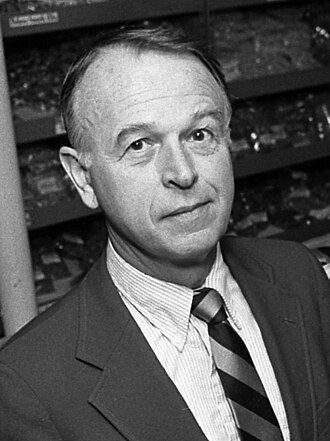
Joe Coulombe
Founder of Trader Joe's
Where to hear and read about Joe Coulombe1 episode or test

Joe Coulombe was a Stanford-trained executive who bought six 7-Eleven clones in 1962, nearly lost them to 7-Eleven itself, and rebuilt them into Trader Joe's, a grocer aimed at the 'overeducated and underpaid.' The lesson most worth taking from him is counter-positioning: never fight a bigger rival on its own terms, and design a business whose every tradeoff makes it impossible to copy.
The answer is to design a store that has no competition.
Trader Joe’s: Hawaiian shirts and counter positioning
Joe Coulombe: the story and the lessons
1Joe Coulombe's path to owning Pronto Markets
Coulombe came out of Stanford with one job offer, at a drugstore chain. Born in 1930 in San Diego, he earned a Stanford economics degree in 1952 and an MBA in 1954. His only offer came from Owl Drug, a West Coast chain of about 300 stores.
His boss sent him to scour the country for ideas, and he came back with 7-Eleven. While Owl's parent Rexall slowly weighed it, he spent 18 months as finance chief of Hughes's semiconductor division, which grew 700%.
He bought six convenience stores in 1962 when Rexall gave up on retail. Rexall chose Tupperware over retail and put six Pronto Markets up for $25,000, $10,000 over their $15,000 book value. Coulombe and his wife sold their house and borrowed from family and Bank of America.
The stores sold ammunition, tobacco and girly magazines, none of which survived into Trader Joe's.
He closed the funding gap by selling employees equity below his own price. Still $11,000 short, he offered store staff shares at book value, about a 40% discount to what he paid. The employees earned almost twice his multiple.
"I will offer to you to also invest in this buyout at book value." Early employees ended up holding a quarter to a third of the stock.
Treating crew as well-paid partners started on day one. Pay ran 40% to 150% above retail averages by one count. Coulombe's view was that high pay is not overpaying, because it attracts the best people.
"We're going to have some of the highest paid employees in the industry." Each store had a captain and a first mate, and everyone else rotated through every job.
2How Pronto nearly died and liquor bought Coulombe time
Coulombe's 7-Eleven clone had no moat at all. His main supplier, Ador Milk Farms, had lent him money in exchange for exclusive dairy sales. Over gin cocktails at a monthly lunch, owner Merritt Adamson Jr. told him he had sold to Southland, 7-Eleven's parent.
Coulombe was now leveraged to a supplier turned rival, selling the same goods as a company a thousand times larger, and landlords would favor 7-Eleven. "He's in this business that has no structural or strategic barriers at all."
He stepped away to think, then took on more debt for liquor licenses. He went to a family retreat in St. Barts, then raised a third round of debt to buy liquor licenses. 7-Eleven was out of state and sold no hard liquor, and the licenses also kept supermarkets out.
Depression-era fair trade laws made it illegal to sell liquor below producers' set prices, so it was a guaranteed, high-value margin source. Pronto drifted into being mostly a liquor store, which bought him a couple of years.
The governing rule: never fight a bigger rival on its own footing. The near-death of Pronto set the pattern for everything after it.
"You never want to compete with someone bigger, more established, better capitalized than you on the exact same footing that they're on."
3How Coulombe designed Trader Joe's for the overeducated and underpaid
Coulombe read two trends that told him a new customer was coming. Scientific American reported college attendance had gone from 2% to 60% of high school graduates by 1964, and The Wall Street Journal said the 747 would make overseas travel affordable.
The 747 cut the cost of flying to Europe by 50% at once and by 15 times within a decade. He wrote that 7-Eleven served the most mindless demographics with cigarettes, Coke and milk.
In 1970 he chose to be an active merchant, not a supermarket landlord. He saw two paths: grow big and compete on price, where only one or two chains survive, or find products rivals could not copy. He chose the second.
Packaged-goods brands had taken over advertising, couponing and often shelf stocking, so supermarkets had stopped choosing products. Coulombe described his choice as "rejecting a passive role as a supermarket landlord."
Tiki culture gave the store its name, look and crew uniforms. The first Trader Joe's opened in Pasadena in August 1967, near Caltech, with crew in Hawaiian shirts. It advertised 100 scotches, 70 bourbons and 50 rums.
The South Seas theme drew on Trader Vic's, South Pacific and the Disney Jungle Cruise. The Victorian art with punny captions flattered educated shoppers and was free because it was public domain.
He picked sites himself for a narrow customer. Stores sat near campuses and large hospitals, serving college grads and value-minded retirees. He drove neighborhoods to judge access, down to which side of a divided highway a store sat on.
The first store was 7,000 to 8,000 square feet, twice his 4,000 target, and he accepted that to get the right market.
Every product had to pass four tests. High value per cubic inch, high rate of consumption, easy to handle, and outstanding on price or assortment. The fourth test is the counter-positioning.
A butcher concession tried to fill the oversized first store failed two tests: hard to handle and not differentiated.
4Selling groceries like a wine merchant
Wine passed every test and became the template for all of grocery. A store manager's butcher friend in Napa led Coulombe to stock 17 Napa wines. By 1970, three years after the first store, Trader Joe's was California's largest wine retailer.
Coulombe did not drink wine at the time and later became a devoted oenophile. "They are wine merchants and they merchandise everything in the same way you would merchandise wine."
The promise was delight in the merchant's picks, not constant supply. Wine is a non-commodity commodity: you have to sell wines, not wine. Small batches that run out suited a store that never promised to stock everything.
This freed Trader Joe's from carrying a full range and taught customers to expect "sometimes we have it, sometimes we don't."
He read the regulations himself and found edges in them. Fair trade set imported wine minimums by importer, not label, so he found importers with the lowest minimums and undercut the street price.
He went through USDA, FTC and California rules personally and refused to trust secondhand advice. A 1970 newsletter taught customers about each shipment and became the Fearless Flyer in 1985.
He married the health food store to the liquor store. Coulombe saw wine drinkers and health food buyers as the same kind of person. By spring 1971 the store had shifted from 'Good Time Charlie' to 'Whole Earth Harry,' five to eight years before Whole Foods began.
Retirees bought liquor, candy, high-fiber foods and vitamins. The ingredient blacklist grew into no GMOs, no high fructose corn syrup, no MSG and no bleached flour.
He bought deals big chains could not use. When a farmer offered extra-large eggs, at least 12% bigger, at a discount, Coulombe took them. Supermarkets wanted only steady, uniform supply.
He called it intensive buying: take all the supply of a great deal.
The wine bank was a mistake he dropped. At the peak of the wine boom he offered customers storage for their collections. When couples divorced, one spouse raided the bank and the other sued.
"They get dragged into all these divorce lawsuits." Trader Joe's no longer runs wine banks.
5Coulombe's rules for private label
Private label had to be different, never just a cheaper copy. A house product had to differ in the item, packaging, price or merchandising. Tasty Bite eggplant cost $3.39 at Whole Foods and a dollar less as the Trader Joe's version.
"But Trader Joe's will never introduce any private label product just for the sake of having a private label product in that category."
He started in unbranded categories and spread one at a time. Granola came first, then honey, vitamins, nuts and dried fruit. Nuts were added on a whim from the bran flake vendor, and Trader Joe's became California's largest nut and dried fruit retailer.
Trader Joe's invented packaged almond butter, which needed a different process than peanuts. Today over 80% of the store is Trader Joe's brand.
The end of fair trade in 1977 made private label the only safe path. Repeal let discounters slash wine and liquor prices, and retailers went out of business left and right. A one-of-one product has no direct competitor.
Coulombe called this phase Mac the Knife. After 1978 he stopped paying attention to nearby supermarkets, liquor stores and health food stores.
Only Trader Joe's puts its own name on its house brand. Other chains use separate names like Kirkland or Good & Gather and also sell third-party brands. Trader Joe's has no such split.
Suppliers make the products slightly differently for Trader Joe's and never say they make them.
6The low-cost operating model behind Trader Joe's
It earns money only when a customer checks out. No slotting fees, co-op marketing, in-store ads or brand reps stocking shelves. Trader Joe's and Costco each carry about 4,000 items against about 50,000 at a typical supermarket.
"We only make money one way and that's when someone checks out an item and pays money to us."
Items are ranked by margin dollars per shelf inch. A $20 item earning a couple of dollars beats a $4 item earning one, because shelf space is the scarce thing. Sales run over $2,000 per square foot against about $1,200 at Costco.
Few SKUs mean bulk buying, no distributors and deliveries to the distribution center rather than stores.
Suppliers get paid cash on delivery. Costco, Amazon and Walmart pay at 60 to 90 days. Trader Joe's pays on delivery and becomes the preferred customer for small vendors.
Inventory turns about 60 times a year, so it could float on supplier credit but chooses not to.
Technology is weighed against opening the next store. No loyalty program, shopper data, PA system or e-commerce. Price scanners arrived only in 2001.
Desktop publishing was adopted because it cut the Fearless Flyer's cost to a hundredth. "Opening the next store is always wildly more profitable, so we just do that."
Coulombe replaced advertising with cheap, personal marketing. He wrote and voiced the radio spots himself, each about one product, and laid out the early Fearless Flyer on the first Macintosh.
The Flyer was mailed by zip code, so no customer addresses were kept. Its tagline: "free and worth every penny."
High pay keeps turnover at a tenth of grocery's. Turnover runs about 5 to 6% a year against 65 to 70% for grocery. All captains come from first mate, and 80% of those started as crew.
Crew get 15% into a retirement plan, health and dental cover, and a 20% discount.
7How Coulombe sold Trader Joe's to Theo Albrecht on one page
An estate-planning problem forced a sale in 1979. An employee stock plan collapsed when fair trade's end made a valuation impossible, and Coulombe faced a 73% marginal tax rate.
Albrecht, founder of Aldi Nord, spent years courting him, and he refused at first. Albrecht bought it personally, not through Aldi.
He set the terms himself and kept the strategy intact. No link to Aldi, full management autonomy, the private label strategy, CEO as long as he liked, three times the earlier offer, and one page with no diligence.
"One-page contract, no diligence, no definitive merger agreement BS." By 1976 the company had no fixed interest-bearing debt and had never recorded a loss.
The deal left the business compounding on its own cash. Coulombe stayed CEO until 1988, and Albrecht never added another dollar. The company had about 20 California stores at the sale.
Private ownership spared it public-market pressure to take co-op marketing money.
8Why Coulombe stayed regional and successors scaled Trader Joe's
Coulombe wanted a great retailer, not a big one. He retired in 1988 with just under 30 stores and seemed to want every store within a day's drive of home.
"Bigger wasn't necessarily the goal." Founders who do not want to scale need operators who do.
John Shields took it national along the Boston to DC corridor. An old Stanford friend from Macy's and Mervyn's, Shields became CEO on January 1, 1989, and grew stores from about 27 to 175.
The corridor holds the densest cluster of universities in America.
Dan Bane widened the range without becoming a supermarket. Bane took SKUs from about 1,500 to about 4,000 in the same footprint, turning a once-a-month stop for wine, cheese and nuts into a weekly one.
"We are not going to become a supermarket." Revenue went from about $1 billion when he joined to over $20 billion by 2023 across 608 stores.
Two Buck Chuck extended Coulombe's wine playbook to the mass market. Bronco Wines bought the bankrupt Charles Shaw label for $27,000 and surplus wine below cost, and Trader Joe's launched it at $1.99 in 2002.
It is about 10% of the 40 million bottles Trader Joe's sells a year. Coulombe himself said the limited-batch deals of the early days are no longer possible.

Trader Joe’s: Hawaiian shirts and counter positioning
Joe Coulombe was a young executive trying to clone 7-Eleven. He built a counter-positioned grocery store around liquor, wine, health food and private label that has no direct competitor. The sharp choices to skip the supermarket and brand playbook, and to sell to Theo Albrecht on a one-page deal, are why it now earns over $2,000 per square foot, about double Whole Foods.
Coulombe came out of Stanford with one job offer, at a drugstore chain. Born in 1930 in San Diego, he earned a Stanford economics degree in 1952 and an MBA in 1954. His only offer came from Owl Drug, a West Coast chain of about 300 stores.
His boss sent him to scour the country for ideas, and he came back with 7-Eleven. While Owl's parent Rexall slowly weighed it, he spent 18 months as finance chief of Hughes's semiconductor division, which grew 700%.
He bought six convenience stores in 1962 when Rexall gave up on retail. Rexall chose Tupperware over retail and put six Pronto Markets up for $25,000, $10,000 over their $15,000 book value. Coulombe and his wife sold their house and borrowed from family and Bank of America.
The stores sold ammunition, tobacco and girly magazines, none of which survived into Trader Joe's.
He closed the funding gap by selling employees equity below his own price. Still $11,000 short, he offered store staff shares at book value, about a 40% discount to what he paid. The employees earned almost twice his multiple.
"I will offer to you to also invest in this buyout at book value." Early employees ended up holding a quarter to a third of the stock.
Treating crew as well-paid partners started on day one. Pay ran 40% to 150% above retail averages by one count. Coulombe's view was that high pay is not overpaying, because it attracts the best people.
"We're going to have some of the highest paid employees in the industry." Each store had a captain and a first mate, and everyone else rotated through every job.
Coulombe's 7-Eleven clone had no moat at all. His main supplier, Ador Milk Farms, had lent him money in exchange for exclusive dairy sales. Over gin cocktails at a monthly lunch, owner Merritt Adamson Jr. told him he had sold to Southland, 7-Eleven's parent.
Coulombe was now leveraged to a supplier turned rival, selling the same goods as a company a thousand times larger, and landlords would favor 7-Eleven. "He's in this business that has no structural or strategic barriers at all."
He stepped away to think, then took on more debt for liquor licenses. He went to a family retreat in St. Barts, then raised a third round of debt to buy liquor licenses. 7-Eleven was out of state and sold no hard liquor, and the licenses also kept supermarkets out.
Depression-era fair trade laws made it illegal to sell liquor below producers' set prices, so it was a guaranteed, high-value margin source. Pronto drifted into being mostly a liquor store, which bought him a couple of years.
The governing rule: never fight a bigger rival on its own footing. The near-death of Pronto set the pattern for everything after it.
"You never want to compete with someone bigger, more established, better capitalized than you on the exact same footing that they're on."
Coulombe read two trends that told him a new customer was coming. Scientific American reported college attendance had gone from 2% to 60% of high school graduates by 1964, and The Wall Street Journal said the 747 would make overseas travel affordable.
The 747 cut the cost of flying to Europe by 50% at once and by 15 times within a decade. He wrote that 7-Eleven served the most mindless demographics with cigarettes, Coke and milk.
In 1970 he chose to be an active merchant, not a supermarket landlord. He saw two paths: grow big and compete on price, where only one or two chains survive, or find products rivals could not copy. He chose the second.
Packaged-goods brands had taken over advertising, couponing and often shelf stocking, so supermarkets had stopped choosing products. Coulombe described his choice as "rejecting a passive role as a supermarket landlord."
Tiki culture gave the store its name, look and crew uniforms. The first Trader Joe's opened in Pasadena in August 1967, near Caltech, with crew in Hawaiian shirts. It advertised 100 scotches, 70 bourbons and 50 rums.
The South Seas theme drew on Trader Vic's, South Pacific and the Disney Jungle Cruise. The Victorian art with punny captions flattered educated shoppers and was free because it was public domain.
He picked sites himself for a narrow customer. Stores sat near campuses and large hospitals, serving college grads and value-minded retirees. He drove neighborhoods to judge access, down to which side of a divided highway a store sat on.
The first store was 7,000 to 8,000 square feet, twice his 4,000 target, and he accepted that to get the right market.
Every product had to pass four tests. High value per cubic inch, high rate of consumption, easy to handle, and outstanding on price or assortment. The fourth test is the counter-positioning.
A butcher concession tried to fill the oversized first store failed two tests: hard to handle and not differentiated.
Wine passed every test and became the template for all of grocery. A store manager's butcher friend in Napa led Coulombe to stock 17 Napa wines. By 1970, three years after the first store, Trader Joe's was California's largest wine retailer.
Coulombe did not drink wine at the time and later became a devoted oenophile. "They are wine merchants and they merchandise everything in the same way you would merchandise wine."
The promise was delight in the merchant's picks, not constant supply. Wine is a non-commodity commodity: you have to sell wines, not wine. Small batches that run out suited a store that never promised to stock everything.
This freed Trader Joe's from carrying a full range and taught customers to expect "sometimes we have it, sometimes we don't."
He read the regulations himself and found edges in them. Fair trade set imported wine minimums by importer, not label, so he found importers with the lowest minimums and undercut the street price.
He went through USDA, FTC and California rules personally and refused to trust secondhand advice. A 1970 newsletter taught customers about each shipment and became the Fearless Flyer in 1985.
He married the health food store to the liquor store. Coulombe saw wine drinkers and health food buyers as the same kind of person. By spring 1971 the store had shifted from 'Good Time Charlie' to 'Whole Earth Harry,' five to eight years before Whole Foods began.
Retirees bought liquor, candy, high-fiber foods and vitamins. The ingredient blacklist grew into no GMOs, no high fructose corn syrup, no MSG and no bleached flour.
He bought deals big chains could not use. When a farmer offered extra-large eggs, at least 12% bigger, at a discount, Coulombe took them. Supermarkets wanted only steady, uniform supply.
He called it intensive buying: take all the supply of a great deal.
The wine bank was a mistake he dropped. At the peak of the wine boom he offered customers storage for their collections. When couples divorced, one spouse raided the bank and the other sued.
"They get dragged into all these divorce lawsuits." Trader Joe's no longer runs wine banks.
Private label had to be different, never just a cheaper copy. A house product had to differ in the item, packaging, price or merchandising. Tasty Bite eggplant cost $3.39 at Whole Foods and a dollar less as the Trader Joe's version.
"But Trader Joe's will never introduce any private label product just for the sake of having a private label product in that category."
He started in unbranded categories and spread one at a time. Granola came first, then honey, vitamins, nuts and dried fruit. Nuts were added on a whim from the bran flake vendor, and Trader Joe's became California's largest nut and dried fruit retailer.
Trader Joe's invented packaged almond butter, which needed a different process than peanuts. Today over 80% of the store is Trader Joe's brand.
The end of fair trade in 1977 made private label the only safe path. Repeal let discounters slash wine and liquor prices, and retailers went out of business left and right. A one-of-one product has no direct competitor.
Coulombe called this phase Mac the Knife. After 1978 he stopped paying attention to nearby supermarkets, liquor stores and health food stores.
Only Trader Joe's puts its own name on its house brand. Other chains use separate names like Kirkland or Good & Gather and also sell third-party brands. Trader Joe's has no such split.
Suppliers make the products slightly differently for Trader Joe's and never say they make them.
It earns money only when a customer checks out. No slotting fees, co-op marketing, in-store ads or brand reps stocking shelves. Trader Joe's and Costco each carry about 4,000 items against about 50,000 at a typical supermarket.
"We only make money one way and that's when someone checks out an item and pays money to us."
Items are ranked by margin dollars per shelf inch. A $20 item earning a couple of dollars beats a $4 item earning one, because shelf space is the scarce thing. Sales run over $2,000 per square foot against about $1,200 at Costco.
Few SKUs mean bulk buying, no distributors and deliveries to the distribution center rather than stores.
Suppliers get paid cash on delivery. Costco, Amazon and Walmart pay at 60 to 90 days. Trader Joe's pays on delivery and becomes the preferred customer for small vendors.
Inventory turns about 60 times a year, so it could float on supplier credit but chooses not to.
Technology is weighed against opening the next store. No loyalty program, shopper data, PA system or e-commerce. Price scanners arrived only in 2001.
Desktop publishing was adopted because it cut the Fearless Flyer's cost to a hundredth. "Opening the next store is always wildly more profitable, so we just do that."
Coulombe replaced advertising with cheap, personal marketing. He wrote and voiced the radio spots himself, each about one product, and laid out the early Fearless Flyer on the first Macintosh.
The Flyer was mailed by zip code, so no customer addresses were kept. Its tagline: "free and worth every penny."
High pay keeps turnover at a tenth of grocery's. Turnover runs about 5 to 6% a year against 65 to 70% for grocery. All captains come from first mate, and 80% of those started as crew.
Crew get 15% into a retirement plan, health and dental cover, and a 20% discount.
An estate-planning problem forced a sale in 1979. An employee stock plan collapsed when fair trade's end made a valuation impossible, and Coulombe faced a 73% marginal tax rate.
Albrecht, founder of Aldi Nord, spent years courting him, and he refused at first. Albrecht bought it personally, not through Aldi.
He set the terms himself and kept the strategy intact. No link to Aldi, full management autonomy, the private label strategy, CEO as long as he liked, three times the earlier offer, and one page with no diligence.
"One-page contract, no diligence, no definitive merger agreement BS." By 1976 the company had no fixed interest-bearing debt and had never recorded a loss.
The deal left the business compounding on its own cash. Coulombe stayed CEO until 1988, and Albrecht never added another dollar. The company had about 20 California stores at the sale.
Private ownership spared it public-market pressure to take co-op marketing money.
Coulombe wanted a great retailer, not a big one. He retired in 1988 with just under 30 stores and seemed to want every store within a day's drive of home.
"Bigger wasn't necessarily the goal." Founders who do not want to scale need operators who do.
John Shields took it national along the Boston to DC corridor. An old Stanford friend from Macy's and Mervyn's, Shields became CEO on January 1, 1989, and grew stores from about 27 to 175.
The corridor holds the densest cluster of universities in America.
Dan Bane widened the range without becoming a supermarket. Bane took SKUs from about 1,500 to about 4,000 in the same footprint, turning a once-a-month stop for wine, cheese and nuts into a weekly one.
"We are not going to become a supermarket." Revenue went from about $1 billion when he joined to over $20 billion by 2023 across 608 stores.
Two Buck Chuck extended Coulombe's wine playbook to the mass market. Bronco Wines bought the bankrupt Charles Shaw label for $27,000 and surplus wine below cost, and Trader Joe's launched it at $1.99 in 2002.
It is about 10% of the 40 million bottles Trader Joe's sells a year. Coulombe himself said the limited-batch deals of the early days are no longer possible.