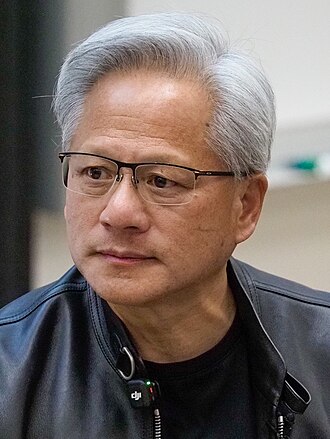
Jensen Huang
Co-founder and CEO of Nvidia
Where to hear and read about Jensen Huang5 episodes and tests

 FoundersHow Jensen Works

 AcquiredNVIDIA CEO Jensen Huang
 AcquiredNvidia Part III: The Dawn of the AI Era (2022-2023)
 AcquiredNvidia: The Machine Learning Company (2006-2022)
 AcquiredNvidia: The GPU Company (1993-2006)
Jensen Huang co-founded Nvidia in 1993 and has run it ever since, taking it from one of about 90 graphics chip startups to the platform under modern AI. The thing most worth learning from him is how he bets the company: he positions years early in markets that don't exist yet, simulates away as much risk as he can, and then holds the course through 80% stock drops until the market arrives.
My will to survive exceeds almost everybody else's will to kill me.
Nvidia: The GPU Company (1993-2006)
Jensen Huang: the story and the lessons
1Jensen Huang's path from a Kentucky reform school to founding Nvidia
A reform school at age nine taught Huang to tolerate discomfort. Born in Taiwan in 1963, he was sent with his older brother to Oneida Baptist Institute in Kentucky, a cheap boarding school that turned out to be a reform school. His roommate was a 17-year-old fresh out of prison and recovering from seven stab wounds.
The roommate taught him weightlifting while Huang helped with math, and the two became friends. "I can tolerate a lot of discomfort," he says. He has since given the school a few million dollars.
He was a fast starter who learned big picture before details. He skipped two grades, placed third in the junior nationals in table tennis, and started electrical engineering at Oregon State at 16, where his lab partner Lori became his wife.
He once got angry when professors were imprecise with numbers, then came to accept that details only matter once you understand the big picture. Nvidia staff call his rounding "CEO math."
AMD and LSI Logic taught him specialization and customer-driven chip design. After graduating in 1984 he worked on CPUs at AMD while taking eight years of night classes for a Stanford master's. At LSI Logic he embedded with the young Sun Microsystems and helped build the chips for the SPARCstation 1.
Seeing manual, fully integrated chipmaking, he concluded the industry needed specialists and shared design tools. At LSI he built a reputation for turning customer visions into shipping chips.
Nvidia started as a Denny's pitch to bring 3D graphics to PCs. In late 1992, Sun engineers Chris Malachowski and Curtis Priem pitched him on putting workstation-grade 3D into consumer PCs, when 3D still required costly SGI machines and Doom showed players wanted it.
The idea looked like an obvious yes, which is why about 90 other startups made the same bet within months. The mission was to make 3D graphics a new medium for storytelling, and he pitched games as bigger than Hollywood and music.
A referral, not the pitch, got him funded by Don Valentine. LSI's CEO Wilf Corrigan called Sequoia's Don Valentine to recommend him. Huang botched the pitch, and Sequoia and Sutter Hill still put in $2 million at a $6 million post-money valuation.
Valentine said he was investing against his judgment and added: "if you lose my money I'll kill you." Nvidia went public in 1999 at a $600 million market cap, 100 times that first round.
2How Huang saved Nvidia with the Riva 128 in 1997
Nvidia's first design was built for a world that vanished. Its first chips used quadrilaterals and curved surfaces and squeezed memory that cost about $200 per chip. Microsoft then built triangle-based Direct3D into Windows, most of the 89 rivals adopted it, and by launch rivals were paying about $50 for more memory.
Sega pulled out of the half-designed NV2 in 1996. Huang calls the original approach "completely the wrong answer": being first meant designing "for a constraint that was no longer true."
Huang told his own team the strategy had failed. With months of cash left, he told co-founders and more than 100 engineers, hired to set standards, that Nvidia would drop its own design and compete on performance inside Microsoft's standard.
His framing: if strategy was his job and execution theirs, the strategy was what had failed. He calls intellectual honesty "the cornerstone" of Nvidia's culture.
He cut 70% of staff and bet everything on one tape-out. Nvidia went down to about 35 people and could afford only one chip tape-out. It spent about $1 million, a third of its cash, on an emulator from a firm that was going out of business, and sent the design straight to production without a physical prototype.
The software team ran the full stack, every driver, game and VGA application, on the emulator before tape-out. Nvidia ordered about 100,000 units, and the foundry asked if they were sure.
He built the biggest, fastest chip and priced it above rivals. Riva 128 used the largest die and fastest memories and accelerated every stage in hardware, at a cost point higher than any competitor would accept. It sold 1 million units in four months.
The logic: built that way, "there could be nothing that could be faster." It still only supported part of Direct3D's blend modes, so Nvidia toured developers asking them to use the ones that worked, and they agreed because buyers pay for graphics speed.
Huang bets big only after simulating the risk away. Asked whether the lesson is to bet on conviction, he said no: he pushes in only when he knows it will work. "Everything in the future that we can simulate today, we prefetch it."
The desperate methods became permanent. Nvidia still designs chips this way, because time to market is performance: "once you pull out all the stops and you see what you're capable of, why would you put stops in next time?"
A hand-written letter to Morris Chang won him TSMC. TSMC's salespeople wouldn't return his calls, so he wrote to Morris Chang in Taiwan. Chang phoned the office himself, and the next year TSMC signed a multi-year deal to be Nvidia's primary foundry.
Huang shouted for the office to be quiet when the call came. Nvidia is now close to TSMC's biggest customer.
3How Huang moved Nvidia out of commodity graphics
A six-month ship cycle became Nvidia's standing advantage. From 1997 Nvidia roughly doubled performance every six months, from GeForce 256 in fall 1999 through GeForce 3 Ti-500 in 2001, while rivals took 18 to 24 months.
Rivals knew what the next chip would hold but couldn't ship it as fast. After loosening to a yearly cadence, Nvidia returned to six-month cycles after covid to stay ahead in AI.
Writing its own drivers gave Nvidia a software bench rivals lacked. Other graphics makers left drivers to partners. Nvidia brought them in-house, taking on more fixed engineering cost to control the experience for gamers paying $300 to $500 a card.
That pool of low-level systems engineers later made CUDA possible.
Naming the GeForce 256 a GPU was a claim against Intel. Intel absorbed successful add-in cards like sound into the motherboard. Calling the 1999 GeForce 256 a graphics processing unit staked out a separate category; it ran about 5x faster than anything else.
The label ran ahead of the truth until the chip became programmable.
Programmable shaders were his second bet-the-company move. GeForce 3 let developers program lighting and style on the chip, with Nvidia's C-based Cg language, built with Microsoft this time. Revenue went from $158 million to about $1.4 billion by 2001, the fastest a chipmaker had reached a billion.
Staffing it so aggressively left Nvidia months from running out of cash again. The Xbox chip was a variant, under a deal paying $500 million a year with a $200 million advance.
He turns down work that isn't unique, including most consoles. Nvidia has powered only the original Xbox, PlayStation 3 and Nintendo Switch, because console revenue carries low margin and can vanish with the next generation.
"If I don't think that we can do anything really unique and special and really change the world then we have better things to spend our resources on."
By 2006 Nvidia had product-market fit but no lasting power. Revenue stalled near $2.8 billion in 2005, gross margin was 29% in 2004, and ATI had matched programmable shaders. AMD tried to buy Nvidia, and the deal died when Huang insisted on being CEO.
AMD bought ATI instead in 2006 and became Nvidia's main GPU rival.
4How Jensen Huang bet Nvidia on CUDA
Researchers hacking gaming cards pointed Huang to a bigger market. A 2002 paper simulated cloud movement on a GPU, and scientists were forcing chemistry work through Cg by treating data as triangles and lighting. Huang hired the researcher, Harris, who coined GPGPU.
The idea: anything made easier to do expands its market, and CUDA would be the tool for that. He saw the same promise in simulation when he invested in Keyhole in 2006, which became Google Earth.
He started CUDA in 2006 with no clear market. The visible market was scientific computing worth perhaps a couple billion dollars, and CUDA wasn't usable for six-plus years. His logic: "If you don't build it they can't come."
He also wanted to escape 13 or 14 years of being commoditized by owning a platform the way Apple does.
Every GPU shipped CUDA-capable, which built the install base. Putting CUDA in every card took chip space and was questioned internally, but gaming customers effectively paid for the base. Developers grew from 100,000 after four years to 4 million by May 2023.
Architectural compatibility across every chip is "the only unnegotiable rule in our company, everything else is negotiable." There are roughly 250 to 300 million active CUDA GPUs.
CUDA is free but runs only on Nvidia hardware. Nvidia gives away a full stack of compiler, runtime, libraries and over 150 SDKs, and earns on the chips, an Apple-style model chosen before the iPhone proved it.
Huang says Nvidia had to create the compiler team, evangelize developers and even help them market their software: "everything that's associated with being a computing platform company had to be created."
He held the course while margins and the stock collapsed. CUDA cut gross margin from 45% to 35% in 2007 and 2008, and the stock fell more than 80% from a roughly $20 billion peak. Most CEOs would have shopped the company; he kept building.
Nvidia went through two or three drawdowns of more than 80% and didn't regain its 2007 peak until 2016. "You have to really really believe it and really really want it, otherwise it's just too much to endure." He credits long-time colleagues, his family and early investors.
Nvidia taught the market to use CUDA. Its chief scientist offered schools CUDA machines if they taught a class, gave over 100 talks in a year, and wrote the missing textbook, which sold tens of thousands of copies.
Intel did the same with traveling seminars when it invented the microprocessor.
5How Huang went all in on deep learning and the data center
AlexNet ran on CUDA, and Huang reasoned it would touch everything. In 2012 the Toronto team trained on two GeForce GTX 580s in CUDA and cut the ImageNet error rate from about 25% to 15%. Huang asked why it worked and whether it scaled.
He concluded deep learning is a universal function approximator, that much of the world needs only prediction, and that nearly all software could be built this way. He admits he did not foresee deep learning, but Nvidia latched on almost instantly.
He overruled lieutenants who called deep learning a fad. Several key executives argued against more investment. He announced at an all-hands that it was the company's top priority: "Deep learning is going to be really big. We should go all in on it."
A recurring machine learning item in employees' top five emails had already led him to invest more in GPU acceleration tools.
He went to every AI researcher and asked how to help. CUDA's science users gave Nvidia university ties, so he met Yann LeCun, Andrew Ng, Geoff Hinton and Ilya Sutskever. He hand-delivered the first DGX to OpenAI.
He read arXiv papers himself. Nvidia's Brian Catanzaro and Andrew Ng matched a 1,000-node Google Brain result with three nodes, and that work became cuDNN.
He started building data center products about 17 years early. Worried that GPUs tied to desks would cap the business, he backed cloud gaming, which became GeForce Now, then enterprise graphics and CUDA supercomputers.
A CEO must stand near the tree to make a diving catch when the apple falls: "you can't wait until the opportunity is sitting in front of you for you to reach out for it."
He bought Mellanox because the data center is the computer. In 2019 Nvidia agreed to pay $7 billion for Mellanox, the last major InfiniBand maker, when most saw Ethernet as good enough. AI runs one job across many processors, so networking defines the data center.
Nvidia had trained an 8.3 billion parameter model on 512 GPUs and knew bandwidth between machines would be the bottleneck. He calls it one of his best strategic decisions, and Nvidia now has about 3,200 people in Israel.
The preparation paid off when generative AI arrived. After ChatGPT in November 2022, data center revenue hit $10.3 billion in one quarter, up 141% in three months, and Nvidia passed $1 trillion in market value.
Nvidia builds full stack, with its own Grace CPU, networking and DGX systems, but sells any layer: bare chips, DGX boxes or DGX Cloud. Gross margin rose from 24% in the commodity days to 70%.
6Huang's rules for strategy: create the market, then grow the network
He enters zero billion dollar markets about a decade early. Nvidia did this in cars, PC gaming, workstations, supercomputing and machine learning, so few competitors were shaped to compete when each market emerged.
An automotive CTO told him cars can't tolerate the blue screen of death; he bet they would become software defined. On robotics: "Where there are no customers, there are also no competitors."
He refuses commodity products and does what others can't. He told investors Nvidia would be the one chip company whose average selling prices rise while everyone else's fall.
"You build a great company by doing things that other people can't do. You don't build a company by fighting other people to do things that everyone can do." He waited to build a CPU until Grace had a specific job in GPU clusters.
He picks markets where the technology is never good enough. He chose 3D graphics because enthusiasts always pay for a 10x jump, which gives a sustainable technology opportunity.
He calls it a network, not a moat. Helping an ecosystem succeed builds a network of developers and customers who share the final market's success, and they bring you ideas you wouldn't have alone.
He dislikes moat because it means building around your castle; it may also breed complacency.
He sizes the company by the opportunity, not the chip. He was once told no chip company could top a billion dollars. Moving from selling chips to selling the work a system does grew the opportunity perhaps a thousand times.
In 2023 he sized the market as $1 trillion of installed data center assets plus about $250 billion a year spent upgrading it.
He blocks low-end rivals by shipping the whole cow. Having read The Innovator's Dilemma, he sold chips that failed top-speed tests as cheaper products, with almost no extra R&D, forcing low-cost rivals into losses.
"I don't want to let someone come in and be the price leader, lock me out of the bottom, and then climb their way to the top."
He learns from everyone but copies no one, and plans continuously. Books and rivals are free education, but each lesson must be translated to Nvidia's own situation. Nvidia has no five-year plan.
"Strategy is not words. Strategy is actions." His favorite business writers are Clayton Christensen and Andy Grove.
7How Jensen Huang runs Nvidia
He keeps 40 to 60 direct reports and no one-on-ones. He refused board advice to hire a COO so everybody knows what's going on, and built a company he can drive directly, "as small as possible."
He treats senior people as the best in the world at what they do and gives them information and strategy, not coaching, mentoring only recent graduates.
The org is shaped like the product, and mission is the boss. Nvidia is organized like a computing stack. Whoever is best at a layer is the pilot in command regardless of title, with one named owner per project reporting to him.
"Your organization should be the architecture of the machinery of building the product." Staff sit in function pools so they can be wired to new missions, which on a chart "doesn't make any sense."
Decisions reach everyone at once, so leaders can't hoard information. In one robotics meeting, new college grads, three vice presidents and two executive staff heard a decision at the same moment.
Leaders earn their jobs by reasoning and helping others succeed, which puts heavy pressure on them.
Top five emails bring him weak signals from the edge. Employees at every level email five action-led bullets on their work, customers, competitors and delays. He reads about 100 a day.
"It's easy to pick up on the strong signals, but I want to intercept them when they are weak." He reads them as a pastime: "I drink a scotch and I do emails."
He teaches constantly at the whiteboard. Colleagues call him Professor Jensen, and every meeting centers on drawing and talking at the board, which shows at once who hasn't thought it through.
He writes short emails and says "Lua" when someone rambles. He also learns firsthand, attending a machine learning conference himself: "I'm here to learn."
He criticizes in public so the whole company learns. After the NV30 chip failed, he called out the architects at an all-company meeting, had a Best Buy executive describe customer complaints, and took blame for how teams worked together.
"We are not optimizing for not embarrassing somebody. We're optimizing for the company learning from our mistakes."
Work is judged against the speed of light. Each project is broken into tasks timed as if there were no delays or queues, and teams are judged against that limit, not past results or rivals.
He does his highest priority work first each day, then helps others.
He hands out stock himself to reward top people. He reviews nominations and approves special grants vesting over four years, and can award stock on the spot outside the annual review.
The case comes from the Medici line "I will choke you with gold."
8Huang on complacency, pain and endurance
He treats complacency as Nvidia's worst enemy. Early on he told monthly meetings Nvidia was 30 days from going out of business. In 1997 he said "We need to kill Intel," then 860 times Nvidia's revenue.
"When technology moves this fast if you're not reinventing yourself you're just slowly dying." Of about 90 graphics startups, only Nvidia and ATI survived.
He tells himself he sucks after his best quarters. After a quarter that "blew the doors off," he told executives he looks in the mirror every morning and says, "You suck."
He sees praise as a distraction and says, "I'd rather torture them into greatness."
He ranks endurance above intelligence. He calls pain and suffering "the ultimate superpowers" and told Stanford graduates, "I hope suffering happens to you."
He says no one will work harder than him; he starts at 5am seven days a week and says working is relaxing. Nvidia survived at least four near-death moments partly because he never declared game over.
He says not knowing how hard it is was his superpower. Building Nvidia was a million times harder than expected, and knowing the pain and shame in advance, he would not start it again.
He still asks himself "how hard can it be" each morning about new projects. He also says success needs the market's help: he did many dumb things and still won.
9Jensen Huang's mistakes and what changed after
Going first on standards nearly killed Nvidia. Designing its own standard before Microsoft set one left Nvidia stranded, and the fix was to join the standard and win on speed.
He later said Riva 128 should have supported every blend mode and that Nvidia "did a lot of things wrong" against Microsoft.
Tegra was a distraction that used little of Nvidia's skill. Launched as the stock sank in 2008, the smartphone chip faced Qualcomm and Samsung and thin Android margins; Nvidia also bought Icera in 2011 and shut it down.
Tegra later found homes in the Tesla Model S screen and the Nintendo Switch, and Icera's founders started rival Graphcore.
Crypto demand he couldn't see hit revenue in 2018. Miners bought GeForce cards through retail, so when crypto winter came revenue fell and the stock dropped about 50%.
Nvidia then throttled mining on gaming cards, sold dedicated mining cards, and banned consumer cards in data centers to separate buyers.
Regulators blocked his Arm deal, so Nvidia built its own CPU. He wanted Arm to own more of the data center and bring CUDA to Arm designs, but regulators feared a chipmaker controlling licenses sold to rivals.
Nvidia built Grace, an Arm-based data center CPU paired with Hopper.
A 2022 inventory write-off became a cornered resource. Nvidia over-ordered TSMC capacity for crypto and gaming and wrote it off in 2022; then AI demand made that reserved capacity, including scarce CoWoS packaging, hugely valuable.
How Jensen Works
Jensen Huang built Nvidia around a handful of repeatable habits: constant teaching, a flat organization, blunt feedback, fear of complacency and long-term bets on markets he creates. The decision that makes it worth hearing is his 2007 and 2008 all-in bet on CUDA, which cost margins and stock value but built the base of Nvidia's AI dominance.
Researchers hacking gaming cards pointed Huang to a bigger market. A 2002 paper simulated cloud movement on a GPU, and scientists were forcing chemistry work through Cg by treating data as triangles and lighting. Huang hired the researcher, Harris, who coined GPGPU.
The idea: anything made easier to do expands its market, and CUDA would be the tool for that. He saw the same promise in simulation when he invested in Keyhole in 2006, which became Google Earth.
He held the course while margins and the stock collapsed. CUDA cut gross margin from 45% to 35% in 2007 and 2008, and the stock fell more than 80% from a roughly $20 billion peak. Most CEOs would have shopped the company; he kept building.
Nvidia went through two or three drawdowns of more than 80% and didn't regain its 2007 peak until 2016. "You have to really really believe it and really really want it, otherwise it's just too much to endure." He credits long-time colleagues, his family and early investors.
Nvidia taught the market to use CUDA. Its chief scientist offered schools CUDA machines if they taught a class, gave over 100 talks in a year, and wrote the missing textbook, which sold tens of thousands of copies.
Intel did the same with traveling seminars when it invented the microprocessor.
He overruled lieutenants who called deep learning a fad. Several key executives argued against more investment. He announced at an all-hands that it was the company's top priority: "Deep learning is going to be really big. We should go all in on it."
A recurring machine learning item in employees' top five emails had already led him to invest more in GPU acceleration tools.
He enters zero billion dollar markets about a decade early. Nvidia did this in cars, PC gaming, workstations, supercomputing and machine learning, so few competitors were shaped to compete when each market emerged.
An automotive CTO told him cars can't tolerate the blue screen of death; he bet they would become software defined. On robotics: "Where there are no customers, there are also no competitors."
He refuses commodity products and does what others can't. He told investors Nvidia would be the one chip company whose average selling prices rise while everyone else's fall.
"You build a great company by doing things that other people can't do. You don't build a company by fighting other people to do things that everyone can do." He waited to build a CPU until Grace had a specific job in GPU clusters.
He calls it a network, not a moat. Helping an ecosystem succeed builds a network of developers and customers who share the final market's success, and they bring you ideas you wouldn't have alone.
He dislikes moat because it means building around your castle; it may also breed complacency.
He blocks low-end rivals by shipping the whole cow. Having read The Innovator's Dilemma, he sold chips that failed top-speed tests as cheaper products, with almost no extra R&D, forcing low-cost rivals into losses.
"I don't want to let someone come in and be the price leader, lock me out of the bottom, and then climb their way to the top."
He learns from everyone but copies no one, and plans continuously. Books and rivals are free education, but each lesson must be translated to Nvidia's own situation. Nvidia has no five-year plan.
"Strategy is not words. Strategy is actions." His favorite business writers are Clayton Christensen and Andy Grove.
He keeps 40 to 60 direct reports and no one-on-ones. He refused board advice to hire a COO so everybody knows what's going on, and built a company he can drive directly, "as small as possible."
He treats senior people as the best in the world at what they do and gives them information and strategy, not coaching, mentoring only recent graduates.
The org is shaped like the product, and mission is the boss. Nvidia is organized like a computing stack. Whoever is best at a layer is the pilot in command regardless of title, with one named owner per project reporting to him.
"Your organization should be the architecture of the machinery of building the product." Staff sit in function pools so they can be wired to new missions, which on a chart "doesn't make any sense."
Top five emails bring him weak signals from the edge. Employees at every level email five action-led bullets on their work, customers, competitors and delays. He reads about 100 a day.
"It's easy to pick up on the strong signals, but I want to intercept them when they are weak." He reads them as a pastime: "I drink a scotch and I do emails."
He teaches constantly at the whiteboard. Colleagues call him Professor Jensen, and every meeting centers on drawing and talking at the board, which shows at once who hasn't thought it through.
He writes short emails and says "Lua" when someone rambles. He also learns firsthand, attending a machine learning conference himself: "I'm here to learn."
He criticizes in public so the whole company learns. After the NV30 chip failed, he called out the architects at an all-company meeting, had a Best Buy executive describe customer complaints, and took blame for how teams worked together.
"We are not optimizing for not embarrassing somebody. We're optimizing for the company learning from our mistakes."
Work is judged against the speed of light. Each project is broken into tasks timed as if there were no delays or queues, and teams are judged against that limit, not past results or rivals.
He does his highest priority work first each day, then helps others.
He hands out stock himself to reward top people. He reviews nominations and approves special grants vesting over four years, and can award stock on the spot outside the annual review.
The case comes from the Medici line "I will choke you with gold."
He treats complacency as Nvidia's worst enemy. Early on he told monthly meetings Nvidia was 30 days from going out of business. In 1997 he said "We need to kill Intel," then 860 times Nvidia's revenue.
"When technology moves this fast if you're not reinventing yourself you're just slowly dying." Of about 90 graphics startups, only Nvidia and ATI survived.
He tells himself he sucks after his best quarters. After a quarter that "blew the doors off," he told executives he looks in the mirror every morning and says, "You suck."
He sees praise as a distraction and says, "I'd rather torture them into greatness."
He ranks endurance above intelligence. He calls pain and suffering "the ultimate superpowers" and told Stanford graduates, "I hope suffering happens to you."
He says no one will work harder than him; he starts at 5am seven days a week and says working is relaxing. Nvidia survived at least four near-death moments partly because he never declared game over.
NVIDIA CEO Jensen Huang
Jensen Huang explains how Nvidia survived near-death in 1997, then repeatedly positioned itself years ahead of new markets, from CUDA to the data center to AI. The Riva 128 bet, made with one tape-out and an emulator, and the Mellanox deal show how he bets the company only after pulling the risk forward.
A referral, not the pitch, got him funded by Don Valentine. LSI's CEO Wilf Corrigan called Sequoia's Don Valentine to recommend him. Huang botched the pitch, and Sequoia and Sutter Hill still put in $2 million at a $6 million post-money valuation.
Valentine said he was investing against his judgment and added: "if you lose my money I'll kill you." Nvidia went public in 1999 at a $600 million market cap, 100 times that first round.
Nvidia's first design was built for a world that vanished. Its first chips used quadrilaterals and curved surfaces and squeezed memory that cost about $200 per chip. Microsoft then built triangle-based Direct3D into Windows, most of the 89 rivals adopted it, and by launch rivals were paying about $50 for more memory.
Sega pulled out of the half-designed NV2 in 1996. Huang calls the original approach "completely the wrong answer": being first meant designing "for a constraint that was no longer true."
He cut 70% of staff and bet everything on one tape-out. Nvidia went down to about 35 people and could afford only one chip tape-out. It spent about $1 million, a third of its cash, on an emulator from a firm that was going out of business, and sent the design straight to production without a physical prototype.
The software team ran the full stack, every driver, game and VGA application, on the emulator before tape-out. Nvidia ordered about 100,000 units, and the foundry asked if they were sure.
He built the biggest, fastest chip and priced it above rivals. Riva 128 used the largest die and fastest memories and accelerated every stage in hardware, at a cost point higher than any competitor would accept. It sold 1 million units in four months.
The logic: built that way, "there could be nothing that could be faster." It still only supported part of Direct3D's blend modes, so Nvidia toured developers asking them to use the ones that worked, and they agreed because buyers pay for graphics speed.
Huang bets big only after simulating the risk away. Asked whether the lesson is to bet on conviction, he said no: he pushes in only when he knows it will work. "Everything in the future that we can simulate today, we prefetch it."
The desperate methods became permanent. Nvidia still designs chips this way, because time to market is performance: "once you pull out all the stops and you see what you're capable of, why would you put stops in next time?"
Every GPU shipped CUDA-capable, which built the install base. Putting CUDA in every card took chip space and was questioned internally, but gaming customers effectively paid for the base. Developers grew from 100,000 after four years to 4 million by May 2023.
Architectural compatibility across every chip is "the only unnegotiable rule in our company, everything else is negotiable." There are roughly 250 to 300 million active CUDA GPUs.
He held the course while margins and the stock collapsed. CUDA cut gross margin from 45% to 35% in 2007 and 2008, and the stock fell more than 80% from a roughly $20 billion peak. Most CEOs would have shopped the company; he kept building.
Nvidia went through two or three drawdowns of more than 80% and didn't regain its 2007 peak until 2016. "You have to really really believe it and really really want it, otherwise it's just too much to endure." He credits long-time colleagues, his family and early investors.
AlexNet ran on CUDA, and Huang reasoned it would touch everything. In 2012 the Toronto team trained on two GeForce GTX 580s in CUDA and cut the ImageNet error rate from about 25% to 15%. Huang asked why it worked and whether it scaled.
He concluded deep learning is a universal function approximator, that much of the world needs only prediction, and that nearly all software could be built this way. He admits he did not foresee deep learning, but Nvidia latched on almost instantly.
He went to every AI researcher and asked how to help. CUDA's science users gave Nvidia university ties, so he met Yann LeCun, Andrew Ng, Geoff Hinton and Ilya Sutskever. He hand-delivered the first DGX to OpenAI.
He read arXiv papers himself. Nvidia's Brian Catanzaro and Andrew Ng matched a 1,000-node Google Brain result with three nodes, and that work became cuDNN.
He started building data center products about 17 years early. Worried that GPUs tied to desks would cap the business, he backed cloud gaming, which became GeForce Now, then enterprise graphics and CUDA supercomputers.
A CEO must stand near the tree to make a diving catch when the apple falls: "you can't wait until the opportunity is sitting in front of you for you to reach out for it."
He bought Mellanox because the data center is the computer. In 2019 Nvidia agreed to pay $7 billion for Mellanox, the last major InfiniBand maker, when most saw Ethernet as good enough. AI runs one job across many processors, so networking defines the data center.
Nvidia had trained an 8.3 billion parameter model on 512 GPUs and knew bandwidth between machines would be the bottleneck. He calls it one of his best strategic decisions, and Nvidia now has about 3,200 people in Israel.
He enters zero billion dollar markets about a decade early. Nvidia did this in cars, PC gaming, workstations, supercomputing and machine learning, so few competitors were shaped to compete when each market emerged.
An automotive CTO told him cars can't tolerate the blue screen of death; he bet they would become software defined. On robotics: "Where there are no customers, there are also no competitors."
He picks markets where the technology is never good enough. He chose 3D graphics because enthusiasts always pay for a 10x jump, which gives a sustainable technology opportunity.
He calls it a network, not a moat. Helping an ecosystem succeed builds a network of developers and customers who share the final market's success, and they bring you ideas you wouldn't have alone.
He dislikes moat because it means building around your castle; it may also breed complacency.
He sizes the company by the opportunity, not the chip. He was once told no chip company could top a billion dollars. Moving from selling chips to selling the work a system does grew the opportunity perhaps a thousand times.
In 2023 he sized the market as $1 trillion of installed data center assets plus about $250 billion a year spent upgrading it.
He learns from everyone but copies no one, and plans continuously. Books and rivals are free education, but each lesson must be translated to Nvidia's own situation. Nvidia has no five-year plan.
"Strategy is not words. Strategy is actions." His favorite business writers are Clayton Christensen and Andy Grove.
The org is shaped like the product, and mission is the boss. Nvidia is organized like a computing stack. Whoever is best at a layer is the pilot in command regardless of title, with one named owner per project reporting to him.
"Your organization should be the architecture of the machinery of building the product." Staff sit in function pools so they can be wired to new missions, which on a chart "doesn't make any sense."
Decisions reach everyone at once, so leaders can't hoard information. In one robotics meeting, new college grads, three vice presidents and two executive staff heard a decision at the same moment.
Leaders earn their jobs by reasoning and helping others succeed, which puts heavy pressure on them.
He says not knowing how hard it is was his superpower. Building Nvidia was a million times harder than expected, and knowing the pain and shame in advance, he would not start it again.
He still asks himself "how hard can it be" each morning about new projects. He also says success needs the market's help: he did many dumb things and still won.
Going first on standards nearly killed Nvidia. Designing its own standard before Microsoft set one left Nvidia stranded, and the fix was to join the standard and win on speed.
He later said Riva 128 should have supported every blend mode and that Nvidia "did a lot of things wrong" against Microsoft.
Nvidia Part III: The Dawn of the AI Era (2022-2023)
Nvidia spent five years rebuilding the data center around GPUs, networking, its own CPU and the CUDA software platform, so it was ready when generative AI arrived in late 2022. The result was a roughly $800 billion company that crossed a trillion dollars, and a quarter with $10.3 billion of data center revenue that more than doubled in three months.
A six-month ship cycle became Nvidia's standing advantage. From 1997 Nvidia roughly doubled performance every six months, from GeForce 256 in fall 1999 through GeForce 3 Ti-500 in 2001, while rivals took 18 to 24 months.
Rivals knew what the next chip would hold but couldn't ship it as fast. After loosening to a yearly cadence, Nvidia returned to six-month cycles after covid to stay ahead in AI.
Every GPU shipped CUDA-capable, which built the install base. Putting CUDA in every card took chip space and was questioned internally, but gaming customers effectively paid for the base. Developers grew from 100,000 after four years to 4 million by May 2023.
Architectural compatibility across every chip is "the only unnegotiable rule in our company, everything else is negotiable." There are roughly 250 to 300 million active CUDA GPUs.
AlexNet ran on CUDA, and Huang reasoned it would touch everything. In 2012 the Toronto team trained on two GeForce GTX 580s in CUDA and cut the ImageNet error rate from about 25% to 15%. Huang asked why it worked and whether it scaled.
He concluded deep learning is a universal function approximator, that much of the world needs only prediction, and that nearly all software could be built this way. He admits he did not foresee deep learning, but Nvidia latched on almost instantly.
He bought Mellanox because the data center is the computer. In 2019 Nvidia agreed to pay $7 billion for Mellanox, the last major InfiniBand maker, when most saw Ethernet as good enough. AI runs one job across many processors, so networking defines the data center.
Nvidia had trained an 8.3 billion parameter model on 512 GPUs and knew bandwidth between machines would be the bottleneck. He calls it one of his best strategic decisions, and Nvidia now has about 3,200 people in Israel.
The preparation paid off when generative AI arrived. After ChatGPT in November 2022, data center revenue hit $10.3 billion in one quarter, up 141% in three months, and Nvidia passed $1 trillion in market value.
Nvidia builds full stack, with its own Grace CPU, networking and DGX systems, but sells any layer: bare chips, DGX boxes or DGX Cloud. Gross margin rose from 24% in the commodity days to 70%.
He refuses commodity products and does what others can't. He told investors Nvidia would be the one chip company whose average selling prices rise while everyone else's fall.
"You build a great company by doing things that other people can't do. You don't build a company by fighting other people to do things that everyone can do." He waited to build a CPU until Grace had a specific job in GPU clusters.
He sizes the company by the opportunity, not the chip. He was once told no chip company could top a billion dollars. Moving from selling chips to selling the work a system does grew the opportunity perhaps a thousand times.
In 2023 he sized the market as $1 trillion of installed data center assets plus about $250 billion a year spent upgrading it.
He keeps 40 to 60 direct reports and no one-on-ones. He refused board advice to hire a COO so everybody knows what's going on, and built a company he can drive directly, "as small as possible."
He treats senior people as the best in the world at what they do and gives them information and strategy, not coaching, mentoring only recent graduates.
He ranks endurance above intelligence. He calls pain and suffering "the ultimate superpowers" and told Stanford graduates, "I hope suffering happens to you."
He says no one will work harder than him; he starts at 5am seven days a week and says working is relaxing. Nvidia survived at least four near-death moments partly because he never declared game over.
A 2022 inventory write-off became a cornered resource. Nvidia over-ordered TSMC capacity for crypto and gaming and wrote it off in 2022; then AI demand made that reserved capacity, including scarce CoWoS packaging, hugely valuable.
Nvidia: The Machine Learning Company (2006-2022)
Jensen Huang spent more than a decade pouring gaming profits into CUDA, a free but closed parallel computing platform with no clear market, and it became the foundation of modern machine learning. The story teaches how owning a full stack, enduring years of doubt, and being ready when a breakthrough lands can turn a graphics chip maker into a generational company.
A six-month ship cycle became Nvidia's standing advantage. From 1997 Nvidia roughly doubled performance every six months, from GeForce 256 in fall 1999 through GeForce 3 Ti-500 in 2001, while rivals took 18 to 24 months.
Rivals knew what the next chip would hold but couldn't ship it as fast. After loosening to a yearly cadence, Nvidia returned to six-month cycles after covid to stay ahead in AI.
Writing its own drivers gave Nvidia a software bench rivals lacked. Other graphics makers left drivers to partners. Nvidia brought them in-house, taking on more fixed engineering cost to control the experience for gamers paying $300 to $500 a card.
That pool of low-level systems engineers later made CUDA possible.
Researchers hacking gaming cards pointed Huang to a bigger market. A 2002 paper simulated cloud movement on a GPU, and scientists were forcing chemistry work through Cg by treating data as triangles and lighting. Huang hired the researcher, Harris, who coined GPGPU.
The idea: anything made easier to do expands its market, and CUDA would be the tool for that. He saw the same promise in simulation when he invested in Keyhole in 2006, which became Google Earth.
He started CUDA in 2006 with no clear market. The visible market was scientific computing worth perhaps a couple billion dollars, and CUDA wasn't usable for six-plus years. His logic: "If you don't build it they can't come."
He also wanted to escape 13 or 14 years of being commoditized by owning a platform the way Apple does.
CUDA is free but runs only on Nvidia hardware. Nvidia gives away a full stack of compiler, runtime, libraries and over 150 SDKs, and earns on the chips, an Apple-style model chosen before the iPhone proved it.
Huang says Nvidia had to create the compiler team, evangelize developers and even help them market their software: "everything that's associated with being a computing platform company had to be created."
He held the course while margins and the stock collapsed. CUDA cut gross margin from 45% to 35% in 2007 and 2008, and the stock fell more than 80% from a roughly $20 billion peak. Most CEOs would have shopped the company; he kept building.
Nvidia went through two or three drawdowns of more than 80% and didn't regain its 2007 peak until 2016. "You have to really really believe it and really really want it, otherwise it's just too much to endure." He credits long-time colleagues, his family and early investors.
AlexNet ran on CUDA, and Huang reasoned it would touch everything. In 2012 the Toronto team trained on two GeForce GTX 580s in CUDA and cut the ImageNet error rate from about 25% to 15%. Huang asked why it worked and whether it scaled.
He concluded deep learning is a universal function approximator, that much of the world needs only prediction, and that nearly all software could be built this way. He admits he did not foresee deep learning, but Nvidia latched on almost instantly.
He went to every AI researcher and asked how to help. CUDA's science users gave Nvidia university ties, so he met Yann LeCun, Andrew Ng, Geoff Hinton and Ilya Sutskever. He hand-delivered the first DGX to OpenAI.
He read arXiv papers himself. Nvidia's Brian Catanzaro and Andrew Ng matched a 1,000-node Google Brain result with three nodes, and that work became cuDNN.
He ranks endurance above intelligence. He calls pain and suffering "the ultimate superpowers" and told Stanford graduates, "I hope suffering happens to you."
He says no one will work harder than him; he starts at 5am seven days a week and says working is relaxing. Nvidia survived at least four near-death moments partly because he never declared game over.
Tegra was a distraction that used little of Nvidia's skill. Launched as the stock sank in 2008, the smartphone chip faced Qualcomm and Samsung and thin Android margins; Nvidia also bought Icera in 2011 and shut it down.
Tegra later found homes in the Tesla Model S screen and the Nintendo Switch, and Icera's founders started rival Graphcore.
Crypto demand he couldn't see hit revenue in 2018. Miners bought GeForce cards through retail, so when crypto winter came revenue fell and the stock dropped about 50%.
Nvidia then throttled mining on gaming cards, sold dedicated mining cards, and banned consumer cards in data centers to separate buyers.
Regulators blocked his Arm deal, so Nvidia built its own CPU. He wanted Arm to own more of the data center and bring CUDA to Arm designs, but regulators feared a chipmaker controlling licenses sold to rivals.
Nvidia built Grace, an Arm-based data center CPU paired with Hopper.
Nvidia: The GPU Company (1993-2006)
Nvidia began as one of about 90 graphics chip startups and survived by repeatedly admitting its strategy had failed and betting the company on a fix. The decision to drop its own standards, ship a chip in six months and then build programmable GPUs turned a commodity business into an industry leader.
A reform school at age nine taught Huang to tolerate discomfort. Born in Taiwan in 1963, he was sent with his older brother to Oneida Baptist Institute in Kentucky, a cheap boarding school that turned out to be a reform school. His roommate was a 17-year-old fresh out of prison and recovering from seven stab wounds.
The roommate taught him weightlifting while Huang helped with math, and the two became friends. "I can tolerate a lot of discomfort," he says. He has since given the school a few million dollars.
He was a fast starter who learned big picture before details. He skipped two grades, placed third in the junior nationals in table tennis, and started electrical engineering at Oregon State at 16, where his lab partner Lori became his wife.
He once got angry when professors were imprecise with numbers, then came to accept that details only matter once you understand the big picture. Nvidia staff call his rounding "CEO math."
AMD and LSI Logic taught him specialization and customer-driven chip design. After graduating in 1984 he worked on CPUs at AMD while taking eight years of night classes for a Stanford master's. At LSI Logic he embedded with the young Sun Microsystems and helped build the chips for the SPARCstation 1.
Seeing manual, fully integrated chipmaking, he concluded the industry needed specialists and shared design tools. At LSI he built a reputation for turning customer visions into shipping chips.
Nvidia started as a Denny's pitch to bring 3D graphics to PCs. In late 1992, Sun engineers Chris Malachowski and Curtis Priem pitched him on putting workstation-grade 3D into consumer PCs, when 3D still required costly SGI machines and Doom showed players wanted it.
The idea looked like an obvious yes, which is why about 90 other startups made the same bet within months. The mission was to make 3D graphics a new medium for storytelling, and he pitched games as bigger than Hollywood and music.
A referral, not the pitch, got him funded by Don Valentine. LSI's CEO Wilf Corrigan called Sequoia's Don Valentine to recommend him. Huang botched the pitch, and Sequoia and Sutter Hill still put in $2 million at a $6 million post-money valuation.
Valentine said he was investing against his judgment and added: "if you lose my money I'll kill you." Nvidia went public in 1999 at a $600 million market cap, 100 times that first round.
Nvidia's first design was built for a world that vanished. Its first chips used quadrilaterals and curved surfaces and squeezed memory that cost about $200 per chip. Microsoft then built triangle-based Direct3D into Windows, most of the 89 rivals adopted it, and by launch rivals were paying about $50 for more memory.
Sega pulled out of the half-designed NV2 in 1996. Huang calls the original approach "completely the wrong answer": being first meant designing "for a constraint that was no longer true."
Huang told his own team the strategy had failed. With months of cash left, he told co-founders and more than 100 engineers, hired to set standards, that Nvidia would drop its own design and compete on performance inside Microsoft's standard.
His framing: if strategy was his job and execution theirs, the strategy was what had failed. He calls intellectual honesty "the cornerstone" of Nvidia's culture.
He cut 70% of staff and bet everything on one tape-out. Nvidia went down to about 35 people and could afford only one chip tape-out. It spent about $1 million, a third of its cash, on an emulator from a firm that was going out of business, and sent the design straight to production without a physical prototype.
The software team ran the full stack, every driver, game and VGA application, on the emulator before tape-out. Nvidia ordered about 100,000 units, and the foundry asked if they were sure.
He built the biggest, fastest chip and priced it above rivals. Riva 128 used the largest die and fastest memories and accelerated every stage in hardware, at a cost point higher than any competitor would accept. It sold 1 million units in four months.
The logic: built that way, "there could be nothing that could be faster." It still only supported part of Direct3D's blend modes, so Nvidia toured developers asking them to use the ones that worked, and they agreed because buyers pay for graphics speed.
A hand-written letter to Morris Chang won him TSMC. TSMC's salespeople wouldn't return his calls, so he wrote to Morris Chang in Taiwan. Chang phoned the office himself, and the next year TSMC signed a multi-year deal to be Nvidia's primary foundry.
Huang shouted for the office to be quiet when the call came. Nvidia is now close to TSMC's biggest customer.
A six-month ship cycle became Nvidia's standing advantage. From 1997 Nvidia roughly doubled performance every six months, from GeForce 256 in fall 1999 through GeForce 3 Ti-500 in 2001, while rivals took 18 to 24 months.
Rivals knew what the next chip would hold but couldn't ship it as fast. After loosening to a yearly cadence, Nvidia returned to six-month cycles after covid to stay ahead in AI.
Naming the GeForce 256 a GPU was a claim against Intel. Intel absorbed successful add-in cards like sound into the motherboard. Calling the 1999 GeForce 256 a graphics processing unit staked out a separate category; it ran about 5x faster than anything else.
The label ran ahead of the truth until the chip became programmable.
Programmable shaders were his second bet-the-company move. GeForce 3 let developers program lighting and style on the chip, with Nvidia's C-based Cg language, built with Microsoft this time. Revenue went from $158 million to about $1.4 billion by 2001, the fastest a chipmaker had reached a billion.
Staffing it so aggressively left Nvidia months from running out of cash again. The Xbox chip was a variant, under a deal paying $500 million a year with a $200 million advance.
He turns down work that isn't unique, including most consoles. Nvidia has powered only the original Xbox, PlayStation 3 and Nintendo Switch, because console revenue carries low margin and can vanish with the next generation.
"If I don't think that we can do anything really unique and special and really change the world then we have better things to spend our resources on."
By 2006 Nvidia had product-market fit but no lasting power. Revenue stalled near $2.8 billion in 2005, gross margin was 29% in 2004, and ATI had matched programmable shaders. AMD tried to buy Nvidia, and the deal died when Huang insisted on being CEO.
AMD bought ATI instead in 2006 and became Nvidia's main GPU rival.
Researchers hacking gaming cards pointed Huang to a bigger market. A 2002 paper simulated cloud movement on a GPU, and scientists were forcing chemistry work through Cg by treating data as triangles and lighting. Huang hired the researcher, Harris, who coined GPGPU.
The idea: anything made easier to do expands its market, and CUDA would be the tool for that. He saw the same promise in simulation when he invested in Keyhole in 2006, which became Google Earth.
He treats complacency as Nvidia's worst enemy. Early on he told monthly meetings Nvidia was 30 days from going out of business. In 1997 he said "We need to kill Intel," then 860 times Nvidia's revenue.
"When technology moves this fast if you're not reinventing yourself you're just slowly dying." Of about 90 graphics startups, only Nvidia and ATI survived.
Going first on standards nearly killed Nvidia. Designing its own standard before Microsoft set one left Nvidia stranded, and the fix was to join the standard and win on speed.
He later said Riva 128 should have supported every blend mode and that Nvidia "did a lot of things wrong" against Microsoft.