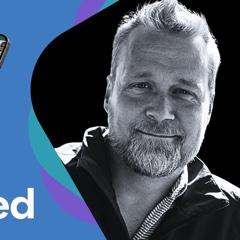
Jelte Liebrand
Founder and CEO of Savvy Navvy, a marine navigation app (Google Maps for boats)
Where to hear and read about Jelte Liebrand1 episode or test

Jelte Liebrand left Google to build Savvy Navvy, a navigation app often described as Google Maps for boats, and funded it through equity crowdfunding instead of venture capital. The lesson most worth taking is to raise as little as possible and win trust through partners such as boat makers and instructors, who are listened to more than any ad.
if you're building anything with the intent of launching it in 12 months from now, you've already lost
He left Google to build the Google Maps for boats — Jelte Liebrand, Savvy Navvy
Jelte Liebrand: the story and the lessons
1How Jelte Liebrand came to build Savvy Navvy
A bad day at Google sent Liebrand into a round-the-world yacht race. After a bad day at work he entered the Clipper Round the World race, which he had seen on posters many times. He signed up without telling his wife and took a sabbatical from Google after a lot of pre-race training.
He had worked on Google Maps and Chrome, so he arrived at sea with a strong sense of what good navigation software feels like.
On a racing yacht, he did the data fusion in his head. On a 70-foot yacht in the Pacific, separate tools each covered one factor and the boat's systems did not talk to each other. Screens showed pretty pictures while he combined hazards, weather, tide and current himself.
His verdict: "Being Dutch and being arrogant, I thought I could do better." Planning six hours ahead meant checking the tide and current for that hour and asking whether they pushed the boat into danger.
He doubted a market existed beyond ocean racers until he asked boaters. On the race he assumed few people sail 70-foot yachts. Back home he bought a clipboard and walked pontoons asking motorboaters, kayakers, paddle boarders and sailors what kept them off the water.
Qualified sailors stayed ashore for fear of getting tide calculations wrong, and some feared they would injure someone. The racing yacht made the market look tiny and the research showed it was huge. He says "anybody with a clipboard is taken seriously".
He brought the Google Maps interaction model into marine software. Liebrand says marine software trails land software by 15 to 20 years. He first guessed ten.
His view is that a product needing a manual has already lost. Google Maps takes two pins and handles traffic and roadworks, and he wanted the same for the sea, where human error costs more.
2Liebrand on customer research and shifting expectations
Liebrand keeps talking to customers long after launch. Needs differ by country, since Italy has no tides, and people use tools differently than five years ago. The team still talks to customers before building each new feature.
He notes that many founders research for a while, then run on that old information.
He assumes AI has already reset what users expect. Before ChatGPT few people expected to talk to a computer, and now an AI error annoys them. A build planned to launch in 12 months is already stale.
His test is to ask what feels dumb in 2026 but looked fine three years ago. One example is a game-cataloging app that scans a shelf with AI instead of making you type every title.
Liebrand expects asking questions to replace dropping a pin. A boater could ask when to go to Cowes, hear Saturday 11:00, then see the route. The pin was the original idea, but even that is starting to feel dated.
Software adapts quickly, while hardware has long lead times, which he learned from working with boat manufacturers.
3How Savvy Navvy funded itself with crowdfunding, not VC
Liebrand walked away from a VC term sheet over mismatched goals. A Google pitch day brought VC interest while he and his co-founder were bootstrapping. He met one VC several times and flew out to them, but friction showed.
His summary: "They want one thing from the business, we want something else." He had assumed an angel was just a small VC and that all funding sources were alike.
A friend's suggestion led him to crowdfund among existing users. A year later a friend, who was a potential angel and a customer, suggested crowdfunding. The app had 10,000 users who understood what the founders were building.
They had not considered it before and decided to give it a go. The company wanted capital to speed up growth but did not need the VC route.
The first campaign targeted 125,000 and closed at about 370,000 in 6 days. Demand passed the target within 24 hours, and the campaign launched with a video and no sense of what to expect. They closed it early to avoid giving up too much equity.
In his words, "within 6 days we shut it down because it was triple of what we what we needed". The first round gave every investor a Savvy Navvy sailing jacket.
Every investor gets the same shares on terms the lead angels set. Liebrand agrees terms and valuation with a handful of chosen angels before launch. Later rounds were mostly around 1 million, led by two or three angels who each put in six digits, and a long tail filled the rest.
There is no preferred class, and the platform (Seedrs, now owned by Republic, or Crowdcube) sits on the cap table as the front for small investors. Shares trade on a secondary market even though the company is private. Small investors are paid only at an exit.
The money went into marketing, and investors became an advice network. As a mostly B2C business, Savvy Navvy needs enough subscribers to cover fixed costs, so the raise funded marketing. About 2,500 investors now back it.
The team has asked them for help on logistics and marketing: "we can tap into these two and a half thousand investors and go, 'Hey guys, we need some help with this.'"
4Liebrand's rules for raising money
Liebrand tells most founders to raise half of what they think they need. Raising means selling part of the business, so a bigger round gives up more equity. His first advice is often not to raise at all.
He says "in the majority of the cases I would tell them raise half of what you're trying to raise".
He sees VC as the right model for only a narrow set of businesses. VCs invest repeatedly and want you to spend it all so they own more, chasing 20x on their fund. Angels have usually made their money already, want the business to succeed and bring vertical expertise, but write smaller cheques.
He guesses VC is wrong for 80 to 90% of businesses, while saying the number is made up. He compares a half-fitting business to a round peg in a square hole.
Set a minimum and a maximum raise before the campaign launches. The minimum is what funds the next 12 to 18 months. Oversubscribing means giving up more equity, and the range is wider in crowdfunding than in a VC round, so the cap matters more.
Valuation is only what someone will pay: he could argue the company is worth half a billion, but if nobody invests at that price, it isn't.
Each public round commits him to proving what he promised. Plans and past campaigns stay public on the platform, and investors compare them with results before the next round. His first letter promised the good, the bad and the ugly.
That openness won him the Seedrs Entrepreneur of the Year award in 2019.
Liebrand watches dilution and sets a sensible revenue multiple. A 1.5 million raise at 15 million is 10%, and giving up 40% is a red flag. The last round raised almost $700,000 at a $15 million valuation, about 3 to 4 times revenue.
Revenue is about 3.5 million B2C ARR plus over 2 million B2B. A 20x multiple would be absurd, since VCs pay that only because they fund 100% annual growth. He calls it low partly because raising was hard in 2025 and black swans such as boating downturns have blocked planned growth.
5How Liebrand built the boat manufacturer flywheel
Helm display integration turned an app into a platform. Plugging into boat helm displays gave Savvy Navvy a second route to market. Liebrand says it works like a firewall around the consumer business.
Drivers expect their phone to sync with the car dash, and boaters expect the same. The investor pitch shifted from an app to a platform changing marine navigation.
The Arc Boats partnership brought a wave of inbound interest. Arc is a fully electric wake boat maker in LA, which Liebrand calls the Tesla for boats, and Savvy Navvy supplies its charts and other technology. After the press release, unannounced builders reached out.
Incumbents could not give innovative builders what they wanted. Some approached with unreleased R&D projects, and builders now also find him at boat shows because their customers ask about Savvy Navvy.
CarPlay brought navigation to pontoon boats that never had it. Full marine navigation was too big, complex and costly for family pontoons. CarPlay gives the same ease as a car.
US pontoons go fast, so unseen shallows are a real safety risk.
Makers pay to bundle the app, and their name lends credibility. A high-end pontoon might include 12 months of the app, paid for by the maker via a QR code, and other deals bundle an extended trial. Consumers ask makers for it, and makers add it to the helm.
"The consumer wants it. Therefore, the manufacturer wants to provide it." A builder with decades of boats putting the app on board carries weight the app's own claims cannot.
Savvy Navvy skips boat show stands and uses shows to network. The company attends all boat shows but pays for no stand, since stands are priced per metre of boat and do not suit apps.
Walking the shows to meet industry people led to partnership opportunities.
6Why Liebrand wins trust through instructors, shops and brand
Instructors get the app free and a say in the product. They get webinars, early features, beta access and a student discount, and their feedback drives teaching tools in the app. Many refuse commissions so they are not seen as sales reps.
Instructors recommend Savvy Navvy first because it is the app company that listens to them. American Sailing has just signed in the US. His line: "not every mouth is the same value".
Instructor feedback produced a feature no other app has. The app does the three-point fix, a bearing-based position check for when GPS fails.
GPS does fail, for example in the Baltic Sea given geopolitics.
Chandleries reach buyers who never search for boat apps. Shops show a QR code to customers who are not on Facebook or looking for boat apps.
Seeing the app in a trusted store implies it must be good: "that must mean that it's good".
Liebrand builds brand because users trust the app with their safety. He can't measure brand and says growth would be easy if he could. A recipe app needs no brand, but people trusting an app with their family on the water want a good one.
Brand can lift the ceiling that performance marketing hits, and maker endorsement is a form of brand building paid ads cannot replicate.
7How a two-year plan sped up Savvy Navvy's CAC payback
A discounted two-year plan pulls cash forward to fund marketing. Boaters keep a boat for years, so a longer plan at a discount suits them. Revenue per person over two years is about the same, but the company collects it up front.
The gain is cash earlier, not extra money overall. Liebrand calls it one of the biggest wins of the last 12 months.
The plan is priced at about 30% off the annual rate. The annual plan is $129 and the two-year plan is $183, a clear saving for customers.
The money comes back as it is spent, which lifts what the company can afford on marketing. "That's had a huge impact on what we're then able to do on the marketing side."
8Liebrand's anonymous accounts mistake
Skipping signup looked like a huge win in the test. Account creation is a drop-off point, so the team created anonymous accounts under the hood. Early results were "through the roof".
At 100% rollout the success rate began to fall. Later they found metric issues in one region that had inflated the uptake.
Users wanted privacy but still needed to log in. People with a phone and an iPad could not sync without a login. That brought a flood of customer support issues.
Staff still have scars from it, and it remains a topic on the team's whiteboard. Friction removed at the top reappeared as support load.
He admits small startups rarely have the sample size for clean A/B tests. At Google, with a billion users, testing is easy and most ideas still fail. Without that scale it is easy to read in what you want and miss a metric further down the funnel.
His lesson is that nothing is in isolation, so a rollout needs watching after the test.

He left Google to build the Google Maps for boats — Jelte Liebrand, Savvy Navvy
Savvy Navvy's founder explains how he funded a consumer app through equity crowdfunding instead of VC, built a B2B boat manufacturer flywheel, and used a two-year plan to speed up CAC payback. He also shares why removing signup friction backfired and why most startups can't A/B test cleanly.
A bad day at Google sent Liebrand into a round-the-world yacht race. After a bad day at work he entered the Clipper Round the World race, which he had seen on posters many times. He signed up without telling his wife and took a sabbatical from Google after a lot of pre-race training.
He had worked on Google Maps and Chrome, so he arrived at sea with a strong sense of what good navigation software feels like.
On a racing yacht, he did the data fusion in his head. On a 70-foot yacht in the Pacific, separate tools each covered one factor and the boat's systems did not talk to each other. Screens showed pretty pictures while he combined hazards, weather, tide and current himself.
His verdict: "Being Dutch and being arrogant, I thought I could do better." Planning six hours ahead meant checking the tide and current for that hour and asking whether they pushed the boat into danger.
He doubted a market existed beyond ocean racers until he asked boaters. On the race he assumed few people sail 70-foot yachts. Back home he bought a clipboard and walked pontoons asking motorboaters, kayakers, paddle boarders and sailors what kept them off the water.
Qualified sailors stayed ashore for fear of getting tide calculations wrong, and some feared they would injure someone. The racing yacht made the market look tiny and the research showed it was huge. He says "anybody with a clipboard is taken seriously".
He brought the Google Maps interaction model into marine software. Liebrand says marine software trails land software by 15 to 20 years. He first guessed ten.
His view is that a product needing a manual has already lost. Google Maps takes two pins and handles traffic and roadworks, and he wanted the same for the sea, where human error costs more.
Liebrand keeps talking to customers long after launch. Needs differ by country, since Italy has no tides, and people use tools differently than five years ago. The team still talks to customers before building each new feature.
He notes that many founders research for a while, then run on that old information.
He assumes AI has already reset what users expect. Before ChatGPT few people expected to talk to a computer, and now an AI error annoys them. A build planned to launch in 12 months is already stale.
His test is to ask what feels dumb in 2026 but looked fine three years ago. One example is a game-cataloging app that scans a shelf with AI instead of making you type every title.
Liebrand expects asking questions to replace dropping a pin. A boater could ask when to go to Cowes, hear Saturday 11:00, then see the route. The pin was the original idea, but even that is starting to feel dated.
Software adapts quickly, while hardware has long lead times, which he learned from working with boat manufacturers.
Liebrand walked away from a VC term sheet over mismatched goals. A Google pitch day brought VC interest while he and his co-founder were bootstrapping. He met one VC several times and flew out to them, but friction showed.
His summary: "They want one thing from the business, we want something else." He had assumed an angel was just a small VC and that all funding sources were alike.
A friend's suggestion led him to crowdfund among existing users. A year later a friend, who was a potential angel and a customer, suggested crowdfunding. The app had 10,000 users who understood what the founders were building.
They had not considered it before and decided to give it a go. The company wanted capital to speed up growth but did not need the VC route.
The first campaign targeted 125,000 and closed at about 370,000 in 6 days. Demand passed the target within 24 hours, and the campaign launched with a video and no sense of what to expect. They closed it early to avoid giving up too much equity.
In his words, "within 6 days we shut it down because it was triple of what we what we needed". The first round gave every investor a Savvy Navvy sailing jacket.
Every investor gets the same shares on terms the lead angels set. Liebrand agrees terms and valuation with a handful of chosen angels before launch. Later rounds were mostly around 1 million, led by two or three angels who each put in six digits, and a long tail filled the rest.
There is no preferred class, and the platform (Seedrs, now owned by Republic, or Crowdcube) sits on the cap table as the front for small investors. Shares trade on a secondary market even though the company is private. Small investors are paid only at an exit.
The money went into marketing, and investors became an advice network. As a mostly B2C business, Savvy Navvy needs enough subscribers to cover fixed costs, so the raise funded marketing. About 2,500 investors now back it.
The team has asked them for help on logistics and marketing: "we can tap into these two and a half thousand investors and go, 'Hey guys, we need some help with this.'"
Liebrand tells most founders to raise half of what they think they need. Raising means selling part of the business, so a bigger round gives up more equity. His first advice is often not to raise at all.
He says "in the majority of the cases I would tell them raise half of what you're trying to raise".
He sees VC as the right model for only a narrow set of businesses. VCs invest repeatedly and want you to spend it all so they own more, chasing 20x on their fund. Angels have usually made their money already, want the business to succeed and bring vertical expertise, but write smaller cheques.
He guesses VC is wrong for 80 to 90% of businesses, while saying the number is made up. He compares a half-fitting business to a round peg in a square hole.
Set a minimum and a maximum raise before the campaign launches. The minimum is what funds the next 12 to 18 months. Oversubscribing means giving up more equity, and the range is wider in crowdfunding than in a VC round, so the cap matters more.
Valuation is only what someone will pay: he could argue the company is worth half a billion, but if nobody invests at that price, it isn't.
Each public round commits him to proving what he promised. Plans and past campaigns stay public on the platform, and investors compare them with results before the next round. His first letter promised the good, the bad and the ugly.
That openness won him the Seedrs Entrepreneur of the Year award in 2019.
Liebrand watches dilution and sets a sensible revenue multiple. A 1.5 million raise at 15 million is 10%, and giving up 40% is a red flag. The last round raised almost $700,000 at a $15 million valuation, about 3 to 4 times revenue.
Revenue is about 3.5 million B2C ARR plus over 2 million B2B. A 20x multiple would be absurd, since VCs pay that only because they fund 100% annual growth. He calls it low partly because raising was hard in 2025 and black swans such as boating downturns have blocked planned growth.
Helm display integration turned an app into a platform. Plugging into boat helm displays gave Savvy Navvy a second route to market. Liebrand says it works like a firewall around the consumer business.
Drivers expect their phone to sync with the car dash, and boaters expect the same. The investor pitch shifted from an app to a platform changing marine navigation.
The Arc Boats partnership brought a wave of inbound interest. Arc is a fully electric wake boat maker in LA, which Liebrand calls the Tesla for boats, and Savvy Navvy supplies its charts and other technology. After the press release, unannounced builders reached out.
Incumbents could not give innovative builders what they wanted. Some approached with unreleased R&D projects, and builders now also find him at boat shows because their customers ask about Savvy Navvy.
CarPlay brought navigation to pontoon boats that never had it. Full marine navigation was too big, complex and costly for family pontoons. CarPlay gives the same ease as a car.
US pontoons go fast, so unseen shallows are a real safety risk.
Makers pay to bundle the app, and their name lends credibility. A high-end pontoon might include 12 months of the app, paid for by the maker via a QR code, and other deals bundle an extended trial. Consumers ask makers for it, and makers add it to the helm.
"The consumer wants it. Therefore, the manufacturer wants to provide it." A builder with decades of boats putting the app on board carries weight the app's own claims cannot.
Savvy Navvy skips boat show stands and uses shows to network. The company attends all boat shows but pays for no stand, since stands are priced per metre of boat and do not suit apps.
Walking the shows to meet industry people led to partnership opportunities.
Instructors get the app free and a say in the product. They get webinars, early features, beta access and a student discount, and their feedback drives teaching tools in the app. Many refuse commissions so they are not seen as sales reps.
Instructors recommend Savvy Navvy first because it is the app company that listens to them. American Sailing has just signed in the US. His line: "not every mouth is the same value".
Instructor feedback produced a feature no other app has. The app does the three-point fix, a bearing-based position check for when GPS fails.
GPS does fail, for example in the Baltic Sea given geopolitics.
Chandleries reach buyers who never search for boat apps. Shops show a QR code to customers who are not on Facebook or looking for boat apps.
Seeing the app in a trusted store implies it must be good: "that must mean that it's good".
Liebrand builds brand because users trust the app with their safety. He can't measure brand and says growth would be easy if he could. A recipe app needs no brand, but people trusting an app with their family on the water want a good one.
Brand can lift the ceiling that performance marketing hits, and maker endorsement is a form of brand building paid ads cannot replicate.
A discounted two-year plan pulls cash forward to fund marketing. Boaters keep a boat for years, so a longer plan at a discount suits them. Revenue per person over two years is about the same, but the company collects it up front.
The gain is cash earlier, not extra money overall. Liebrand calls it one of the biggest wins of the last 12 months.
The plan is priced at about 30% off the annual rate. The annual plan is $129 and the two-year plan is $183, a clear saving for customers.
The money comes back as it is spent, which lifts what the company can afford on marketing. "That's had a huge impact on what we're then able to do on the marketing side."
Skipping signup looked like a huge win in the test. Account creation is a drop-off point, so the team created anonymous accounts under the hood. Early results were "through the roof".
At 100% rollout the success rate began to fall. Later they found metric issues in one region that had inflated the uptake.
Users wanted privacy but still needed to log in. People with a phone and an iPad could not sync without a login. That brought a flood of customer support issues.
Staff still have scars from it, and it remains a topic on the team's whiteboard. Friction removed at the top reappeared as support load.
He admits small startups rarely have the sample size for clean A/B tests. At Google, with a billion users, testing is easy and most ideas still fail. Without that scale it is easy to read in what you want and miss a metric further down the funnel.
His lesson is that nothing is in isolation, so a rollout needs watching after the test.