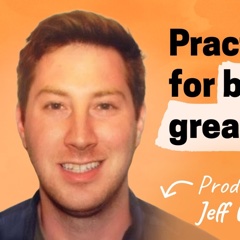
Jeff Weinstein
Product lead at Stripe, led payments infrastructure and Stripe Atlas
Where to hear and read about Jeff Weinstein1 episode or test

Jeff Weinstein is a product lead at Stripe who led payments infrastructure and Stripe Atlas, and who builds by staying close to paying customers and measuring their outcomes. The one thing most worth learning from him is to find a burning customer problem first, prove it with real payment, and add craft only after.
craft is a dessert that you get after the meal of does your thing solve a real problem in the world
Building product at Stripe: craft, metrics, and customer obsession | Jeff Weinstein (Product lead)
Jeff Weinstein: the story and the lessons
1Jeff Weinstein's path from a Baltimore school to Stripe
A school that let him choose his courses taught him to value his time. His Baltimore K-12 school let students pick classes outside AP tracks, grades or requirements. A History of Science teacher gave each student a ticket per class, priced at tuition divided by hours, to hand back only if the class was not worth it.
The class spent a full year on past scientific beliefs that turned out false. Handing over the ticket made him judge the value of his time, not just collect a grade.
Weinstein stays in the class he is worst at. In advanced microeconomics he and a friend used the same cheat sheets, quizzes and books. The friend got the top grade and Jeff the bottom, and the professor suggested he drop down a level.
He declined because he liked the topic and wanted to improve. A bad grade says little about whether to leave.
He added computer science after noticing who ran the companies he admired. He started as an English major and added computer science midway because the leaders of companies he admired had technical backgrounds. He finished with both a computer science and a liberal arts degree.
He did similarly poorly in the pre-med science classes along the way.
His SQL startup taught him craft means little without need. As a SQL analyst he built a tool with GitHub-style version control, charts and pivot tables for data queries. It reached a couple hundred customers and was eventually sold.
He calls the years 'wasting' only loosely, since the team built good software and learned a lot. That experience is where his craft obsession comes from, worked backwards from a failure.
Weinstein joined Stripe after recommending 7 Powers to Patrick Collison. He recommended the book during his Stripe job application. He had skipped the foreword, which quotes Collison.
His favorite powers in the book are counter-positioning and process power. He doubts process power is often real, since rivals can usually copy it.
2How Weinstein finds a burning customer problem
Weinstein read customer silence during an outage as missing product market fit. His SQL startup went down for 10 to 20 minutes and customers only murmured instead of emailing, texting or showing up. He celebrated the fast recovery and missed what the silence meant.
He spent many more years on that project before selling it. Polish comes after people badly need the product and will pause their day for it.
He never opens a customer call with a pitch. A pitch anchors the call on your guess of their top problem, and customers will not interrupt to correct you. He asks open prompts like 'what would you take off your plate with a magic wand' and then stays silent.
Recurring complaints reveal adjacencies. Customers' identity-fraud worries pushed Stripe into identity. 'Via silence, you can just create your roadmap pretty quickly.'
He counts only paying customers and sets friends' feedback to zero. He defines the target customer as one specific person with a specific problem, and made a rule not to even write down friends' feedback. He uses price as a forcing function, such as asking whether they would pay $10,000 with a full refund promise.
Friends click around and say they like it, but that differs from someone who has the problem and will pay. His intuition is mostly B2B.
Weinstein asks for real money, not stated willingness to pay. He has founders send him a $1 invoice or payment link on the spot so their first charge does not feel like a first. For big enterprise deals or partners, he suggests asking them to wire $1 million, refundable, before building off-roadmap.
A flat refusal saves months of building, and eager follow-up questions signal real pull. 'Ready to pay is very different from paying.' Stripe's founders still push this method inside a company of 8,000 people.
He answers customer messages immediately and turns angry ones into promoters. He treats a customer's message as a top-priority alert, since most people silently walk away. An Atlas bug printed 25 shares instead of 25% in some legal docs and a founder tweeted about it.
The team regenerated the documents quickly. The founder, who has a law degree, then offered to review Atlas docs anytime and became a close advisor.
He bounds overwhelming feedback with a short program or a structured email. He asks for three to five bullet points by email so detailed customers self-select. He also improvised a three-day Stripe bug-finder program in a tweet.
It produced 65 videos and dozens of issues. Even an arbitrary program gives people permission and bounds the work.
He keeps a few well-chosen customers a text message away. He pattern-matches to the most ambitious, technical and fastest-growing customers, and stays in touch with five or 10 of them. He pulls an engineer onto a call or forwards a message to Slack.
People post Reddit threads and screenshots of bad service, and he is surprised when teams do not use them.
3How Weinstein designs metrics at Stripe
Weinstein measures the outcome the customer wanted, from the customer's side. Counting is cheap now, so the work is choosing what to measure. He keeps the set small to force trade-offs and treats quantitative and qualitative evidence as equals.
His test of a good metric: 'if you accidentally leaked your dashboard to them, your customer would be ecstatic to learn that that's what you were measuring the whole time.'
Atlas's headline metric was founders finishing with zero support tickets. It came from reading sad support tickets and was a yes or no per founder, covering the first page load through the IRS wait plus a two-week buffer. The share rose from 15% to 85% in about 18 months, and market share followed the same curve.
He used a share of the cohort, not an average, because going from 0.3 tickets to 0.2 makes nobody recommend you. Engineers took ticket topics, replied to customers and shaped the fixes, which made them PMs.
Each tactic behind the headline metric gets its own owner and metric. One tactic was faster risk review, owned by an engineer and tracked as a cohort chart of days to a final decision. Roughly 100% of founders now get a decision within an hour, from a long tail.
Once the target was met the team put the tactic down. He rejects the Airbnb-style trap of making support harder to reach, and prefers watching several metrics with judgment.
He logs a line every time a user has a bad day. Events include a 404, a payout a day past its ETA, or more than 10 payment declines, stacked in one bar chart. Anyone on the team can add a new reason, and the team picks which to burn down.
The frequencies were mind-blowing at Stripe's scale. When an incident has no count, add one right away.
Weinstein will not look at a metric that is not on Go Metrics. One-off queries and screenshots cannot be interrogated and are usually wrong. A new metric goes through excitement, confusion, discovery of a counting error and a corrected version.
By week four team meetings open the live URL. He wants short customer-minded names like 'Companies with zero support', the same X-axis on every chart, and no false precision. Stripe can see which teams open their dashboards, which predicts how customer obsessed they are.
4How Weinstein keeps teams in the customer's seat
He runs Study Groups where colleagues play a made-up customer company. Four to eight volunteers invent a company, such as Dolphin Aquarium Industries, pick a CEO and a goal, and go through the product for an hour or more. Rule one is you do not work at Stripe, and rule two is nobody solves anything.
The facilitator pauses anyone using internal knowledge and the group redoes the step. More than 250 people have joined 25+ sessions, and teams now run their own. Findings go into Stripe's normal bug system with no mandate.
He ranks three ways to see the product as the customer does. Best is being your own customer, second is sitting next to a real customer, and third is pantomiming a customer with no internal knowledge. The failure mode is not looking at all.
Products drift from customers by default, and internal lingo leaks into the product. Friction logs work but set a high bar for time and context.
He lets customers draw the product, not just comment on it. Early founders join Atlas team meetings, all NPS scores go to Slack, and any score below 10 gets a direct follow-up. Founders draw what they want in Whimsical instead of the team running UXR first.
One diagram the team is working from was drawn by a customer before design saw it. 'Giving your customers write access, and not just read access, to your company is incredibly powerful.'
Weinstein wins internal buy-in with customer evidence and a working proof. He gathers about 50 customers saying the same thing, adds three bullets of strategy, and storyboards the ideal with a Sharpie. He asks for little headcount and gets one thing working once.
For the 83(b) election, one engineer mailed a single blank page. More than 10,000 elections have since been filed on time. 'I find proof of existence to be an incredibly powerful proof, rather than proof by theory or proof by debate.'
He pairs go-go-go speed with slow compounding investment. Payment methods and countries stayed flat through seven or eight years of pushing hard. The team then slowed down, built internal platforms and sent staff abroad to live with local payment methods.
Methods went from about 10 to 50 quickly and on to over 100. He will never regret faster API latency or more reliable 83(b) mailings. 'You had to mix the go, go, go with the long-term compounding.'
5How Weinstein built Stripe Atlas
Atlas started from founders abroad needing a plane to form a US company. A US company gave access to the financial system, US investors, USD and US customers. The US encourages foreign founders to incorporate there, so the barrier was process, not law.
Needing a plane to run a business from a laptop is an alarm bell for a product person. Instacart signed up for Stripe with a Gmail address, then delivered food during Covid.
Three years of automation turned company formation into one click. The 83(b) election gives 30 calendar days to snail-mail a form to the IRS, with no verification and no redo at day 31. Atlas now handles share purchase, bank account, tax ID and filings in the background.
The goal is to quit on Sunday night and run a business on Monday. Automation roughly halved the time to a first customer, even though Atlas was already well loved.
The 10-person Atlas team refuses work it cannot automate. The team needs leverage, so it takes on only automatable work. Each year it writes a document called 'Should We Do This Ourselves?' and always concludes no.
Mail vendors come with backups, SLAs, alerts and playbooks, and results are checked with OCR and checksums. Faxes and phone calls still happen, with robots waiting on hold.
He treated AngelList as an alternative, not a competitor. When AngelList launched incorporation, Atlas kept a shared Slack channel, discussed legal constructs openly and held to its long-term approach. About two years later AngelList exited incorporation and sent customers to Atlas.
Data now flows between them, with similar integrations for Mercury and Carta. 'They're not competitors. It's alternatives, and if you care about your customer, you care about their alternatives.'
He built the Atlas candidate pool diverse before hiring. His earlier startup was all men when sold to Box, and each later hire got harder. For Atlas he checked each role's candidate pool matched the team he wanted, and the 10-person team is majority women.
'It's not a down funnel problem, it is an up funnel problem.'
Atlas results: high NPS, wide reach, and companies that grow. Atlas NPS is above 80 with almost 50% response. One in six new Delaware corporations starts on Atlas, and its 55,000 companies to date make $5 billion a year.
In a survey, about 20% of founders said they would not have started, or not then, without Atlas.
He won long-term investment by showing economics and shared metrics. He showed Atlas as the best customer acquisition per dollar, or a margin and ecosystem builder. A shared metrics page replaced long update decks.
Doubters who asked why Atlas makes so little money became people rooting for it as the curves moved. Jeff is about the fourth Atlas lead.
6What the Collisons taught Weinstein about hard problems
John Collison told him to stay stuck on problems one and two. John said Jeff was great at problems three through 100 but he needed him stuck on problems one and two. Jeff then brought only those two to their one-on-ones, even while the team kept working on the rest.
He had been arriving with a clipboard and checklists of everything done and stuck. The easier problems were masking the hardest ones.
Patrick Collison pushed him to write in his own voice. In his first month Jeff wrote the quarterly business review for payments infrastructure. Patrick told him the draft did not sound like him yet, so he rewrote it.
The Collisons' best advice, in his telling, was to sound like yourself and stay stuck on the hardest problems.
Weinstein's mottos are 'Go Go Go' and 'Let's make some mistakes'. Colleagues now say 'Go Go Go' back to him. He uses 'Let's make some mistakes' in brainstorms to drop pretense and invite creativity.
He notes they fit some work and not others, such as the five nines of reliability on Stripe's API.
His reading list shapes how he leads and thinks about strategy. High Output Management gives a bar for leaders: your work is the sum of everyone around you. Orbiting the Giant Hairball is about staying creative inside a slow, rule-heavy company.
The first two apps he installs on a new laptop are Raycast and CleanShot, the latter for blurring, arrows and lines on screenshots to show what he sees.

Building product at Stripe: craft, metrics, and customer obsession | Jeff Weinstein (Product lead)
Jeff Weinstein explains how Stripe builds products by staying close to paying customers, choosing a few customer-facing metrics, and using fun, unnatural practices like Study Groups to keep quality high. The result: Atlas went from 15% to 85% of founders finishing with zero support tickets in 18 months, with NPS above 80 and about one in six new Delaware corporations started on it.
A school that let him choose his courses taught him to value his time. His Baltimore K-12 school let students pick classes outside AP tracks, grades or requirements. A History of Science teacher gave each student a ticket per class, priced at tuition divided by hours, to hand back only if the class was not worth it.
The class spent a full year on past scientific beliefs that turned out false. Handing over the ticket made him judge the value of his time, not just collect a grade.
Weinstein stays in the class he is worst at. In advanced microeconomics he and a friend used the same cheat sheets, quizzes and books. The friend got the top grade and Jeff the bottom, and the professor suggested he drop down a level.
He declined because he liked the topic and wanted to improve. A bad grade says little about whether to leave.
He added computer science after noticing who ran the companies he admired. He started as an English major and added computer science midway because the leaders of companies he admired had technical backgrounds. He finished with both a computer science and a liberal arts degree.
He did similarly poorly in the pre-med science classes along the way.
His SQL startup taught him craft means little without need. As a SQL analyst he built a tool with GitHub-style version control, charts and pivot tables for data queries. It reached a couple hundred customers and was eventually sold.
He calls the years 'wasting' only loosely, since the team built good software and learned a lot. That experience is where his craft obsession comes from, worked backwards from a failure.
Weinstein joined Stripe after recommending 7 Powers to Patrick Collison. He recommended the book during his Stripe job application. He had skipped the foreword, which quotes Collison.
His favorite powers in the book are counter-positioning and process power. He doubts process power is often real, since rivals can usually copy it.
Weinstein read customer silence during an outage as missing product market fit. His SQL startup went down for 10 to 20 minutes and customers only murmured instead of emailing, texting or showing up. He celebrated the fast recovery and missed what the silence meant.
He spent many more years on that project before selling it. Polish comes after people badly need the product and will pause their day for it.
He never opens a customer call with a pitch. A pitch anchors the call on your guess of their top problem, and customers will not interrupt to correct you. He asks open prompts like 'what would you take off your plate with a magic wand' and then stays silent.
Recurring complaints reveal adjacencies. Customers' identity-fraud worries pushed Stripe into identity. 'Via silence, you can just create your roadmap pretty quickly.'
He counts only paying customers and sets friends' feedback to zero. He defines the target customer as one specific person with a specific problem, and made a rule not to even write down friends' feedback. He uses price as a forcing function, such as asking whether they would pay $10,000 with a full refund promise.
Friends click around and say they like it, but that differs from someone who has the problem and will pay. His intuition is mostly B2B.
Weinstein asks for real money, not stated willingness to pay. He has founders send him a $1 invoice or payment link on the spot so their first charge does not feel like a first. For big enterprise deals or partners, he suggests asking them to wire $1 million, refundable, before building off-roadmap.
A flat refusal saves months of building, and eager follow-up questions signal real pull. 'Ready to pay is very different from paying.' Stripe's founders still push this method inside a company of 8,000 people.
He answers customer messages immediately and turns angry ones into promoters. He treats a customer's message as a top-priority alert, since most people silently walk away. An Atlas bug printed 25 shares instead of 25% in some legal docs and a founder tweeted about it.
The team regenerated the documents quickly. The founder, who has a law degree, then offered to review Atlas docs anytime and became a close advisor.
He bounds overwhelming feedback with a short program or a structured email. He asks for three to five bullet points by email so detailed customers self-select. He also improvised a three-day Stripe bug-finder program in a tweet.
It produced 65 videos and dozens of issues. Even an arbitrary program gives people permission and bounds the work.
He keeps a few well-chosen customers a text message away. He pattern-matches to the most ambitious, technical and fastest-growing customers, and stays in touch with five or 10 of them. He pulls an engineer onto a call or forwards a message to Slack.
People post Reddit threads and screenshots of bad service, and he is surprised when teams do not use them.
Weinstein measures the outcome the customer wanted, from the customer's side. Counting is cheap now, so the work is choosing what to measure. He keeps the set small to force trade-offs and treats quantitative and qualitative evidence as equals.
His test of a good metric: 'if you accidentally leaked your dashboard to them, your customer would be ecstatic to learn that that's what you were measuring the whole time.'
Atlas's headline metric was founders finishing with zero support tickets. It came from reading sad support tickets and was a yes or no per founder, covering the first page load through the IRS wait plus a two-week buffer. The share rose from 15% to 85% in about 18 months, and market share followed the same curve.
He used a share of the cohort, not an average, because going from 0.3 tickets to 0.2 makes nobody recommend you. Engineers took ticket topics, replied to customers and shaped the fixes, which made them PMs.
Each tactic behind the headline metric gets its own owner and metric. One tactic was faster risk review, owned by an engineer and tracked as a cohort chart of days to a final decision. Roughly 100% of founders now get a decision within an hour, from a long tail.
Once the target was met the team put the tactic down. He rejects the Airbnb-style trap of making support harder to reach, and prefers watching several metrics with judgment.
He logs a line every time a user has a bad day. Events include a 404, a payout a day past its ETA, or more than 10 payment declines, stacked in one bar chart. Anyone on the team can add a new reason, and the team picks which to burn down.
The frequencies were mind-blowing at Stripe's scale. When an incident has no count, add one right away.
Weinstein will not look at a metric that is not on Go Metrics. One-off queries and screenshots cannot be interrogated and are usually wrong. A new metric goes through excitement, confusion, discovery of a counting error and a corrected version.
By week four team meetings open the live URL. He wants short customer-minded names like 'Companies with zero support', the same X-axis on every chart, and no false precision. Stripe can see which teams open their dashboards, which predicts how customer obsessed they are.
He runs Study Groups where colleagues play a made-up customer company. Four to eight volunteers invent a company, such as Dolphin Aquarium Industries, pick a CEO and a goal, and go through the product for an hour or more. Rule one is you do not work at Stripe, and rule two is nobody solves anything.
The facilitator pauses anyone using internal knowledge and the group redoes the step. More than 250 people have joined 25+ sessions, and teams now run their own. Findings go into Stripe's normal bug system with no mandate.
He ranks three ways to see the product as the customer does. Best is being your own customer, second is sitting next to a real customer, and third is pantomiming a customer with no internal knowledge. The failure mode is not looking at all.
Products drift from customers by default, and internal lingo leaks into the product. Friction logs work but set a high bar for time and context.
He lets customers draw the product, not just comment on it. Early founders join Atlas team meetings, all NPS scores go to Slack, and any score below 10 gets a direct follow-up. Founders draw what they want in Whimsical instead of the team running UXR first.
One diagram the team is working from was drawn by a customer before design saw it. 'Giving your customers write access, and not just read access, to your company is incredibly powerful.'
Weinstein wins internal buy-in with customer evidence and a working proof. He gathers about 50 customers saying the same thing, adds three bullets of strategy, and storyboards the ideal with a Sharpie. He asks for little headcount and gets one thing working once.
For the 83(b) election, one engineer mailed a single blank page. More than 10,000 elections have since been filed on time. 'I find proof of existence to be an incredibly powerful proof, rather than proof by theory or proof by debate.'
He pairs go-go-go speed with slow compounding investment. Payment methods and countries stayed flat through seven or eight years of pushing hard. The team then slowed down, built internal platforms and sent staff abroad to live with local payment methods.
Methods went from about 10 to 50 quickly and on to over 100. He will never regret faster API latency or more reliable 83(b) mailings. 'You had to mix the go, go, go with the long-term compounding.'
Atlas started from founders abroad needing a plane to form a US company. A US company gave access to the financial system, US investors, USD and US customers. The US encourages foreign founders to incorporate there, so the barrier was process, not law.
Needing a plane to run a business from a laptop is an alarm bell for a product person. Instacart signed up for Stripe with a Gmail address, then delivered food during Covid.
Three years of automation turned company formation into one click. The 83(b) election gives 30 calendar days to snail-mail a form to the IRS, with no verification and no redo at day 31. Atlas now handles share purchase, bank account, tax ID and filings in the background.
The goal is to quit on Sunday night and run a business on Monday. Automation roughly halved the time to a first customer, even though Atlas was already well loved.
The 10-person Atlas team refuses work it cannot automate. The team needs leverage, so it takes on only automatable work. Each year it writes a document called 'Should We Do This Ourselves?' and always concludes no.
Mail vendors come with backups, SLAs, alerts and playbooks, and results are checked with OCR and checksums. Faxes and phone calls still happen, with robots waiting on hold.
He treated AngelList as an alternative, not a competitor. When AngelList launched incorporation, Atlas kept a shared Slack channel, discussed legal constructs openly and held to its long-term approach. About two years later AngelList exited incorporation and sent customers to Atlas.
Data now flows between them, with similar integrations for Mercury and Carta. 'They're not competitors. It's alternatives, and if you care about your customer, you care about their alternatives.'
He built the Atlas candidate pool diverse before hiring. His earlier startup was all men when sold to Box, and each later hire got harder. For Atlas he checked each role's candidate pool matched the team he wanted, and the 10-person team is majority women.
'It's not a down funnel problem, it is an up funnel problem.'
Atlas results: high NPS, wide reach, and companies that grow. Atlas NPS is above 80 with almost 50% response. One in six new Delaware corporations starts on Atlas, and its 55,000 companies to date make $5 billion a year.
In a survey, about 20% of founders said they would not have started, or not then, without Atlas.
He won long-term investment by showing economics and shared metrics. He showed Atlas as the best customer acquisition per dollar, or a margin and ecosystem builder. A shared metrics page replaced long update decks.
Doubters who asked why Atlas makes so little money became people rooting for it as the curves moved. Jeff is about the fourth Atlas lead.
John Collison told him to stay stuck on problems one and two. John said Jeff was great at problems three through 100 but he needed him stuck on problems one and two. Jeff then brought only those two to their one-on-ones, even while the team kept working on the rest.
He had been arriving with a clipboard and checklists of everything done and stuck. The easier problems were masking the hardest ones.
Patrick Collison pushed him to write in his own voice. In his first month Jeff wrote the quarterly business review for payments infrastructure. Patrick told him the draft did not sound like him yet, so he rewrote it.
The Collisons' best advice, in his telling, was to sound like yourself and stay stuck on the hardest problems.
Weinstein's mottos are 'Go Go Go' and 'Let's make some mistakes'. Colleagues now say 'Go Go Go' back to him. He uses 'Let's make some mistakes' in brainstorms to drop pretense and invite creativity.
He notes they fit some work and not others, such as the five nines of reliability on Stripe's API.
His reading list shapes how he leads and thinks about strategy. High Output Management gives a bar for leaders: your work is the sum of everyone around you. Orbiting the Giant Hairball is about staying creative inside a slow, rule-heavy company.
The first two apps he installs on a new laptop are Raycast and CleanShot, the latter for blurring, arrows and lines on screenshots to show what he sees.