Jason Lemkin
Founder and CEO of SaaStr, veteran SaaS investor
Where to hear and read about Jason Lemkin1 episode or test
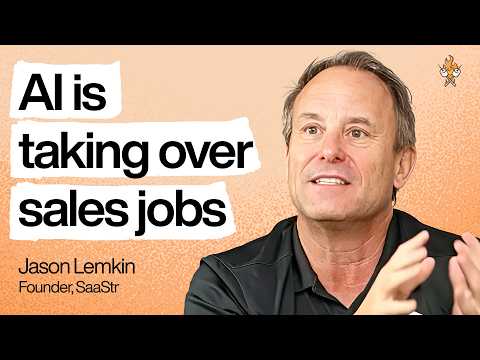
Jason Lemkin is the founder and CEO of SaaStr, a SaaS investor and the builder of the largest community for B2B founders. The thing most worth learning from him is to train and run one AI agent yourself, because well-trained agents now do the work of a mid-level sales team and almost nobody has done it.
If you can go do this and get it live into production, you're hyper employable.
We replaced our sales team with 20 AI agents—here’s what happened next | Jason Lemkin (SaaStr)
Jason Lemkin: the story and the lessons
1How Jason Lemkin built SaaStr
Lemkin started SaaStr as a blog about his own mistakes. He began it in 2012, after selling his startup to Adobe. It grew into a community, an event business and an investing pipeline.
The annual event draws 10,000 people and revenue runs to eight figures. Events carry heavy costs, while the media side has almost none.
He invests only in founders from his own community. He has invested almost $200 million and returned almost 10x.
He also backed Salesloft when nobody wanted the AI SDR category.
SaaStr's revenue depends on selling sponsorships and tickets at volume. Sponsorships average $70 to 80K. Tickets run from a couple hundred dollars to about $2,000 and bring in four to five million dollars a year.
Landing two sponsors for a podcast takes a few emails. Selling about a hundred takes real work, and that gap is what he later handed to agents.
2How Lemkin replaced SaaStr's sales team with 20 AI agents
Lemkin stopped hiring sales reps after his eighth team. He could not pay a junior SDR $150,000 a year to quit one more time. Two well-paid reps quit on site at the 10,000-person event.
He expected agents to 'sort of work' because a general digital-clone agent had already closed a $70K sponsorship on its own.
He started with a digital clone of himself for support. He built it on Delphi with 10,000 pieces of his content, after seeing Brian Halligan's HubSpot clone. Attendees asked it about refunds, discounts and venue location, which human support used to answer about two weeks late.
Setup took about a week. Early on it gave wrong event dates, and he spent an hour each morning correcting it until he no longer needed to.
Outbound and inbound agents took the work no human wanted. Artisan worked a 400,000-name list and sent about 60,000 emails. Qualified answers site visitors, screens out poor fits and books meetings.
One sponsor signed at 11 p.m. on a Saturday. In his words, no human would pick up the phone for these people.
Each sales motion got its own agent. Sponsorships, tickets and lapsed attendees each run on a separate agent, sometimes on different vendors. A human might reach 2,000 people from a 1.2 million list, while an agent can work all of it.
The team went from about 10 people to 1.2 humans and 20 agents. It was two to three SDRs and up to five AEs. Now it is one AE plus about 20% of chief AI officer Amelia's time, with productivity 'about the same, not better, not worse.'
No SDRs or BDRs are left. One human negotiates and closes, and he is still learning how an AE-side agent would work.
The same-output claim rests on his own account. No revenue, conversion or cost figures are set against the old team, and SaaStr is a niche business with mostly inbound and renewal sales.
His 90% and 70% to 40% job-loss figures are guesses, and he mentions the cost of drying entry-level pipelines only in passing.
3Lemkin's rules for deploying AI agents
Lemkin says train one agent yourself, end to end. Pick one painful problem and one leading vendor, ingest your data, answer the agent's questions, then correct its output for an hour or two a day for about 30 days. He puts it at 50 to 60 hours.
A public B2B company worth over $10 billion had 20 people on a call and nobody had trained an agent. The second agent is much easier than the first.
He buys go-to-market agents and builds none of them. Building your own is like building your own Notion: possible, but a homegrown tool can be obsolete within months. Only build if an engineer is itching to do it, as at Vercel.
He calls himself a top 1% Replit user. His own builds include a startup calculator used 800,000 times in 90 days and a pitch deck reviewer that has reviewed almost 3,000 decks.
He picks vendors by who will help deploy, not by features. Leading tools are 'more similar than different' under the hood, so he adds a column for the forward-deployed engineer. He chose Artisan and Qualified because they offered the most help.
Another vendor wanted $100K up front. Both chosen deployments worked quickly.
He does not expect agents to work out of the box. 2024 tools failed because models were weaker before Claude 4 and vendors said to just turn the product on. He plans for about 30 days of daily correction of hallucinations and wrong facts.
Buying an agent and disappearing gives zero ROI.
He trains agents on his best person's emails. Upload the top rep's or marketer's copy as the template. The agent then A/B tests variants and lightly personalizes with CRM data and site-visitor tracking.
The bar to beat is the midpack human, whose emails are often worse. Poor AI emails usually mean a poorly trained product or a bad vendor.
Lemkin points agents at leads his reps skipped. Agentforce, pointed at leads reps had ignored, got a 70% response rate. Reps skip leads when they are busy or the commission is small.
He calls them 'people that were dying to interact with us.' A company with a few thousand leads or visitors has enough data to benefit.
He gives each agent fleet a nerdy insider as owner. Amelia spends 10 to 15 hours a week reviewing 20 agents, because agents work nights, weekends and Christmas. He would promote a data-minded person from product, marketing or RevOps who already builds apps in Replit or Vercel.
The owner must also segment the customer base so agents for inbound, retargeting and new outreach do not collide. The odds the person comes from regular sales approach zero.
He tells people to start where nothing exists today. Support and inbound qualification are easy first picks because any result is pure gain. Most apps lack good 24/7 support.
To find the gap, sign up for your own product in incognito mode with a fresh Gmail address and fix whatever makes you 'cry the most.' He suggests running the test once a quarter.
He does not hide that emails come from AI. SaaStr sent hundreds of thousands of emails, labeled and unlabeled, and found no difference. Some founders reply that they can tell it is AI but it is pretty good, and still ask for a meeting.
He calls worry about disclosure an excuse not to do the work.
4What Lemkin expects for sales jobs
Lemkin says agents displace the midpack, not the best humans. He expects email-cadence SDRs to be about 90% displaced within a year and inbound qualifiers 'mostly extinct.' The safe share of AE work falls from about 70% toward 40 or 50%.
The reps at risk do not know what Linear does or what a pull request is. Agents already qualify leads better than people, and customers prefer it.
He keeps humans for a short list of huge accounts. For 50 target sponsors worth half a million dollars each over two years, the best people split the list on a whiteboard and write by hand.
At 5,000 targets that approach cannot work, and every company reaches high volume as it grows. He still uses Claude to research and sharpen his best emails.
He would pay SDRs who manage agents far more. He pictures $250,000 SDRs managing ten agents each, instead of $80,000 SDRs working alone. Owner.com targets $3 to 5 million per rep, against $300 to 500K three or four years ago.
Reps who accept activity tracking and extra meetings leap ahead of those who resist. One rep quit the day tracking launched, having done nothing in 30 days.
He thinks only about 20% of GTM leaders fit the AI era. Executives and VPs stay, because agents still need someone to lead them. Most leaders he talks to are still panicking about AI.
For a startup hire he wants someone ready to roll up their sleeves and do the 2026 and 2027 job. Working at Slack does not mean having the skills a startup needs.
He offers no fix for the vanishing entry-level path. Agents will close simple deals where little is negotiated, which shrinks the SDR and AE rungs. He names the open question of how to build the profession without them.
He notes Shopify and others cut entry-level hires and prefer a six or seven-year engineer who is a 'Cursor machine.'
Being a people person no longer protects a sales job. His team closed hundreds of thousands of deals this way, and people did not mind an AI. He says people have weaker customer relationships than they think.
Door knocking and field sales are still safe. He sums the range up as 80% automated in support to 0% in door knocking.
5How Lemkin thinks about go-to-market and change
Lemkin says take the plays from GTM books, not the playbooks. Outbound, webinars, podcasts and events still work, but the 2021 playbooks do not. He declined to write a foreword for a respected leader's book because it was too dated on AI.
'The plays all work, but the playbooks don't really work as well.' Pick two or three useful items rather than copying a system.
He calls the current buying surge an AI bubble. Normally 3 to 5% of prospects are in market in a year. In many AI categories it is now north of 50%.
He says an enterprise cannot buy in every year, so the surge will end. He advises vendors to close within 12 months, before buyers hit agent fatigue.
He wants agents proving value before the contract is signed. Customers now expect the agent to work during the pilot. One AI leader closed a $3 million deal where the forward-deployed engineer did the whole deployment and sales only handled procurement.
He claims a 100% launch success rate against about 5% in 2024. His favorite engineer for the role is a mediocre one who loves the product.
He tells teams plainly that AI helps the best and threatens some. At SaaStr, departing reps were backfilled with agents. He says he has never fired anyone except for inappropriate conduct.
In his view many layoffs blamed on AI are an excuse to downsize anyway. At Vercel, SDRs were moved between inbound and outbound instead of being let go.
He says mastering AI means working harder, not less. Fast-growing winners like ElevenLabs and Replit are adding sales staff. He says nobody should plan past three to four years and that people should either commit fully or join a slower-growth company.
'If you don't feel tired, you aren't living the AI dream.' He also tells founders with happy customers not to quit, since turning existing customers into an AI product is easier than starting over.

We replaced our sales team with 20 AI agents—here’s what happened next | Jason Lemkin (SaaStr)
Jason Lemkin explains how SaaStr replaced a go-to-market team of about 10 people with 1.2 humans and 20 AI agents, and what it took to train, manage and choose vendors for them. The result is similar sales output to the old human team, plus a clear picture of which sales roles survive and how to become hyper-employable.
Lemkin started SaaStr as a blog about his own mistakes. He began it in 2012, after selling his startup to Adobe. It grew into a community, an event business and an investing pipeline.
The annual event draws 10,000 people and revenue runs to eight figures. Events carry heavy costs, while the media side has almost none.
He invests only in founders from his own community. He has invested almost $200 million and returned almost 10x.
He also backed Salesloft when nobody wanted the AI SDR category.
SaaStr's revenue depends on selling sponsorships and tickets at volume. Sponsorships average $70 to 80K. Tickets run from a couple hundred dollars to about $2,000 and bring in four to five million dollars a year.
Landing two sponsors for a podcast takes a few emails. Selling about a hundred takes real work, and that gap is what he later handed to agents.
Lemkin stopped hiring sales reps after his eighth team. He could not pay a junior SDR $150,000 a year to quit one more time. Two well-paid reps quit on site at the 10,000-person event.
He expected agents to 'sort of work' because a general digital-clone agent had already closed a $70K sponsorship on its own.
He started with a digital clone of himself for support. He built it on Delphi with 10,000 pieces of his content, after seeing Brian Halligan's HubSpot clone. Attendees asked it about refunds, discounts and venue location, which human support used to answer about two weeks late.
Setup took about a week. Early on it gave wrong event dates, and he spent an hour each morning correcting it until he no longer needed to.
Outbound and inbound agents took the work no human wanted. Artisan worked a 400,000-name list and sent about 60,000 emails. Qualified answers site visitors, screens out poor fits and books meetings.
One sponsor signed at 11 p.m. on a Saturday. In his words, no human would pick up the phone for these people.
Each sales motion got its own agent. Sponsorships, tickets and lapsed attendees each run on a separate agent, sometimes on different vendors. A human might reach 2,000 people from a 1.2 million list, while an agent can work all of it.
The team went from about 10 people to 1.2 humans and 20 agents. It was two to three SDRs and up to five AEs. Now it is one AE plus about 20% of chief AI officer Amelia's time, with productivity 'about the same, not better, not worse.'
No SDRs or BDRs are left. One human negotiates and closes, and he is still learning how an AE-side agent would work.
The same-output claim rests on his own account. No revenue, conversion or cost figures are set against the old team, and SaaStr is a niche business with mostly inbound and renewal sales.
His 90% and 70% to 40% job-loss figures are guesses, and he mentions the cost of drying entry-level pipelines only in passing.
Lemkin says train one agent yourself, end to end. Pick one painful problem and one leading vendor, ingest your data, answer the agent's questions, then correct its output for an hour or two a day for about 30 days. He puts it at 50 to 60 hours.
A public B2B company worth over $10 billion had 20 people on a call and nobody had trained an agent. The second agent is much easier than the first.
He buys go-to-market agents and builds none of them. Building your own is like building your own Notion: possible, but a homegrown tool can be obsolete within months. Only build if an engineer is itching to do it, as at Vercel.
He calls himself a top 1% Replit user. His own builds include a startup calculator used 800,000 times in 90 days and a pitch deck reviewer that has reviewed almost 3,000 decks.
He picks vendors by who will help deploy, not by features. Leading tools are 'more similar than different' under the hood, so he adds a column for the forward-deployed engineer. He chose Artisan and Qualified because they offered the most help.
Another vendor wanted $100K up front. Both chosen deployments worked quickly.
He does not expect agents to work out of the box. 2024 tools failed because models were weaker before Claude 4 and vendors said to just turn the product on. He plans for about 30 days of daily correction of hallucinations and wrong facts.
Buying an agent and disappearing gives zero ROI.
He trains agents on his best person's emails. Upload the top rep's or marketer's copy as the template. The agent then A/B tests variants and lightly personalizes with CRM data and site-visitor tracking.
The bar to beat is the midpack human, whose emails are often worse. Poor AI emails usually mean a poorly trained product or a bad vendor.
Lemkin points agents at leads his reps skipped. Agentforce, pointed at leads reps had ignored, got a 70% response rate. Reps skip leads when they are busy or the commission is small.
He calls them 'people that were dying to interact with us.' A company with a few thousand leads or visitors has enough data to benefit.
He gives each agent fleet a nerdy insider as owner. Amelia spends 10 to 15 hours a week reviewing 20 agents, because agents work nights, weekends and Christmas. He would promote a data-minded person from product, marketing or RevOps who already builds apps in Replit or Vercel.
The owner must also segment the customer base so agents for inbound, retargeting and new outreach do not collide. The odds the person comes from regular sales approach zero.
He tells people to start where nothing exists today. Support and inbound qualification are easy first picks because any result is pure gain. Most apps lack good 24/7 support.
To find the gap, sign up for your own product in incognito mode with a fresh Gmail address and fix whatever makes you 'cry the most.' He suggests running the test once a quarter.
He does not hide that emails come from AI. SaaStr sent hundreds of thousands of emails, labeled and unlabeled, and found no difference. Some founders reply that they can tell it is AI but it is pretty good, and still ask for a meeting.
He calls worry about disclosure an excuse not to do the work.
Lemkin says agents displace the midpack, not the best humans. He expects email-cadence SDRs to be about 90% displaced within a year and inbound qualifiers 'mostly extinct.' The safe share of AE work falls from about 70% toward 40 or 50%.
The reps at risk do not know what Linear does or what a pull request is. Agents already qualify leads better than people, and customers prefer it.
He keeps humans for a short list of huge accounts. For 50 target sponsors worth half a million dollars each over two years, the best people split the list on a whiteboard and write by hand.
At 5,000 targets that approach cannot work, and every company reaches high volume as it grows. He still uses Claude to research and sharpen his best emails.
He would pay SDRs who manage agents far more. He pictures $250,000 SDRs managing ten agents each, instead of $80,000 SDRs working alone. Owner.com targets $3 to 5 million per rep, against $300 to 500K three or four years ago.
Reps who accept activity tracking and extra meetings leap ahead of those who resist. One rep quit the day tracking launched, having done nothing in 30 days.
He thinks only about 20% of GTM leaders fit the AI era. Executives and VPs stay, because agents still need someone to lead them. Most leaders he talks to are still panicking about AI.
For a startup hire he wants someone ready to roll up their sleeves and do the 2026 and 2027 job. Working at Slack does not mean having the skills a startup needs.
He offers no fix for the vanishing entry-level path. Agents will close simple deals where little is negotiated, which shrinks the SDR and AE rungs. He names the open question of how to build the profession without them.
He notes Shopify and others cut entry-level hires and prefer a six or seven-year engineer who is a 'Cursor machine.'
Being a people person no longer protects a sales job. His team closed hundreds of thousands of deals this way, and people did not mind an AI. He says people have weaker customer relationships than they think.
Door knocking and field sales are still safe. He sums the range up as 80% automated in support to 0% in door knocking.
Lemkin says take the plays from GTM books, not the playbooks. Outbound, webinars, podcasts and events still work, but the 2021 playbooks do not. He declined to write a foreword for a respected leader's book because it was too dated on AI.
'The plays all work, but the playbooks don't really work as well.' Pick two or three useful items rather than copying a system.
He calls the current buying surge an AI bubble. Normally 3 to 5% of prospects are in market in a year. In many AI categories it is now north of 50%.
He says an enterprise cannot buy in every year, so the surge will end. He advises vendors to close within 12 months, before buyers hit agent fatigue.
He wants agents proving value before the contract is signed. Customers now expect the agent to work during the pilot. One AI leader closed a $3 million deal where the forward-deployed engineer did the whole deployment and sales only handled procurement.
He claims a 100% launch success rate against about 5% in 2024. His favorite engineer for the role is a mediocre one who loves the product.
He tells teams plainly that AI helps the best and threatens some. At SaaStr, departing reps were backfilled with agents. He says he has never fired anyone except for inappropriate conduct.
In his view many layoffs blamed on AI are an excuse to downsize anyway. At Vercel, SDRs were moved between inbound and outbound instead of being let go.
He says mastering AI means working harder, not less. Fast-growing winners like ElevenLabs and Replit are adding sales staff. He says nobody should plan past three to four years and that people should either commit fully or join a slower-growth company.
'If you don't feel tired, you aren't living the AI dream.' He also tells founders with happy customers not to quit, since turning existing customers into an AI product is easier than starting over.