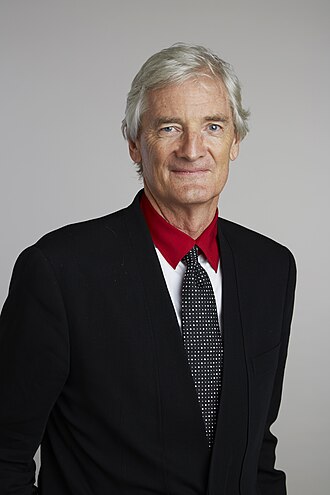
James Dyson
Founder of Dyson and inventor of the bagless cyclone vacuum cleaner
Where to hear and read about James Dyson1 episode or test

James Dyson is the British engineer who spent years and 5,127 prototypes building the bagless dual cyclone vacuum cleaner after every major manufacturer turned it down, then built Dyson as a company he fully controls. The thing most worth learning from him is how doggedness, hands-on trial and error, and keeping control of the whole chain from invention to sale let a fragile idea survive.
I aim not to be clever but to be dogged.
James Dyson: 5,127 Prototypes
James Dyson: the story and the lessons
1How James Dyson's early life shaped a risk taker
Losing his father young left Dyson comfortable with risk. His father died of cancer when Dyson was eight or nine, after fighting in Burma and teaching classics for three years. Dyson reasons that once you lose a parent that young, life can't get much worse.
His father had wanted to work for the BBC and never got the chance, and his mother also died of cancer, at 55. Those losses made Dyson impatient to get the most from life, and he says living on the knife edge does not keep him awake.
Being the youngest forced him to punch above his weight. He grew up living in a school among teachers' children up to five years older, and was the youngest of three. To beat them at tennis or in a race he had to be really, really good.
His headmaster let him stay at boarding school 10 years without fees, and his impoverished mother was the only parent who visited. He ties his restlessness and quick recovery from failure to this childhood.
A classical education gave him a lifelong love of history. He studied Latin, Greek and ancient history, and around 2001, while building his company, wrote A History of Great Inventions.
He wanted to know who made inventions and what personalities drove them. He says history is repeating itself rather too quickly at the moment.
Engineering came late and gave him an audacious ambition. After classics he went to study design, discovered engineering, and wanted to engineer, develop, manufacture and sell his own products. He calls that megalomania for a penniless London student.
The mid-1960s of Concorde, Issigonis's Mini, Foster, Rogers and Buckminster Fuller gave him the bug.
2What Jeremy Fry and the Sea Truck taught Dyson
Fry turned a request for money into a job. At the Royal College of Art, Dyson asked millionaire engineer Jeremy Fry to fund a Buckminster Fuller-type theatre structure. Fry refused the money but gave him work, including a high-speed landing craft, the Sea Truck.
Fry was 20 years older, a friend of Issigonis, and practised minimalist engineering. His answer on aerodynamics was to tie a piece of wood behind a boat and measure.
Fry showed him the engineer is the best person to sell. When Dyson said he could not sell, Fry replied that he had chosen every square inch of the product, so he was the best person to sell it.
That removed the idea that engineering, sales and management are separate professions. Dyson's lesson: it is fine to be an obsessive engineer, then go out and sell.
Seven years on the Sea Truck taught him the whole business. He learned to get components made, set up a factory, and sell overseas through agents and distributors, with both failures and successes.
He backs the enthusiastic person over the established company. A newcomer distributor with no name may put everything behind a product and work all hours, while a public company might dismiss them as irresponsible.
"It's the person, not the business, really, that you're backing."
3How Dyson lost the Ballbarrow
Selling direct worked until backers pushed him into retail. Tiny newspaper ads for the Ballbarrow brought cheques in the post and kept the business small but paying its way. Investors pushed a factory and retail distribution, and debt grew as interest hit 22% against a normal net profit of 5 to 10%.
Retailers laughed at the big red ball, yet customers bought it. Dyson concluded that the entrenched professional always resists longer than the independent consumer.
Backers who wanted vengeance forced a costly lawsuit. When an ex-employee copied the Ballbarrow in America, Dyson wanted to let him pave the way and sell the original against him. The backers sued instead, and it did little good.
The board later took the company and the patent. Dyson had offered them the vacuum cleaner idea and they didn't believe in it.
The wrong backers, not borrowing, were the real danger. He says the problem was involving people who did not understand startups and the pain they put you through. He kept ringing investors to ask, "Is it okay if I do this?"
"It's not borrowing money that's the problem, it's involving people who don't understand startups and the pain you have to go through."
A seasonal product taught him to avoid seasonal businesses. The Ballbarrow sold nothing in fallow months, a wet spring could never be made up, and weather hid whether a design change had helped.
That pushed him toward vacuum cleaners, which people buy every day. "Seasonal business is a horrible business. Avoid seasonal businesses."
4How James Dyson invented the cyclone vacuum
A clogged factory filter led to a 30-foot cyclone. The Ballbarrow factory's powder-coating filters clogged constantly. An industrial cyclone was unaffordable, so Dyson built one over two weekends, 30 feet high and poking through the roof, and it never clogged.
The cyclone flings fine dust to the outer wall by centrifugal force, like a car skidding off a corner, and air leaves by a central chimney.
He saw that vacuum bags fail by clogging, not filling. He emptied a clogged bag, taped it shut and still had no suction, because a fine lining of dust blocked the pores.
"They call it a bag full indicator. That's a lie. It's a bag-clogged indicator."
A cardboard model in his kitchen proved the idea. He built a cyclone from cardboard and gaffer tape in one sitting, swapped it for the bag on his upright cleaner, and had the first vacuum that never loses suction. He then filed a patent.
He called the idea not very clever: put a foot-high version of the 30-foot cyclone inside a vacuum cleaner. It came as a byproduct of Ballbarrow work, which he sees as luck that finds those who stay in the game.
He chose a product everyone used and found frustrating. He compared a vacuum to a 100-watt bulb that quickly drops to 20 watts, and thought others would buy one that fixed that.
He had no savings and no working prototype. "You don't know you can solve it. But you've just got to try."
He prototyped cheaply by hand in a coach house. A £50,000 bank guarantee, split £25,000 each with Fry, paid for nearly free work. He had no lathe, only small Black & Decker tools, and made one or two prototypes a day, soldering the cones by hand.
He had guessed one year, then two; the cyclone took five. The first working dual cyclone came on 2 May 1992, with him still deep in debt, and he reached 5,127 prototypes.
He changes one thing at a time and records the result. Young engineers want to change 15 things at once, and then no one knows which change mattered.
Logical experiments sometimes throw up something illogical that works, and one such accident gave him the strong patentable design he needed. Years of handwork wore his fingerprints too thin for airport scanners.
5Why Dyson stopped licensing and built the machines himself
Rejections from every manufacturer made him more determined. Hoover, Electrolux and others turned the cyclone down, saying if a better vacuum were possible they would have made it. None gave a real design flaw.
Firms earning about $500 million a year from bags had little reason to change. He says he would have listened to a genuine flaw. "The more it was turned down, the more I realized I had something."
Licensing like an author proved a delusion. He and Fry assumed a good enough invention would be licensed. It became unreliable licensees, constant contract drafting and a drip of income, such as about 70,000 a year from the first Japanese license.
Constant travel to Japan and America gave him meningitis. He calls the belief delusion.
He bought out Fry and fought on alone. Fry owned 49%, hated lawsuits and doubted the product, so Dyson bought him out for £45,000. After a five-year lawsuit against Amway he decided to manufacture himself.
They stayed friends, though he says Fry's children will never forgive him. "It's most likely to succeed if the original visionary, or mule, sees it right through."
One banker saw determination in his lawsuit. In 1992, a deep recession, venture capitalists wanted restaurants or an industry veteran in charge. A Lloyds Bank adviser took the refused £600,000 tooling loan to the bank's ombudsman and won it, secured against Dyson's house.
The banker said his wife loved the bagless idea and the five-year lawsuit showed determination. Dyson calls it a real piece of luck.
Borrowing in his own name kept decisions his own. He and his wife signed away the house, but the money was his. He has no executive directors and asks only whether a choice makes a better product or sells more.
"If there's a failure, it's my failure." He still wants good advisers and runs his private firm as if it were public.
6Dyson's motor and the electric car he shut down
Dyson spent 10 years building a new high-speed motor. Faster motors can be smaller and more efficient, so his team, though not a motor maker, hired academics and reached about 140,000 RPM against roughly 30,000 for the motors they had bought.
Electric motors had barely changed in 150 years. The motor later enabled the compact hair dryer. "We were being stupid, but no one had done this before."
He refuses to sell motors, though it would pay. Dyson has made about 150 million motors and makes about 30 million a year, yet he will not supply other firms.
He admits it is not a good commercial decision but wants engineers on Dyson products only. "That doesn't excite me."
He started a car in 2014 because it matched existing skills. Motors, filtration, cooling and battery work were in house, and he thought forecasts of 2% electric cars by 2030 were wrong.
After Dieselgate in 2017, big makers sold EVs at a loss to keep selling profitable SUVs, and low volume left Dyson's costs about 30% higher. Tesla overcame this with scale and about $30 billion.
The car cost about 750 million dollars and taught nothing. After five or six years, he stopped it. Half the team went to other carmakers and half to other Dyson products.
He says the flaw was starting from skills instead of a clear breakthrough. "We didn't have that sort of money. We couldn't take that sort of risk, so we stopped it."
7James Dyson's working principles
Enjoy failure, because it teaches more than success. When something works, nobody asks why. When it fails you question it, and the reason is often interesting.
He enjoyed years of mounting debt with a wife, three children and a mortgage because he had a real aim. "You have to enjoy failure if you want to improve things."
Doggedness counts for more than cleverness. He aims to never give up and to ignore what others say, and says criticism and rejection became fuel.
Hope, meaning excitement to see if the next experiment was better, kept him at the bench, not confidence.
Do one thing really well and let the rest go. The vacuum was Dyson's only product for about eight years. He says big companies wrongly assume they can do everything.
"You can't do everything well, and you probably can't do everything anyway." He is still learning to manage several lines, helped by his son.
Build and test prototypes yourself. Engineers at Dyson run their own tests, because gluing and machining teaches what a test report cannot.
He agrees with Charlie Munger that outsourcing manufacturing hands learning to whoever does the trial and error. "Experiencing the whole thing is absolutely critical."
A product must be better, never a me-too copy. He backs what he believes is a breakthrough, accepting it may not be better in every way, as emptying a bin makes a little dust.
He treats intuition as thousands of experiences you cannot reduce to a formula, not a feeling.
He distrusts experts and never feels satisfied. Following Fry's "Don't trust an expert", he says experts know why things won't work. He calls satisfaction a dangerous smugness.
He admits this restlessness is slightly torturous, but it is what excites him, and money is not his driver.
8Why Dyson hires naive 17 and 18 year olds
Dyson prizes naive questions over experience. He says the naive person asks how to do something and thinks harder, while the experienced person assumes they know.
"I love naivete, people asking silly questions, stupid questions, because it creates a different way of doing things."
He built a paid university inside his company. Students study two days and work three, earning $45,000 a year. About 170 are spread through engineering, marketing, selling and manufacturing.
Government approval forced seven years of partnering with another university, and none would at first because they saw a competitor that pays students. He avoids hiring from other firms to dodge bad habits.
9James Dyson's mistakes and what he changed
Refusing Fry's money for the Ballbarrow was a really stupid decision. He wanted to prove himself, so he borrowed from his brother-in-law and others who did not understand growth pains.
For the vacuum he went back to Fry, who understood starting businesses.
He lost money by cutting the washing machine price. The machine cost $1,200 to $1,300 against $200 to $300 for his vacuums. Marketing said a lower price would sell more; it did not, and the non-executive directors made him stop.
It had two drums, two motors and a gearbox. He says alone he would have raised the price. "For the last time in my life, I listened to them."
He now warns against fitting skills to a product. The car team said the technology would go well in a car without asking if it was a breakthrough.
He prefers the reverse route, having a technology and then finding the product, as with the hair dryer.

James Dyson: 5,127 Prototypes
Dyson spent 14 years and 5,127 prototypes, with rejections from every major manufacturer, before building the first dual cyclone vacuum on his 45th birthday, and he then kept full control of his company. The story teaches that a fragile idea survives through doggedness, hands-on learning, focus and owning the whole chain from invention to sale.
Losing his father young left Dyson comfortable with risk. His father died of cancer when Dyson was eight or nine, after fighting in Burma and teaching classics for three years. Dyson reasons that once you lose a parent that young, life can't get much worse.
His father had wanted to work for the BBC and never got the chance, and his mother also died of cancer, at 55. Those losses made Dyson impatient to get the most from life, and he says living on the knife edge does not keep him awake.
Being the youngest forced him to punch above his weight. He grew up living in a school among teachers' children up to five years older, and was the youngest of three. To beat them at tennis or in a race he had to be really, really good.
His headmaster let him stay at boarding school 10 years without fees, and his impoverished mother was the only parent who visited. He ties his restlessness and quick recovery from failure to this childhood.
A classical education gave him a lifelong love of history. He studied Latin, Greek and ancient history, and around 2001, while building his company, wrote A History of Great Inventions.
He wanted to know who made inventions and what personalities drove them. He says history is repeating itself rather too quickly at the moment.
Engineering came late and gave him an audacious ambition. After classics he went to study design, discovered engineering, and wanted to engineer, develop, manufacture and sell his own products. He calls that megalomania for a penniless London student.
The mid-1960s of Concorde, Issigonis's Mini, Foster, Rogers and Buckminster Fuller gave him the bug.
Fry turned a request for money into a job. At the Royal College of Art, Dyson asked millionaire engineer Jeremy Fry to fund a Buckminster Fuller-type theatre structure. Fry refused the money but gave him work, including a high-speed landing craft, the Sea Truck.
Fry was 20 years older, a friend of Issigonis, and practised minimalist engineering. His answer on aerodynamics was to tie a piece of wood behind a boat and measure.
Fry showed him the engineer is the best person to sell. When Dyson said he could not sell, Fry replied that he had chosen every square inch of the product, so he was the best person to sell it.
That removed the idea that engineering, sales and management are separate professions. Dyson's lesson: it is fine to be an obsessive engineer, then go out and sell.
Seven years on the Sea Truck taught him the whole business. He learned to get components made, set up a factory, and sell overseas through agents and distributors, with both failures and successes.
He backs the enthusiastic person over the established company. A newcomer distributor with no name may put everything behind a product and work all hours, while a public company might dismiss them as irresponsible.
"It's the person, not the business, really, that you're backing."
Selling direct worked until backers pushed him into retail. Tiny newspaper ads for the Ballbarrow brought cheques in the post and kept the business small but paying its way. Investors pushed a factory and retail distribution, and debt grew as interest hit 22% against a normal net profit of 5 to 10%.
Retailers laughed at the big red ball, yet customers bought it. Dyson concluded that the entrenched professional always resists longer than the independent consumer.
Backers who wanted vengeance forced a costly lawsuit. When an ex-employee copied the Ballbarrow in America, Dyson wanted to let him pave the way and sell the original against him. The backers sued instead, and it did little good.
The board later took the company and the patent. Dyson had offered them the vacuum cleaner idea and they didn't believe in it.
The wrong backers, not borrowing, were the real danger. He says the problem was involving people who did not understand startups and the pain they put you through. He kept ringing investors to ask, "Is it okay if I do this?"
"It's not borrowing money that's the problem, it's involving people who don't understand startups and the pain you have to go through."
A seasonal product taught him to avoid seasonal businesses. The Ballbarrow sold nothing in fallow months, a wet spring could never be made up, and weather hid whether a design change had helped.
That pushed him toward vacuum cleaners, which people buy every day. "Seasonal business is a horrible business. Avoid seasonal businesses."
A clogged factory filter led to a 30-foot cyclone. The Ballbarrow factory's powder-coating filters clogged constantly. An industrial cyclone was unaffordable, so Dyson built one over two weekends, 30 feet high and poking through the roof, and it never clogged.
The cyclone flings fine dust to the outer wall by centrifugal force, like a car skidding off a corner, and air leaves by a central chimney.
He saw that vacuum bags fail by clogging, not filling. He emptied a clogged bag, taped it shut and still had no suction, because a fine lining of dust blocked the pores.
"They call it a bag full indicator. That's a lie. It's a bag-clogged indicator."
A cardboard model in his kitchen proved the idea. He built a cyclone from cardboard and gaffer tape in one sitting, swapped it for the bag on his upright cleaner, and had the first vacuum that never loses suction. He then filed a patent.
He called the idea not very clever: put a foot-high version of the 30-foot cyclone inside a vacuum cleaner. It came as a byproduct of Ballbarrow work, which he sees as luck that finds those who stay in the game.
He chose a product everyone used and found frustrating. He compared a vacuum to a 100-watt bulb that quickly drops to 20 watts, and thought others would buy one that fixed that.
He had no savings and no working prototype. "You don't know you can solve it. But you've just got to try."
He prototyped cheaply by hand in a coach house. A £50,000 bank guarantee, split £25,000 each with Fry, paid for nearly free work. He had no lathe, only small Black & Decker tools, and made one or two prototypes a day, soldering the cones by hand.
He had guessed one year, then two; the cyclone took five. The first working dual cyclone came on 2 May 1992, with him still deep in debt, and he reached 5,127 prototypes.
He changes one thing at a time and records the result. Young engineers want to change 15 things at once, and then no one knows which change mattered.
Logical experiments sometimes throw up something illogical that works, and one such accident gave him the strong patentable design he needed. Years of handwork wore his fingerprints too thin for airport scanners.
Rejections from every manufacturer made him more determined. Hoover, Electrolux and others turned the cyclone down, saying if a better vacuum were possible they would have made it. None gave a real design flaw.
Firms earning about $500 million a year from bags had little reason to change. He says he would have listened to a genuine flaw. "The more it was turned down, the more I realized I had something."
Licensing like an author proved a delusion. He and Fry assumed a good enough invention would be licensed. It became unreliable licensees, constant contract drafting and a drip of income, such as about 70,000 a year from the first Japanese license.
Constant travel to Japan and America gave him meningitis. He calls the belief delusion.
He bought out Fry and fought on alone. Fry owned 49%, hated lawsuits and doubted the product, so Dyson bought him out for £45,000. After a five-year lawsuit against Amway he decided to manufacture himself.
They stayed friends, though he says Fry's children will never forgive him. "It's most likely to succeed if the original visionary, or mule, sees it right through."
One banker saw determination in his lawsuit. In 1992, a deep recession, venture capitalists wanted restaurants or an industry veteran in charge. A Lloyds Bank adviser took the refused £600,000 tooling loan to the bank's ombudsman and won it, secured against Dyson's house.
The banker said his wife loved the bagless idea and the five-year lawsuit showed determination. Dyson calls it a real piece of luck.
Borrowing in his own name kept decisions his own. He and his wife signed away the house, but the money was his. He has no executive directors and asks only whether a choice makes a better product or sells more.
"If there's a failure, it's my failure." He still wants good advisers and runs his private firm as if it were public.
Dyson spent 10 years building a new high-speed motor. Faster motors can be smaller and more efficient, so his team, though not a motor maker, hired academics and reached about 140,000 RPM against roughly 30,000 for the motors they had bought.
Electric motors had barely changed in 150 years. The motor later enabled the compact hair dryer. "We were being stupid, but no one had done this before."
He refuses to sell motors, though it would pay. Dyson has made about 150 million motors and makes about 30 million a year, yet he will not supply other firms.
He admits it is not a good commercial decision but wants engineers on Dyson products only. "That doesn't excite me."
He started a car in 2014 because it matched existing skills. Motors, filtration, cooling and battery work were in house, and he thought forecasts of 2% electric cars by 2030 were wrong.
After Dieselgate in 2017, big makers sold EVs at a loss to keep selling profitable SUVs, and low volume left Dyson's costs about 30% higher. Tesla overcame this with scale and about $30 billion.
The car cost about 750 million dollars and taught nothing. After five or six years, he stopped it. Half the team went to other carmakers and half to other Dyson products.
He says the flaw was starting from skills instead of a clear breakthrough. "We didn't have that sort of money. We couldn't take that sort of risk, so we stopped it."
Enjoy failure, because it teaches more than success. When something works, nobody asks why. When it fails you question it, and the reason is often interesting.
He enjoyed years of mounting debt with a wife, three children and a mortgage because he had a real aim. "You have to enjoy failure if you want to improve things."
Doggedness counts for more than cleverness. He aims to never give up and to ignore what others say, and says criticism and rejection became fuel.
Hope, meaning excitement to see if the next experiment was better, kept him at the bench, not confidence.
Do one thing really well and let the rest go. The vacuum was Dyson's only product for about eight years. He says big companies wrongly assume they can do everything.
"You can't do everything well, and you probably can't do everything anyway." He is still learning to manage several lines, helped by his son.
Build and test prototypes yourself. Engineers at Dyson run their own tests, because gluing and machining teaches what a test report cannot.
He agrees with Charlie Munger that outsourcing manufacturing hands learning to whoever does the trial and error. "Experiencing the whole thing is absolutely critical."
A product must be better, never a me-too copy. He backs what he believes is a breakthrough, accepting it may not be better in every way, as emptying a bin makes a little dust.
He treats intuition as thousands of experiences you cannot reduce to a formula, not a feeling.
He distrusts experts and never feels satisfied. Following Fry's "Don't trust an expert", he says experts know why things won't work. He calls satisfaction a dangerous smugness.
He admits this restlessness is slightly torturous, but it is what excites him, and money is not his driver.
Dyson prizes naive questions over experience. He says the naive person asks how to do something and thinks harder, while the experienced person assumes they know.
"I love naivete, people asking silly questions, stupid questions, because it creates a different way of doing things."
He built a paid university inside his company. Students study two days and work three, earning $45,000 a year. About 170 are spread through engineering, marketing, selling and manufacturing.
Government approval forced seven years of partnering with another university, and none would at first because they saw a competitor that pays students. He avoids hiring from other firms to dodge bad habits.
Refusing Fry's money for the Ballbarrow was a really stupid decision. He wanted to prove himself, so he borrowed from his brother-in-law and others who did not understand growth pains.
For the vacuum he went back to Fry, who understood starting businesses.
He lost money by cutting the washing machine price. The machine cost $1,200 to $1,300 against $200 to $300 for his vacuums. Marketing said a lower price would sell more; it did not, and the non-executive directors made him stop.
It had two drums, two motors and a gearbox. He says alone he would have raised the price. "For the last time in my life, I listened to them."
He now warns against fitting skills to a product. The car team said the technology would go well in a car without asking if it was a breakthrough.
He prefers the reverse route, having a technology and then finding the product, as with the hair dryer.