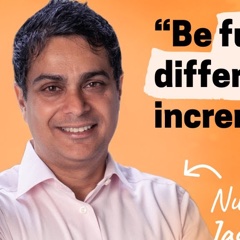
Jag Duggal
Chief Product Officer at Nubank; formerly Facebook, Quantcast and Google
Where to hear and read about Jag Duggal1 episode or test

Jag Duggal is Chief Product Officer at Nubank, who came from product and strategy roles at Google, Facebook and Quantcast. The thing most worth learning from him is to build something fundamentally different and not scale it until customers measurably love it.
We're in the business of being fundamentally different, not incrementally better.
Be fundamentally different, not incrementally better | Jag Duggal (Nubank, Facebook, Google)
Jag Duggal: the story and the lessons
1Jag Duggal's path from Google ads to Nubank
Duggal spent years in ad products before moving into banking. He was group product manager and head of strategy for Display ads at Google, then Google's second-largest business. He later became director of product management at Facebook, leading monetization of video and third-party content such as news, gaming and influencer content, then senior vice president of product and strategy at Quantcast.
Before product work he spent almost a decade in strategy consulting.
He had to learn that his job was shipping code, not slides. Coming from consulting, Duggal took 12 to 18 months at Google to absorb that product management meant shipping.
Google would not let him launch a product unless it worked in 40 countries and 40 languages. Language 40 was Finnish.
He checked whether Nubank's values were real before joining. A founder reached out, and Duggal joined a little short of five years before this talk. In his Sao Paulo interviews he spent much of the process testing whether the values were real or just a sign on the wall.
The founders, David, Ed and Chris, built the culture on purpose.
2The Google radio bet that nearly cost Duggal his job
Duggal quit two grad schools for a Google bet that failed. In 2006 he moved to California for Google's radio ad effort. Broadcast serves top-of-funnel brand advertising and inventory was scarce, and owners like NBC, CBS and Clear Channel were far less fragmented, so they held more leverage than bloggers.
Google chose to let TV come to YouTube instead of chasing it.
The near-layoff led to the display play that built a business. Duggal was nearly laid off, then got the mandate to bring real-time bidding to brand advertising. He believes display is still Google's second largest business.
The related acquisition ended in arbitration, lawsuits and depositions. He kept a Coldplay and Jay-Z mashup, Lost, on repeat: just because you're losing doesn't mean you've lost.
He pairs hard pursuit of a goal with openness to the market. Duggal's lesson is to be clear about what you want and what it is worth to you, while staying transparent to feedback on what works.
The skill is knowing which parts to let go and which to hold tightly. Perseverance and openness work as a pair.
3How Nubank made customer love its North Star
Nubank started from a pain point customers hated emotionally. Brazil's big banks were among the most profitable and most hated in the world. In 1997 a client walking past his branch told Duggal: that's my bank and I hate them.
The first value is that customers love Nubank fanatically. Nubank has five short values, with ownership underneath all of them. Duggal estimates 80% to 90% of employees could recite them unprompted.
The other four are: be hungry and challenge the status quo, build strong and diverse teams, pursue smart efficiency, and think and act like owners, not renters.
Hard trade-offs lean toward whether customers will tell friends. Cost, convenience and short-term viability always tempt a startup to cut corners. Duggal says Nubank is not perfect but biases toward whether customers will tell friends and family.
The payoff is growth driven by word of mouth at large scale. 80% to 90% of Nubank's growth comes from word of mouth. It has over 90 million customers across three countries, more than Bank of America, and is bigger than Coinbase, Robinhood, Affirm, SoFi and Lemonade combined.
4Duggal's rule: do not scale until customers would be very disappointed to lose it
Duggal gates scaling on a Sean Ellis score of 50%. The survey asks how disappointed customers would be if the product went away: not, somewhat or very. Ellis's bar is 40% very disappointed, but Nubank uses 50% because Brazilians are polite and optimistic.
"I don't believe we have product market fit unless 50% of Brazilians are telling us they would be very disappointed." Post-launch reviews always ask for the score.
He cuts the score by behavior to find the bullseye cohort. The payments assistant scored about 40% overall but 70% among users with four or more bills across at least two payment rails. After the team rebuilt the product around that cohort, it went from hundreds of thousands to over 10 million monthly actives in about 15 months.
The fix let customers onboard many bills across many rails in one go, so automation takes over. The team launched early, in the spirit of Reid Hoffman's line about being embarrassed by V1.
Ultravioleta waited years to scale after launch. The card launched in July 2021 and began scaling two to two and a half years later, with aggressive scaling only in the last six to nine months before the talk.
The segment that loved it was customers who spent enough to get the fee waiver and enjoyed the bundled benefits. Customers paying the monthly fee found the same benefits less exciting.
Duggal treats a small problem as something to fix before scaling. A big user base can make any product look good for months, which he calls bouncing a dead cat. Happy customers tell friends, so a product iterated until it works tends to scale itself.
"We are not going to take a small problem and scale it because if we do that, we end up with a big mess."
He asks whether a borderline product is great enough. For products near the bar, Duggal asks for the three to five things that would push them decisively past 50%, and which cohorts already clear it. Several newer Nubank products sit borderline.
The phrase came from a lead designer: "Good enough isn't good enough. Is it great enough?" He wants spend on making the product great, not on marketing.
NPS and churn check that love holds after launch. Nubank's NPS skews in the 70s, 80s and occasionally 90s, and in Mexico it was 94 to 95 in the first couple of years. Duggal treats a dip of one or two points as cause for alarm.
Low churn keeps the word-of-mouth loop from being a leaky bucket.
He expects product managers to say no and bring bad news early. Everyone up the executive chain wants a launch to scale, so a product manager's job is often to say no, with clear data and argument, even with a promotion at stake.
Duggal says senior leaders who have killed or pivoted products respect clarity and a high bar. "If you really don't think it's going to work, don't tell me what I want to hear."
5How Duggal's teams find out what customers love
Duggal requires a mock press release before engineering starts. The team must explain in two paragraphs why the intended customer should care before a single engineer is put on the project.
"If you can't tell me in two paragraphs why the customer you're building this for should care, then there's still work to do." Product and design reviews run several times a week.
Reviews ask how a product redefines its category. Duggal's reviews ask why a product is fundamentally different, usually on quality, complexity and price at once. The aim is to break the trade-offs teams normally accept.
That isn't always possible, but teams often reach for it and sometimes find it.
Product managers phone about ten customers themselves. Duggal skips the three-week survey with cross tabs and the researcher relay. By the fifth call the product manager can usually predict what the rest will say, and tone of voice carries detail statistics miss.
"Pick up the phone yourself. Don't ask a researcher to come up with a plan to go do the research to then summarize it." He cites Bezos: when data and anecdote disagree, the anecdote is usually right.
He writes a crisp hypothesis and tries to disprove it. Without a hypothesis, research data neither validates nor invalidates anything and becomes an interesting conversation. Duggal says the trap is acting as a lawyer for your idea instead of its judge, and he has fallen into it many times.
Research is the area where he says he still struggles most. Nubank's live example is a hypothesis that the 120 to 150 year old joint account does not fit modern customers who share finances with spouses, kids and parents.
He observes customers and asks indirect questions instead of pitching. Customers build workarounds and stop noticing their pain, as with mopping before Procter and Gamble's Swiffer. Duggal searches for the problem more than the solution and asks the same question from several directions.
"Observe more than ask questions if you can, ask indirect questions more than direct questions." In interviews, resist selling and make the customer sell you.
6Duggal's views on strategy and being fundamentally different
Duggal defines strategy as a coherent plan, not an aspiration. Following Richard Rumelt, strategy applies your strengths against a core problem. Duggal writes it as a very specific customer, problem, solution and advantage, then works backward to the minimal activities needed.
"We may not be right, but at least we are clear," he quotes Kevin Systrom saying of early Instagram. Clarity shows when you drift. He also says great execution times a poor strategy is zero.
Nubank's 2014 strategy was specific and branchless. The target was young, urban, middle-class Brazilians angry about card fees and denied credit for lack of history. The offer was a no-fee card, made possible by a branchless digital cost structure.
He concentrates bets and warns against hedging, even after success. Nubank chose credit before bank accounts, which is ten times harder and a hundred times riskier. Duggal says hedging avoids choices and leaves execution diffuse, so nobody can say why traction is missing, as with going to Mexico prematurely.
"Concentration is what builds wealth, diversification is what preserves wealth." A company with one or two cash-driving products that stops betting hard is on a slow path to death.
Duggal wants fundamentally different anchors with improvements around them. Not every feature can be fundamentally different, but the anchors must be. Small sustaining improvements are built around each anchor while the team searches for the next one.
Duggal had the phrase printed on schwag a little over a year before this talk.
He reinvents the category even when entering an existing one. Consignado, secured lending to government employees, has existed in Brazil for decades and was sold through middlemen. Nubank built it direct to consumer and undercut pricing dramatically.
"You cannot fight on the ground that the incumbents stand firm." Duggal argues company-level category creation and category reinvention can coexist, and noted Todd Jackson's opposite view.
7Where Duggal is taking Nubank next
Phase two turned a card company into a full bank. Nubank now has a dozen to 20 core product lines, including a bank account, lending, investments, insurance and small business products. The account moved Nubank from a secondary to a primary relationship for about half of its 90 million-plus customers.
Launches in Mexico and Colombia showed the model was not uniquely Brazilian, despite skepticism.
He sequences new products by debate, not a master plan. Duggal says some choices are obvious, like market size and where the customer pays, but the rest is art resolved through robust debate. The team keeps re-examining what is taking off.
He says he wishes there were a scientific master plan, but there is not.
Phase three aims for a personal banker for everyone. An e-commerce marketplace inside the app is the first step outside finance. Duggal says only about 10 million people worldwide have a personal banker today, and Nubank wants to reach all eight billion.
He wants an AI native bank, and admits it is unsolved. Duggal borrows Fidji Simo's mobile native shift at Facebook Ads as the analogy. The question is what Nubank would design if AI had existed from the start, using a private banker next to every customer as the metaphor.
"Not how do we append AI at the corners of the product, but how do we build it at the heart?" The first wave uses a ringfenced ChatGPT and standard tools, and Nubank has not cracked the larger question.
He calls a single code base and social money features unproven. Duggal's bet is one global code base covering spending, saving, investing, borrowing and protecting, where global banks like Citi and Santander run distinct code bases after acquisitions. He also wants social features about money and automation so customers need not remember every bill or goal.
Banking is harder to scale this way than ads because regulation is local and the stakes are higher.

Be fundamentally different, not incrementally better | Jag Duggal (Nubank, Facebook, Google)
Nubank's product chief explains how the company builds products customers love fanatically, gating scale on a Sean Ellis score of 50% and calling customers directly. The payoff is 80% to 90% of growth through word of mouth and over 90 million customers across three countries.
Duggal spent years in ad products before moving into banking. He was group product manager and head of strategy for Display ads at Google, then Google's second-largest business. He later became director of product management at Facebook, leading monetization of video and third-party content such as news, gaming and influencer content, then senior vice president of product and strategy at Quantcast.
Before product work he spent almost a decade in strategy consulting.
He had to learn that his job was shipping code, not slides. Coming from consulting, Duggal took 12 to 18 months at Google to absorb that product management meant shipping.
Google would not let him launch a product unless it worked in 40 countries and 40 languages. Language 40 was Finnish.
He checked whether Nubank's values were real before joining. A founder reached out, and Duggal joined a little short of five years before this talk. In his Sao Paulo interviews he spent much of the process testing whether the values were real or just a sign on the wall.
The founders, David, Ed and Chris, built the culture on purpose.
Duggal quit two grad schools for a Google bet that failed. In 2006 he moved to California for Google's radio ad effort. Broadcast serves top-of-funnel brand advertising and inventory was scarce, and owners like NBC, CBS and Clear Channel were far less fragmented, so they held more leverage than bloggers.
Google chose to let TV come to YouTube instead of chasing it.
The near-layoff led to the display play that built a business. Duggal was nearly laid off, then got the mandate to bring real-time bidding to brand advertising. He believes display is still Google's second largest business.
The related acquisition ended in arbitration, lawsuits and depositions. He kept a Coldplay and Jay-Z mashup, Lost, on repeat: just because you're losing doesn't mean you've lost.
He pairs hard pursuit of a goal with openness to the market. Duggal's lesson is to be clear about what you want and what it is worth to you, while staying transparent to feedback on what works.
The skill is knowing which parts to let go and which to hold tightly. Perseverance and openness work as a pair.
Nubank started from a pain point customers hated emotionally. Brazil's big banks were among the most profitable and most hated in the world. In 1997 a client walking past his branch told Duggal: that's my bank and I hate them.
The first value is that customers love Nubank fanatically. Nubank has five short values, with ownership underneath all of them. Duggal estimates 80% to 90% of employees could recite them unprompted.
The other four are: be hungry and challenge the status quo, build strong and diverse teams, pursue smart efficiency, and think and act like owners, not renters.
Hard trade-offs lean toward whether customers will tell friends. Cost, convenience and short-term viability always tempt a startup to cut corners. Duggal says Nubank is not perfect but biases toward whether customers will tell friends and family.
The payoff is growth driven by word of mouth at large scale. 80% to 90% of Nubank's growth comes from word of mouth. It has over 90 million customers across three countries, more than Bank of America, and is bigger than Coinbase, Robinhood, Affirm, SoFi and Lemonade combined.
Duggal gates scaling on a Sean Ellis score of 50%. The survey asks how disappointed customers would be if the product went away: not, somewhat or very. Ellis's bar is 40% very disappointed, but Nubank uses 50% because Brazilians are polite and optimistic.
"I don't believe we have product market fit unless 50% of Brazilians are telling us they would be very disappointed." Post-launch reviews always ask for the score.
He cuts the score by behavior to find the bullseye cohort. The payments assistant scored about 40% overall but 70% among users with four or more bills across at least two payment rails. After the team rebuilt the product around that cohort, it went from hundreds of thousands to over 10 million monthly actives in about 15 months.
The fix let customers onboard many bills across many rails in one go, so automation takes over. The team launched early, in the spirit of Reid Hoffman's line about being embarrassed by V1.
Ultravioleta waited years to scale after launch. The card launched in July 2021 and began scaling two to two and a half years later, with aggressive scaling only in the last six to nine months before the talk.
The segment that loved it was customers who spent enough to get the fee waiver and enjoyed the bundled benefits. Customers paying the monthly fee found the same benefits less exciting.
Duggal treats a small problem as something to fix before scaling. A big user base can make any product look good for months, which he calls bouncing a dead cat. Happy customers tell friends, so a product iterated until it works tends to scale itself.
"We are not going to take a small problem and scale it because if we do that, we end up with a big mess."
He asks whether a borderline product is great enough. For products near the bar, Duggal asks for the three to five things that would push them decisively past 50%, and which cohorts already clear it. Several newer Nubank products sit borderline.
The phrase came from a lead designer: "Good enough isn't good enough. Is it great enough?" He wants spend on making the product great, not on marketing.
NPS and churn check that love holds after launch. Nubank's NPS skews in the 70s, 80s and occasionally 90s, and in Mexico it was 94 to 95 in the first couple of years. Duggal treats a dip of one or two points as cause for alarm.
Low churn keeps the word-of-mouth loop from being a leaky bucket.
He expects product managers to say no and bring bad news early. Everyone up the executive chain wants a launch to scale, so a product manager's job is often to say no, with clear data and argument, even with a promotion at stake.
Duggal says senior leaders who have killed or pivoted products respect clarity and a high bar. "If you really don't think it's going to work, don't tell me what I want to hear."
Duggal requires a mock press release before engineering starts. The team must explain in two paragraphs why the intended customer should care before a single engineer is put on the project.
"If you can't tell me in two paragraphs why the customer you're building this for should care, then there's still work to do." Product and design reviews run several times a week.
Reviews ask how a product redefines its category. Duggal's reviews ask why a product is fundamentally different, usually on quality, complexity and price at once. The aim is to break the trade-offs teams normally accept.
That isn't always possible, but teams often reach for it and sometimes find it.
Product managers phone about ten customers themselves. Duggal skips the three-week survey with cross tabs and the researcher relay. By the fifth call the product manager can usually predict what the rest will say, and tone of voice carries detail statistics miss.
"Pick up the phone yourself. Don't ask a researcher to come up with a plan to go do the research to then summarize it." He cites Bezos: when data and anecdote disagree, the anecdote is usually right.
He writes a crisp hypothesis and tries to disprove it. Without a hypothesis, research data neither validates nor invalidates anything and becomes an interesting conversation. Duggal says the trap is acting as a lawyer for your idea instead of its judge, and he has fallen into it many times.
Research is the area where he says he still struggles most. Nubank's live example is a hypothesis that the 120 to 150 year old joint account does not fit modern customers who share finances with spouses, kids and parents.
He observes customers and asks indirect questions instead of pitching. Customers build workarounds and stop noticing their pain, as with mopping before Procter and Gamble's Swiffer. Duggal searches for the problem more than the solution and asks the same question from several directions.
"Observe more than ask questions if you can, ask indirect questions more than direct questions." In interviews, resist selling and make the customer sell you.
Duggal defines strategy as a coherent plan, not an aspiration. Following Richard Rumelt, strategy applies your strengths against a core problem. Duggal writes it as a very specific customer, problem, solution and advantage, then works backward to the minimal activities needed.
"We may not be right, but at least we are clear," he quotes Kevin Systrom saying of early Instagram. Clarity shows when you drift. He also says great execution times a poor strategy is zero.
Nubank's 2014 strategy was specific and branchless. The target was young, urban, middle-class Brazilians angry about card fees and denied credit for lack of history. The offer was a no-fee card, made possible by a branchless digital cost structure.
He concentrates bets and warns against hedging, even after success. Nubank chose credit before bank accounts, which is ten times harder and a hundred times riskier. Duggal says hedging avoids choices and leaves execution diffuse, so nobody can say why traction is missing, as with going to Mexico prematurely.
"Concentration is what builds wealth, diversification is what preserves wealth." A company with one or two cash-driving products that stops betting hard is on a slow path to death.
Duggal wants fundamentally different anchors with improvements around them. Not every feature can be fundamentally different, but the anchors must be. Small sustaining improvements are built around each anchor while the team searches for the next one.
Duggal had the phrase printed on schwag a little over a year before this talk.
He reinvents the category even when entering an existing one. Consignado, secured lending to government employees, has existed in Brazil for decades and was sold through middlemen. Nubank built it direct to consumer and undercut pricing dramatically.
"You cannot fight on the ground that the incumbents stand firm." Duggal argues company-level category creation and category reinvention can coexist, and noted Todd Jackson's opposite view.
Phase two turned a card company into a full bank. Nubank now has a dozen to 20 core product lines, including a bank account, lending, investments, insurance and small business products. The account moved Nubank from a secondary to a primary relationship for about half of its 90 million-plus customers.
Launches in Mexico and Colombia showed the model was not uniquely Brazilian, despite skepticism.
He sequences new products by debate, not a master plan. Duggal says some choices are obvious, like market size and where the customer pays, but the rest is art resolved through robust debate. The team keeps re-examining what is taking off.
He says he wishes there were a scientific master plan, but there is not.
Phase three aims for a personal banker for everyone. An e-commerce marketplace inside the app is the first step outside finance. Duggal says only about 10 million people worldwide have a personal banker today, and Nubank wants to reach all eight billion.
He wants an AI native bank, and admits it is unsolved. Duggal borrows Fidji Simo's mobile native shift at Facebook Ads as the analogy. The question is what Nubank would design if AI had existed from the start, using a private banker next to every customer as the metaphor.
"Not how do we append AI at the corners of the product, but how do we build it at the heart?" The first wave uses a ringfenced ChatGPT and standard tools, and Nubank has not cracked the larger question.
He calls a single code base and social money features unproven. Duggal's bet is one global code base covering spending, saving, investing, borrowing and protecting, where global banks like Citi and Santander run distinct code bases after acquisitions. He also wants social features about money and automation so customers need not remember every bill or goal.
Banking is harder to scale this way than ads because regulation is local and the stakes are higher.