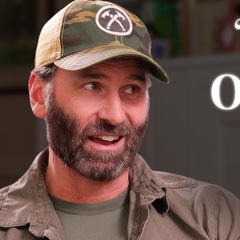
Jack Carr
Former Navy SEAL and thriller author
Where to hear and read about Jack Carr1 episode or test

Jack Carr is a former Navy SEAL who writes the James Reece thrillers, starting with The Terminal List, which became an Amazon Prime series with Chris Pratt. The most useful thing to learn from him is a repeatable process: test the story on one page, draft without stalling, and build scenes from remembered feeling, telling objects and noticed detail.
I can remember the feelings and I can take those now and apply them to a completely fictional narrative.
How to Become a Professional Writer (Jack Carr Interview)
Jack Carr: the story and the lessons
1Jack Carr's path from SEAL to thriller author
Carr read thrillers from age 10 and knew by 11 he would write them. He read Clancy, DeMille and Higgins as a boy, and decided he would write thrillers after the military. His mother was a librarian, so books were everywhere.
He read as a fan, not to prepare. He also read nonfiction on warfare, terrorism and insurgency to prepare for BUD/S.
He treats writing as a profession, as he did the military. Carr says he never had a career, only the profession of arms and now writing. He points to Anton Myrer's Once an Eagle, where that difference is part of the theme.
Following Steven Pressfield, he sits down and writes without waiting for inspiration. He says the dentist doesn't get dentist block.
His real experience is an asset because readers want the person behind the book. Carr says authenticity is an advantage now, since readers want a relationship with the person behind the product. Even readers who don't know his background sense the feelings are real.
He skips interviewing others, so no filters sit between his memory and the page.
He set three goals and now aims only to get better. His early goals were a book, a number one bestseller and a screen adaptation. Now he wants each book to beat the last.
He would like to teach a semester course that ends with an outline, summary, theme and title done.
2How Carr plans a thriller before he writes it
Carr tests each story on a one-page back-cover summary. He asks whether the story is worth a year and a half of his life, and whether a stranger pulling it off an airport shelf would spend time they can never get back. He has used the method since 2014, starting with The Terminal List.
In December 2014 he laid six to ten summaries on the kitchen table and chose one, saving the others for later. Savage Son honors The Most Dangerous Game but waited until his characters were ready.
He boils each book's theme to a few words on a sticky note. For The Terminal List the theme was 'revenge without constraint', kept on a yellow sticky note by his computer. It guides the book without binding it, and it gave him the title almost at once.
The theme can shift while writing. Savage Son began as the dark side of man and became a theme of forgiveness in chapter three.
The summary gives way to an outline he never lets stall him. The summary is discarded once an outline replaces it, usually in three parts with a prologue and epilogue. He takes the outline as far as he is happy with it and leaves gaps open.
He once stewed a week over how his hero escapes a cave in China and calls it a wasted week. A book, unlike a firefight, lets him sleep on a problem.
Carr made his hero literally already dead, borrowing from the samurai. He read in school that samurai went into battle believing they were dead, which made them more effective. Movie voice-overs said heroes had nothing left to lose, so he made it true.
A real history of CIA drug testing, from the 1970s Church hearings, made the premise believable. A drug tested on his hero will kill him.
3Carr's drafting and revision habits
Carr gives himself permission to write badly, then fixes it. His main mantra is to get a bad version out and go back to make it great. If a first line feels weak or he starts comparing himself to other writers, he moves on.
He says: "give yourself permission to write a bad chapter."
He studied craft briefly, then started writing. He read Stephen King's On Writing, David Morrell's The Successful Novelist and Pressfield's creativity books. Each takes about an hour, and then he wrote.
He warns that endless advice is a rabbit hole that makes other people rich.
Each book gets its own notebook, computer and email address. He files each notebook in a drawer when the book is done and starts a fresh one. His writing computer has a private email address used only for notes to himself, so ideas aren't buried in junk mail.
The computer is online only so Word can update. He can write anywhere without interruptions, which is hard with three kids, a dog and a wife.
He writes dialogue as discovery, then cuts repetition. He sets up a character's background briefly, then dives into a conversation with no goal for the scene, writing the exchange he would want to read. On the next pass he removes points made twice a few sentences apart.
The skill comes from years of reading thrillers as a boy.
Five trusted readers see the draft before any editor. They include a photographer who checks weapon details and two attorneys who catch small errors. He acts when five to eight raise the same point, not two to four.
For his first book he sent the draft to 20 to 25 people. His editor Emily Bestler asks him to explain things for readers who weren't in the military, and to add one or two more hints of a twist.
He learns the history of his genre to move it forward. Carr says books like First Blood and The Spy Who Came in from the Cold did more than retell old stories. He cites David Morrell fusing US and UK spy fiction in the 1980s.
He compares it to the military: ignore past lessons and you learn them again in blood. His quote: "You have to know what came before so you can build upon it."
4How Carr makes scenes and characters feel real
Carr carries over the feeling of an experience, not a rebuilt scene. He remembered the feelings of an ambush in Baghdad in 2006 and applied them to the Los Angeles ambush in The Terminal List. He recalls the constraints of the moment, then fits them to the plot.
He says the same works for any job, such as a former car dealer writing a car sale, only without bullets.
He learns his characters by putting them in conversation. Carr knows each character's role in advance but not the person until they talk. Placeholder names often stick after a year with the character.
Names must not look alike, sound alike or rhyme, because audiobook listeners can't tell them apart. Russian names are the hardest.
Objects tell the reader who a character is. In In the Blood, Caroline arrives in a faded 70s FJ40 Land Cruiser, a felt hat and a red bandana. The reader infers she is from Africa, tough and in her mid-60s, without being told she is beautiful.
He reads strangers this way in a gun store, and notes Ian Fleming described brands to build Bond. Firefighters, police and military readers pick up these cues too.
He alternates dense description with sparse passages. He avoids stock words like 'emerald' for green eyes. White walls and a fireplace let each reader add a fond memory, so he goes lighter after a heavily described chapter.
Over-describing costs the reader's personal experience.
He visits at least one real place per book and researches the rest hard. He went to Mozambique for the second book and Kamchatka for the third. COVID blocked Israel for book five, so he used books, photos and maps, and a family there who read it could not believe he had never been.
His first book used places he had already been, such as Iraq and Afghanistan, since he was still in the military.
Carr emails himself odd details the moment he notices them. In a Vietnam alley he noted an eel slipping across the street and a woman putting it back in its bowl, one cat, no dogs and no flies.
In Israel research he looked up a McDonald's menu, a detail only people who have been there recognize.
For Cry Havoc he filled his office with 1968 objects and maps. The office held period weapons, knives, Seiko watches, 1960s maps, a 1960s dictionary and National Geographics. He checked how places were spelled in 1968.
Characters can only bring experience up to that date: "You can't have 50 years of hindsight applied to these different conversations."
He describes gear from photo guides and has an expert check it. When he can't hold a weapon, he uses the Vickers Guides, whose photos help him pick the right gun for the character. For the Iraqi AK variant in The Devil's Hand he described its markings and stock.
The guides' photographer, James Rupley, reviews those paragraphs as a beta reader and points out mistakes.
5Carr on building an audience and ignoring the odds
Carr runs his writing like a business, not a mountain retreat. He decided it is not 1985 and compared himself to someone building a computer in a garage in 1977. He acted as CEO, CFO and marketer, and for the first five to seven years his wife ran the merch line.
He is naturally introverted and taught himself to be extroverted in the SEAL Teams. He applies the battlefield rule that you can't fight the last war.
He gives free value to readers before a book launches. He makes gear lists for each book and for holidays at no cost to readers. He also runs a podcast, where each listener feels like the third person in the conversation.
He notes audiobooks are the fastest growing segment of publishing. Only outliers like Fifty Shades of Grey or Twilight can skip this work.
Carr treats creating new readers as a mission. At signings, people tell him they never read a book that wasn't assigned in school until they found his. Parents bring in an eighth-grade son for a signed copy and then discuss the books together.
He doesn't expect to win an award and is fine with that, and he doesn't write for translation to television. The series did shape book five, In the Blood, with more flashbacks to the father.
Carr ignores people who recite the odds of becoming a writer. Tell someone you want to be a New York Times best-selling author and they ask if you know how hard it is. People say the same about Navy SEAL training.
His answer: every bestselling author he read as a boy did it, and somebody made it through BUD/S, so he asks why not him.
He says to finish the best book you can, then meet agents in person. At ThrillerFest you get two or three minutes with each agent and can meet 20. He knows three people who found agents and were published this way.
You also have to go to Bouchercon and arrive with a finished book.

How to Become a Professional Writer (Jack Carr Interview)
Jack Carr explains how he plans each thriller from a one-page summary and a short theme, then drafts without stalling and polishes with a small circle of trusted readers. The most useful part is how he builds vivid, authentic scenes from remembered feelings, objects that reveal character, firsthand research and small noticed details.
Carr read thrillers from age 10 and knew by 11 he would write them. He read Clancy, DeMille and Higgins as a boy, and decided he would write thrillers after the military. His mother was a librarian, so books were everywhere.
He read as a fan, not to prepare. He also read nonfiction on warfare, terrorism and insurgency to prepare for BUD/S.
He treats writing as a profession, as he did the military. Carr says he never had a career, only the profession of arms and now writing. He points to Anton Myrer's Once an Eagle, where that difference is part of the theme.
Following Steven Pressfield, he sits down and writes without waiting for inspiration. He says the dentist doesn't get dentist block.
His real experience is an asset because readers want the person behind the book. Carr says authenticity is an advantage now, since readers want a relationship with the person behind the product. Even readers who don't know his background sense the feelings are real.
He skips interviewing others, so no filters sit between his memory and the page.
He set three goals and now aims only to get better. His early goals were a book, a number one bestseller and a screen adaptation. Now he wants each book to beat the last.
He would like to teach a semester course that ends with an outline, summary, theme and title done.
Carr tests each story on a one-page back-cover summary. He asks whether the story is worth a year and a half of his life, and whether a stranger pulling it off an airport shelf would spend time they can never get back. He has used the method since 2014, starting with The Terminal List.
In December 2014 he laid six to ten summaries on the kitchen table and chose one, saving the others for later. Savage Son honors The Most Dangerous Game but waited until his characters were ready.
He boils each book's theme to a few words on a sticky note. For The Terminal List the theme was 'revenge without constraint', kept on a yellow sticky note by his computer. It guides the book without binding it, and it gave him the title almost at once.
The theme can shift while writing. Savage Son began as the dark side of man and became a theme of forgiveness in chapter three.
The summary gives way to an outline he never lets stall him. The summary is discarded once an outline replaces it, usually in three parts with a prologue and epilogue. He takes the outline as far as he is happy with it and leaves gaps open.
He once stewed a week over how his hero escapes a cave in China and calls it a wasted week. A book, unlike a firefight, lets him sleep on a problem.
Carr made his hero literally already dead, borrowing from the samurai. He read in school that samurai went into battle believing they were dead, which made them more effective. Movie voice-overs said heroes had nothing left to lose, so he made it true.
A real history of CIA drug testing, from the 1970s Church hearings, made the premise believable. A drug tested on his hero will kill him.
Carr gives himself permission to write badly, then fixes it. His main mantra is to get a bad version out and go back to make it great. If a first line feels weak or he starts comparing himself to other writers, he moves on.
He says: "give yourself permission to write a bad chapter."
He studied craft briefly, then started writing. He read Stephen King's On Writing, David Morrell's The Successful Novelist and Pressfield's creativity books. Each takes about an hour, and then he wrote.
He warns that endless advice is a rabbit hole that makes other people rich.
Each book gets its own notebook, computer and email address. He files each notebook in a drawer when the book is done and starts a fresh one. His writing computer has a private email address used only for notes to himself, so ideas aren't buried in junk mail.
The computer is online only so Word can update. He can write anywhere without interruptions, which is hard with three kids, a dog and a wife.
He writes dialogue as discovery, then cuts repetition. He sets up a character's background briefly, then dives into a conversation with no goal for the scene, writing the exchange he would want to read. On the next pass he removes points made twice a few sentences apart.
The skill comes from years of reading thrillers as a boy.
Five trusted readers see the draft before any editor. They include a photographer who checks weapon details and two attorneys who catch small errors. He acts when five to eight raise the same point, not two to four.
For his first book he sent the draft to 20 to 25 people. His editor Emily Bestler asks him to explain things for readers who weren't in the military, and to add one or two more hints of a twist.
He learns the history of his genre to move it forward. Carr says books like First Blood and The Spy Who Came in from the Cold did more than retell old stories. He cites David Morrell fusing US and UK spy fiction in the 1980s.
He compares it to the military: ignore past lessons and you learn them again in blood. His quote: "You have to know what came before so you can build upon it."
Carr carries over the feeling of an experience, not a rebuilt scene. He remembered the feelings of an ambush in Baghdad in 2006 and applied them to the Los Angeles ambush in The Terminal List. He recalls the constraints of the moment, then fits them to the plot.
He says the same works for any job, such as a former car dealer writing a car sale, only without bullets.
He learns his characters by putting them in conversation. Carr knows each character's role in advance but not the person until they talk. Placeholder names often stick after a year with the character.
Names must not look alike, sound alike or rhyme, because audiobook listeners can't tell them apart. Russian names are the hardest.
Objects tell the reader who a character is. In In the Blood, Caroline arrives in a faded 70s FJ40 Land Cruiser, a felt hat and a red bandana. The reader infers she is from Africa, tough and in her mid-60s, without being told she is beautiful.
He reads strangers this way in a gun store, and notes Ian Fleming described brands to build Bond. Firefighters, police and military readers pick up these cues too.
He alternates dense description with sparse passages. He avoids stock words like 'emerald' for green eyes. White walls and a fireplace let each reader add a fond memory, so he goes lighter after a heavily described chapter.
Over-describing costs the reader's personal experience.
He visits at least one real place per book and researches the rest hard. He went to Mozambique for the second book and Kamchatka for the third. COVID blocked Israel for book five, so he used books, photos and maps, and a family there who read it could not believe he had never been.
His first book used places he had already been, such as Iraq and Afghanistan, since he was still in the military.
Carr emails himself odd details the moment he notices them. In a Vietnam alley he noted an eel slipping across the street and a woman putting it back in its bowl, one cat, no dogs and no flies.
In Israel research he looked up a McDonald's menu, a detail only people who have been there recognize.
For Cry Havoc he filled his office with 1968 objects and maps. The office held period weapons, knives, Seiko watches, 1960s maps, a 1960s dictionary and National Geographics. He checked how places were spelled in 1968.
Characters can only bring experience up to that date: "You can't have 50 years of hindsight applied to these different conversations."
He describes gear from photo guides and has an expert check it. When he can't hold a weapon, he uses the Vickers Guides, whose photos help him pick the right gun for the character. For the Iraqi AK variant in The Devil's Hand he described its markings and stock.
The guides' photographer, James Rupley, reviews those paragraphs as a beta reader and points out mistakes.
Carr runs his writing like a business, not a mountain retreat. He decided it is not 1985 and compared himself to someone building a computer in a garage in 1977. He acted as CEO, CFO and marketer, and for the first five to seven years his wife ran the merch line.
He is naturally introverted and taught himself to be extroverted in the SEAL Teams. He applies the battlefield rule that you can't fight the last war.
He gives free value to readers before a book launches. He makes gear lists for each book and for holidays at no cost to readers. He also runs a podcast, where each listener feels like the third person in the conversation.
He notes audiobooks are the fastest growing segment of publishing. Only outliers like Fifty Shades of Grey or Twilight can skip this work.
Carr treats creating new readers as a mission. At signings, people tell him they never read a book that wasn't assigned in school until they found his. Parents bring in an eighth-grade son for a signed copy and then discuss the books together.
He doesn't expect to win an award and is fine with that, and he doesn't write for translation to television. The series did shape book five, In the Blood, with more flashbacks to the father.
Carr ignores people who recite the odds of becoming a writer. Tell someone you want to be a New York Times best-selling author and they ask if you know how hard it is. People say the same about Navy SEAL training.
His answer: every bestselling author he read as a boy did it, and somebody made it through BUD/S, so he asks why not him.
He says to finish the best book you can, then meet agents in person. At ThrillerFest you get two or three minutes with each agent and can meet 20. He knows three people who found agents and were published this way.
You also have to go to Bouchercon and arrive with a finished book.