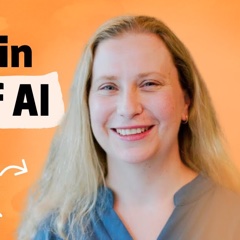
Inbal Shani
Chief Product Officer at GitHub
Where to hear and read about Inbal Shani1 episode or test

Inbal Shani is Chief Product Officer at GitHub, a former robotics engineer who later ran product at AWS and Microsoft before leading Copilot's product side. The most useful thing to learn from her is to start from a customer problem and then choose AI as the tool, with humans kept in the loop.
Copilot is a copilot. It's not a pilot. You still need the human in the loop.
The future of AI in software development | Inbal Shani (CPO of GitHub)
Inbal Shani: the story and the lessons
1Inbal Shani's path from robotics code to GitHub CPO
Shani moved from writing robotics code to running product at GitHub. She started as a senior software developer on Amazon Robotics, then became a general manager at AWS and at Microsoft. She is now Chief Product Officer at GitHub.
At the time of the talk she was celebrating her first year at GitHub and her first GitHub Universe on stage.
Her first aerospace boss taught her to think in systems. She learned to look past her own component to the bigger solution. A filter she tuned was tied to the control system, the ignition system and how it was finally displayed.
She says a chief product officer needs business sense, go-to-market and sales knowledge, and an understanding of how engineering builds.
Shani learned to explain the why before driving change. As a new team leader at TomTom, running location-based services, she saw everything that needed fixing and tried to fix it all at once. Her team told her she was moving too fast.
It was her first international company and her style did not fit every culture. Her team told her: "You're moving too fast. Slow down. Explain the why." She notes that newcomers see gaps long-time teams have stopped noticing.
She treats product management as mostly influence. A product manager must influence engineers to build what is envisioned and the revenue team to sell it as intended. She learned this by watching leaders above, peers and the people she managed.
She keeps the skills she admires and drops habits that made people unhappy.
Shani hires by testing for innovation and for how people disagree. She asks candidates for the most innovative thing they have done and why. She also asks about a disagreement with a manager and what they did.
The first shows whether people reach for a big invention or something personal. The second shows whether they stand their ground and how they influence.
2How GitHub built and runs Copilot under Shani
GitHub started from a developer time problem, then added AI. Developers juggle many tasks and have little time to code. GitHub chose which coding work to automate and only then brought in OpenAI models.
Customers who ask what to do with AI often have a light-bulb moment when shown this path. She says the mistake is plastering AI on many things instead of fixing a manual or configuration-heavy workflow.
Copilot was designed so developers want to use it. In 2020, GitHub engineers worked with designers and OpenAI GPT, building from what a developer would want to experience. Friction, churn and complexity make developers drop a tool.
Developers already carry a full day of tasks, so a tool they must learn on top will not fly. The experience has to fade into the background.
GitHub dogfoods every feature for months before customers see it. GitHub runs on GitHub, and finance, legal and HR use it as well as engineers. Finance shares its AR numbers through discussions, posts and PRs.
The product team was among the first users of chat, checking search answers and PR summaries. The rule: "If we cannot use them, our customers cannot use them for sure."
She runs a change management process, not a tool handout. Companies often expect adoption to happen magically once a tool exists. It lands differently across teams and companies, so rollout needs a deliberate process.
Shani measures each AI tool with its own metric. For Advanced Security the measures are secrets stopped from leaking and code issues fixed before shipping. Quality and security are tracked next to productivity and collaboration.
Time alone is not a success metric because you can write bad code fast. Her line: "There is no one metric to rule them all." GitHub is still working out its definition of productivity.
She pushes time to value over raw time saved. Track how long it takes from putting a developer on a task to full value, defined as revenue, adoption or time to market. This ties productivity gains to business results.
GitHub's surveys show large Copilot gains. Developers write code 55% faster, 85% feel more confident in code quality, 88% feel less frustrated, and code reviews finish 15% faster. Over 37,000 organizations and 1.5 million developers use it.
Accenture kept 88% of suggested code, and over a million lines of Shopify's code base were written by Copilot.
3Shani on AI, developers and what comes next
Shani says AI augments developers and does not replace them. Developers spend less than 25% of their time coding, and some say less than 20%. The rest goes to meetings, builds, legacy code and working with about 21 people a week.
A 25% efficiency gain does not mean 25% fewer engineers. Time saved should go to more code, rest, collaboration and creative thinking, and cutting people removes the human in the loop.
She calls AI-driven testing the most underhyped area. AI produces more code and more applications, so testing load grows. Unit, functional, load, performance, infrastructure, security and penetration tests all need writing.
Much of this work is not thought of as testing, so it gets little time. She wants to hear how companies use AI to build larger test suites.
Shani lets developers choose which work to hand to AI. A developer who likes writing functions but dislikes tests can let AI generate unit tests. Copilot also works as a chat assistant for brainstorming.
She still writes C by hand for tiny CPUs because she does not trust generated code to be efficient there. She compares AI to past shifts, from C to Java to Python, each a higher layer of abstraction.
She expects juniors to learn whole systems from the start. With AI writing simple code, developers can focus on architecture and connected systems early. Today that thinking mostly belongs to senior developers.
Shani predicts a hybrid of general LLMs and niche models. Several LLMs will work together alongside customized models for specific cases. A general model is limited by its training data and tries to be everything for everyone.
She doubts self-driving cars, with delicate tuning and heavy safety regulation, will be built on ChatGPT. She admits she may be wrong.
She expects hardware and code optimization to reach everyday developers. AI has a big footprint and needs many resources, so better CPUs, GPUs, compute and code optimization will matter. Today only a niche works on this.
She also expects AI integration to become normal for every developer, starting early in careers.
4How Shani makes room for innovation at GitHub
GitHub Next invents the future three to five years out. Applied and research scientists write papers, run experiments and build proofs of concept. Copilot came out of this team, and ideas flow both ways with product, engineering and customers.
Shani names two ways research teams fail. One is writing papers while nothing reaches production. The other is leaders demanding something in six months, which turns the team into engineering for horizon one.
Her fix is the right people with freedom to innovate and a plan to reach production from day zero.
She sources ideas from customers and community, not quotas. Customer frustrations and open source projects of every size feed ideas, and engineers pitch with a research paper. Leaders then decide whether to fund it as a proof of concept or a cross-team effort.
A rule like 15 minutes a day to be creative would not work: "If you try to structure innovation, you're losing that organic spark that is humanity."
She protects time for experiments and accepts failures. Without experiments there is no innovation, and without failures there is no learning. The same approach produced Copilot, GitHub Advanced Security and GitHub itself.
GitHub shows its vision six months to a year before shipping. Copilot Workspace was unveiled at the Universe keynote, where Satya Nadella joined.

The future of AI in software development | Inbal Shani (CPO of GitHub)
Inbal Shani explains how GitHub built and measures Copilot, why AI augments rather than replaces developers, and how to adopt AI by starting from customer problems. Copilot reached over 37,000 organizations and 1.5 million developers, with users writing code 55% faster in GitHub's surveys.
Shani moved from writing robotics code to running product at GitHub. She started as a senior software developer on Amazon Robotics, then became a general manager at AWS and at Microsoft. She is now Chief Product Officer at GitHub.
At the time of the talk she was celebrating her first year at GitHub and her first GitHub Universe on stage.
Her first aerospace boss taught her to think in systems. She learned to look past her own component to the bigger solution. A filter she tuned was tied to the control system, the ignition system and how it was finally displayed.
She says a chief product officer needs business sense, go-to-market and sales knowledge, and an understanding of how engineering builds.
Shani learned to explain the why before driving change. As a new team leader at TomTom, running location-based services, she saw everything that needed fixing and tried to fix it all at once. Her team told her she was moving too fast.
It was her first international company and her style did not fit every culture. Her team told her: "You're moving too fast. Slow down. Explain the why." She notes that newcomers see gaps long-time teams have stopped noticing.
She treats product management as mostly influence. A product manager must influence engineers to build what is envisioned and the revenue team to sell it as intended. She learned this by watching leaders above, peers and the people she managed.
She keeps the skills she admires and drops habits that made people unhappy.
Shani hires by testing for innovation and for how people disagree. She asks candidates for the most innovative thing they have done and why. She also asks about a disagreement with a manager and what they did.
The first shows whether people reach for a big invention or something personal. The second shows whether they stand their ground and how they influence.
GitHub started from a developer time problem, then added AI. Developers juggle many tasks and have little time to code. GitHub chose which coding work to automate and only then brought in OpenAI models.
Customers who ask what to do with AI often have a light-bulb moment when shown this path. She says the mistake is plastering AI on many things instead of fixing a manual or configuration-heavy workflow.
Copilot was designed so developers want to use it. In 2020, GitHub engineers worked with designers and OpenAI GPT, building from what a developer would want to experience. Friction, churn and complexity make developers drop a tool.
Developers already carry a full day of tasks, so a tool they must learn on top will not fly. The experience has to fade into the background.
GitHub dogfoods every feature for months before customers see it. GitHub runs on GitHub, and finance, legal and HR use it as well as engineers. Finance shares its AR numbers through discussions, posts and PRs.
The product team was among the first users of chat, checking search answers and PR summaries. The rule: "If we cannot use them, our customers cannot use them for sure."
She runs a change management process, not a tool handout. Companies often expect adoption to happen magically once a tool exists. It lands differently across teams and companies, so rollout needs a deliberate process.
Shani measures each AI tool with its own metric. For Advanced Security the measures are secrets stopped from leaking and code issues fixed before shipping. Quality and security are tracked next to productivity and collaboration.
Time alone is not a success metric because you can write bad code fast. Her line: "There is no one metric to rule them all." GitHub is still working out its definition of productivity.
She pushes time to value over raw time saved. Track how long it takes from putting a developer on a task to full value, defined as revenue, adoption or time to market. This ties productivity gains to business results.
GitHub's surveys show large Copilot gains. Developers write code 55% faster, 85% feel more confident in code quality, 88% feel less frustrated, and code reviews finish 15% faster. Over 37,000 organizations and 1.5 million developers use it.
Accenture kept 88% of suggested code, and over a million lines of Shopify's code base were written by Copilot.
Shani says AI augments developers and does not replace them. Developers spend less than 25% of their time coding, and some say less than 20%. The rest goes to meetings, builds, legacy code and working with about 21 people a week.
A 25% efficiency gain does not mean 25% fewer engineers. Time saved should go to more code, rest, collaboration and creative thinking, and cutting people removes the human in the loop.
She calls AI-driven testing the most underhyped area. AI produces more code and more applications, so testing load grows. Unit, functional, load, performance, infrastructure, security and penetration tests all need writing.
Much of this work is not thought of as testing, so it gets little time. She wants to hear how companies use AI to build larger test suites.
Shani lets developers choose which work to hand to AI. A developer who likes writing functions but dislikes tests can let AI generate unit tests. Copilot also works as a chat assistant for brainstorming.
She still writes C by hand for tiny CPUs because she does not trust generated code to be efficient there. She compares AI to past shifts, from C to Java to Python, each a higher layer of abstraction.
She expects juniors to learn whole systems from the start. With AI writing simple code, developers can focus on architecture and connected systems early. Today that thinking mostly belongs to senior developers.
Shani predicts a hybrid of general LLMs and niche models. Several LLMs will work together alongside customized models for specific cases. A general model is limited by its training data and tries to be everything for everyone.
She doubts self-driving cars, with delicate tuning and heavy safety regulation, will be built on ChatGPT. She admits she may be wrong.
She expects hardware and code optimization to reach everyday developers. AI has a big footprint and needs many resources, so better CPUs, GPUs, compute and code optimization will matter. Today only a niche works on this.
She also expects AI integration to become normal for every developer, starting early in careers.
GitHub Next invents the future three to five years out. Applied and research scientists write papers, run experiments and build proofs of concept. Copilot came out of this team, and ideas flow both ways with product, engineering and customers.
Shani names two ways research teams fail. One is writing papers while nothing reaches production. The other is leaders demanding something in six months, which turns the team into engineering for horizon one.
Her fix is the right people with freedom to innovate and a plan to reach production from day zero.
She sources ideas from customers and community, not quotas. Customer frustrations and open source projects of every size feed ideas, and engineers pitch with a research paper. Leaders then decide whether to fund it as a proof of concept or a cross-team effort.
A rule like 15 minutes a day to be creative would not work: "If you try to structure innovation, you're losing that organic spark that is humanity."
She protects time for experiments and accepts failures. Without experiments there is no innovation, and without failures there is no learning. The same approach produced Copilot, GitHub Advanced Security and GitHub itself.
GitHub shows its vision six months to a year before shipping. Copilot Workspace was unveiled at the Universe keynote, where Satya Nadella joined.