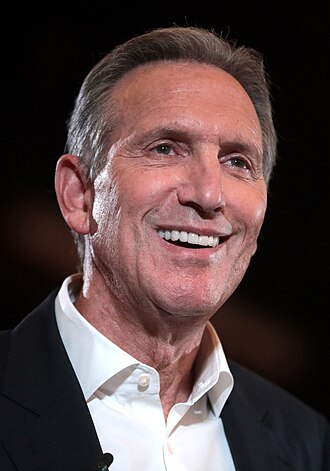
Howard Schultz
Longtime CEO who built Starbucks from six Seattle bean stores into a global coffee brand
Where to hear and read about Howard Schultz1 episode or test

Howard Schultz joined a six-store Seattle bean roaster as head of marketing, bought it in 1987, and built Starbucks into a global brand of about 39,000 stores by selling a third place run by well-treated partners on a high-margin, repeat-visit model. The lesson most worth taking from him is that scale and efficiency quietly drain the human experience that made a brand work, so leaders have to keep refilling it even when the numbers look great.
the ubiquity of Starbucks was an enemy to the company
Starbucks (with Howard Schultz)
Howard Schultz: the story and the lessons
1Howard Schultz's path from Xerox to a Seattle bean store
Schultz's drive came from growing up in the projects with debt everywhere. His parents were always in debt and bill collectors kept calling, which later made him run Starbucks with no debt at all.
He credits his wife Sherri's support with giving him the courage to leave safe jobs.
He left a prestigious Xerox sales job after a rating told him he'd stall. At Xerox he made 50 cold calls a day across assigned Manhattan blocks, and the rejection taught him humility.
A performance rating of three convinced him he would be stuck there.
He found Starbucks as a coffee maker salesman and moved to Seattle in 1982. Selling Hammarplast, he noticed a small Seattle company buying a lot of his product and fell for its romance and coffee education.
He became head of marketing when Starbucks had three stores and its biggest ambition was Portland, Oregon. He took about $1,000 a month and lived at home. Jerry Baldwin's strict freshness rule, about a 10 day shelf life, shaped him.
Milan's coffee bars in 1983 showed him the business was the place. He concluded Starbucks should sell the experience and community of the bar, with beans behind it. A test bar in the sixth store took traffic from 200 to 300 customers a day to about 500 within a week.
He pitched investors by pointing to people lingering and talking. "The coffee was the conduit."
He pushed the founders for two years, then left to start Il Giornale. Baldwin and Gordon Bowker did not want to be in the restaurant business, so after the test Schultz founded Il Giornale, with Starbucks investing.
"I banged on the door for two years." Persistence plus a live test is what moved the idea.
Almost everyone said no to funding an espresso bar in Seattle. Of 242 investors he pitched, 217 declined. He raised about $1.6 million from local backers and opened three shops, two in Seattle and one in Vancouver.
He took no salary for almost two years while Sherri was pregnant and working. Her father called it a hobby, and she refused to turn back.
2How Schultz bought Starbucks for $3.8 million in 1987
A surprise cash bid from his own investor nearly took the deal. Baldwin set a $3.8 million price and gave Schultz about 99 days. With half raised, one of his investors offered all cash with no diligence.
Bill Gates Sr. walked him into the investor's office and stopped it. After asking Schultz whether his story was true and complete, Gates Sr. told investor Sam Stroum that whatever was planned would not happen, then helped raise the money.
Schultz had never fully told the story to protect the investor, who stayed on the cap table. "Whatever it is it's not going to happen."
The deal made Il Giornale the owner of Starbucks. It closed in August 1987 with six Starbucks stores, three Il Giornale shops and two under construction: 11 stores and 100 employees by year end.
The old owners kept the Peet's name for themselves.
He vowed never to take on debt after watching the old owners get cornered. The original Starbucks bought Peet's at a debt to equity ratio above six to one, which left no room to take risk or innovate.
Schultz ran the combined company with no debt the entire time.
3The store model and small details behind Starbucks
Each store had to hit 2:1 sales to investment and 20% operating profit. Schultz chose the first 500 locations himself, targeting $1 million in year-one sales on a $500,000 investment. Stores paid back in about two years, sometimes a year and a half.
In-house roasting gave roughly an 80% gross margin, and the most loyal customers came about 18 times a month. Wall Street had never seen a retail model like it.
Sites were picked by counting people walking past. The early team counted pedestrians on urban corners, and an office building with 3,000 to 4,000 people was a home run.
Grocery stores were attractive neighbors because people buy food so often.
The cup and the sizes were designed to match the coffee. Styrofoam turned golden under boiling water, so he went to International Paper for a paper cup with a sip lid. Designer Terry Heckler helped replace small, medium and large with short, tall and Grande.
Schultz says he should have secured an exclusive on the lid.
Writing names on cups scaled intimacy and turned the cup into a billboard. A barista started it to tell orders apart, and it kept the experience personal as thousands came through a store. With no marketing budget, people carrying the cup did the advertising.
Schultz calls Starbucks the first experiential brand at scale.
Customers set the final price of their own drink. The base price is fixed and most people add something, so customization raises the ticket. Baristas now handle about 100,000 beverage variations.
4Why Schultz made every employee a partner
He gave stock options to all employees, part-timers included, before the IPO. In 1991 everyone working 20 or more hours a week, about 1,300 people, got options worth 14% of base pay at a $6 strike. The IPO priced at $17 a year later.
Two venture capital board members resisted. Schultz wanted to give his father the dignity he never got, and calls the announcement the turning point of the culture: "we became partners."
The equity and benefits paid off in retention. Health insurance reached part-timers in 1988, turnover ran about half the industry rate, and tenure about double. The grants are up about 800x after six splits.
Early acts of care became the culture's imprinting moments. When AIDS was treated like leprosy, store manager Tom Carrian came to resign in tears, and Starbucks covered his health insurance.
Schultz argues the sheer number of such stories across communities is the point, not any single one.
He is proudest of free college tuition for partners. Partners can earn a four-year degree through Arizona State University, led by Michael Crow, and thousands have enrolled and graduated.
Schultz puts the partner in the green apron ahead of shareholders. His view is that if partners' expectations are exceeded, customers and shareholders win.
On union organizing he says the company underestimated the groundswell and that "clearly mistakes were made," while noting few stores petitioned relative to the whole.
5How Schultz grew Starbucks across America
By 1988 he already planned a national coffeehouse chain. With 11 stores, he promised to go from six stores built in 17 years to 26 in one year and over 100 in five. Starbucks reached 2,000 stores by 1999, beating its 2000 goal.
Regional rivals like Gloria Jean's pushed the pace. "The equity of the brand was much larger than the size of the business."
His ambition was balanced by Howard Behar's soul and Orin Smith's restraint. Smith, the only MBA, would tell both Howards no, and they mostly listened. The three had dinner every Monday night for about a decade.
Growth always ran ahead of systems and people, and Smith kept saying the infrastructure wasn't there.
Starbucks entered a new market only after the last one worked. Behar refused to open several markets at once. Chicago failed at first, and he spent the winter there fixing it.
Schultz calls Behar 100% right on this.
Schultz overruled Behar to enter Los Angeles for its halo. Behar wanted San Diego, and the meeting erupted. In LA, celebrities embraced the brand and the halo dwarfed earlier markets.
"We had to go and even though we maybe were not ready we just had to do it." Behar later agreed. The aim stayed an affordable luxury a CEO and a truck driver could both buy.
He bought Boston's beloved local rival instead of fighting it. In 1994 Starbucks paid about $23 million for George Howell's Coffee Connection: 23 stores with $16 million in sales, near one times sales.
Howell stayed involved to protect local loyalty, and the deal brought the Frappuccino trademark.
Starbucks rented other companies' reach instead of buying marketing. Costco, United Airlines and Barnes & Noble put the brand where people already went, despite internal revolts, and Starbucks says it never spent a marketing dollar.
Costco's Jeff Brotman and Jim Sinegal showed him the cars in their parking lot as his customers. Bean sales at Costco measurably lifted nearby eastside stores.
Coke gave him under 30 minutes, and Pepsi shook on a napkin. In 1995 Pepsi's Roger Enrico and Craig Weatherup agreed to a 50-50 joint venture for bottled Frappuccino. It sold so fast new factories were needed, and Frappuccino was 7% of revenue by 1996.
He refused to franchise even when capital was scarce. He believed franchisees would build their own subcultures and make Starbucks transactional. Abroad, country partners run stores while Starbucks controls roasting, recipes and design.
"I don't think we'd be having this conversation if Starbucks was a franchise system."
Goldman Sachs passed on the IPO because Starbucks was too small. Alex Brown led it with about 130 stores, $93 million in revenue and a market cap near $250 million.
With no public coffee company to compare to, Schultz had to teach investors from scratch and insisted "we are Merchants," not a restaurant.
6Taking Starbucks to Japan, China and Italy
Schultz went to Japan against his board and a consultant. The consultant said nobody would walk with a cup and rents and the no-smoking rule would sink it. The 1996 Tokyo opening drew a line of about 200 people.
A handwritten letter from a Japanese restaurant founder led to the joint venture, and Japan grew to about 2,000 stores. Demand came from the brand's mystique, not coffee culture.
China lost money for almost a decade under the wrong partner. Starbucks entered in 1999 through a partner that did not share its values, then bought it out amid heavy pressure to close the market.
Schultz says he did not really understand what he was getting into.
China took off once Belinda Wong ran it without Seattle. She required a decentralized setup reporting only to Schultz and John Culver. Stores grew from 500 in 2011 to nearly 7,000, and China is 18% of revenue.
Seattle had misjudged real estate and breakfast in a tea culture. Wong won approval for health insurance covering partners' parents. "Take Seattle out of the equation."
He waited decades to enter Italy until the Roastery was ready. He built a Willy Wonka style theater of roasting, then opened in a former Milan post office on Piazza Cordusio, closing with Blackstone's John Gray. About 30 Italian stores followed.
Straight espresso is now the top drink at Starbucks in Italy. "I didn't think we earned the right to go to Italy until we were really ready."
7Schultz's 2008 return and turnaround
He stepped back in 2000, and the company drifted. At 3,500 stores and $2.2 billion in revenue he moved to executive chair, exhausted and feeling he had missed his kids growing up. Outsider Jim Donald's fit failed in under three years.
Growth had hidden unprofitable stores and diluted coffee. By 2008 comps were negative for the first time and market cap fell from $30 billion to under $7 billion. Brewing with less coffee per batch had raised yield and hurt quality.
He closed about 1,000 stores, cried and apologized to staff over layoffs, and shut stores from noon for retraining.
He told 10,000 managers the truth: seven months to insolvency. At a New Orleans conference that included 50,000 hours of service in the Ninth Ward, he spoke openly over his CFO's objection. The CFO resigned a week later.
He framed the fix as about 10 or 11 extra customers per store per day, which made it feel tangible: one store, one cup, one customer.
Profits tripled in two years. Profit rose from $315 million in 2008 to $945 million in 2010.
On a walk at Apple, Steve Jobs told him to fire his entire leadership team. Everyone except the General Counsel left, and Schultz later told Jobs on stage he was right.
8Howard Schultz on ubiquity and the mobile app
Schultz says Starbucks must get smaller as it gets bigger. Ubiquity creates complexity, complexity demands efficiency, and efficiency threatens the barista and customer moment. He says Starbucks must be "defined by the one store you come into."
The worst outcome, in his view, is becoming a utility.
He treats culture as a reservoir that strong numbers can hide draining. Withdrawing without deposits is fatal, and high profits and stock price camouflage it. He calls that Fool's Gold.
He has not found a KPI for it.
The mobile app grew without a governor and ate the third place. About 33% of orders are mobile. At 8 a.m. in Chicago crowds were all told "seven minutes," which he calls a mosh pit.
He would have slow-rolled it and not offered it 24 hours a day, giving up economics for experience. "A governor didn't exist."
He admits the app's float makes it extremely lucrative. About $1.8 billion of customer cash sits as an interest-free advance, with around $4 billion a year loaded onto gift cards.
In 2022 he returned, ended buybacks and redirected money to partners. He found four to five years of underinvestment and buybacks used to lift EPS, and moved more than $2 billion a year to partners, expecting the stock to fall.
His later letter warns the app is a "runaway train" and that Starbucks must be more coffee forward. He says he has no desire to return as CEO.
9What Schultz got wrong and admits
He dismissed Frappuccino and was dead wrong. He disliked the drink, but a Santa Monica manager reformulated it and customers loved it. Starbucks had no cold drink for its first decade, and about 70% of drinks are now iced.
His first Il Giornale played only Italian opera and had no chairs. "I was wrong dead wrong obviously."
Customers and baristas drove many of Starbucks' best ideas. From names on cups to customized drinks, he credits partners who understood the business better than he did.
Schultz blames himself for failing at succession. He kept hoping Orin Smith would stay instead of developing internal talent, then hired outsider Jim Donald just before the financial crisis.
"It's on me."
Leaning on the founder covered up mistakes. The organization relied on his merchant and marketing instincts, so others followed instead of leading. He says companies that play defense lose their entrepreneurial offense, and hubris is the other disease.
He has stepped away and returned as CEO three times.

Starbucks (with Howard Schultz)
Howard Schultz turned a six-store Seattle bean roaster into a 39,000-store global brand by treating coffee as an experience, his people as partners, and growth as something that could erode the soul of the company. The story is worth hearing because it shows both the choices that built Starbucks and the 2008 near-insolvency and later mobile app drift that followed when the experience was allowed to slip.
Schultz's drive came from growing up in the projects with debt everywhere. His parents were always in debt and bill collectors kept calling, which later made him run Starbucks with no debt at all.
He credits his wife Sherri's support with giving him the courage to leave safe jobs.
He left a prestigious Xerox sales job after a rating told him he'd stall. At Xerox he made 50 cold calls a day across assigned Manhattan blocks, and the rejection taught him humility.
A performance rating of three convinced him he would be stuck there.
He found Starbucks as a coffee maker salesman and moved to Seattle in 1982. Selling Hammarplast, he noticed a small Seattle company buying a lot of his product and fell for its romance and coffee education.
He became head of marketing when Starbucks had three stores and its biggest ambition was Portland, Oregon. He took about $1,000 a month and lived at home. Jerry Baldwin's strict freshness rule, about a 10 day shelf life, shaped him.
Milan's coffee bars in 1983 showed him the business was the place. He concluded Starbucks should sell the experience and community of the bar, with beans behind it. A test bar in the sixth store took traffic from 200 to 300 customers a day to about 500 within a week.
He pitched investors by pointing to people lingering and talking. "The coffee was the conduit."
He pushed the founders for two years, then left to start Il Giornale. Baldwin and Gordon Bowker did not want to be in the restaurant business, so after the test Schultz founded Il Giornale, with Starbucks investing.
"I banged on the door for two years." Persistence plus a live test is what moved the idea.
Almost everyone said no to funding an espresso bar in Seattle. Of 242 investors he pitched, 217 declined. He raised about $1.6 million from local backers and opened three shops, two in Seattle and one in Vancouver.
He took no salary for almost two years while Sherri was pregnant and working. Her father called it a hobby, and she refused to turn back.
A surprise cash bid from his own investor nearly took the deal. Baldwin set a $3.8 million price and gave Schultz about 99 days. With half raised, one of his investors offered all cash with no diligence.
Bill Gates Sr. walked him into the investor's office and stopped it. After asking Schultz whether his story was true and complete, Gates Sr. told investor Sam Stroum that whatever was planned would not happen, then helped raise the money.
Schultz had never fully told the story to protect the investor, who stayed on the cap table. "Whatever it is it's not going to happen."
The deal made Il Giornale the owner of Starbucks. It closed in August 1987 with six Starbucks stores, three Il Giornale shops and two under construction: 11 stores and 100 employees by year end.
The old owners kept the Peet's name for themselves.
He vowed never to take on debt after watching the old owners get cornered. The original Starbucks bought Peet's at a debt to equity ratio above six to one, which left no room to take risk or innovate.
Schultz ran the combined company with no debt the entire time.
Each store had to hit 2:1 sales to investment and 20% operating profit. Schultz chose the first 500 locations himself, targeting $1 million in year-one sales on a $500,000 investment. Stores paid back in about two years, sometimes a year and a half.
In-house roasting gave roughly an 80% gross margin, and the most loyal customers came about 18 times a month. Wall Street had never seen a retail model like it.
Sites were picked by counting people walking past. The early team counted pedestrians on urban corners, and an office building with 3,000 to 4,000 people was a home run.
Grocery stores were attractive neighbors because people buy food so often.
The cup and the sizes were designed to match the coffee. Styrofoam turned golden under boiling water, so he went to International Paper for a paper cup with a sip lid. Designer Terry Heckler helped replace small, medium and large with short, tall and Grande.
Schultz says he should have secured an exclusive on the lid.
Writing names on cups scaled intimacy and turned the cup into a billboard. A barista started it to tell orders apart, and it kept the experience personal as thousands came through a store. With no marketing budget, people carrying the cup did the advertising.
Schultz calls Starbucks the first experiential brand at scale.
Customers set the final price of their own drink. The base price is fixed and most people add something, so customization raises the ticket. Baristas now handle about 100,000 beverage variations.
He gave stock options to all employees, part-timers included, before the IPO. In 1991 everyone working 20 or more hours a week, about 1,300 people, got options worth 14% of base pay at a $6 strike. The IPO priced at $17 a year later.
Two venture capital board members resisted. Schultz wanted to give his father the dignity he never got, and calls the announcement the turning point of the culture: "we became partners."
The equity and benefits paid off in retention. Health insurance reached part-timers in 1988, turnover ran about half the industry rate, and tenure about double. The grants are up about 800x after six splits.
Early acts of care became the culture's imprinting moments. When AIDS was treated like leprosy, store manager Tom Carrian came to resign in tears, and Starbucks covered his health insurance.
Schultz argues the sheer number of such stories across communities is the point, not any single one.
He is proudest of free college tuition for partners. Partners can earn a four-year degree through Arizona State University, led by Michael Crow, and thousands have enrolled and graduated.
Schultz puts the partner in the green apron ahead of shareholders. His view is that if partners' expectations are exceeded, customers and shareholders win.
On union organizing he says the company underestimated the groundswell and that "clearly mistakes were made," while noting few stores petitioned relative to the whole.
By 1988 he already planned a national coffeehouse chain. With 11 stores, he promised to go from six stores built in 17 years to 26 in one year and over 100 in five. Starbucks reached 2,000 stores by 1999, beating its 2000 goal.
Regional rivals like Gloria Jean's pushed the pace. "The equity of the brand was much larger than the size of the business."
His ambition was balanced by Howard Behar's soul and Orin Smith's restraint. Smith, the only MBA, would tell both Howards no, and they mostly listened. The three had dinner every Monday night for about a decade.
Growth always ran ahead of systems and people, and Smith kept saying the infrastructure wasn't there.
Starbucks entered a new market only after the last one worked. Behar refused to open several markets at once. Chicago failed at first, and he spent the winter there fixing it.
Schultz calls Behar 100% right on this.
Schultz overruled Behar to enter Los Angeles for its halo. Behar wanted San Diego, and the meeting erupted. In LA, celebrities embraced the brand and the halo dwarfed earlier markets.
"We had to go and even though we maybe were not ready we just had to do it." Behar later agreed. The aim stayed an affordable luxury a CEO and a truck driver could both buy.
He bought Boston's beloved local rival instead of fighting it. In 1994 Starbucks paid about $23 million for George Howell's Coffee Connection: 23 stores with $16 million in sales, near one times sales.
Howell stayed involved to protect local loyalty, and the deal brought the Frappuccino trademark.
Starbucks rented other companies' reach instead of buying marketing. Costco, United Airlines and Barnes & Noble put the brand where people already went, despite internal revolts, and Starbucks says it never spent a marketing dollar.
Costco's Jeff Brotman and Jim Sinegal showed him the cars in their parking lot as his customers. Bean sales at Costco measurably lifted nearby eastside stores.
Coke gave him under 30 minutes, and Pepsi shook on a napkin. In 1995 Pepsi's Roger Enrico and Craig Weatherup agreed to a 50-50 joint venture for bottled Frappuccino. It sold so fast new factories were needed, and Frappuccino was 7% of revenue by 1996.
He refused to franchise even when capital was scarce. He believed franchisees would build their own subcultures and make Starbucks transactional. Abroad, country partners run stores while Starbucks controls roasting, recipes and design.
"I don't think we'd be having this conversation if Starbucks was a franchise system."
Goldman Sachs passed on the IPO because Starbucks was too small. Alex Brown led it with about 130 stores, $93 million in revenue and a market cap near $250 million.
With no public coffee company to compare to, Schultz had to teach investors from scratch and insisted "we are Merchants," not a restaurant.
Schultz went to Japan against his board and a consultant. The consultant said nobody would walk with a cup and rents and the no-smoking rule would sink it. The 1996 Tokyo opening drew a line of about 200 people.
A handwritten letter from a Japanese restaurant founder led to the joint venture, and Japan grew to about 2,000 stores. Demand came from the brand's mystique, not coffee culture.
China lost money for almost a decade under the wrong partner. Starbucks entered in 1999 through a partner that did not share its values, then bought it out amid heavy pressure to close the market.
Schultz says he did not really understand what he was getting into.
China took off once Belinda Wong ran it without Seattle. She required a decentralized setup reporting only to Schultz and John Culver. Stores grew from 500 in 2011 to nearly 7,000, and China is 18% of revenue.
Seattle had misjudged real estate and breakfast in a tea culture. Wong won approval for health insurance covering partners' parents. "Take Seattle out of the equation."
He waited decades to enter Italy until the Roastery was ready. He built a Willy Wonka style theater of roasting, then opened in a former Milan post office on Piazza Cordusio, closing with Blackstone's John Gray. About 30 Italian stores followed.
Straight espresso is now the top drink at Starbucks in Italy. "I didn't think we earned the right to go to Italy until we were really ready."
He stepped back in 2000, and the company drifted. At 3,500 stores and $2.2 billion in revenue he moved to executive chair, exhausted and feeling he had missed his kids growing up. Outsider Jim Donald's fit failed in under three years.
Growth had hidden unprofitable stores and diluted coffee. By 2008 comps were negative for the first time and market cap fell from $30 billion to under $7 billion. Brewing with less coffee per batch had raised yield and hurt quality.
He closed about 1,000 stores, cried and apologized to staff over layoffs, and shut stores from noon for retraining.
He told 10,000 managers the truth: seven months to insolvency. At a New Orleans conference that included 50,000 hours of service in the Ninth Ward, he spoke openly over his CFO's objection. The CFO resigned a week later.
He framed the fix as about 10 or 11 extra customers per store per day, which made it feel tangible: one store, one cup, one customer.
Profits tripled in two years. Profit rose from $315 million in 2008 to $945 million in 2010.
On a walk at Apple, Steve Jobs told him to fire his entire leadership team. Everyone except the General Counsel left, and Schultz later told Jobs on stage he was right.
Schultz says Starbucks must get smaller as it gets bigger. Ubiquity creates complexity, complexity demands efficiency, and efficiency threatens the barista and customer moment. He says Starbucks must be "defined by the one store you come into."
The worst outcome, in his view, is becoming a utility.
He treats culture as a reservoir that strong numbers can hide draining. Withdrawing without deposits is fatal, and high profits and stock price camouflage it. He calls that Fool's Gold.
He has not found a KPI for it.
The mobile app grew without a governor and ate the third place. About 33% of orders are mobile. At 8 a.m. in Chicago crowds were all told "seven minutes," which he calls a mosh pit.
He would have slow-rolled it and not offered it 24 hours a day, giving up economics for experience. "A governor didn't exist."
He admits the app's float makes it extremely lucrative. About $1.8 billion of customer cash sits as an interest-free advance, with around $4 billion a year loaded onto gift cards.
In 2022 he returned, ended buybacks and redirected money to partners. He found four to five years of underinvestment and buybacks used to lift EPS, and moved more than $2 billion a year to partners, expecting the stock to fall.
His later letter warns the app is a "runaway train" and that Starbucks must be more coffee forward. He says he has no desire to return as CEO.
He dismissed Frappuccino and was dead wrong. He disliked the drink, but a Santa Monica manager reformulated it and customers loved it. Starbucks had no cold drink for its first decade, and about 70% of drinks are now iced.
His first Il Giornale played only Italian opera and had no chairs. "I was wrong dead wrong obviously."
Customers and baristas drove many of Starbucks' best ideas. From names on cups to customized drinks, he credits partners who understood the business better than he did.
Schultz blames himself for failing at succession. He kept hoping Orin Smith would stay instead of developing internal talent, then hired outsider Jim Donald just before the financial crisis.
"It's on me."
Leaning on the founder covered up mistakes. The organization relied on his merchant and marketing instincts, so others followed instead of leading. He says companies that play defense lose their entrepreneurial offense, and hubris is the other disease.
He has stepped away and returned as CEO three times.