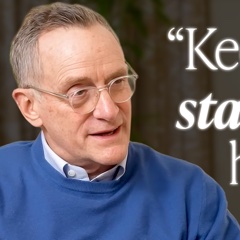
Howard Marks
Co-founder of Oaktree Capital Management and author of The Most Important Thing
Where to hear and read about Howard Marks1 episode or test

Howard Marks is co-founder of Oaktree Capital Management, which now manages more than $190 billion, and author of The Most Important Thing and the investment memos behind it. The thing most worth learning from him is how he turns decades of experience into plain, speech-like writing that makes readers say "I never thought of it that way."
In writing, you can't BS because the reader is going to go back and read it again.
How He Raised Billions with Simple Ideas | Howard Marks
Howard Marks: the story and the lessons
1How Howard Marks became a writer
Marks studied Japanese at Wharton and became a serious student. Wharton required a foreign literature course and a non-business minor, so he chose Japanese and took five graduate courses. Classes of eight people at a table replaced 200-student lectures.
He had just turned 17 and had been an indifferent student. An accounting course had led him to Wharton, because he wanted to be an accountant like his father, though his guidance counselor said he would not get in.
Professor E. Dale Saunders sharpened his writing with blunt margin notes. Saunders marked WW for wrong word, REP for repetitive and RED for redundant. A good line earned an "AHH," which felt like real reward to Marks.
From 1969 to 1990 Marks wrote well on the job but never produced writing as a stand-alone product.
Marks met two opposed views of investing early and had to reconcile them. He studied at Wharton from 1963 to 1967, where teaching was practical and qualitative. He then went to Chicago, among the first classes exposed to the Chicago School's quantitative theory and efficient markets.
Most of his peers wanted a job and ignored the conflict. Marks is drawn to intellectual puzzles and says he can't leave them unsolved. He cites Gladwell's Outliers on the luck of being in the right place at the right time.
He started the memos in 1990 for fun, after 21 years in the business. In October 1990 each memo was typed, copied on a Xerox, folded, addressed and stamped for about 100 clients. He heard nothing back and likens it to throwing them in the sewer.
He wrote the first because he had a story to share, not to win business. Oaktree began in 1995 and the memos then also went out electronically. Within hours of one going out, a stranger in Russia replied, though Marks had sent it to nobody there, so he realized it had gone viral. The audience grew to 300,000 subscribers.
2Where Marks gets his ideas
Marks clips articles and thoughts into a pile until it has substance. He adds an article, a piece from another source on a connected topic, a jotted thought and a video note. When the pile is substantial in content, not height, he writes a memo.
He keeps no Roman-numeral outline, only lists of topics and thoughts he turns over for a long time. His Getting Lucky memo began with a Four Seasons magazine article in a Riyadh hotel room that quoted Jack Dorsey: "You make your own luck." Marks wrote, "I couldn't disagree more."
He looks for two ideas that clash and works out how both can hold. Wharton's practical teaching, Chicago's quantitative theory and what works in real markets did not fit together cleanly. He says only the challenging reconciliations are interesting.
He suggests asking what doesn't make sense, and how two opposing worldviews can each seem coherent. After 35 years of writing he still thinks "I never thought of that before," and says that keeps you young.
Marks links investing to unrelated fields to make it interesting. He has written a memo on sports and investing every decade, and most decades one on gambling and investing.
He says a memo on investing alone is not too interesting, but one on how poker or backgammon relates to investing can be quite interesting. He scored best on SAT analogies, which helped him get into Wharton.
He thinks in pictures and draws graphs to make abstract ideas visible. He pictures a ball held up by a water spout: the spout is Fed stimulus and the ball is the economy. When the stimulus stops, the ball falls, so the picture separates temporary influences from permanent ones.
He draws graphs on whiteboards in client meetings. A photo of a 2016 whiteboard in Shanghai, seen again in bed in Jaipur, became an idea in Mastering the Market Cycle. He adds a warning to be careful when reasoning by analogy.
Marks quotes the great thinkers instead of reinventing the wheel. His memos draw on Taleb on randomness, Galbraith on forecasting, Ellis on avoiding losers and Milken on avoiding defaults. Peter Bernstein is his greatest hero in investment philosophy.
He calls it an unacceptable conceit to think nobody before you knew it better. In Risk Revisited Again he put new Bernstein material in italics so readers could see what was added.
He keeps returning to his core questions and rewriting the ideas that survive. He wrote Risk in 2006 after working out what was wrong with the conventional view he learned at Chicago. He followed it with Risk Revisited in 2014 and Risk Revisited Again in 2015 or 2016.
Old memos often show he holds the same idea he wrote 25 or 30 years ago, which convinces him it is sound. He says risk cannot be reduced to a single number, and that recording your thoughts matters because experience may produce ideas you never had before.
3How Marks writes and edits a memo
Marks writes only when he has an idea, with no forced schedule. He sets a loose goal of no less than quarterly. A memo has appeared each September and each January for 35 years, written over the summer and over Christmas.
Three months of silence brings emails asking if he is dead. With no deadline he feels no pressure, and treats the memos as relaxing, creative recreation.
He waits for the clarifying phrases, then drafts fast. He thinks long about organization before writing, and waits for the phrases that clarify and simplify. The first draft is rapid, and he enjoys the editing most.
He can't say whether the key phrase begins or ends a memo. Getting a clear thought onto the page takes time but is not hard.
Marks polishes each memo about five times, expecting smaller gains. The first pass improves it about 20%, the second 10%, the third 5%, then 2 and 1. He moves paragraphs, connects sentences and swaps two sentences when that reads better.
His goal is to move the memo from B to A to A+.
He sends the draft to a few trusted readers, nitpicker first. Four or five readers see each memo, finding roughly 6, 4, 10 and 200 problems. The one who finds about 200 nits, such as a long hyphen where a short one belongs, reads first.
Marks incorporates those changes before the others see it, so the rest of the review is clearer sailing. He borrows William Safire's word for such helpers: his "irregulars."
He lets the idea set the length. His first memo in 1990 ran a page and a half. Memos now run 12, 13 or 14 pages, and he does not aim for a length.
He finds anything longer becomes laborious and anything much shorter can't deliver the idea.
4Marks's rules for clear, useful writing
Marks writes the way he speaks. He uses contractions, common words and simple words over sophisticated ones when meaning survives. He wants no barrier between himself and the reader.
Readers tell him he makes complex things simple. One note compared him to Einstein's four levels of intelligence: bright, brilliant, genius, simple. Marks credits a logical, literal mind that breaks a process into orderly steps.
He skips jargon and treats the reader as an equal. He quotes Mark Twain's definition of a profession as a conspiracy against the laity, and thinks insecure professionals use jargon to keep outsiders away.
He rejects authors who show off erudition: "I'm a person. You're a person. We're both people." He points to Buffett's success with the same plain approach.
He uses humor to keep readers engaged. Marks likes to make people laugh, a habit from his father's jokes, and leans on conjunctions to keep the tone conversational.
In his words: "If it's dull and humorless and high-flown in terms of its verbiage, it's not going to be fun to read."
Marks studies Buffett's habit of packing a big idea into few words. Buffett said in 2009 that only when the tide goes out do you learn who has been swimming naked, making the point that apparent skill may be luck. Marks says it takes him many words to say that, and Buffett used 15.
Marks tries to emulate Buffett's folksy, funny, compact style.
He builds the logic so a rereading reader finds no bluff. Marks says writing differs from speaking because the reader will go back and reread. The logic must connect, the foundation must be solid and the explanation clear.
He cites Oliver Wendell Holmes on valuing the simplicity on the far side of complexity.
He aims for the reaction "I never thought of it that way". The brain has a strong confirmation bias, so a book that matches what readers already believe adds little. A reader who says this has been made to question what they thought they knew.
He says a reader who says "I knew all that before I started" won't buy your next book. His measure of success, in the spirit of Bezos's small crystallized lessons, is what you have helped readers with.
He tells writers to wait until they have something to say. Marks started the memos after 21 years in the business. He tells newer investors to write for practice until they have wisdom to share, then to work out a creed: what they believe, what works and what they will refuse to do.
He says to build on lasting principles, not yesterday's news or tomorrow's forecast. Anyone who kept score of daily predictions would find they are right about half the time.
5What Marks believes about luck, quality and sharing ideas
Marks rejects "you make your own luck". He believes in randomness and says he has been incredibly lucky himself. Opportunity is not evenly distributed, and some people with none of the good traits get lucky anyway.
Preparation does not always meet opportunity, and able, hardworking people still go unlucky.
He says quality of output is the one thing you control. Because randomness shapes outcomes, the quality of your output is within your control. Once you have made the best product you can, you can relax.
He told his son that when everyone else dumbs things down with emojis and the internet, keeping a high standard makes you shine.
Marks gives his ideas away because it costs him little. Some readers reject the ideas, and others accept them but can't carry them out.
In his words: "I'm not giving that much away, and I get so much out of it."
He sees the real achievement in investing as making money with risk under control. Making money is easy when markets rise, and they rise about eight years in ten. His book has 21 chapters, each naming a different "most important thing."
He wrote it because he kept telling clients different things, such as controlling risk and not losing money.

How He Raised Billions with Simple Ideas | Howard Marks
Howard Marks explains how he turns decades of investing experience into clear, speech-like memos that make readers say "I never thought of it that way." The habit worth hearing is his pile of clippings and scraps that he only turns into a memo once it has enough substance, followed by about five rounds of polishing and a small circle of readers.
Marks studied Japanese at Wharton and became a serious student. Wharton required a foreign literature course and a non-business minor, so he chose Japanese and took five graduate courses. Classes of eight people at a table replaced 200-student lectures.
He had just turned 17 and had been an indifferent student. An accounting course had led him to Wharton, because he wanted to be an accountant like his father, though his guidance counselor said he would not get in.
Professor E. Dale Saunders sharpened his writing with blunt margin notes. Saunders marked WW for wrong word, REP for repetitive and RED for redundant. A good line earned an "AHH," which felt like real reward to Marks.
From 1969 to 1990 Marks wrote well on the job but never produced writing as a stand-alone product.
Marks met two opposed views of investing early and had to reconcile them. He studied at Wharton from 1963 to 1967, where teaching was practical and qualitative. He then went to Chicago, among the first classes exposed to the Chicago School's quantitative theory and efficient markets.
Most of his peers wanted a job and ignored the conflict. Marks is drawn to intellectual puzzles and says he can't leave them unsolved. He cites Gladwell's Outliers on the luck of being in the right place at the right time.
He started the memos in 1990 for fun, after 21 years in the business. In October 1990 each memo was typed, copied on a Xerox, folded, addressed and stamped for about 100 clients. He heard nothing back and likens it to throwing them in the sewer.
He wrote the first because he had a story to share, not to win business. Oaktree began in 1995 and the memos then also went out electronically. Within hours of one going out, a stranger in Russia replied, though Marks had sent it to nobody there, so he realized it had gone viral. The audience grew to 300,000 subscribers.
Marks clips articles and thoughts into a pile until it has substance. He adds an article, a piece from another source on a connected topic, a jotted thought and a video note. When the pile is substantial in content, not height, he writes a memo.
He keeps no Roman-numeral outline, only lists of topics and thoughts he turns over for a long time. His Getting Lucky memo began with a Four Seasons magazine article in a Riyadh hotel room that quoted Jack Dorsey: "You make your own luck." Marks wrote, "I couldn't disagree more."
He looks for two ideas that clash and works out how both can hold. Wharton's practical teaching, Chicago's quantitative theory and what works in real markets did not fit together cleanly. He says only the challenging reconciliations are interesting.
He suggests asking what doesn't make sense, and how two opposing worldviews can each seem coherent. After 35 years of writing he still thinks "I never thought of that before," and says that keeps you young.
Marks links investing to unrelated fields to make it interesting. He has written a memo on sports and investing every decade, and most decades one on gambling and investing.
He says a memo on investing alone is not too interesting, but one on how poker or backgammon relates to investing can be quite interesting. He scored best on SAT analogies, which helped him get into Wharton.
He thinks in pictures and draws graphs to make abstract ideas visible. He pictures a ball held up by a water spout: the spout is Fed stimulus and the ball is the economy. When the stimulus stops, the ball falls, so the picture separates temporary influences from permanent ones.
He draws graphs on whiteboards in client meetings. A photo of a 2016 whiteboard in Shanghai, seen again in bed in Jaipur, became an idea in Mastering the Market Cycle. He adds a warning to be careful when reasoning by analogy.
Marks quotes the great thinkers instead of reinventing the wheel. His memos draw on Taleb on randomness, Galbraith on forecasting, Ellis on avoiding losers and Milken on avoiding defaults. Peter Bernstein is his greatest hero in investment philosophy.
He calls it an unacceptable conceit to think nobody before you knew it better. In Risk Revisited Again he put new Bernstein material in italics so readers could see what was added.
He keeps returning to his core questions and rewriting the ideas that survive. He wrote Risk in 2006 after working out what was wrong with the conventional view he learned at Chicago. He followed it with Risk Revisited in 2014 and Risk Revisited Again in 2015 or 2016.
Old memos often show he holds the same idea he wrote 25 or 30 years ago, which convinces him it is sound. He says risk cannot be reduced to a single number, and that recording your thoughts matters because experience may produce ideas you never had before.
Marks writes only when he has an idea, with no forced schedule. He sets a loose goal of no less than quarterly. A memo has appeared each September and each January for 35 years, written over the summer and over Christmas.
Three months of silence brings emails asking if he is dead. With no deadline he feels no pressure, and treats the memos as relaxing, creative recreation.
He waits for the clarifying phrases, then drafts fast. He thinks long about organization before writing, and waits for the phrases that clarify and simplify. The first draft is rapid, and he enjoys the editing most.
He can't say whether the key phrase begins or ends a memo. Getting a clear thought onto the page takes time but is not hard.
Marks polishes each memo about five times, expecting smaller gains. The first pass improves it about 20%, the second 10%, the third 5%, then 2 and 1. He moves paragraphs, connects sentences and swaps two sentences when that reads better.
His goal is to move the memo from B to A to A+.
He sends the draft to a few trusted readers, nitpicker first. Four or five readers see each memo, finding roughly 6, 4, 10 and 200 problems. The one who finds about 200 nits, such as a long hyphen where a short one belongs, reads first.
Marks incorporates those changes before the others see it, so the rest of the review is clearer sailing. He borrows William Safire's word for such helpers: his "irregulars."
He lets the idea set the length. His first memo in 1990 ran a page and a half. Memos now run 12, 13 or 14 pages, and he does not aim for a length.
He finds anything longer becomes laborious and anything much shorter can't deliver the idea.
Marks writes the way he speaks. He uses contractions, common words and simple words over sophisticated ones when meaning survives. He wants no barrier between himself and the reader.
Readers tell him he makes complex things simple. One note compared him to Einstein's four levels of intelligence: bright, brilliant, genius, simple. Marks credits a logical, literal mind that breaks a process into orderly steps.
He skips jargon and treats the reader as an equal. He quotes Mark Twain's definition of a profession as a conspiracy against the laity, and thinks insecure professionals use jargon to keep outsiders away.
He rejects authors who show off erudition: "I'm a person. You're a person. We're both people." He points to Buffett's success with the same plain approach.
He uses humor to keep readers engaged. Marks likes to make people laugh, a habit from his father's jokes, and leans on conjunctions to keep the tone conversational.
In his words: "If it's dull and humorless and high-flown in terms of its verbiage, it's not going to be fun to read."
Marks studies Buffett's habit of packing a big idea into few words. Buffett said in 2009 that only when the tide goes out do you learn who has been swimming naked, making the point that apparent skill may be luck. Marks says it takes him many words to say that, and Buffett used 15.
Marks tries to emulate Buffett's folksy, funny, compact style.
He builds the logic so a rereading reader finds no bluff. Marks says writing differs from speaking because the reader will go back and reread. The logic must connect, the foundation must be solid and the explanation clear.
He cites Oliver Wendell Holmes on valuing the simplicity on the far side of complexity.
He aims for the reaction "I never thought of it that way". The brain has a strong confirmation bias, so a book that matches what readers already believe adds little. A reader who says this has been made to question what they thought they knew.
He says a reader who says "I knew all that before I started" won't buy your next book. His measure of success, in the spirit of Bezos's small crystallized lessons, is what you have helped readers with.
He tells writers to wait until they have something to say. Marks started the memos after 21 years in the business. He tells newer investors to write for practice until they have wisdom to share, then to work out a creed: what they believe, what works and what they will refuse to do.
He says to build on lasting principles, not yesterday's news or tomorrow's forecast. Anyone who kept score of daily predictions would find they are right about half the time.
Marks rejects "you make your own luck". He believes in randomness and says he has been incredibly lucky himself. Opportunity is not evenly distributed, and some people with none of the good traits get lucky anyway.
Preparation does not always meet opportunity, and able, hardworking people still go unlucky.
He says quality of output is the one thing you control. Because randomness shapes outcomes, the quality of your output is within your control. Once you have made the best product you can, you can relax.
He told his son that when everyone else dumbs things down with emojis and the internet, keeping a high standard makes you shine.
Marks gives his ideas away because it costs him little. Some readers reject the ideas, and others accept them but can't carry them out.
In his words: "I'm not giving that much away, and I get so much out of it."
He sees the real achievement in investing as making money with risk under control. Making money is easy when markets rise, and they rise about eight years in ten. His book has 21 chapters, each naming a different "most important thing."
He wrote it because he kept telling clients different things, such as controlling risk and not losing money.